Tajweed for Kids: 9 Simple Rules for Parents
Tajweed for Kids helps children read the Quran more carefully, clearly, and respectfully by learning how Arabic letters should sound, how long sounds should be held, and how to avoid common recitation mistakes.
Many Muslim parents want their children to read Quran beautifully, but they are not always sure how Tajweed should begin. Should children memorize rules first? Should they focus on pronunciation? Should they start with Madd, Noon Sakinah, Qalqalah, or simply reading slowly?
The answer depends on the child’s level. Tajweed for Kids should not begin as a heavy list of complicated terms. It should begin with listening, correct letters, gentle repetition, short rules, and regular teacher correction.
For Muslim children in the UK and other English-speaking environments, Quran recitation may need extra support because Arabic is not always used daily at home or school. A child may love Quran but still struggle with Arabic sounds, vowel marks, stretching, stopping, or reading fluently.
This parent guide explains Tajweed for Kids in a simple way. It gives you 9 important areas to understand, common mistakes to watch for, and gentle ways to help your child improve Quran recitation without pressure.
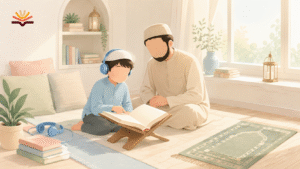
Quick answer: Tajweed for Kids should start with correct letter sounds, short vowels, slow recitation, Madd, basic Noon and Meem rules, Qalqalah, stopping correctly, and regular listening with teacher correction.
| Parent Question | Simple Answer |
|---|---|
| When should kids start Tajweed? | Children can begin basic Tajweed once they can recognize Arabic letters and read simple Quran words. |
| Should kids memorize Tajweed terms first? | No. Children should first practise correct sounds and simple recitation before memorizing many terms. |
| Can parents teach Tajweed at home? | Parents can support practice, but a qualified teacher is helpful for correcting pronunciation and recitation mistakes. |
| What is the biggest Tajweed mistake? | One common mistake is rushing through recitation without giving letters, vowels, and Madd their proper sound. |
Table of Contents
What Is Tajweed for Kids?

Tajweed for Kids means teaching children how to recite the Quran with better pronunciation, clearer letter sounds, correct vowel reading, suitable stretching, and careful stopping.
The word Tajweed is often explained as improving or making something better. In Quran recitation, Tajweed helps the reader give each letter its proper sound and read the Quran with care.
For children, Tajweed should be taught gradually. A young child does not need to understand every advanced rule at once. They need to hear correct recitation, repeat after a teacher, learn the most common mistakes, and build good habits slowly.
Tajweed for Kids is not only about making recitation sound beautiful. It is also about accuracy. Some Arabic letters sound similar to children, especially if they mostly speak English. A teacher can help the child hear and pronounce the difference.
For example, children may confuse ح and ه, س and ص, ت and ط, or ذ and ز. These differences need patient listening and correction.
A child who learns basic Tajweed early may grow with more confidence in Quran reading, memorization, and revision.
Why Tajweed Matters for Children
Tajweed for Kids matters because Quran reading is not like ordinary reading. The Quran should be recited carefully, with respect, and with attention to the way letters and sounds are pronounced.
The Quran itself encourages measured recitation. Parents can read the verse about reciting the Quran with measured recitation on Quran.com.
There is also a well-known hadith about the virtue of learning and teaching the Quran, which parents can find on Sunnah.com.
For children, Tajweed helps in four important ways:
- It improves Quran pronunciation.
- It reduces repeated recitation mistakes.
- It supports memorization because the child memorizes with correct sounds.
- It builds confidence when the child recites to a teacher or parent.
A child may memorize many surahs, but if the pronunciation is weak, they may need to correct the same mistakes later. This is why Tajweed for Kids should be part of Quran learning from the beginning, in a gentle and age-appropriate way.
If your child is also memorizing Quran, you may find this useful: Quran Memorization Schedule for Kids.
Not sure if your child needs Tajweed support?
Sibghah Academy can help you understand whether your child needs Quran reading, Tajweed correction, memorization support, or revision practice.
Tajweed for Kids: 9 Simple Rules for Parents

These are not all the rules of Tajweed. They are the main areas parents should understand when helping children begin Tajweed for Kids.
1. Correct Arabic Letter Sounds
The first step in Tajweed for Kids is correct letter pronunciation. Before a child learns advanced rules, they need to pronounce Arabic letters as clearly as possible.
Some children can recognize the Arabic letters but still pronounce them with English-influenced sounds. This is common for children growing up in English-speaking environments.
Parents should pay attention to letters that children commonly confuse, such as:
- ح and ه
- ع and أ
- س and ص
- ت and ط
- د and ض
- ذ and ز
- ق and ك
Do not correct every sound harshly. Let your child listen, repeat, and improve gradually. A qualified Quran teacher can help correct these letters with patience.
2. Short Vowels Must Be Clear
Short vowels are very important in Quran reading. Fatha, Kasra, and Damma change the sound of a letter. Children need to read them clearly and not skip them.
| Short Vowel | Simple Sound | Example |
|---|---|---|
| Fatha | a | بَ sounds like ba |
| Kasra | i | بِ sounds like bi |
| Damma | u | بُ sounds like bu |
In Tajweed for Kids, short vowels should not be rushed. If the child ignores vowel marks, the word may change. This is why strong Arabic reading foundations are important before advanced Quran recitation.
If your child still struggles with letters and vowels, read: Teach Arabic Letters to Kids.
3. Sukun and Shaddah Need Attention
Sukun means the letter has no vowel sound after it. Children may skip Sukun or add an extra vowel by mistake. For example, a child may read a still letter as if it has Fatha or Damma.
Shaddah means the letter is doubled or stressed. Children often read Shaddah too lightly because they do not notice it.
When teaching Tajweed for Kids, parents can simply say: “This letter needs to be held a little more,” or “This letter should not get an extra vowel.”
Children do not need a long theory lesson at the beginning. They need examples, listening, and correction during recitation.
4. Madd Should Not Be Too Short or Too Long
Madd means stretching a sound. Children often make two kinds of mistakes with Madd: they either do not stretch enough, or they stretch randomly for too long.
For beginners, the first goal is to notice long vowels and read them steadily. Later, children can learn different types of Madd and how long each one should be.
Tajweed for Kids should make Madd simple at first. You can tell your child, “This sound is longer than a normal short vowel.” Then the teacher can gradually explain more rules.
If you want a detailed parent guide, read: Madds in Tajweed for Kids.
5. Noon Sakinah and Tanween Rules Should Be Introduced Slowly
Noon Sakinah and Tanween rules can feel complicated for children if they are introduced too quickly. Parents may hear terms such as Izhar, Idgham, Iqlab, and Ikhfa.
At the beginning, children do not need to memorize all the names immediately. They need to hear the difference in recitation and practise with examples.
| Rule Name | Parent-Friendly Meaning |
|---|---|
| Izhar | The sound is made clear. |
| Idgham | The sound joins into the next letter. |
| Iqlab | The sound changes before a specific letter. |
| Ikhfa | The sound is hidden softly with nasal sound. |
In Tajweed for Kids, the teacher should give one rule at a time, with many examples and repetition.
6. Meem Sakinah Rules Should Stay Simple at First
Meem Sakinah rules are also important, but they should be taught gently. Children may need to learn when the Meem is clear, when there is a nasal sound, and when the lips close correctly.
For parents, the key is to notice whether the child is rushing or missing the sound. The teacher can then explain the rule in a child-friendly way.
Tajweed for Kids should not become a burden of rule names. The child should practise real Quran examples and slowly connect the sound to the rule.
7. Qalqalah Needs a Clear Bounce
Qalqalah is a light echo or bounce sound on specific letters when they have Sukun. Children may either skip the bounce or exaggerate it too much.
The Qalqalah letters are often taught together as: ق، ط، ب، ج، د.
For children, it can help to say: “This letter has a small bounce when it stops.” The teacher can model the sound and ask the child to repeat.
In Tajweed for Kids, Qalqalah should be practised with listening first. The child needs to hear the sound clearly before they can produce it correctly.
8. Stopping and Pausing Should Be Taught Early
Children may read Quran without knowing where to stop, where to continue, or how the ending of a word changes when stopping.
Stopping correctly is an important part of recitation. A child who reads too quickly may run through several words without breathing properly or may stop in a confusing place.
For early Tajweed for Kids, parents can remind children to read slowly, breathe calmly, and follow the teacher’s guidance on where to stop.
Advanced Waqf signs can come later. At the beginning, the child needs good habits: do not rush, do not panic, and do not guess the stop without help.
9. Slow Recitation Is Better Than Rushed Recitation
Children often want to finish quickly, especially if they are nervous. But Tajweed needs calm recitation.
A slow child is not necessarily weak. A slow child may be learning carefully. Parents should praise careful reading, not only fast reading.
When supporting Tajweed for Kids, remind your child:
- Read slowly.
- Listen first.
- Repeat after the teacher.
- Do not rush the letters.
- Stop and correct gently.
- Revise the same passage again.
Good Tajweed grows with time. A child who reads calmly and corrects mistakes patiently is building a strong Quran foundation.
Sibghah Teacher Note: children should not feel that Tajweed is a test they keep failing. Tajweed should feel like a guided journey toward more careful Quran recitation.
How to Teach Tajweed by Age
The way we teach Tajweed for Kids should match the child’s age, reading level, and ability to focus.
Ages 5–6
At this age, children usually need listening, repetition, and very simple correction. They may not be ready for many rule names.
Focus on Arabic letters, short vowels, listening to Quran, and repeating short surahs calmly.
Ages 7–9
Children at this age can often begin simple Tajweed rules if their Arabic reading is ready. They can practise Madd, clear letter sounds, basic stopping, and common mistakes.
Tajweed for Kids at this stage should include lots of examples and short recitation practice.
Ages 10–12
Older children can understand more rule names and begin connecting the rule to the recitation. They may be ready for Noon Sakinah, Tanween, Meem Sakinah, Qalqalah, and more structured revision.
Ages 13–15
Teenagers can handle more detailed feedback, but they still need encouragement. They may feel embarrassed if corrected harshly, especially if they started late.
At this age, Tajweed should feel respectful and goal-based. The teacher can explain why the rule matters and how it improves recitation.
Simple Tajweed Practice Routine
A simple routine can help children practise Tajweed for Kids without feeling overwhelmed.
Try this routine at home:
- Listen: play the assigned ayah or short passage.
- Repeat: ask your child to repeat after the teacher or reciter.
- Read slowly: let your child recite while looking.
- Correct one point: focus on one main Tajweed correction.
- Repeat again: let your child try the same part after correction.
- Revise: read an older passage to protect previous learning.
- End positively: praise effort and improvement.
This routine can take 10–20 minutes depending on the child’s age. The key is consistency.
If your child is memorizing Quran, Tajweed should not be separate from memorization. New memorization should be corrected early so the child does not memorize repeated mistakes.
For a full memorization routine, read: Quran Revision Plan for Kids.
Want a Quran routine with Tajweed and revision?
Sibghah Academy can help your child build a Quran routine that includes reading, Tajweed correction, memorization, and revision.
Common Tajweed Mistakes Kids Make
Children make Tajweed mistakes for different reasons. Some mistakes happen because Arabic is new. Some happen because the child is rushing. Some happen because the child memorized the passage before receiving correction.
Here are common mistakes parents may notice during Tajweed for Kids practice:
| Common Mistake | What It Looks Like | Gentle Response |
|---|---|---|
| Rushing | The child reads too fast and skips sounds. | Ask the child to slow down and repeat one short line. |
| Weak letter sounds | Similar Arabic letters sound the same. | Use teacher modelling and repetition. |
| Ignoring Madd | Long sounds become too short. | Practise one Madd example at a time. |
| Overstretching | The child stretches sounds randomly. | Teach that Madd has limits and should follow the rule. |
| Skipping Sukun | The child adds extra vowels. | Point out the still letter and repeat slowly. |
| Fear of correction | The child becomes silent or nervous. | Correct gently and praise effort. |
Parents should avoid turning every mistake into a big issue. Choose one correction at a time. Children improve faster when they feel safe enough to try again.
How Parents Can Support Tajweed at Home
Parents do not need to be Tajweed experts to support Tajweed for Kids. Even if you are not confident in your own recitation, you can still help your child build routine and love for Quran.
Here are simple ways to support your child:
- Play the assigned recitation before practice.
- Keep Quran practice short and consistent.
- Ask your child to repeat after the teacher or reciter.
- Do not rush to finish many pages.
- Use one main correction at a time.
- Praise careful recitation, not only memorization speed.
- Communicate with the teacher about repeated mistakes.
- Review old passages regularly.
Tajweed for Kids works best when the child has both teacher guidance and parent encouragement. The teacher corrects recitation, while the parent helps with routine, listening, and motivation.
You can also use Quran.com to access Quran text and recitation support while practising at home.
How Tajweed Supports Quran Memorization
Tajweed for Kids is closely connected to memorization. If a child memorizes with incorrect pronunciation, the mistake can become fixed in memory. Later, it may be harder to correct.
This is why children should listen carefully before memorizing and recite to a teacher when possible. Correcting early saves time later.
A good memorization routine includes:
- Listening to the new passage.
- Reading with the teacher.
- Correcting pronunciation.
- Repeating after correction.
- Memorizing in small parts.
- Revising regularly.
If your child is currently memorizing, read this next: Quran Memorization Schedule for Kids.
How to Keep Tajweed Gentle for Children
Some children begin to fear Quran recitation if every session is full of correction. Correction matters, but the way it is given matters too.
To keep Tajweed for Kids gentle, use this approach:
- Start with listening before correction.
- Correct one repeated mistake instead of every small mistake.
- Say, “Let’s try that sound again,” instead of “That is wrong.”
- Praise what improved.
- Keep practice short if the child is tired.
- End with encouragement.
Children who feel emotionally safe are more likely to recite, repeat, and accept correction.
If your child resists Quran practice, this guide may help: Help Your Child Love Quran.
How Sibghah Academy Supports Quran Recitation
Sibghah Academy offers live online Quran, Arabic, and Islamic Studies lessons for Muslim children aged 5–15.
For Tajweed for Kids, Sibghah Academy helps children improve Quran recitation through one-to-one lessons, teacher correction, listening practice, memorization support, and revision follow-up.
Some children need help with Arabic letters before Tajweed. Some need basic Quran reading fluency. Some already read Quran but need correction in Madd, Sukun, Shaddah, Qalqalah, or stopping. Others need support because they memorize but forget or repeat recitation mistakes.
In one-to-one Quran lessons, the teacher can listen carefully to the child, correct mistakes gently, and give a suitable next step. This is especially helpful for children who may feel shy in group settings.
If your child needs a structured path, Sibghah Academy’s Quran Memorization Program for Kids can support Quran reading, Tajweed, memorization, and revision. You may also find Online Quran Lessons for Kids helpful if you are exploring the right starting point.
Quick Parent Checklist
Use this checklist when supporting Tajweed for Kids at home:
- Can my child recognize Arabic letters clearly?
- Can my child read short vowels correctly?
- Does my child rush recitation?
- Does my child notice Madd sounds?
- Does my child struggle with similar Arabic letters?
- Do we listen before reading?
- Are corrections gentle and limited?
- Does the schedule include revision?
- Do we need teacher support for Tajweed correction?
FAQ: Tajweed for Kids
1. What is Tajweed for Kids?
Tajweed for Kids means teaching children how to recite the Quran with clearer pronunciation, correct letter sounds, proper vowels, Madd, and careful stopping.
2. When should children start learning Tajweed?
Children can start basic Tajweed when they can recognize Arabic letters and begin reading simple Quran words. The rules should be taught gradually.
3. Should kids memorize Tajweed rules first?
No. Children should first listen, repeat, and practise correct recitation. Tajweed rule names can be introduced slowly when the child is ready.
4. Can parents teach Tajweed at home?
Parents can support listening, routine, and revision at home, but a qualified Quran teacher is very helpful for correcting pronunciation and recitation.
5. What are the most important Tajweed rules for children?
The most important areas in Tajweed for Kids include letter sounds, short vowels, Sukun, Shaddah, Madd, Noon Sakinah, Meem Sakinah, Qalqalah, and stopping.
6. How can I help my child improve Tajweed?
Let your child listen first, repeat slowly, recite to a teacher, correct one mistake at a time, and revise regularly.
7. What if my child finds Tajweed difficult?
Make the practice shorter, focus on one rule at a time, use listening, and avoid overwhelming your child with too many terms.
8. Does Tajweed help Quran memorization?
Yes. Tajweed helps children memorize with correct sounds and reduces the need to fix repeated pronunciation mistakes later.
9. How long should Tajweed practice be?
For many children, 10–20 minutes can be enough, depending on age and level. Short consistent practice is often better than long stressful sessions.
10. Should Tajweed be taught before memorization?
Basic Tajweed and correct pronunciation should support memorization from the beginning, so the child memorizes with fewer mistakes.
11. What if my child rushes while reciting Quran?
Ask your child to slow down, listen first, and repeat a shorter section. Praise careful recitation instead of speed.
12. What if my child cannot pronounce some Arabic letters?
This is common, especially for children who mostly speak English. A teacher can help with letter sounds through repetition and gentle correction.
13. Is online Tajweed suitable for kids?
Yes, online Tajweed can work well when lessons are live, one-to-one, and the teacher listens carefully to the child’s recitation.
14. Can Sibghah Academy help with Tajweed for Kids?
Yes. Sibghah Academy supports Tajweed for Kids through live Quran lessons, teacher correction, memorization support, and revision follow-up.
15. What should my child learn before Tajweed?
Your child should have basic Arabic letter recognition, vowel reading, and the ability to read simple Quran words before learning more structured Tajweed rules.
16. How can I make Tajweed gentle for my child?
Use listening, short practice, gentle correction, praise, and one rule at a time. Avoid making Tajweed feel like constant criticism.
Book your child’s free Quran trial on WhatsApp
Tajweed for Kids can help your child read Quran more carefully, correct repeated mistakes, and build confidence in recitation.
Send Sibghah Academy a WhatsApp message with your child’s age, Quran level, and main goal, and we will help you choose the right Quran learning path.