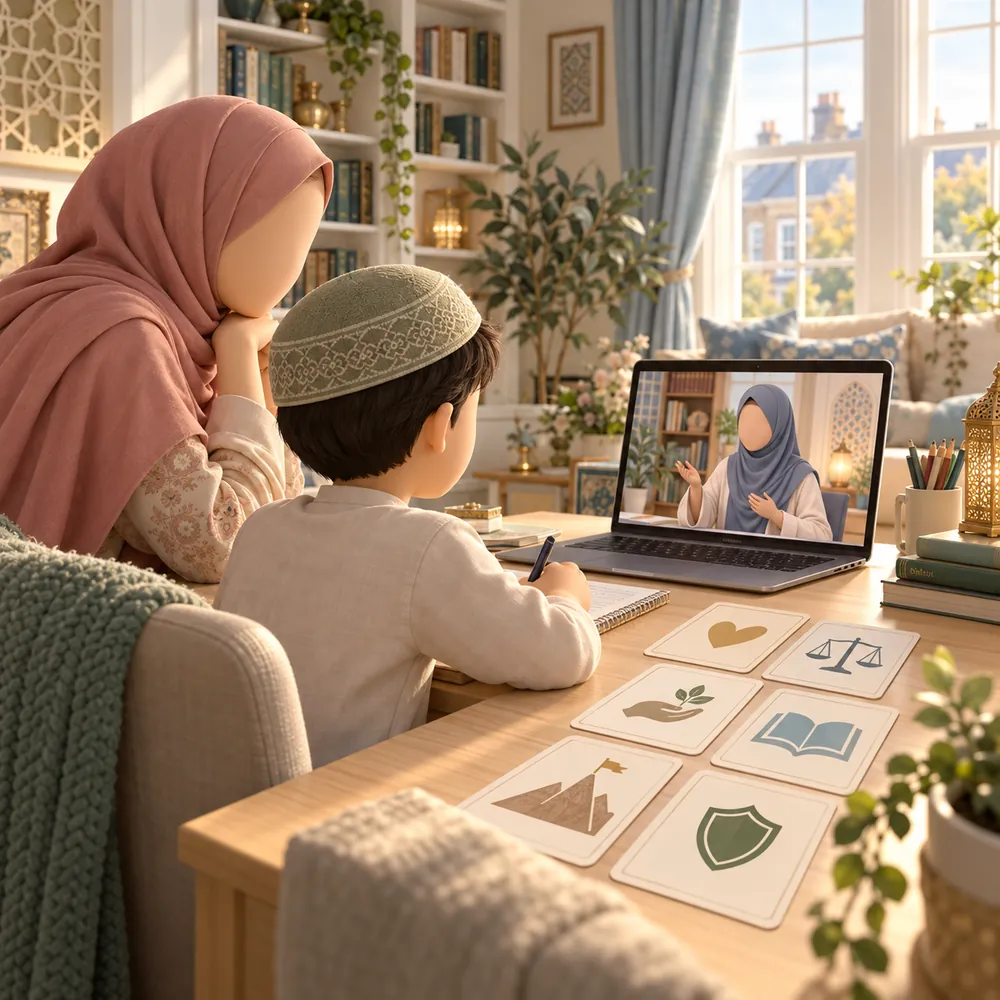
Sahaba Stories for Kids can give Muslim children something they deeply need: real role models whose lives were shaped by faith, truthfulness, courage, generosity, knowledge and love for the Prophet Muhammad ﷺ. Instead of admiring people only because they are famous, wealthy or popular, children can discover men and women who tried to live Islam sincerely and who learned directly from the Messenger of Allah ﷺ.
The goal of Sahaba Stories for Kids should not be simply to memorise names, battles or dates. Children should be able to ask: Who was this Companion? What value did they show? How did they follow the Prophet ﷺ? What can I learn from their example today?
Quick answer: good Sahaba Stories for Kids should connect each Companion with a clear Islamic value and then help children practise that value in real life. A simple model is: Story → Value → Reflection → Action.
Who Were the Sahabah?
Before teaching Sahaba Stories for Kids, children need a simple understanding of who the Sahabah were.
The Sahabah, or Companions of the Prophet ﷺ, were Muslims who met the Prophet Muhammad ﷺ, believed in him, and died as Muslims.
They included:
- men and women;
- young and old;
- wealthy and poor;
- people from different tribes and backgrounds;
- early Muslims who faced persecution;
- the Muhajirun who migrated;
- the Ansar who welcomed and supported them.
The Quran speaks with honour about the early Muhajirun and Ansar. In Surah At-Tawbah 9:100, Allah mentions the foremost among the Emigrants and Helpers and those who followed them in goodness.
The Prophet ﷺ also spoke about the virtue of his generation. Parents can read Sahih al-Bukhari 3650, where the Prophet ﷺ describes his generation as the best of his Ummah.
This is one reason Sahaba Stories for Kids deserve a meaningful place in children’s Islamic education.
Why Sahaba Stories for Kids Matter
Sahaba Stories for Kids matter because children learn values more clearly when they see those values lived by real people.
It is easy to tell a child:
“Be honest.”
But it becomes more memorable when the child learns about a Companion known for truthfulness.
It is easy to say:
“Be generous.”
But children can understand generosity more deeply when they learn how the early Muslims gave, shared and supported one another.
It is easy to tell children:
“Be brave.”
But Sahaba Stories for Kids can show that courage is not only physical strength. Courage can mean:
- telling the truth;
- admitting a mistake;
- standing against unfairness;
- remaining Muslim when peer pressure feels strong;
- helping someone even when it costs something;
- continuing to learn and improve.
Learning about the Companions is one part of a wider Islamic education. Families can also explore Sibghah’s current guide to Islamic Studies for Kids in the UK to see how Aqeedah, worship, character, Prophets’ stories and Muslim role models fit together.
Prophets and Sahabah: Different but Important Role Models
When teaching Sahaba Stories for Kids, children should understand the difference between Prophets and Companions.
The Prophets and Messengers were chosen by Allah and received revelation.
The Sahabah were followers of Prophet Muhammad ﷺ who believed in him, learned directly from him and tried to live according to his guidance.
The Sahabah were not Prophets.
That distinction matters.
At the same time, the Companions are powerful examples because children can see how ordinary human beings were transformed through faith, knowledge, worship and following the Messenger ﷺ.
Families who want to build this connection in the right order can first read Stories of Prophets for Kids and then continue into Sahaba Stories for Kids.
1. Sahaba Stories for Kids: Abu Bakr رضي الله عنه — Truthfulness and Loyalty
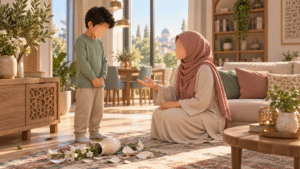
Abu Bakr رضي الله عنه is one of the clearest examples children can meet through Sahaba Stories for Kids.
He was one of the closest Companions of the Prophet ﷺ and is remembered for truthfulness, faith, loyalty and support.
For children, one of the most useful values to focus on is:
Truthfulness matters even when telling the truth is uncomfortable.
An Abu Bakr story for kids should not become only a collection of historical details.
Parents can connect truthfulness to daily situations such as:
- admitting who broke something;
- telling the truth about homework;
- not changing a story to avoid consequences;
- keeping promises;
- supporting a friend without encouraging wrongdoing.
Truthfulness Does Not Mean Harshness
Children should also learn that being truthful does not give someone permission to be rude.
Islamic character combines:
- truthfulness;
- kindness;
- wisdom;
- loyalty to what is right.
Parent Reflection
After teaching an Abu Bakr story for kids, ask:
- Why is it sometimes difficult to tell the truth?
- Can you be loyal to a friend without helping them do something wrong?
- What would truthfulness look like at school?
- What should you do if telling the truth means admitting your own mistake?
This is how Sahaba Stories for Kids move from history into behaviour.
2. Sahaba Stories for Kids: Umar ibn Al-Khattab رضي الله عنه — Courage and Justice
Umar ibn Al-Khattab رضي الله عنه gives parents another powerful teaching opportunity in Sahaba Stories for Kids.
Children often hear the word “strong” and imagine someone loud, physically powerful or intimidating.
But Islamic strength should include responsibility.
An Umar ibn Al-Khattab story for kids can introduce values such as:
- courage;
- justice;
- accountability;
- responsibility;
- taking truth seriously.
Justice Begins in Small Situations
Children do not need to be leaders of a community to practise fairness.
Justice can begin with:
- not blaming a sibling unfairly;
- sharing turns;
- listening to both sides of a disagreement;
- not changing the rules simply because you are losing;
- admitting when you were wrong.
Courage Is Not Aggression
When teaching Sahaba Stories for Kids, it is important not to confuse courage with anger.
A courageous Muslim child can be:
- calm;
- fair;
- honest;
- firm without being cruel.
Parent Reflection
Ask:
- What does fair mean?
- Can strength be used wrongly?
- When do you need courage to admit a mistake?
- How can you be fair when you are angry?
This helps the stories of the Sahaba for kids build moral judgement rather than admiration of strength alone.
3. Sahaba Stories for Kids: Uthman ibn Affan رضي الله عنه — Generosity and Modesty
Uthman ibn Affan رضي الله عنه offers a different kind of role model in Sahaba Stories for Kids.
Children can learn about:
- generosity;
- modesty;
- gentleness;
- supporting the Muslim community;
- giving without making yourself the centre of attention.
An Uthman ibn Affan story for kids is a useful opportunity to teach that generosity is not limited to money.
A child can be generous with:
- time;
- food;
- attention;
- knowledge;
- help;
- kindness;
- things they value.
Generosity and the Spirit of the Early Muslims
The Quran describes the remarkable generosity of the Ansar in Surah Al-Hashr 59:9, praising their willingness to give preference to others even when they themselves had needs.
This verse is about the Ansar generally, not specifically Uthman رضي الله عنه, but it gives children a wider picture of the generosity and selflessness found among the early Muslim community.
Parent Reflection
Ask:
- Can you be generous without giving money?
- What is something you like that you could share?
- Why is giving quietly sometimes better than asking everyone to notice?
- Can generosity include helping someone with your time?
This makes Sahaba Stories for Kids practical even for young children.
4. Sahaba Stories for Kids: Ali ibn Abi Talib رضي الله عنه — Courage and Knowledge
Ali ibn Abi Talib رضي الله عنه gives children another important balance through Sahaba Stories for Kids: courage together with knowledge.
An Ali ibn Abi Talib story for kids can encourage children to admire:
- bravery;
- learning;
- thoughtfulness;
- commitment to truth;
- asking questions;
- using knowledge responsibly.
This is particularly valuable because children can sometimes think confidence means having an answer to everything.
Islamic learning teaches something different.
A strong learner is also able to say:
“I don’t know yet.”
Then they ask, study and learn.
Knowledge Is a Form of Strength
Children can practise this value by:
- asking questions respectfully;
- reading;
- listening carefully;
- checking information before repeating it;
- admitting when they do not know something;
- using what they learn to make better choices.
Parent Reflection
Ask:
- Why is knowledge important before making a decision?
- Is asking a question a sign of weakness?
- What should we do when we hear something online and are not sure it is true?
- Can someone be brave and thoughtful at the same time?
This helps Sahaba Stories for Kids support both character and learning habits.
Who Were the Ten Companions Promised Paradise?
Many parents searching for Sahaba Stories for Kids also come across the phrase Ten Companions promised Paradise.
This group is often called Al-‘Asharah Al-Mubashsharah.
They are:
- Abu Bakr رضي الله عنه
- Umar ibn Al-Khattab رضي الله عنه
- Uthman ibn Affan رضي الله عنه
- Ali ibn Abi Talib رضي الله عنه
- Talhah ibn Ubaydillah رضي الله عنه
- Az-Zubayr ibn Al-Awwam رضي الله عنه
- Abdur-Rahman ibn Awf رضي الله عنه
- Sa’d ibn Abi Waqqas رضي الله عنه
- Sa’id ibn Zayd رضي الله عنه
- Abu Ubaydah ibn Al-Jarrah رضي الله عنه
For children, the aim should not be only memorising ten names.
A useful ten companions promised paradise for kids programme can connect each Companion with:
- a part of their life;
- their relationship with the Prophet ﷺ;
- a challenge they faced;
- a value;
- a practical lesson.
This is also the approach used in Sibghah’s current Companions programme, which places special focus on the Ten Companions promised Paradise while teaching faith, character and practical values.
Sahaba Stories for Kids Should Build Love for the Prophet ﷺ
One important mistake to avoid when teaching Sahaba Stories for Kids is presenting each Companion as an independent hero disconnected from the Prophet ﷺ.
Much of what made the Companions remarkable came from:
- believing in the Messenger ﷺ;
- learning directly from him;
- following his guidance;
- loving him;
- supporting the message of Islam;
- trying to live what he taught.
This helps children understand why the Sahabah are important.
They are not admired simply because they were famous people in Islamic history.
They are admired because of their faith and the way they followed the Messenger of Allah ﷺ.
A good Sahaba Stories for Kids lesson should therefore ask:
How did this Companion follow the Prophet ﷺ?
Sahaba Stories for Kids: Islamic Role Models in a Celebrity Culture
Children today meet role models everywhere.
They may admire people because of:
- followers;
- money;
- appearance;
- talent;
- fame;
- entertainment.
Not every popular person is necessarily a bad influence. But children need a deeper framework for deciding what makes someone worth admiring.
Sahaba Stories for Kids offer a different set of qualities:
- faith;
- truthfulness;
- justice;
- generosity;
- knowledge;
- sacrifice;
- loyalty;
- humility;
- love for Allah and His Messenger ﷺ.
A useful parent question is:
“What exactly do you admire about this person?”
If the answer is only:
“They are famous.”
the child can be encouraged to think more deeply.
Learning Sahaba Stories for Kids gives Muslim children an Islamic vocabulary for admiration.
A Simple Framework for Teaching Sahaba Stories for Kids
Parents do not need to turn Sahaba Stories for Kids into complicated history lessons.
Use four steps:
Story → Value → Question → Action.
| Companion | Value | Parent Question | Simple Action |
|---|---|---|---|
| Abu Bakr رضي الله عنه | Truthfulness | When is telling the truth difficult? | Tell the truth even when uncomfortable |
| Umar رضي الله عنه | Justice | What does being fair mean? | Be fair with siblings and friends |
| Uthman رضي الله عنه | Generosity | What can you give or share? | Give something valuable without seeking praise |
| Ali رضي الله عنه | Knowledge | What should we do when we do not know? | Ask, read and learn |
This framework turns Sahaba Stories for Kids into action rather than information alone.
How Parents Can Teach Sahaba Stories for Kids at Home
Choose One Companion at a Time
Do not overload the child with five biographies at once.
One Companion, one story and one clear value can be enough.
Ask Reflection Questions
After Sahaba Stories for Kids, ask:
- Who was this Companion?
- How did they follow the Prophet ﷺ?
- What challenge did they face?
- What value did you notice?
- Where could you practise that value this week?
Return to the Value Later
If the lesson was truthfulness, return to it when honesty becomes difficult.
If the lesson was generosity, remind the child when they have an opportunity to share.
If the lesson was justice, connect it to sibling disagreements.
That is how Sahaba Stories for Kids begin to shape habits.
Use Reliable Sources
Stories about the Companions sometimes circulate online with weak or unsupported details.
Parents do not need dramatic additions to make Islamic history meaningful.
If a detail cannot be verified, avoid presenting it confidently as fact.
Common Mistakes When Teaching Sahaba Stories for Kids
1. Turning the Sahabah into Superheroes
The Companions were real human beings who worshipped Allah and followed the Prophet ﷺ. They should not be presented like fictional characters with magical personalities.
2. Teaching Only Battles
Military events are part of Islamic history, but Sahaba Stories for Kids should also include worship, generosity, family life, knowledge, honesty and character.
3. Ignoring Their Faith
A Companion’s character should not be separated from belief in Allah and following the Prophet ﷺ.
4. Using Unreliable Stories
Exciting details should not be treated as authentic simply because they are widely repeated.
5. Making Every Companion Sound the Same
Different Companions had different strengths, personalities and contributions.
6. Teaching Values Without Application
Ask how the lesson could appear in the child’s real life.
7. Memorising Names Without Context
Knowing ten names is useful, but understanding who they were is more important.
8. Forgetting the Prophet ﷺ
Their love for and following of the Messenger ﷺ should remain central.
How Sibghah Teaches Sahaba Stories for Kids
Sibghah Academy offers a live online programme focused on the Lives of the Companions for Kids.
The course introduces children to selected Sahabah, with special attention to the Ten Companions promised Paradise.
The programme focuses on values such as:
- faith;
- truthfulness;
- courage;
- justice;
- generosity;
- knowledge;
- loyalty;
- humility;
- sacrifice;
- love for the Prophet ﷺ.
The goal is not simply for the child to remember:
“This is Abu Bakr.”
or:
“This is Umar.”
The deeper questions are:
- What made this Companion a strong Muslim role model?
- How did they follow the Prophet ﷺ?
- What value can the child learn?
- Where can the child practise that value?
Lessons are delivered live online using storytelling, questions, discussion and simple activities so children can understand the value behind the story rather than only memorising facts.
Parents can explore the current Lives of the Companions for Kids course page for the latest programme information.
Children who are still building broader Islamic foundations can also use Sibghah’s Pillars of Iman and Islam for Kids guide to understand where belief in Allah, the Messengers and Islamic practice fit together.
Book a free Lives of the Companions trial on WhatsApp
Sibghah Teacher Note
Sibghah Teacher Note: after teaching Sahaba Stories for Kids, do not finish only by asking, “What was his name?” Ask: “What value did you see?”, “How did this Companion follow the Prophet ﷺ?” and “Where could you practise that value this week?” The goal is not only memory. It is admiration that leads to action.
Sahaba Stories for Kids: Parent Checklist
When choosing a lesson, book or course, ask:
- Is the story based on reliable Islamic sources?
- Does my child understand who the Sahabah were?
- Is the difference between Prophets and Companions clear?
- Does the story show the Companion’s connection to the Prophet ﷺ?
- Is one central value clear?
- Can my child explain that value?
- Can my child connect it to their life?
- Are stories appropriate for the child’s understanding?
- Are unsupported dramatic details avoided?
- Does the lesson build respect without turning the Companion into a fictional hero?
- Does the child learn something about faith as well as character?
A strong resource for Sahaba Stories for Kids should help parents answer most of these questions positively.
Frequently Asked Questions About Sahaba Stories for Kids
Who were the Sahabah?
The Sahabah were Companions of Prophet Muhammad ﷺ who met him, believed in him and died as Muslims. They learned directly from the Prophet ﷺ and played an important role in the early Muslim community.
Why are Sahaba Stories for Kids important?
Sahaba Stories for Kids give children real Muslim examples of faith, truthfulness, justice, generosity, courage, sacrifice, knowledge and love for the Prophet ﷺ.
Are the Sahabah the same as Prophets?
No. The Prophets were chosen by Allah and received revelation. The Sahabah were followers of Prophet Muhammad ﷺ who learned from him and followed his guidance.
What can children learn from Abu Bakr رضي الله عنه?
An Abu Bakr story for kids can teach truthfulness, loyalty, faith and supporting what is right.
What can children learn from Umar ibn Al-Khattab رضي الله عنه?
An Umar ibn Al-Khattab story for kids can teach courage, justice, accountability and responsible strength.
What can children learn from Uthman ibn Affan رضي الله عنه?
An Uthman ibn Affan story for kids can help children understand generosity, modesty, gentleness and giving without seeking attention.
What can children learn from Ali ibn Abi Talib رضي الله عنه?
An Ali ibn Abi Talib story for kids can encourage courage, love of knowledge, thoughtful decision-making and commitment to truth.
Who are the Ten Companions promised Paradise?
They are Abu Bakr, Umar, Uthman, Ali, Talhah ibn Ubaydillah, Az-Zubayr ibn Al-Awwam, Abdur-Rahman ibn Awf, Sa’d ibn Abi Waqqas, Sa’id ibn Zayd and Abu Ubaydah ibn Al-Jarrah رضي الله عنهم.
Do children need to memorise all the Companions’ names?
Memorising names can support learning, but understanding who the Companions were, what they valued and how they followed the Prophet ﷺ is more important than memorisation alone.
How can Sahaba Stories for Kids build Muslim identity?
They give children Islamic role models and help them learn that qualities such as faith, honesty, generosity, courage and knowledge are worth admiring.
How can parents teach Sahaba stories at home?
Choose one Companion, tell one reliable story, focus on one clear value and ask the child where they could practise that value in daily life.
Can children learn Sahaba Stories for Kids online?
Yes. Live online lessons can work well when teachers combine storytelling with discussion, questions, reflection and practical examples.
Does Sibghah offer Sahaba Stories for Kids?
Yes. Sibghah offers a live online Lives of the Companions course with special focus on the Ten Companions promised Paradise, Islamic values and practical role-model learning.
Can my child try the programme first?
Yes. Families can book a free trial to experience the learning format before deciding whether it is suitable for their child.
Final Thoughts: Sahaba Stories for Kids Should Build Role Models, Not Just Memories
Sahaba Stories for Kids can help Muslim children discover people worth admiring for reasons deeper than popularity.
Abu Bakr رضي الله عنه can teach truthfulness and loyalty.
Umar رضي الله عنه can teach courage and justice.
Uthman رضي الله عنه can teach generosity and modesty.
Ali رضي الله عنه can teach courage and knowledge.
But the goal is not to stop with:
“I know four Companions.”
The better outcome is:
- I understand why Muslims respect the Sahabah.
- I know that they followed the Prophet ﷺ.
- I can identify a value in their lives.
- I can practise something I learned.
That is what turns Sahaba Stories for Kids into meaningful Islamic education.
Story → Value → Reflection → Action.
If you would like your child to learn from the Companions through live, structured Islamic Studies lessons, you can begin with a free Sibghah trial.