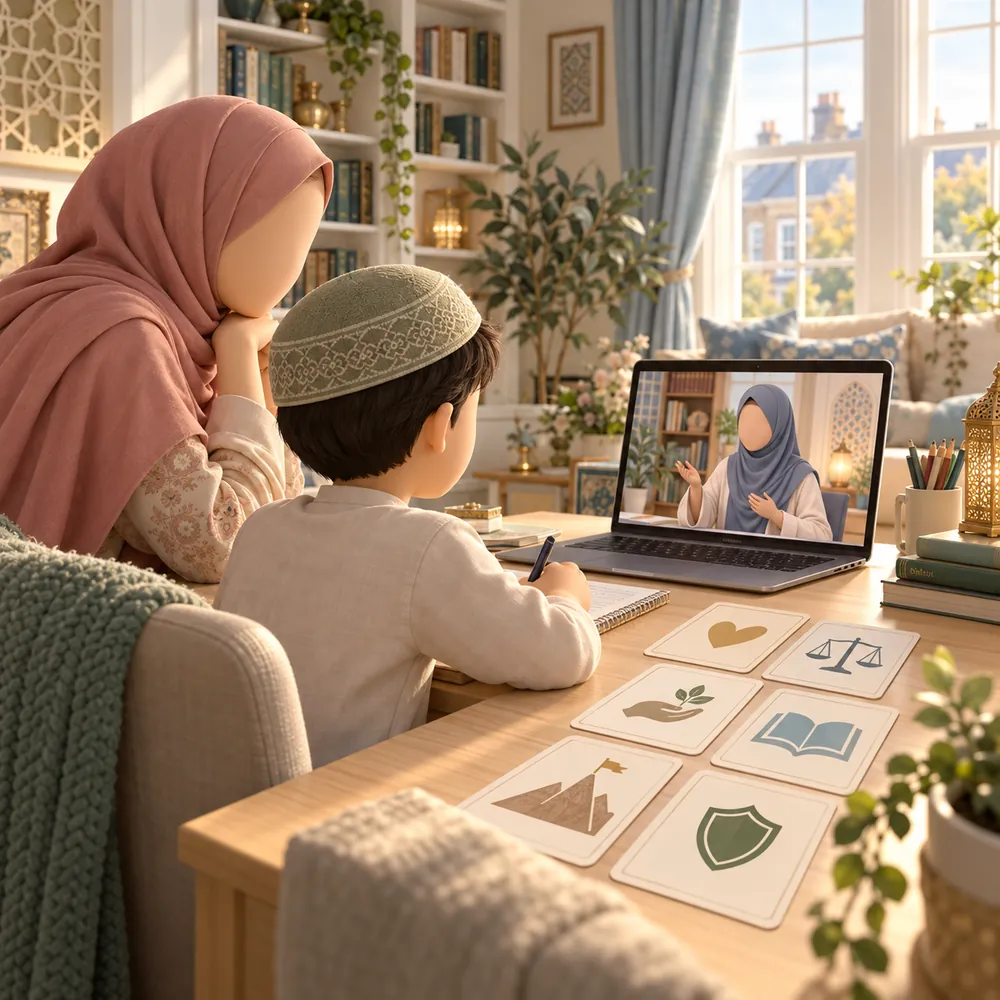
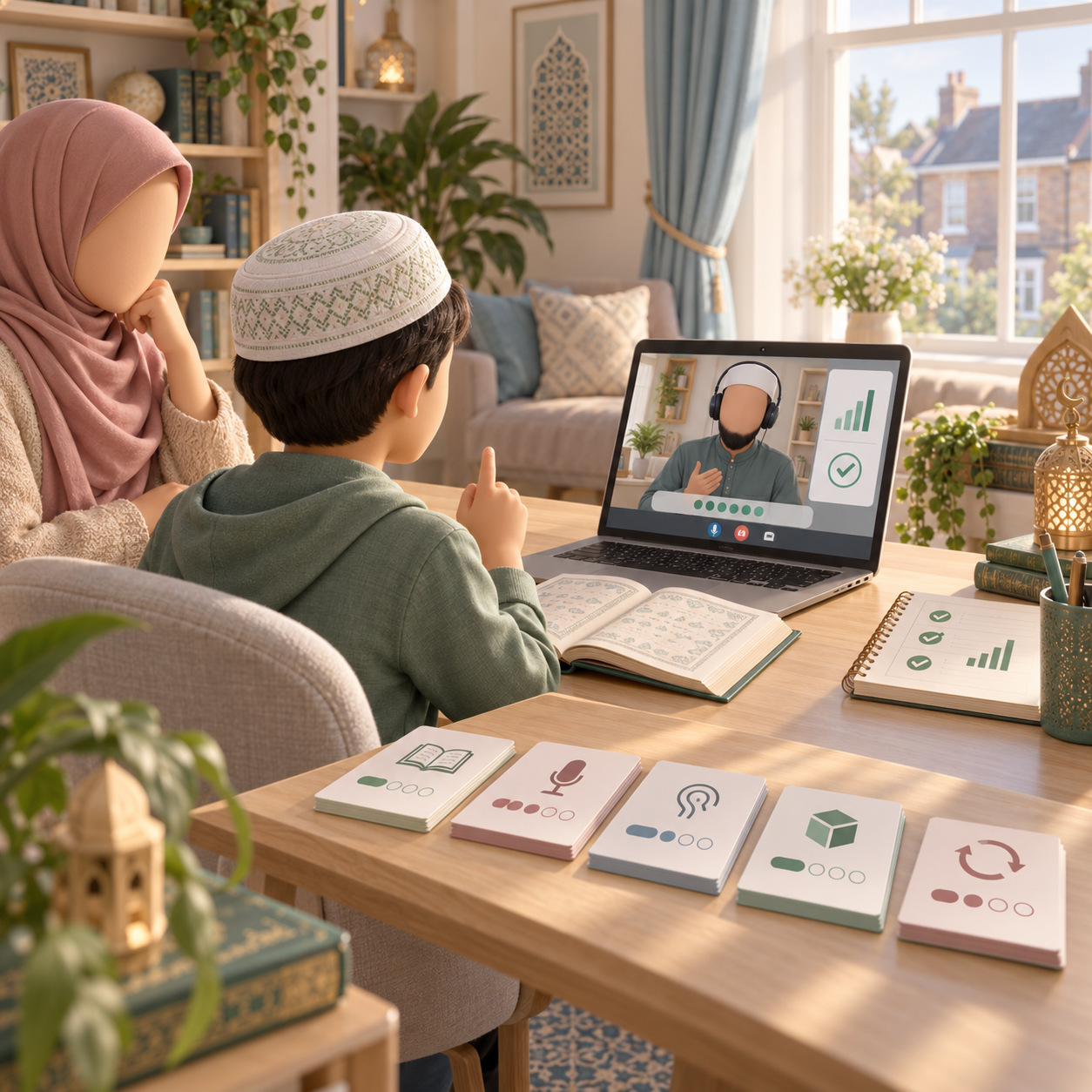
A good quran level test for kids should check more than whether a child can read one page of Quran. A useful level test may look separately at Arabic reading foundations, independent Quran reading, recitation accuracy, pronunciation, practical Tajweed, Hifz, revision, and how the child responds to correction. The goal is not to give the child a stressful score. It is to identify the right starting point for regular lessons.
One reason a quran level test for kids is useful is that a child can be strong in one area and still need support in another. A child may memorise several surahs through listening while still struggling to read independently. Another may read fluently but need Tajweed correction. A third may have strong new Hifz but weak older revision.
Quick answer: a practical quran level test for kids should build a learning profile across seven areas: reading foundations, Quran reading and fluency, recitation and pronunciation, practical Tajweed, Hifz, revision and retention, and response to correction. The result should lead to a clear recommended starting focus rather than just a label such as “beginner” or “advanced”.
What Is a Quran Level Test for Kids?
A quran level test for kids is best understood as a placement check rather than a school-style exam. Its purpose is to find out what the child can already do independently, where support begins to be needed, and what should be taught next.
A useful test may check:
- Arabic letter and vowel foundations if the child is a beginner.
- Independent Quran reading.
- Reading accuracy and fluency.
- Recitation and pronunciation.
- Practical Tajweed application.
- Current Hifz.
- Recent and older revision.
- Listening and repetition ability.
- How the child responds when the teacher gives one correction.
The purpose is therefore to help the teacher decide where regular lessons should begin, not to prove that one child is “better” than another.
This distinction matters because Quran learning includes several connected skills. Reading, recitation, Tajweed, and Hifz do not always develop at the same speed.
Why a Quran Level Test for Kids Should Create a Profile, Not One Label
A single label such as “beginner”, “intermediate”, or “advanced” can hide important differences.
Example: Child A
- Reading: early beginner.
- Hifz: several short surahs memorised through listening.
- Tajweed: developing through imitation.
Example: Child B
- Reading: independent.
- Hifz: little previous memorisation.
- Pronunciation: several repeated sound errors.
Example: Child C
- Reading: strong.
- Hifz: many surahs previously memorised.
- Revision: older Hifz is weak and needs rebuilding.
All three children could be called “intermediate” in a broad system, but that label would not tell the teacher what to do next.
A stronger quran level test for kids should describe each area separately so that the recommended learning plan matches the child’s real needs.
1. Quran Level Test for Kids: Check Reading Foundations When Needed
For a complete beginner, the first part of a quran level test for kids may begin before a full Quran passage.
The teacher may check whether the child can:
- recognise familiar Arabic letters;
- connect letters with their sounds;
- recognise short vowels;
- recognise joined letter forms;
- blend simple sound combinations;
- read short simple words without being given the answer first.
If the child already reads Quran independently, there is no reason to spend a long time testing basic letters simply because they appear on a standard checklist. The teacher should move to the level where the child’s real ability becomes visible.
This follows a broader reading principle: decoding, or working out unfamiliar written words, is different from later fluency. The UK Department for Education’s Reading Framework discusses decoding, fluency, and assessment as distinct parts of reading development. It is general literacy guidance rather than Quran-specific guidance, but the distinction is useful when identifying what a child can genuinely read independently.
Arabic also has script-specific demands. A 2026 peer-reviewed review in the Journal of Psycholinguistic Research discusses how Arabic letter-form variation, connectivity, and vowelisation interact with literacy development. The research focuses mainly on native Arabic-speaking learners, so it should not be treated as direct evidence about every UK child learning Quran. It does, however, reinforce the value of looking at Arabic reading skills separately.
For a child who needs to rebuild this pathway, parents can also read Learn to Read the Quran.
2. Quran Level Test for Kids: Check Quran Reading and Fluency
Once basic foundations are sufficient, a quran level test for kids can move to actual Quran reading.
The teacher may listen for:
- how accurately the child decodes words;
- whether the child guesses or reads what is actually written;
- how often the child needs prompting;
- whether pauses happen at nearly every word;
- whether the child can continue after a mistake;
- whether reading becomes smoother after a second attempt;
- whether the child can handle a short unfamiliar passage independently.
Fluency should not be confused with rushing. A child may read slowly but accurately because decoding still requires conscious attention. Another child may appear faster because they guess familiar-looking words.
During a quran level test for kids, accuracy and independence should therefore matter alongside pace.
The practical question is:
Can this child read Quranic text independently enough for lessons to focus mainly on recitation and Tajweed, or does reading itself still need direct teaching?
3. Quran Level Test for Kids: Check Recitation and Pronunciation Separately
Reading the correct word and pronouncing it correctly are related but different skills.
A child may decode accurately but still have difficulty with:
- particular Arabic sounds;
- Makharij;
- sound substitutions influenced by another language;
- repeated pronunciation habits;
- word endings;
- maintaining accurate pronunciation in longer recitation.
A quran level test for kids should therefore distinguish a reading error from a pronunciation error.
The teacher can listen to a short passage and notice whether the child:
- knows what is written but produces one sound inaccurately;
- needs a model before producing the sound;
- can imitate the teacher’s correction;
- can use the same correction again later.
That final point is particularly useful. A child who can copy a sound immediately may still need practice before the correction transfers into normal recitation.
4. Quran Level Test for Kids: Check Practical Tajweed
A useful quran level test for kids should distinguish between knowing Tajweed terminology and applying Tajweed during recitation.
Some children can name several rules but forget them while reading.
Other children may apply a familiar pattern accurately through listening and practice even though they cannot yet explain its technical name.
The teacher can therefore check:
- whether the child recognises familiar Tajweed patterns;
- whether those patterns are applied during normal recitation;
- whether the child remembers a previous Tajweed correction;
- whether Makharij needs more work;
- whether the amount of Tajweed theory matches the child’s current reading level.
For a beginner, the test should not become a technical-vocabulary quiz. The more useful question is what the child can actually apply while reciting.
Parents who want to understand this distinction in more detail can read Online Tajweed Lessons for Kids.
5. Quran Level Test for Kids: Check Hifz Beyond the Number of Surahs
Hifz is another area where a simple number can be misleading.
A parent may say:
“My child has memorised fifteen surahs.”
A useful quran level test for kids should then explore:
- which surahs are secure;
- which need occasional prompts;
- which were memorised recently;
- which have not been revised for a long time;
- whether pronunciation and Tajweed remain accurate in memorised material;
- whether the child can recover after forgetting one word;
- how dependent the child is on prompts.
The teacher may also listen to a small amount of new teacher-led repetition if appropriate. This can show how the child responds to listening, imitation, and memorisation.
The result should therefore describe both the amount memorised and the strength of that memorisation.
Parents can read Online Hifz Teacher for Kids for a deeper explanation of new Hifz, recent revision, and older Muraja’ah.
6. Quran Level Test for Kids: Check Revision and Retention
Memorised and retained do not always mean the same thing.
This is why revision deserves its own place in a quran level test for kids.
For example, a child may previously have memorised fifteen surahs, but the check may show:
- five are strong;
- four need occasional prompts;
- three contain several recurring mistakes;
- three need substantial rebuilding.
That information is much more useful than recording only “15 surahs memorised”.
The teacher may check:
- recent Hifz;
- older Hifz;
- how quickly forgotten material returns with a small prompt;
- whether pronunciation corrections were retained;
- whether the child can revise without constant teacher support.
A level result may therefore recommend stronger Muraja’ah before adding a large new memorisation portion.
That is not moving the child backwards. It is choosing a starting plan that protects what has already been learned.
7. Quran Level Test for Kids: Check Response to Correction and Build the Starting Plan
One of the most useful parts of a quran level test for kids can happen immediately after the teacher notices a mistake.
The teacher gives one small correction and observes:
- Does the child understand the instruction?
- Can the child repeat the corrected sound or word?
- Can they apply it immediately in the phrase?
- Do they remember it a few minutes later?
- Do they need verbal explanation or repeated modelling?
- Can they calmly try again after an error?
This reveals more than the child’s current knowledge. It can also give the teacher useful information about how the learner responds to instruction.
The observations should then be converted into a recommended starting plan.
That plan might prioritise:
- Arabic reading foundations;
- Quran reading accuracy;
- fluency;
- pronunciation and Makharij;
- practical Tajweed;
- Hifz;
- Muraja’ah;
- or a combination of these.
Not sure which starting point fits your child?
Book a free one-to-one Quran trial and level check on WhatsApp
Quran Level Test for Kids: What Should the Result Tell Parents?
The result of a quran level test for kids does not need to be a percentage or formal grade to be useful.
A practical result should answer four questions:
- What can the child currently do independently?
- Where does the child begin to need help?
- What is the first learning priority?
- What starting lesson focus is recommended?
A useful profile might look like this:
| Area | Current Position | Main Need | Recommended Focus |
|---|---|---|---|
| Reading | Developing | Slow blending | Accuracy and fluency practice |
| Recitation | Developing | Repeated pronunciation errors | Makharij and live correction |
| Tajweed | Early practical level | Needs stronger application | Practical Tajweed during recitation |
| Hifz | Good recent memorisation | Old revision is weaker | Muraja’ah before increasing the new portion |
| Independence | Needs regular prompts | Teacher dependence | Gradually reduce prompts |
Important: this table is an example of a useful result format. It is not an official Sibghah scoring or grading system.
The value of the level check comes from the learning decision it supports, not from producing the highest possible score.
Ask Sibghah to help identify your child’s Quran starting point
What Starting Path Could Follow a Quran Level Test for Kids?
Once the profile is clear, the result should make the next decision easier.
Profile 1: Reading foundations are weak
The child may need structured Arabic reading foundations before direct Quran reading becomes the main lesson focus.
At Sibghah, Noor Al-Bayan is the beginner reading pathway designed for reading fluency and Quran readiness. It progresses through letter sounds and short vowels, long vowels and Tanween, Sukoon, then Shaddah and increasingly fluent reading.
Profile 2: Reading is independent but pronunciation is weak
The child may be ready for Quran reading, recitation, Makharij, and practical Tajweed rather than returning to alphabet-level work.
Profile 3: Reading is strong and the main goal is Hifz
The learning plan can focus more heavily on memorisation, correct recitation, and structured Muraja’ah.
Profile 4: Hifz quantity is high but retention is weak
The child may need a revision-heavy plan before increasing new memorisation.
Profile 5: The child cannot yet read independently but memorises well by listening
The plan may develop reading foundations while allowing suitable teacher-led Hifz through listening and repetition when appropriate.
This is why a quran level test for kids can help families avoid choosing a programme based only on age or a course title.
How Parents Can Prepare a Child for a Quran Level Test for Kids
The most useful result comes from seeing the child’s normal ability rather than a heavily rehearsed performance.
Before the session:
- Tell your child that it is not a pass-or-fail exam.
- Avoid intensive last-minute coaching simply to reach a “higher level”.
- Tell the teacher what the child has studied before.
- Share which surahs have been memorised.
- Mention any reading book or method previously used.
- Explain the main concern you have noticed at home.
- Share the family’s current goal: reading, Tajweed, Hifz, revision, or another Quran priority.
Parents should also avoid answering for the child during the level check. A small pause can give the teacher useful information.
The teacher needs to see where independent performance ends and support becomes necessary.
How Long Should a Quran Level Test for Kids Take?
There is no universal duration for a quran level test for kids.
The appropriate length can depend on:
- the child’s age;
- whether the child is a complete beginner or experienced learner;
- how many areas need to be checked;
- the child’s concentration and comfort;
- whether there is previous Hifz to review;
- whether reading foundations need to be checked first.
A longer test is not automatically a better test.
The aim is to collect enough useful information to choose a sensible starting point without turning the session into an exhausting examination.
Common Mistakes Before a Quran Level Test for Kids
1. Trying to Help the Child “Pass”
The goal is accurate placement, not achieving the highest label.
2. Intensive Coaching Immediately Before the Test
This can make it harder to see what the child can do without recent prompting.
3. Focusing Only on Reading
A complete quran level test for kids may need to separate reading, recitation, Tajweed, Hifz, and revision.
4. Assuming Hifz Means Strong Reading
A child can memorise successfully through listening while independent decoding is still developing.
5. Ignoring Older Memorisation
Previous Hifz should be checked for retention, not only counted.
6. Treating Slow Reading as Automatically Low Level
Slow but accurate reading is different from fast guessing.
7. Asking Only Whether the Child Knows Tajweed Rule Names
Application during recitation often provides more useful information.
8. Judging the Whole Child from One Mistake
A level check should look for patterns rather than overreacting to one hesitation.
9. Wanting the Highest Possible Placement
The strongest placement is the one that begins where useful learning can happen.
How a Quran Level Test for Kids Can Work at Sibghah Academy
At Sibghah Academy, Quran learning uses individual learning plans. The Quran programme focuses on memorisation with proper Tajweed and supports both native and non-native Arabic speakers.
For families considering lessons, a quran level test for kids can help identify whether the most useful starting focus is:
- Arabic reading foundations;
- Quran reading;
- recitation and pronunciation;
- practical Tajweed;
- Hifz;
- revision;
- or a combination of these areas.
Sibghah provides live one-to-one lessons for children aged 5–15, allowing the teacher to listen directly to one learner rather than assigning a starting point from age alone.
If the child needs beginner reading foundations, Sibghah also has a Noor Al-Bayan pathway focused on reading fluency and Quran readiness. If those foundations are already in place, the Quran learning plan can focus more directly on recitation, Tajweed, Hifz, or revision.
Families can begin with a free trial so the teacher can observe the child’s starting point and the parent can experience the one-to-one format before deciding whether it is suitable.
Message Sibghah Academy to book a free Quran trial and level check
Sibghah Teacher Note
Sibghah Teacher Note: during a quran level test for kids, the aim is not to find the hardest task a child can fail. A more useful approach is to begin with something manageable and increase the difficulty gradually. The important point is where the child moves from working independently to needing support, because that tells the teacher what should be taught next.
Quran Level Test for Kids: Parent Checklist
Before or after a quran level test for kids, check whether you can answer these questions:
- Do I know my child’s current Arabic reading foundation?
- Can my child read Quran independently?
- Is the reading accurate, even if it is slow?
- Are the main errors decoding errors or pronunciation errors?
- Can my child apply basic Tajweed while reciting?
- What Quran has my child memorised?
- How much of the older Hifz is still secure?
- How much prompting does my child need?
- How does my child respond when corrected?
- What is the first learning priority?
- Do I understand why the recommended starting point was chosen?
- Do I know what progress should be reviewed later?
If the result does not answer these kinds of questions, ask for more explanation before choosing a long-term programme.
Frequently Asked Questions About a Quran Level Test for Kids
What is a Quran level test for kids?
A quran level test for kids is a placement check used to understand a child’s current Quran skills and identify an appropriate starting point. It may look at reading foundations, Quran reading, recitation, pronunciation, Tajweed, Hifz, revision, and response to correction.
Is a Quran level test an exam?
It does not need to be treated like a school exam. The most useful purpose is placement and planning rather than passing, failing, or competing with other children.
What does the reading part check?
Depending on the child’s level, the teacher may check letter and vowel foundations, joined forms, word decoding, Quran reading accuracy, fluency, and how independently the child reads.
How is Tajweed checked?
The teacher can listen to real recitation and observe whether the child applies familiar rules, produces important sounds accurately, and remembers corrections. Knowing rule names can also be checked when appropriate, but application matters.
How is Hifz checked?
The teacher may check what has been memorised, how independently the child recalls it, recitation accuracy, recent Hifz, older Hifz, and how much prompting is needed.
Should old memorisation be checked too?
Yes, when Hifz is part of the child’s learning history. Older revision helps show whether previous memorisation is secure or whether Muraja’ah should become a priority.
Can a complete beginner take a Quran level test?
Yes. For a complete beginner, the test may focus more on Arabic letter recognition, sounds, vowels, listening, and repetition rather than asking the child to read a passage they are not ready for.
Can my child take the test if they cannot read Arabic?
Yes. The purpose is to identify the starting point. A child who cannot yet read Arabic can still be checked for beginner reading foundations, listening, repetition, and any previous Hifz.
Can Hifz level be strong while reading level is low?
Yes. Some children memorise Quran through listening and repetition before independent reading develops. This is one reason different Quran skills should be assessed separately.
How long does a Quran level test take?
There is no universal duration. It depends on the child’s age, current level, previous Hifz, number of areas being checked, and concentration. The session should be long enough to guide placement without becoming unnecessarily exhausting.
What should parents know after the test?
Parents should understand the child’s current position, the main gap or priority, and the recommended starting focus. A percentage score is less useful if it does not explain what should happen next.
Does Sibghah provide a Quran level test for kids?
Sibghah uses individual learning plans and can begin by checking a child’s current Quran level so the teacher can recommend an appropriate starting focus. Families can begin with a free one-to-one trial and level check.
Is the level check part of the free trial?
The free trial gives the teacher an opportunity to observe the child’s current level and allows the family to experience the one-to-one format. The exact areas checked depend on the child’s previous learning and current goals.
Final Thoughts: Use a Quran Level Test for Kids to Choose the Right Starting Point
A useful quran level test for kids should not reduce a child’s Quran learning to one number.
It should show what the child can already do.
It should separate reading from pronunciation.
It should distinguish practical Tajweed from memorised terminology.
It should look at Hifz and whether older memorisation is still secure.
It should notice how much prompting the child needs and how they respond to correction.
Most importantly, a quran level test for kids should lead to a clear next step.
For one child, that may be Arabic reading foundations.
For another, it may be Quran fluency and pronunciation.
For another, it may be practical Tajweed.
For another, it may be Hifz with structured Muraja’ah.
The strongest result is not the highest label. It is the starting point that gives the teacher enough challenge to help the child progress without skipping an important foundation.
If you are unsure where your child should begin, Sibghah Academy offers a free live one-to-one trial and level check for Muslim children aged 5–15.
Book your child’s free Quran trial and level check on WhatsApp