
If you are looking for an online Hifz teacher for kids, do not judge the lesson only by how many new ayat your child memorises each week. A good Hifz teacher should listen carefully, correct recitation, choose a realistic new portion, build regular revision into the lesson, and check whether older memorisation is still secure before adding more.
The right online Hifz teacher for kids should also understand that memorisation is different for every child. One learner may memorise quickly but forget older surahs. Another may need more listening and repetition before a new ayah becomes stable. Another may already have strong Hifz but need pronunciation and Tajweed correction.
Quick answer: a strong online Hifz teacher for kids balances new memorisation with recent and older revision, uses listening and repetition, corrects mistakes before they become memorised habits, adjusts the portion to the child’s level, and gives parents a clear idea of what should be revised between lessons.
What Makes a Good Online Hifz Teacher for Kids?
A good online Hifz teacher for kids does much more than assign a new passage and listen to it at the next lesson.
Hifz works best as a continuing cycle:
Listen → Repeat → Memorise → Recite → Correct → Review → Retrieve Again Later.
The teacher should know when the child is ready for new memorisation and when the wiser choice is to slow down and strengthen what has already been memorised.
For this reason, a good Hifz lesson should contain both new memorisation and Muraja’ah. Revision should not be treated as optional work that happens only when there is spare time.
A thoughtful online Hifz teacher for kids therefore looks at the strength of the whole memorisation journey, not only today’s new ayat.
1. An Online Hifz Teacher for Kids Should Start with the Child’s Real Level
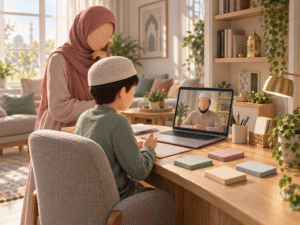
Before setting a memorisation target, an online Hifz teacher for kids should understand what the child has already memorised and how secure that memorisation actually is.
A useful first assessment may explore:
- Which surahs or passages the child has memorised.
- Whether they can recite them without prompting.
- How secure recent Hifz is.
- How much older Hifz has become weak.
- Current recitation accuracy.
- Pronunciation and Makharij.
- Current Tajweed application.
- How the child responds to correction.
- How easily the child memorises through listening and repetition.
- How much home revision is realistic for the family.
An online Hifz teacher for kids should not assume that a child who has “memorised five surahs” has five equally secure surahs.
One may be very strong. Two may need occasional revision. Two others may require rebuilding before adding more new Hifz.
This is why assessment should look at retention as well as quantity.
Parents can use our Quran Assessment for Kids guide to understand how reading, recitation, Hifz and Tajweed can be assessed separately.
2. A Good Online Hifz Teacher for Kids Chooses a Realistic New Portion
A useful online Hifz teacher for kids does not treat a larger daily portion as automatic evidence of better progress.
The right amount of new memorisation depends on factors such as:
- The child’s age.
- Attention span.
- Quran reading ability.
- Previous memorisation experience.
- Pronunciation needs.
- How much old revision is required.
- Lesson frequency.
- School workload.
- How much practice the family can realistically support.
For one child, two short ayat may be an appropriate target. Another child may comfortably handle more.
The better question is not:
“How much did my child memorise this week?”
It is:
“Can my child still recite this accurately after time has passed?”
A responsible online Hifz teacher for kids should also be willing to reduce the new portion when previous memorisation is weakening.
More new Hifz is not always more progress
If a child continues adding passages while older surahs are rapidly disappearing, the revision workload becomes larger and larger.
Parents can ask the teacher:
“How do you decide when my child should continue new Hifz and when revision should become the priority?”
A useful answer should refer to the child’s actual retention and recitation rather than only a fixed weekly syllabus.
3. An Online Hifz Teacher for Kids Should Use Listening and Repetition
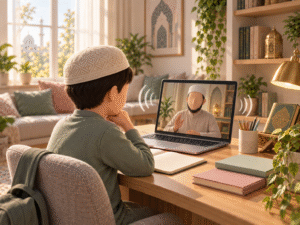
For many children, an online Hifz teacher for kids will use a teacher-led process in which the child first hears a correct model, then repeats and gradually memorises it.
A practical sequence may look like this:
- The teacher recites a short portion correctly.
- The child listens carefully.
- The child repeats.
- The teacher corrects pronunciation or Tajweed where needed.
- The child repeats the corrected form.
- The new part is connected to the previous part.
- The child gradually recites without the teacher’s prompt.
This approach is closely related to Talaqqi, a traditional teacher-led method of Quran learning based on listening directly to correct recitation and repeating it accurately.
A 2025 case study of kindergarten children described Quran memorisation through teacher recitation, student repetition, Muraja’ah and evaluation. Because it involved one specific school, its results should not be treated as a universal formula for every child, but it provides a useful recent example of structured teacher-led Hifz.
Read the 2025 study on Talaqqi and Juz ‘Amma memorisation.
The practical lesson for parents is that an online Hifz teacher for kids should not simply tell a beginner, “Memorise these ayat for next week,” without first helping the child hear and practise them correctly.
4. An Online Hifz Teacher for Kids Should Correct Before Mistakes Become Memorised
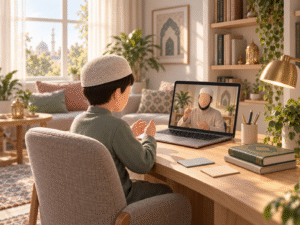
When a child repeats the same passage many times, both correct and incorrect patterns can become familiar.
This is why an online Hifz teacher for kids should listen carefully before encouraging large amounts of repetition.
The teacher may need to correct:
- Letter pronunciation.
- Makharij.
- Vowel errors.
- Missing or added words.
- Word endings.
- Basic Tajweed application.
- Places where the child repeatedly hesitates.
The aim is not to demand perfect advanced Tajweed from a beginner before allowing them to memorise.
The aim is to make sure the child is repeating an appropriately accurate model for their level.
A careful online Hifz teacher for kids therefore combines memorisation with recitation correction instead of treating them as completely separate tasks.
Correction should remain manageable
If the child makes several different errors, the teacher does not always need to interrupt every few seconds.
One or two recurring priorities may deserve focused correction first.
That allows the child to memorise accurately without turning every repetition into a stressful test.
5. The Best Online Hifz Teacher for Kids Builds Revision into Every Plan

Revision is one of the clearest signs of a thoughtful online Hifz teacher for kids.
A useful Hifz plan normally needs to distinguish between:
- Recent revision: material memorised recently.
- Older revision: material memorised further in the past.
- New memorisation: the portion currently being learned.
If the lesson focuses only on today’s new portion, older Hifz can slowly weaken without being noticed.
Sibghah’s Quran teaching approach specifically uses revision for both recent and older memorisation, and revision can occupy a substantial part of a Hifz lesson according to the learner’s needs.
A broader principle from learning science also supports revisiting material across time. A review published in Nature Reviews Psychology discusses how spacing and retrieval practice can support longer-term retention across different kinds of learning.
This is general learning and memory research, not Quran-specific research, so it should not be treated as a direct study of Hifz. However, the basic idea is relevant: retrieving something again after time has passed provides different information from simply repeating it many times in one sitting.
Read the review on spacing and retrieval practice.
A simple Hifz structure
An online Hifz teacher for kids might organise a learner’s work like this:
Older revision → Recent revision → New memorisation → Combined recitation.
The proportions should not remain fixed forever.
If old Hifz becomes weak, revision may temporarily take much more of the lesson.
6. An Online Hifz Teacher for Kids Should Check Retention, Not Only Same-Day Performance
A child can sometimes recite a new passage beautifully immediately after repeating it several times.
That does not tell the online Hifz teacher for kids whether the same passage will still be available from memory tomorrow, next week or later.
Useful retention checks may include:
- Reciting the portion again later in the same lesson.
- Testing it at the beginning of the next session.
- Mixing it with previously memorised passages.
- Checking whether previous corrections have remained fixed.
- Reducing teacher prompts gradually.
- Returning to older surahs after a gap.
A 2024 qualitative study of Quran memorisation teachers reported strategies including Talaqqi, Tasmi’, repetition, Muraja’ah and recitation correction.
Because the study examines particular teachers and students, it does not prove that one formula is best for every learner, but it provides useful evidence of how revision and teacher correction are used in real Tahfiz practice.
Read the study on Quran memorisation teaching strategies.
For parents, the practical question is simple:
Can my child retrieve the memorised passage accurately after time has passed?
7. A Good Online Hifz Teacher for Kids Can Add Simple Meaning
An online Hifz teacher for kids can help a child understand the basic meaning of what they are memorising without turning every Hifz lesson into a long Tafsir class.
Age-appropriate understanding might include:
- The main idea of the surah.
- The meaning of an unfamiliar Quranic word.
- A clear value found in the ayat.
- A short connection to faith, worship or manners.
For example, if a passage teaches gratitude, patience or trust in Allah, the teacher can briefly help the child notice that meaning.
This does not replace memorisation time.
It gives the child some context for the words they are repeating.
Sibghah’s Quran teaching plan includes brief explanation of the surah, clarification of unfamiliar Quran vocabulary and discussion of a clear value contained in the verses.
8. One-to-One Teaching Helps an Online Hifz Teacher for Kids Adapt the Pace
Individual lessons can be useful when an online Hifz teacher for kids needs to balance several needs at once:
- New Hifz.
- Recent revision.
- Older revision.
- Pronunciation.
- Tajweed.
- Reading ability.
- Confidence.
One-to-one teaching allows the teacher to hear the child’s entire assigned portion and adjust immediately.
If a child forgets repeatedly, the teacher can increase revision.
If a particular ayah is difficult, the teacher can repeat it more.
If the child’s old Hifz is strong, the new portion may gradually increase.
If pronunciation needs attention, the lesson can slow down before more memorisation is added.
This does not mean group Hifz is ineffective. Group learning can offer motivation and a sense of community.
The important question is whether the child receives enough individual listening and correction for their own memorisation.
If teacher quality is one of your main concerns, read our Online Quran Teacher in the UK guide.
Would you like to see how your child responds to one-to-one Quran memorisation?
Book a free one-to-one Quran trial on WhatsApp
9. An Online Hifz Teacher for Kids Should Give Parents a Clear Revision Plan
Parents should not finish a lesson wondering what their child is supposed to do before the next session.
A useful online Hifz teacher for kids can give a simple plan such as:
- Listen to today’s portion before practising.
- Repeat the new portion in manageable cycles.
- Revise specific recent passages.
- Revise one or more older surahs.
- Focus on one recurring pronunciation correction.
- Pause new memorisation if the assigned revision is becoming unstable.
The home plan should fit real family life.
Children may already have school, homework and other commitments. A technically perfect revision timetable that the family cannot maintain will not remain useful for long.
The role of the online Hifz teacher for kids is therefore not simply to assign more work. The teacher should help the parent understand which work matters most.
What Can a Lesson with an Online Hifz Teacher for Kids Look Like?
There is no single timetable that every online Hifz teacher for kids must follow.
However, a Hifz lesson should normally make space for both revision and new memorisation.
For a 45–60 minute session, an illustrative structure could be:
| Approximate Time | Possible Focus |
|---|---|
| 10–15 minutes | Older revision |
| 10–15 minutes | Recent revision |
| 15–20 minutes | New memorisation through listening, repetition and correction |
| 5–10 minutes | Combined recitation, Tajweed focus, simple meaning and home plan |
This is only an example, not a fixed formula.
A child whose old Hifz has become weak might spend much more time on revision.
A young beginner may spend much more time listening and repeating a very small new portion.
At Sibghah, Quran sessions are generally 45–60 minutes and use individual learning plans. :contentReference[oaicite:4]{index=4}
Choosing an Online Hifz Teacher for Kids by Age and Level
Ages 5–7
For younger children, an online Hifz teacher for kids may rely more heavily on listening, short portions and frequent repetition.
Long explanations and large targets are usually less useful than short cycles of:
Listen → Repeat → Correct → Repeat Again.
The priority should be a manageable Quran routine and accurate modelling rather than competing over quantity.
Ages 8–11
Children at this age may be able to follow clearer weekly targets and understand the difference between:
- New memorisation.
- Recent Muraja’ah.
- Older Muraja’ah.
The teacher can gradually help the child take more responsibility for revision.
Ages 12–15
Older children may be able to practise more independently and understand why a revision schedule matters.
However, age alone should not determine the size of the new Hifz target.
A fourteen-year-old with a large amount of weak previous memorisation may reasonably need more revision than a younger child with very secure Hifz.
Common Mistakes When Choosing an Online Hifz Teacher for Kids
1. Measuring success only by new pages
New quantity is only one part of Hifz. Retention matters too.
2. Treating Muraja’ah as optional
A strong online Hifz teacher for kids should make revision part of the memorisation plan, not an extra activity for weeks when there is time.
3. Repeating incorrect recitation many times
The child should hear an accurate model and receive appropriate correction before a mistake becomes familiar through repetition.
4. Giving every child the same target
Children differ in age, memory, reading ability, attention, school schedule and existing Hifz.
5. Moving forward while today’s portion is still unstable
More content is not always the best next step.
6. Revising only the newest surahs
Older memorisation also needs planned retrieval.
7. Using pressure when a child forgets
Forgetting gives the teacher useful information about the revision plan. It should not become a reason to embarrass the child.
8. Depending entirely on recordings
Audio is useful for modelling and repetition, but a recording cannot hear whether the child’s recitation contains a repeated error.
9. Never asking how retention is measured
A good teacher should be able to explain when a passage is considered secure enough to move forward.
How to Measure Progress with an Online Hifz Teacher for Kids
Parents working with an online Hifz teacher for kids can track much more than the total number of memorised ayat.
Useful signs of progress include:
- The child recites recent Hifz with fewer prompts.
- Older memorisation remains accessible.
- Previous pronunciation corrections remain fixed.
- Hesitation decreases in familiar passages.
- The child can recover after a small mistake.
- The teacher needs to prompt less often.
- The child becomes more independent with home revision.
- New memorisation and old revision remain balanced.
- The child remains encouraged rather than overwhelmed by targets.
A useful progress conversation with an online Hifz teacher for kids might ask:
- What is secure?
- What is beginning to weaken?
- What needs revision this week?
- Is the new portion still appropriate?
- Which recitation error should we focus on?
- Does the Hifz plan need to change?
How Sibghah Supports Families Looking for an Online Hifz Teacher for Kids
Sibghah Academy provides live one-to-one Quran lessons for Muslim children aged 5–15.
The Quran programme uses individual learning plans and focuses on memorisation with proper Tajweed for both native and non-native Arabic speakers. :contentReference[oaicite:5]{index=5}
For families looking for an online Hifz teacher for kids, the learning path can include:
- Initial level assessment.
- A suitable memorisation pace.
- Teacher-led listening and repetition.
- Correct recitation.
- Pronunciation correction.
- Age-appropriate Tajweed support.
- Recent Muraja’ah.
- Older Muraja’ah.
- Simple age-appropriate understanding of memorised verses.
- Home practice and parent follow-up.
Sibghah’s Quran teaching framework also asks teachers to set portions according to the student’s level, repeat the ayah until it is memorised appropriately, and use a review plan covering both recent and older memorisation. :contentReference[oaicite:6]{index=6}
You can explore the Online Quran Memorization Program for Kids for more details about Sibghah’s Hifz pathway.
If your child already has previous Hifz, the first step should not automatically be adding another surah. The teacher can first understand how much of the previous memorisation remains secure.
Message Sibghah Academy to book a free Hifz trial and level check
Sibghah Teacher Note
Sibghah Teacher Note: when an online Hifz teacher for kids sees that a child can memorise new ayat quickly but older memorisation is becoming weak, the answer is not always to add more. Sometimes the better lesson is a revision lesson. Strong Hifz means that the child can return to what was memorised before, recite it accurately and gradually need fewer prompts.
Online Hifz Teacher for Kids: Parent Checklist
Before choosing an online Hifz teacher for kids, ask whether you can answer “yes” to most of these:
- Does the teacher assess my child’s existing Hifz before setting targets?
- Does the teacher check how secure older memorisation is?
- Is the new portion adapted to my child’s level?
- Does my child hear correct recitation before repeated memorisation?
- Are pronunciation and Tajweed errors corrected?
- Is recent revision included?
- Is older revision included?
- Does the teacher check retention later, not only immediately?
- Can the teacher reduce new memorisation when revision needs more time?
- Does my child receive enough individual recitation time?
- Are home revision instructions clear?
- Does the teacher communicate useful progress information to parents?
- Are the goals realistic alongside school and family life?
- Does the child remain encouraged rather than frightened by mistakes?
A suitable teacher should be able to explain how new Hifz and Muraja’ah work together.
Frequently Asked Questions About an Online Hifz Teacher for Kids
What should I look for in an online Hifz teacher for kids?
Look for an online Hifz teacher for kids who assesses the child’s current level, listens carefully, models correct recitation, corrects mistakes, chooses realistic portions, includes recent and older revision, checks retention and gives parents a clear home plan.
How much Quran should a child memorise each day?
There is no single amount that suits every child. The appropriate portion depends on age, level, reading ability, retention, revision needs, lesson frequency and family routine. A smaller portion that remains secure may be more useful than a larger portion that is quickly forgotten.
Should Hifz lessons focus more on new memorisation or revision?
The balance should depend on the learner. If previous Hifz is secure, the child may be ready for more new memorisation. If older passages are weakening, revision should reasonably receive more lesson time.
Can my child start Hifz before reading Quran fluently?
Yes, some children can memorise suitable passages through listening and repetition while independent reading develops. The teacher should still protect pronunciation and recitation accuracy and make sure the overall learning load remains manageable.
What is Muraja’ah in Hifz?
Muraja’ah means reviewing Quran that has already been memorised. A good plan includes both recent and older material instead of focusing only on today’s new Hifz.
How can an online Hifz teacher for kids help prevent forgetting?
No teacher can guarantee that a child will never forget. An online Hifz teacher for kids can support stronger retention through regular Muraja’ah, repeated retrieval, listening, correction and adjusting the amount of new Hifz when previous memorisation needs strengthening.
Does my child need Tajweed while memorising?
Children should memorise from a correct model and receive age-appropriate pronunciation and Tajweed correction. This reduces the chance of repeatedly memorising an avoidable recitation error.
Are one-to-one Hifz lessons better?
One-to-one lessons can provide more individual listening, correction and personalised pacing. Group Hifz can also provide motivation and community when every child still receives adequate individual recitation and feedback.
How long should a child’s Hifz lesson be?
There is no universal duration for every child. Sibghah’s Quran programme uses 45–60 minute sessions, while the actual balance between revision, new memorisation and recitation depends on the learner’s level and needs.
How should parents support Hifz between lessons?
Parents can protect a regular revision time, help younger children access the assigned recitation, follow the teacher’s current priority and avoid increasing the child’s target independently just to memorise faster.
How do I know whether my child’s Hifz is really improving?
Look at retention as well as quantity. Stronger Hifz may mean fewer prompts, more secure older surahs, remembered corrections, smoother retrieval and greater independence with revision.
Does Sibghah provide an online Hifz teacher for kids?
Yes. Sibghah provides live one-to-one Quran lessons for Muslim children aged 5–15. The Quran programme uses individual learning plans and can include Quran memorisation, Tajweed, recitation correction and structured revision according to the child’s level.
Final Thoughts: Choosing an Online Hifz Teacher for Kids
Choosing an online Hifz teacher for kids should not come down to one question:
“How quickly can my child memorise?”
A stronger set of questions is:
Does the teacher know what my child has already memorised?
Is that old Hifz still secure?
Is the new portion realistic?
Does my child hear a correct model before repeating?
Are mistakes corrected before they become habits?
Is recent revision planned?
Is older revision planned?
Does the teacher check retention after time has passed?
Does the home plan fit our actual family routine?
A strong online Hifz teacher for kids understands that new memorisation and revision are not competing goals. New Hifz grows on top of old Hifz, so both need attention.
The aim is not simply to collect more memorised pages. It is to help the child memorise accurately, retain what they have learned, improve recitation and develop a sustainable relationship with Quran.
If you want to understand your child’s current Hifz level before deciding on a longer-term plan, Sibghah Academy offers a free live one-to-one Quran trial for Muslim children aged 5–15.