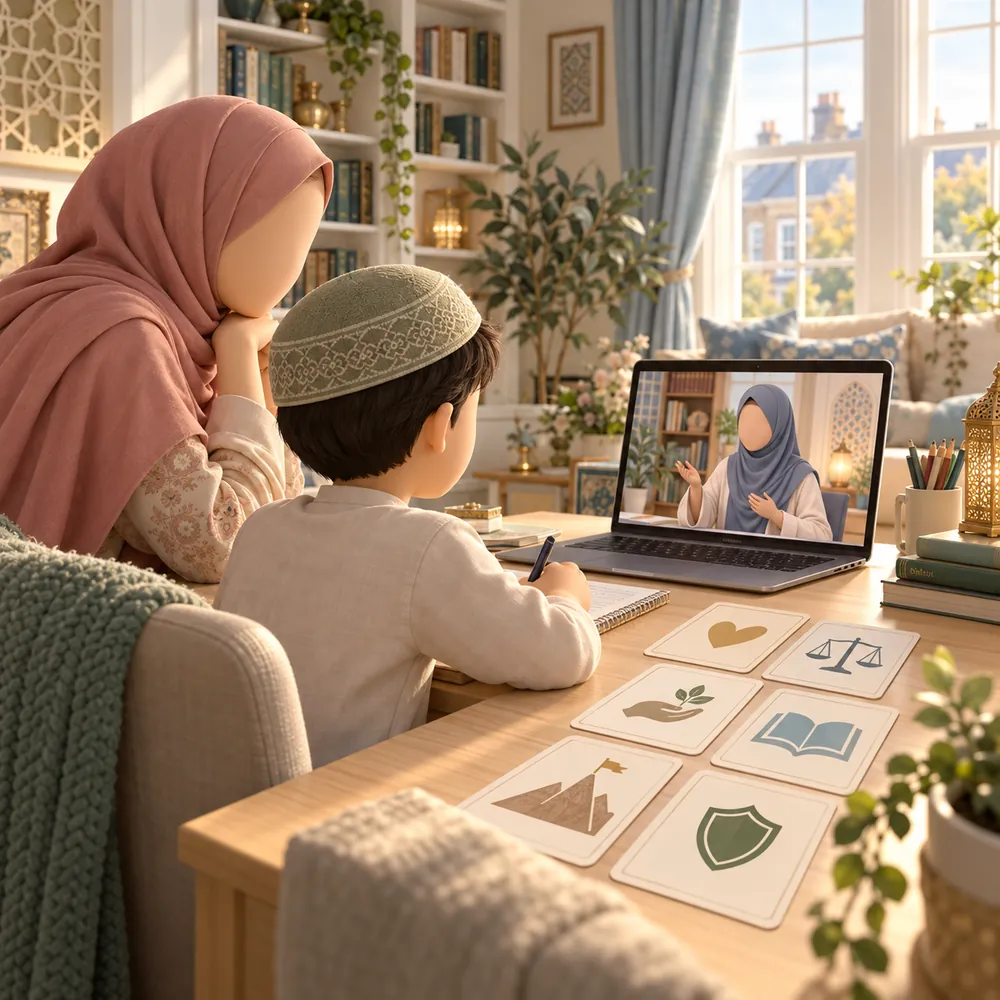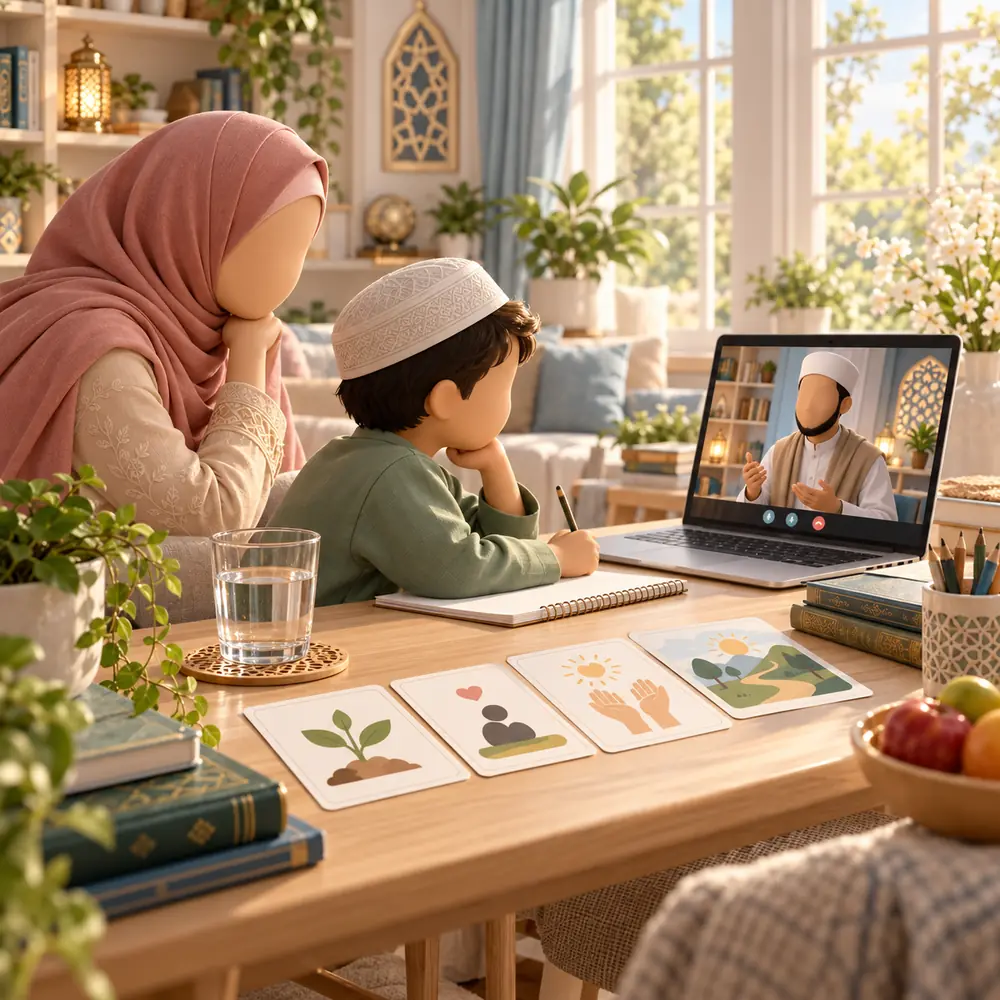
Good online Tajweed lessons for kids should give children plenty of time to listen, recite, receive gentle correction, repeat difficult sounds, and apply what they learn while reading Quran. Tajweed is not only a list of rule names to memorise. A child needs to hear correct recitation, try the sound or rule, receive clear feedback, and then use that correction again in real recitation.
The best online Tajweed lessons for kids also match the amount of theory to the child’s reading level. A beginner who is still decoding Arabic words may need pronunciation modelling and simple practical correction, while a more fluent reader may be ready to understand Tajweed terminology and apply more detailed rules.
Quick answer: effective online Tajweed lessons for kids usually follow a simple cycle: teacher listens → identifies a priority → models the correct recitation → child repeats → child applies it in Quran reading → teacher gives immediate feedback → the same skill is checked again later. The goal is not only to know Tajweed, but to use it while reciting.
What Should Online Tajweed Lessons for Kids Actually Teach?

Parents sometimes expect online Tajweed lessons for kids to look mainly like a classroom lesson about definitions: the teacher explains a rule, the child remembers its name, and then the lesson moves to the next rule.
That knowledge can be useful, but Tajweed is ultimately heard and applied during recitation. A child may know the name of a rule and still fail to recognise when it appears while reading. Another child may be able to recite a pattern correctly after listening even before learning all of its technical terminology.
Good online Tajweed lessons for kids should therefore combine knowledge with repeated practical application.
A lesson may work on:
- correct pronunciation of Arabic sounds;
- Makharij, or articulation points, at an age-appropriate level;
- listening carefully to the teacher’s model;
- identifying recurring recitation errors;
- repeating difficult words or short phrases;
- applying a Tajweed rule during actual Quran recitation;
- remembering a previous correction in a new place;
- gradually building smoother and more accurate recitation.
The teaching approach should connect explanation directly with recitation. Children benefit from hearing the correct model, trying it themselves, receiving feedback, and then repeating the difficult part until the correction becomes easier to reproduce.
This is the central idea of this guide: online Tajweed lessons for kids should help a child turn a rule into a better recitation habit.
1. Online Tajweed Lessons for Kids Should Match the Child’s Reading Level
Before choosing online Tajweed lessons for kids, parents should ask a simple question: What can my child already read independently?
Children who need Tajweed support can be at very different stages.
Beginner reader
A beginner may still be learning Arabic letters, vowels, joined forms, or basic word decoding. At this stage, the child can still hear correct recitation and receive gentle pronunciation correction, but heavy Tajweed terminology may compete with the basic reading task.
Developing reader
A developing reader may read Quran independently but slowly, with repeated pronunciation or application errors. This child may be ready for simple rule names, focused Makharij work, and repeated application during recitation.
More fluent reader
A more fluent reader can usually give more attention to finer recitation details because basic decoding requires less effort. The teacher can introduce more explicit Tajweed explanation while keeping recitation practice central.
This is why a level check matters before the Tajweed programme becomes fixed. The child’s age is relevant, but actual Quran reading ability is often more important for deciding how much theory and application to use.
Parents who are unsure about the starting point can first review Sibghah’s Quran Assessment for Kids guide, which separates reading foundations, independent reading, pronunciation, Tajweed, Hifz, and revision.
2. Separate Quran Reading from Tajweed
One of the most important things to understand before starting online Tajweed lessons for kids is that a reading difficulty and a Tajweed difficulty are not always the same problem.
| Quran Reading | Tajweed and Recitation |
|---|---|
| Can the child recognise and decode the written word? | Can the child pronounce and recite it correctly? |
| Letters, vowels, joined forms and blending | Makharij, sound qualities and practical rule application |
| Reading accuracy and fluency | Recitation accuracy and refinement |
| Builds the decoding foundation | Builds on reading and listening |
A child who cannot decode a word reliably may appear to have a Tajweed problem because the recitation is inaccurate. But teaching the name of a Tajweed rule will not repair a missing short-vowel or blending skill.
Likewise, a child can read the word correctly from the page but pronounce one letter from the wrong articulation point. That is a different learning need.
Useful online Tajweed lessons for kids should identify which kind of problem is happening before deciding how to correct it.
If your child still needs stronger basic Quran reading, Sibghah’s Online Quran Lessons for Kids page explains how reading support can begin from the child’s current level before more advanced recitation work.
3. Online Tajweed Lessons for Kids Should Make Recitation the Centre of the Lesson
The heart of online Tajweed lessons for kids should be actual recitation.
A practical lesson can follow this sequence:
- Teacher listens first. The child reads or recites enough for the teacher to hear the current pattern.
- Teacher identifies a priority. Instead of correcting ten different details at once, the teacher chooses one or two useful targets.
- Teacher models. The child hears the correct sound, word, or phrase.
- Child repeats. The child attempts the model.
- Child applies. The same correction is used inside real Quran recitation.
- Teacher gives immediate feedback. The child knows exactly what improved and what still needs work.
- The difficult part is repeated. The lesson does not move on simply because the explanation was given once.
- The skill is checked again later. The teacher sees whether the correction has transferred beyond the original example.
This approach makes a Tajweed lesson more than a theory class. The child learns what the rule sounds like and what it feels like to apply it.
A 2024 study of schoolchildren examining a digital Tajwid learning tool focused specifically on Makharij and sound qualities and measured improvement through pre- and post-testing. It does not prove that every online method works equally well, but it supports the educational value of active Tajwid practice rather than passive exposure alone.
Parents can read the study here: Enhancing Tajwid Skills through Harakah-Based Learning Media.
4. Use Online Tajweed Lessons for Kids to Teach Makharij Through Listening
Makharij can be difficult to teach only through definitions. In online Tajweed lessons for kids, the child needs to hear the sound and attempt it while the teacher listens.
This can be especially important for children who do not speak Arabic in daily life. Some Arabic sounds may be unfamiliar, and a child may substitute a sound that feels more natural in English or another home language.
A useful pronunciation cycle is:
Hear → Watch → Repeat → Receive Correction → Repeat Again → Apply in Recitation.
The teacher does not need to give a long anatomical explanation to every young learner. The explanation should be as detailed as the child can use.
For a younger child
The teacher may model the sound, give one simple mouth or tongue cue, and practise it in a short word or phrase.
For an older child
The teacher may explain the articulation point more explicitly and help the learner compare similar sounds.
In both cases, online Tajweed lessons for kids work best when the teacher checks the sound in real recitation afterwards. A child may produce a sound correctly in isolation and still return to the old habit when reading a longer passage.
5. Keep Tajweed Theory Age-Appropriate and Useful
Good online Tajweed lessons for kids do not have to choose between “no theory” and “all theory”.
The better question is:
How much theory can this child understand and apply right now?
A beginner may need:
- a simple rule name;
- a child-friendly explanation;
- one clear example;
- several opportunities to hear it;
- much more time applying it than defining it.
An older or more advanced learner can gradually study more technical detail.
For non-Arabic-speaking beginners in particular, the practical side should remain central. Pronunciation, listening and application can be introduced gradually before expecting the learner to retain a large amount of technical terminology.
| Too Theoretical | Practical Tajweed |
|---|---|
| “Can you name this rule?” | “Can you hear and apply this rule while reciting?” |
| Many definitions in one lesson | One or two useful targets with repeated practice |
| Completing the chapter is the goal | Improved recitation is the goal |
| Correction ends after explanation | Correction is checked again in later recitation |
This makes online Tajweed lessons for kids easier to connect with the Quran itself instead of becoming a separate list of terminology.
6. Gentle Online Tajweed Lessons for Kids Still Need Clear Correction
“Gentle” does not mean ignoring errors. Effective online Tajweed lessons for kids should correct mistakes clearly enough for the child to know what to change.
The difference is in the way correction happens.
Instead of:
“Wrong again.”
A teacher might say:
- “Listen to this sound once.”
- “Now you try.”
- “That part was clearer. Repeat the whole word.”
- “Good. Now read the phrase again.”
- “Can you remember the same correction here?”
This keeps the correction specific and actionable.
Recent research on scaffolded corrective feedback in online second-language classrooms describes feedback that progresses from less direct to more direct support during interaction. This research is about language learning, not Quran or Tajweed, so it should not be treated as direct evidence for Quran teaching. It does, however, reinforce a useful general principle for online Tajweed lessons for kids: interactive feedback can be adjusted according to what the learner needs in the moment.
Parents can review the research here: Scaffolded corrective feedback in online language classrooms.
Correct one useful target well
If the child makes several kinds of errors in one passage, the teacher does not always need to interrupt every few seconds. Sometimes one repeated pronunciation issue deserves focused practice first, while other corrections are handled more lightly.
That can make online Tajweed lessons for kids feel more achievable without reducing the standard of recitation.
7. Give Children Enough Individual Recitation Time

Tajweed requires listening. This is one reason live online Tajweed lessons for kids can benefit from individual attention.
One-to-one lessons can give the teacher more time to:
- hear every attempt;
- notice recurring errors;
- repeat a difficult sound several times;
- adjust the lesson pace immediately;
- return to a previous correction;
- focus on the child’s own Makharij needs;
- balance reading, Tajweed, Hifz and revision according to level.
This does not mean group teaching is automatically unsuitable. A small, well-run group can work well when every child receives enough recitation time and personal feedback.
The important question when comparing online Tajweed lessons for kids is:
How much time will the teacher actually spend listening to my child’s recitation?
Sibghah’s Online Quran Teacher in the UK guide explains additional teacher-selection criteria, including assessment, correction style, individual attention and parent communication.
Book a free one-to-one Quran trial and ask about Tajweed support
8. Use Short Practice Between Online Tajweed Lessons for Kids
The value of online Tajweed lessons for kids increases when the child briefly revisits the current correction between sessions.
Home practice does not need to become another full Tajweed lesson.
A simple routine might be:
- 2 minutes: listen to or remember the teacher’s model;
- 3 minutes: repeat the current sound or rule in a few examples;
- 3–5 minutes: apply it in the short passage assigned by the teacher;
- 1 minute: finish by reading something familiar successfully.
This is only an example. Younger children may need less time; older learners may manage more.
The important point is alignment. Home practice should reinforce the target from the teacher rather than introduce several new rules from unrelated videos or books.
If online Tajweed lessons for kids are currently focusing on one repeated Makharij problem, it may be more useful to strengthen that one correction than to study three new Tajweed chapters at home.
9. Measure Applied Tajweed, Not Rule Memorisation Alone
Parents can evaluate online Tajweed lessons for kids by watching what changes in real recitation.
Useful signs of progress include:
- the child makes a repeated error less often;
- the child remembers a correction from the previous lesson;
- the child can hear that two sounds are different;
- the child applies a rule without being reminded every time;
- the correction appears in a new word or ayah, not only the practised example;
- the child notices and self-corrects some mistakes;
- recitation becomes smoother without sacrificing accuracy;
- the child remains calm when asked to repeat a difficult sound.
A child can complete many Tajweed worksheets without showing all of these changes. That is why online Tajweed lessons for kids should measure both understanding and application.
A simple parent progress tracker
| Skill | Current Observation | Next Sign of Progress |
|---|---|---|
| Makharij | Needs a model each time | Produces the sound after one reminder |
| Rule application | Knows the rule but forgets while reading | Applies it in familiar recitation |
| Retention | Correction disappears by next lesson | Remembers it at the next session |
| Self-monitoring | Does not notice the error | Pauses and tries to self-correct |
| Confidence | Becomes tense after correction | Repeats calmly and tries again |
What Can Online Tajweed Lessons for Kids Look Like?
There is no single timetable that every lesson must follow, but online Tajweed lessons for kids should usually leave meaningful time for the child to recite.
A 45-minute example might look like:
| Approximate Time | Lesson Focus |
|---|---|
| 5 minutes | Warm-up and review of a previous correction |
| 10–15 minutes | Child recitation while the teacher listens |
| 5–10 minutes | Focused work on one sound or Tajweed rule |
| 10 minutes | Application, repetition and correction in recitation |
| 5 minutes | Review and a simple home-practice target |
The proportions can change according to the child’s age, concentration, reading level and learning goal.
A 2024 paper describing a web-based Quranic learning model for children included Arabic-letter recognition, Tajweed and basic Quran learning in its design and reported positive usability results. It does not establish one universal method for online Tajweed lessons for kids, but it provides useful evidence that structured digital Quran-learning environments can be designed in child-accessible ways.
See the study: The Web-Based Quranic Learning Model for Children.
Want to see how your child responds to live individual correction?
Try a free live one-to-one Quran session with Sibghah
Online Tajweed Lessons for Kids by Age and Reading Level
Age affects how online Tajweed lessons for kids should be presented, but reading level still matters greatly.
Ages 5–7
For young beginners, Tajweed support is often most useful through listening, imitation, short correction and very simple explanations.
The child may not need to memorise many rule names. The teacher can model correct recitation and help the child reproduce it step by step.
Ages 8–11
Children may be ready to connect simple rule names with actual examples. Online Tajweed lessons for kids at this age can combine brief explanation with plenty of recitation and repetition.
Ages 12–15
Older learners may understand more explicit explanations about Makharij, sound qualities and Tajweed rules. However, theory should still return to the Quran page. Knowing a definition without applying it does not complete the learning goal.
An older beginner should also be taught in an age-respectful way. If basic reading needs repair, the content can return to foundations without making the learner feel they are being treated like a very young child.
Recorded Videos and Apps vs Live Online Tajweed Lessons for Kids
Recorded resources can be useful alongside online Tajweed lessons for kids.
Videos and apps can help with:
- hearing a model more than once;
- reviewing an explanation;
- repeating familiar sounds;
- supporting home practice;
- making some learning activities more engaging.
But a recording cannot personally:
- hear how your child produced the sound;
- identify which mistake keeps returning;
- know whether the child applied the rule accurately;
- change the explanation when the child is confused;
- decide whether a reading problem is being mistaken for a Tajweed problem;
- give immediate personalised correction.
This is why recorded tools can support online Tajweed lessons for kids without necessarily replacing a teacher who listens to the individual child.
The useful question is not “technology or teacher?” It is “what job is each tool doing?”
Common Mistakes to Avoid with Online Tajweed Lessons for Kids
1. Choosing a course because it teaches many rules quickly
More rules do not automatically mean better recitation.
2. Starting advanced theory before reading is secure
If decoding is still difficult, identify the reading gap first while continuing gentle pronunciation modelling.
3. Correcting every detail at once
Too many interruptions can make it hard for the child to remember the priority.
4. Expecting immediate perfection in Makharij
Some sounds require repeated listening, attempts and correction over time.
5. Comparing siblings
Children can have different reading histories, Arabic exposure and pronunciation needs.
6. Measuring only how many Tajweed rules were completed
Ask whether the child’s real recitation is changing.
7. Using recordings as the only source of correction
A model can demonstrate a sound, but it cannot hear whether the child’s attempt was accurate.
8. Turning correction into embarrassment
Clear correction is necessary; humiliation is not.
9. Separating every rule from Quran recitation
The child should repeatedly experience the rule where it actually matters: while reading or reciting Quran.
A good programme should help families avoid these extremes: neither ignoring mistakes nor making the learning process unnecessarily heavy.
How Sibghah Approaches Online Tajweed Lessons for Kids
Sibghah Academy provides live one-to-one online Quran lessons for Muslim children aged 5–15. Tajweed support sits within the Quran learning pathway rather than being treated as a completely separate subject from recitation.
Sibghah’s Quran programme uses individual learning plans and focuses on memorisation with proper Tajweed for both native and non-native Arabic speakers.
Depending on the child’s level, Quran lessons may work on:
- Quran reading;
- recitation;
- pronunciation and Makharij;
- practical Tajweed application;
- Hifz;
- revision.
If the child’s reading foundation is not yet ready for focused online Tajweed lessons for kids, the teacher may first recommend more foundational reading support rather than adding advanced Tajweed theory too early.
Sibghah’s Quran lessons are delivered live one-to-one so the teacher can listen directly to one child’s recitation, mistakes, pace and progress.
The parent can begin with a free trial and level check instead of assuming in advance whether the child needs Quran reading, Tajweed correction, Hifz support or a combination.
Families interested in memorisation alongside recitation can also review Sibghah’s Online Quran Memorization Program for Kids, which includes recitation, pronunciation, basic Tajweed and structured revision according to the child’s level.
Message Sibghah Academy and book a free one-to-one trial
Sibghah Teacher Note
Sibghah Teacher Note: in online Tajweed lessons for kids, correcting one repeated error well can be more useful than introducing several new rules in the same lesson. We want the child to hear the difference, produce it, apply it during Quran recitation, and remember the correction later. The rule becomes meaningful when the child can use it without needing the teacher to explain it again every time.
Online Tajweed Lessons for Kids: Parent Checklist
Before choosing online Tajweed lessons for kids, ask whether you can answer “yes” to most of these:
- The teacher checks my child’s reading and recitation level first.
- The lesson includes meaningful time for my child to recite.
- The teacher listens carefully before deciding what to correct.
- Makharij are modelled and practised, not only explained.
- The amount of Tajweed theory matches my child’s level.
- The teacher focuses on a manageable number of corrections.
- My child is given a chance to repeat after correction.
- The same correction is checked again later.
- The teacher distinguishes reading problems from Tajweed problems.
- My child receives feedback without being embarrassed.
- Home practice has a clear, focused target.
- Progress is measured in recitation as well as rule knowledge.
- I understand what my child is currently working on.
- I can ask questions about the learning plan.
If several of these points are unclear, ask the provider what actually happens during the lesson before enrolling.
Frequently Asked Questions About Online Tajweed Lessons for Kids
What age should a child start Tajweed?
There is no single age for every learner. Children can hear correct recitation and receive gentle pronunciation correction from the beginning. More explicit Tajweed terminology should be introduced according to the child’s reading level, maturity and ability to apply it.
Does my child need to read Quran before starting Tajweed?
A child does not need to be fully fluent before receiving Tajweed support. However, if basic decoding is still weak, the teacher may prioritise reading foundations while continuing simple pronunciation correction. A good teacher should distinguish these needs.
What happens in online Tajweed lessons for kids?
Usually the child recites, the teacher listens, identifies an important correction, models the correct sound or rule, lets the child repeat, and then checks the correction during real Quran recitation. Theory can be added according to the learner’s level.
Can Tajweed really be taught online?
Live online teaching allows the teacher to hear a child’s recitation, model pronunciation, provide immediate feedback and ask the child to repeat. The quality depends on the teacher, lesson structure, audio connection and the child’s needs rather than the online format alone.
How are Makharij taught online?
The teacher can model the sound, explain the articulation point in age-appropriate language, listen to the child’s attempt and give specific correction. The sound should then be checked again during Quran recitation.
Should children memorise Tajweed rules?
Some rule knowledge is useful, particularly as children become more advanced. But knowing the name of a rule is not enough. Online Tajweed lessons for kids should also give the child repeated opportunities to recognise and apply it during recitation.
How much Tajweed theory does a beginner need?
A beginner generally needs only as much theory as they can understand and use. Simple explanations, clear modelling and repeated practical application are often more useful than introducing many technical definitions at once.
Can my child learn Tajweed without speaking Arabic?
Yes. Non-Arabic-speaking children can learn Quran recitation and Tajweed. They may need more deliberate work on unfamiliar Arabic sounds, listening and Makharij, and explanations may be given in a language they understand.
Are one-to-one online Tajweed lessons for kids better?
One-to-one lessons can provide more individual recitation time, immediate correction and personalised pacing. They are not automatically the best format for every child; a suitable group lesson can also work when each learner receives enough individual feedback.
Can videos replace a Tajweed teacher?
Videos can provide useful models and explanations, but they cannot listen to your child’s attempt or identify their specific recurring errors. They are often most useful as support alongside live feedback.
How long does it take a child to improve Tajweed?
There is no fixed timeline. Progress depends on the child’s starting reading level, specific pronunciation needs, lesson frequency, practice, retention and the number of habits that need correction. Track concrete changes in recitation rather than expecting the same number of weeks for every child.
Does Sibghah provide online Tajweed lessons for kids?
Sibghah provides live one-to-one Quran lessons for children aged 5–15, and practical Tajweed can be part of the child’s individual Quran learning plan alongside reading, recitation, pronunciation, Hifz and revision. Families can begin with a free trial and level check.
Final Thoughts on Online Tajweed Lessons for Kids
The most useful online Tajweed lessons for kids do more than teach children to recognise rule names.
They give the child time to recite.
The teacher listens before correcting.
Difficult sounds are modelled.
The child repeats them.
Corrections are applied inside real Quran reading.
The teacher checks whether the child remembers them later.
The amount of theory grows with the child’s reading ability instead of overwhelming a beginner.
And correction remains clear without making mistakes feel frightening.
When online Tajweed lessons for kids work this way, Tajweed becomes something the child gradually does during recitation rather than something they only remember from a worksheet.
Parents should therefore look beyond how many rules a course promises to cover. Ask how much your child will actually recite, how the teacher will correct them, how Makharij will be practised, and how progress will be recognised in real Quran reading.
If you are unsure whether your child needs reading foundations, pronunciation support or more focused Tajweed practice, Sibghah Academy offers a free live one-to-one trial for Muslim children aged 5–15.