
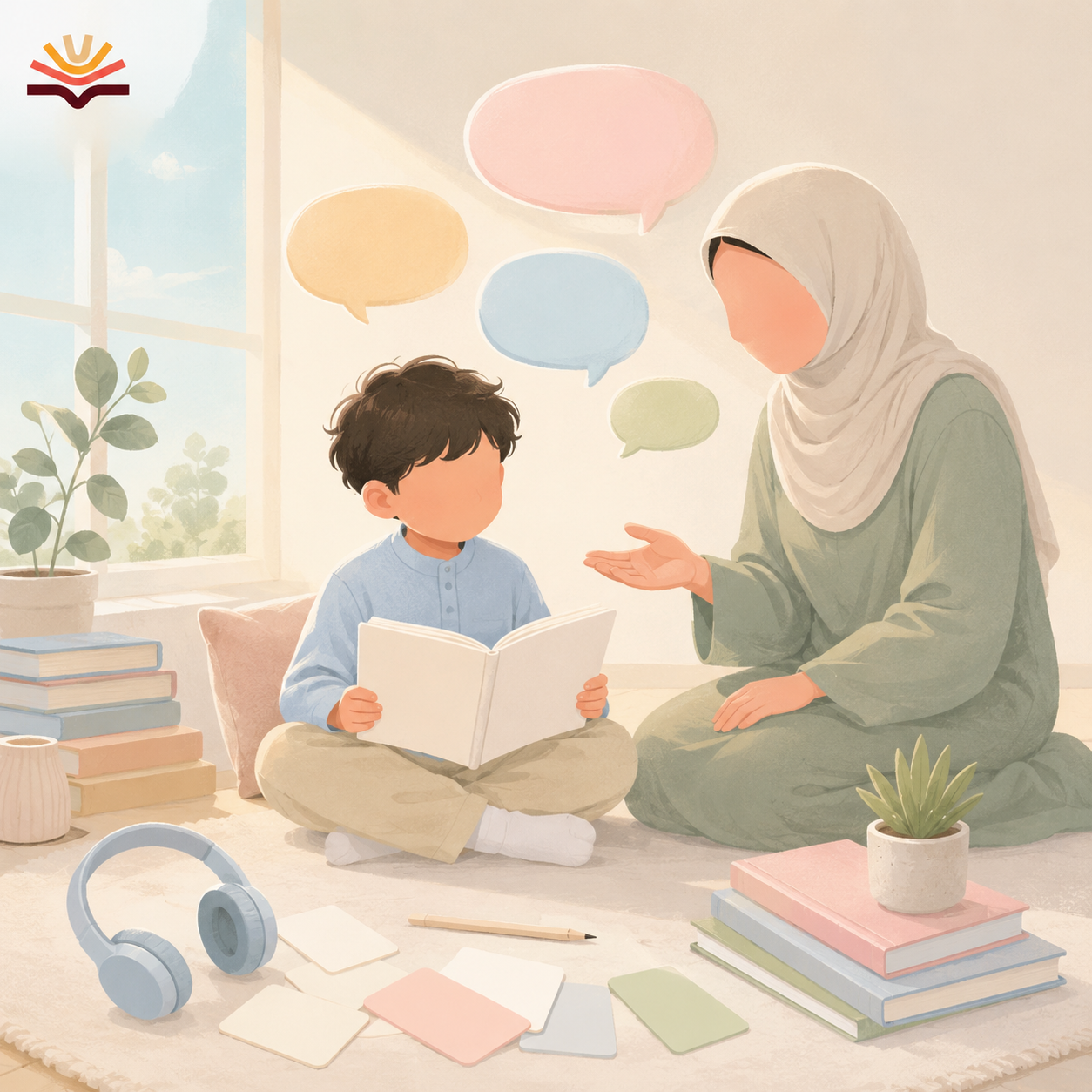
Child Can Read Arabic but Cannot Speak: 6 Helpful Steps
Your child may be able to read Arabic words with vowels. They may read from a book, recognize letters, and even read short Quran passages. But when you ask them to answer a simple Arabic question, describe a picture, or say a short sentence, they may become silent.
This does not mean your child failed. It usually means reading developed faster than speaking. Reading, listening, speaking, writing, vocabulary, and comprehension are connected, but they are not the same skill.
If your Child Can Read Arabic but Cannot Speak, the next step is not to start Arabic from zero. The next step is to build a bridge from reading into meaning, listening, sentence patterns, and gentle speaking practice.
This parent guide explains why this happens and how to help your child move from reading Arabic words to using Arabic in simple speech with confidence.

Quick answer: if your Child Can Read Arabic but Cannot Speak, they probably need more vocabulary, listening practice, sentence patterns, guided conversation, and meaningful Arabic use, not more reading only.
| Parent Question | Simple Answer |
|---|---|
| Why can my child read Arabic but not speak? | Because reading and speaking are different skills. Your child may decode words without enough vocabulary, listening, or sentence practice. |
| Does this mean my child should repeat Noor Al-Bayan? | Not always. If reading is stable, your child may need speaking and language development, not another full reading foundation. |
| Should I force my child to speak Arabic? | No. Use short, safe, repeated speaking moments so Arabic does not feel stressful. |
| What should come next? | Vocabulary, listening, simple sentence patterns, stories, guided conversation, and a structured Arabic language path. |
Table of Contents
- Why Your Child Can Read Arabic but Cannot Speak
- Reading Arabic vs Speaking Arabic
- Child Can Read Arabic but Cannot Speak: 6 Helpful Steps
- Simple Daily Speaking Routine
- Easy Arabic Sentence Patterns
- How to Help by Age
- Common Mistakes Parents Should Avoid
- How Sibghah Academy Supports Arabic Speaking
- FAQ
Why Your Child Can Read Arabic but Cannot Speak

If your Child Can Read Arabic but Cannot Speak, the first thing to understand is that this is normal. Many children learn to decode Arabic words before they can use Arabic as a living language.
This often happens when the child’s Arabic learning has focused mainly on letters, vowels, word reading, and Quran reading. These are important foundations, but they do not automatically create speaking ability.
A child may read the word “باب” correctly but may not know how to say “This is a door.” A child may read “أكل” correctly but may not know how to say “I ate” or “I want food.”
Speaking needs several skills working together:
- Understanding spoken Arabic.
- Knowing enough useful vocabulary.
- Recognizing sentence patterns.
- Feeling safe enough to try.
- Hearing Arabic often.
- Repeating short answers.
- Using Arabic in real situations.
So when a Child Can Read Arabic but Cannot Speak, the problem is usually not laziness. It is often a gap between reading practice and communication practice.
This is why Arabic learning after the reading foundation should include listening, speaking, reading, and writing. Parents can see this broader language-skills approach in Arabic learning programs such as At-Takallum Arabic Learning Series, Bayan Arabic, and Arabic at Our Children’s Hands.
If your child has recently completed Noor Al-Bayan, this guide may also help: After Noor Al-Bayan.
Not sure why your child reads Arabic but does not speak?
Sibghah Academy can help you understand whether your child needs vocabulary, listening, speaking practice, reading fluency, or a structured Arabic path.
Reading Arabic vs Speaking Arabic
To help a Child Can Read Arabic but Cannot Speak, parents need to understand the difference between reading and speaking.
Reading Arabic means the child can look at letters, vowel marks, words, or sentences and pronounce them. Speaking Arabic means the child can choose words, arrange them, and use them to communicate meaning.
These two skills can develop at different speeds. Some children can read very well but cannot speak. Other children can understand spoken Arabic but cannot read. Others can repeat phrases but cannot create new sentences.
| Skill | What It Means | Example |
|---|---|---|
| Reading | The child can decode written Arabic. | Reading “كِتاب” from a page. |
| Vocabulary | The child knows what words mean. | Knowing that “كِتاب” means book. |
| Listening | The child understands spoken Arabic. | Understanding “أين الكتاب؟” |
| Speaking | The child can use Arabic to answer or express meaning. | Saying “الكتاب على الطاولة.” |
| Writing | The child can write words or sentences. | Writing “هذا كتاب.” |
If your Child Can Read Arabic but Cannot Speak, they may need support in the middle steps: vocabulary, listening, and sentence building.
This is why simply asking your child to “speak Arabic” may not work. The child may not have enough ready words or sentence patterns to use.
Instead, parents should give children small speaking tools. A child needs repeated patterns such as “I want,” “This is,” “I like,” “I have,” “Where is,” and “I am.”
Child Can Read Arabic but Cannot Speak: 6 Helpful Steps

Here are six practical steps to help when your Child Can Read Arabic but Cannot Speak. These steps are gentle, realistic, and suitable for children who already have some Arabic reading foundation.
1. Check Whether Your Child Understands the Words They Read
The first step is to check meaning. Some children can read Arabic words without understanding them. This creates a gap between reading and speaking.
Start with simple words your child can read. Ask: “What does this mean?” If the child can read the word but cannot explain it, the next step is vocabulary.
Use common daily words first:
- Family words: mother, father, brother, sister.
- Home words: house, door, room, book, chair.
- Food words: water, milk, apple, bread, dates.
- Action words: eat, drink, read, write, play.
- Feeling words: happy, sad, tired, hungry.
When a Child Can Read Arabic but Cannot Speak, vocabulary is often the missing bridge. The child needs words they can understand and use, not only words they can pronounce.
You can start with this guide: Arabic Words for Kids.
2. Add Listening Before Speaking
Children usually need to hear a language before they can speak it confidently. If your Child Can Read Arabic but Cannot Speak, they may not be hearing enough simple Arabic in a way they can understand.
Listening practice does not need to be long. It can be short and repeated.
Try this:
- Choose one short Arabic sentence.
- Say it slowly.
- Let your child hear it several times.
- Show the meaning with an object, picture, or action.
- Ask your child to repeat only when ready.
For example, say “هذا كتاب” while pointing to a book. Then say it again. Then ask your child to repeat. Later, change the object: “هذا قلم” or “هذا باب.”
Arabic listening resources can support this stage. For example, Al Jazeera Learning Arabic presents Arabic learning content in an interactive way for learners. Parents should still choose content that matches the child’s age and level.
Listening helps the child hear how Arabic sentences sound. It also reduces the pressure of speaking immediately.
3. Teach Sentence Patterns, Not Only Single Words
Single words are useful, but speaking needs patterns. If your Child Can Read Arabic but Cannot Speak, they may know some words but not know how to put them together.
Instead of teaching random words, teach simple sentence frames:
| Arabic Pattern | English Meaning | Example |
|---|---|---|
| هذا… | This is… | هذا كتاب. |
| أُريد… | I want… | أُريد ماءً. |
| أُحِب… | I like… | أُحِب التفاح. |
| عِندي… | I have… | عِندي قلم. |
| أَنا… | I am… | أَنا سعيد. |
| أين…؟ | Where is…? | أين الكتاب؟ |
Do not teach too many patterns in one day. Choose one pattern and repeat it with different words.
For example, with “أُريد,” you can practise:
- أُريد ماءً.
- أُريد تفاحًا.
- أُريد كتابًا.
- أُريد قلمًا.
This helps the child feel that Arabic speaking is possible because they do not need to create a sentence from nothing.
4. Use Pictures, Objects, and Real Situations
When a Child Can Read Arabic but Cannot Speak, abstract speaking practice may feel too hard. Real objects and pictures make speaking easier.
Use things around the house:
- A book.
- A cup.
- A door.
- A chair.
- An apple.
- A bag.
- A pencil.
- A toy.
Point to an object and use one short sentence. For example:
- هذا كتاب.
- هذا باب.
- هذا قلم.
- هذا تفاح.
Then let your child answer with one word first. If you ask “ما هذا؟” the child can first answer “كتاب.” Later, they can answer “هذا كتاب.”
This step is important because speaking should not feel like a test. It should feel like using Arabic for something visible and simple.
5. Turn Reading into Speaking
If your child already reads Arabic, use that strength. A Child Can Read Arabic but Cannot Speak may benefit from turning reading into short spoken answers.
For example, after reading a short sentence, ask one simple question:
| Reading Sentence | Parent Question | Child Answer |
|---|---|---|
| هذا ولد. | Who is this? | ولد. |
| البنت سعيدة. | How does she feel? | سعيدة. |
| أحمد يقرأ. | What is Ahmed doing? | يقرأ. |
| الكتاب على الطاولة. | Where is the book? | على الطاولة. |
At first, accept short answers. Do not force full sentences immediately. A one-word answer can be the beginning of speaking confidence.
Stories are also helpful for this stage. Simple Arabic stories give children repeated words, meaning, and context. You can use: Arabic Stories for Kids with English Translation.
6. Use a Structured Arabic Language Path
When a Child Can Read Arabic but Cannot Speak, a structured Arabic language path can help connect all the skills together.
This is different from only teaching reading. A good language path should include:
- Listening.
- Speaking.
- Reading.
- Writing.
- Vocabulary.
- Simple grammar.
- Stories and conversations.
- Age-appropriate practice.
Educational Arabic programs for non-native speakers often emphasize the importance of combining language skills. For example, Arabic at Our Children’s Hands describes a four-skill approach that integrates listening, speaking, reading, and writing in communicative situations. Bayan Arabic also presents a child-focused Arabic series that includes the four skills and supporting materials.
At Sibghah Academy, the Takallam Series can support children who are ready to move from reading foundations into broader Arabic language development.
The official At-Takallum Arabic Learning Series presents the series as a comprehensive Arabic course for non-native speakers, which makes it relevant for children who need to grow beyond reading into fuller Arabic language skills.
Sibghah Teacher Note: if your child reads Arabic but does not speak, do not restart everything from the beginning. Build from what your child can already do, then add listening, vocabulary, and simple speaking step by step.
Simple Daily Speaking Routine
If your Child Can Read Arabic but Cannot Speak, a short daily routine can work better than one long weekly session.
Try this 10-minute routine:
| Time | Activity | Goal |
|---|---|---|
| 2 minutes | Review 3 old Arabic words. | Build memory. |
| 2 minutes | Listen to 2 short Arabic sentences. | Build understanding. |
| 2 minutes | Repeat one sentence pattern. | Build speaking confidence. |
| 2 minutes | Use the pattern with real objects. | Connect Arabic to life. |
| 2 minutes | Read one short sentence and answer one question. | Turn reading into speaking. |
This routine is short on purpose. Children who are shy or unsure about speaking Arabic may resist long practice. Short practice reduces pressure.
For example, choose the pattern “هذا…” and use it for one week:
- هذا كتاب.
- هذا قلم.
- هذا باب.
- هذا كرسي.
- هذا تفاح.
When the pattern becomes easy, move to another pattern such as “أُريد…” or “عِندي…”
This is how a Child Can Read Arabic but Cannot Speak begins to speak without feeling overwhelmed.
Want a simple Arabic speaking plan for your child?
Sibghah Academy can help your child move from reading Arabic words to using simple Arabic sentences through live one-to-one lessons.
Easy Arabic Sentence Patterns
When a Child Can Read Arabic but Cannot Speak, sentence patterns are very helpful because they give the child a ready structure.
Here are simple patterns parents can practise at home:
Pattern 1: This is…
| Arabic | English |
|---|---|
| هذا كتاب. | This is a book. |
| هذا قلم. | This is a pen. |
| هذا باب. | This is a door. |
| هذا كرسي. | This is a chair. |
Pattern 2: I want…
| Arabic | English |
|---|---|
| أُريد ماءً. | I want water. |
| أُريد حليبًا. | I want milk. |
| أُريد تفاحةً. | I want an apple. |
| أُريد كتابًا. | I want a book. |
Pattern 3: I like…
| Arabic | English |
|---|---|
| أُحِب القراءة. | I like reading. |
| أُحِب التفاح. | I like apples. |
| أُحِب اللعب. | I like playing. |
| أُحِب القرآن. | I love the Quran. |
Pattern 4: I am…
| Arabic | English |
|---|---|
| أنا سعيد. | I am happy. |
| أنا تعبان. | I am tired. |
| أنا جائع. | I am hungry. |
| أنا هادئ. | I am calm. |
Do not introduce all patterns at once. One pattern per week is enough for many children.
If your Child Can Read Arabic but Cannot Speak, the goal is not perfect grammar from day one. The goal is safe, simple, repeated speaking.
How to Help by Age
The way you help a Child Can Read Arabic but Cannot Speak should match the child’s age and confidence.
Ages 5–6
Use objects, repetition, pictures, and songs or rhythms. Keep speaking practice very short. One-word answers are acceptable at this age.
Example: point to a book and say “كتاب.” Then say “هذا كتاب.” Let your child repeat only if they are comfortable.
Ages 7–9
This age can usually handle short sentence patterns. Use daily objects and simple questions. Avoid long grammar explanations.
Example: “ما هذا؟” The child answers: “كتاب” or “هذا كتاب.”
Ages 10–12
Children at this stage can practise short conversations, simple descriptions, and story questions. They may be able to move from one-word answers to full sentences.
Example: “ماذا تحب؟” The child answers: “أحب القراءة” or “أحب التفاح.”
Ages 13–15
Older children may feel embarrassed if their speaking is weak. Keep the tone respectful. Let them practise useful topics such as daily routine, school, family, Quran, hobbies, and opinions.
At this age, a structured Arabic course can be very helpful because it gives them a clear path and reduces random practice.
How Stories Help Children Speak Arabic
Stories can help when a Child Can Read Arabic but Cannot Speak because they combine reading, listening, vocabulary, meaning, and discussion.
A simple story gives the child repeated words in context. Instead of memorizing isolated vocabulary, the child sees how words work together.
After reading or listening to a story, ask simple questions:
- Who is in the story?
- What did the child do?
- Where is the book?
- Is the character happy or sad?
- What did the character say?
Let your child answer with one word first. Then slowly build the answer.
| Stage | Child Answer |
|---|---|
| Stage 1 | ولد. |
| Stage 2 | هذا ولد. |
| Stage 3 | هذا ولد سعيد. |
| Stage 4 | الولد سعيد لأنه يلعب. |
This gradual approach helps a Child Can Read Arabic but Cannot Speak move toward real expression without pressure.
You can also use: Arabic Moral Stories for Kids.
What If Your Child Refuses to Speak Arabic?
Sometimes the issue is not only language skill. The child may feel shy, afraid of mistakes, bored, pressured, or embarrassed.
If your Child Can Read Arabic but Cannot Speak and also refuses to try, reduce the pressure first.
Try these steps:
- Accept one-word answers at the beginning.
- Do not laugh at pronunciation mistakes.
- Do not compare your child to siblings or cousins.
- Give choices: “Do you want to say this word or that word?”
- Use games instead of direct testing.
- Praise effort, not only correct answers.
A child who feels safe is more likely to speak. A child who feels judged may stay silent even if they know the answer.
If your child is resisting Arabic generally, read: My Child Refuses to Learn Arabic.
Common Mistakes Parents Should Avoid
Parents often try hard to help, but some methods can make speaking harder for a Child Can Read Arabic but Cannot Speak.
Only giving more reading practice
Reading is important, but more reading alone may not solve the speaking gap. The child also needs listening, vocabulary, and sentence use.
Asking open-ended questions too early
A question like “Tell me about your day in Arabic” may be too hard. Start with simple choices and short answers.
Correcting every mistake
If you correct every word, the child may stop speaking. Choose one correction at a time.
Using Arabic only as a test
If Arabic appears only when the parent is testing, the child may resist it. Use Arabic during normal life: food, toys, books, bedtime, and family routines.
Skipping listening
Children need to hear Arabic before they can speak naturally. Listening should come before and alongside speaking.
Expecting full sentences immediately
One-word answers are a start. Build gradually from word to phrase to sentence.
Comparing reading ability to speaking ability
A child who reads Arabic is not automatically ready to speak. Speaking needs separate practice.
How Sibghah Academy Supports Arabic Speaking
Sibghah Academy offers live online Quran, Arabic, and Islamic Studies lessons for Muslim children aged 5–15.
When a Child Can Read Arabic but Cannot Speak, Sibghah Academy helps parents identify the missing step. Some children need vocabulary. Some need listening. Some need confidence. Some need sentence patterns. Others need a structured Arabic course after reading foundations.
For children who have completed Noor Al-Bayan or can already read Arabic words, the Takallam Series can help move learning toward broader Arabic language skills.
In one-to-one lessons, the teacher can adapt the lesson to the child’s level. A shy child may begin with repetition and one-word answers. A stronger child may practise short conversations, story questions, sentence building, and simple writing.
This is especially helpful for Muslim children in the UK who may not hear Arabic enough during the day. A structured online lesson gives them a regular Arabic-speaking space with teacher guidance.
The aim is not to pressure children into perfect Arabic speech immediately. The aim is to help them use Arabic step by step with understanding, confidence, and consistency.
Quick Parent Checklist
Use this checklist if your Child Can Read Arabic but Cannot Speak:
- Can my child understand the words they read?
- Does my child hear simple Arabic regularly?
- Can my child answer with one Arabic word?
- Does my child know simple sentence patterns?
- Do we practise speaking with real objects?
- Do we use stories to ask simple questions?
- Am I correcting gently, not constantly?
- Does my child feel safe trying Arabic?
- Would my child benefit from the Takallam Series?
FAQ: Child Can Read Arabic but Cannot Speak
1. Why can my Child Can Read Arabic but Cannot Speak?
If your Child Can Read Arabic but Cannot Speak, it usually means reading developed before listening, vocabulary, sentence building, and speaking confidence.
2. Is it normal if my child reads Arabic but cannot speak?
Yes, it is common. Reading and speaking are different skills, and many children need separate speaking practice after learning to read.
3. Should my child repeat Noor Al-Bayan?
Not always. If your child reads Arabic well, they may need vocabulary, listening, and speaking practice rather than repeating the full reading foundation.
4. How can I help my child speak Arabic at home?
Use simple words, short sentence patterns, daily objects, listening practice, and one-word answers before expecting full sentences.
5. What Arabic words should my child learn first?
Start with family, home, food, school, feelings, actions, and Islamic daily words because they are useful in real life.
6. How do I turn Arabic reading into speaking?
After your child reads a short sentence, ask one simple question and accept short answers. Gradually build from word to phrase to sentence.
7. Should I correct my child’s Arabic speaking mistakes?
Yes, but gently. Correct one point at a time so your child does not become afraid to speak.
8. What if my child understands Arabic but answers in English?
This can happen when English feels easier. Give your child a short Arabic answer to repeat, then practise the same pattern several times.
9. Can stories help my child speak Arabic?
Yes. Stories help children connect reading, meaning, vocabulary, listening, and speaking through context.
10. How long should Arabic speaking practice be?
Short daily practice is best. Even 10 minutes can help if it includes listening, vocabulary, and one simple speaking pattern.
11. Is Takallam suitable if my child can read Arabic but cannot speak?
Takallam can be suitable if your child has basic reading skills and is ready to build vocabulary, listening, speaking, reading, and writing.
12. What if my child refuses to speak Arabic?
Reduce pressure, accept short answers, use games and objects, and avoid comparing or laughing at mistakes.
13. Can online Arabic lessons help speaking?
Yes, live online lessons can help when the teacher gives the child guided speaking practice, repetition, questions, and confidence-building activities.
14. What is the first step if my Child Can Read Arabic but Cannot Speak?
The first step is checking whether your child understands the words they read. Then add vocabulary, listening, and simple sentence patterns.
15. Can Sibghah Academy help if my Child Can Read Arabic but Cannot Speak?
Yes. Sibghah Academy can help your child move from Arabic reading into vocabulary, listening, sentence building, and guided Arabic speaking through live one-to-one lessons.
16. What is the long-term goal for Arabic speaking?
The long-term goal is for your child to understand and use Arabic gradually in reading, speaking, listening, writing, Quran learning, and daily Islamic identity.
Book your child’s free Arabic speaking trial on WhatsApp
If your Child Can Read Arabic but Cannot Speak, the right next step can help them build vocabulary, listening, sentence patterns, and confidence.
Send Sibghah Academy a WhatsApp message with your child’s age, Arabic level, and main goal, and we will help you choose the right Arabic path.