These situations are different, and they do not all require the same starting point.
The encouraging news is that children do not need to speak Arabic fluently before beginning Quran learning. Reading Arabic script, reciting Quran, applying Tajweed, memorising passages and understanding Quranic meanings are related skills, but they are not identical.
For families in Britain, the right approach is to identify the child’s current ability and build a suitable path rather than expecting every beginner to complete the same lessons at the same speed.
This guide explains Quran lessons for kids who don’t speak Arabic through seven practical steps, with examples for different learning levels, home practice ideas and questions to ask before choosing an online Quran teacher.
Quick answer: Yes, your child can start learning Quran without speaking Arabic. Complete beginners may need Arabic letters and reading foundations, while children who can already listen, repeat or read may begin suitable recitation, Tajweed, memorisation or revision. Arabic reading and Quran learning can develop alongside one another. The best starting point depends on your child’s actual skills, age, confidence and learning goals.
Table of Contents
- Does a Child Need to Speak Arabic to Learn Quran?
- Quran Lessons for Kids Who Don’t Speak Arabic: 7 Easy Steps
- Three Different Starting Points for Children
- How Parents Can Support Quran Learning at Home
- Common Mistakes Parents Should Avoid
- How Sibghah Academy Helps Children Who Don’t Speak Arabic
- Parent Checklist
- Frequently Asked Questions
Does a Child Need to Speak Arabic to Learn Quran?
No. Conversational Arabic fluency is not a requirement for beginning Quran learning.
Parents sometimes use the phrase “my child doesn’t know Arabic” to describe several different learning needs.
One child may have no experience of Arabic letters. Another may recognise letters but struggle to join them into words. A third may memorise Quran through listening while finding written Arabic difficult. Another child may read Quranic text confidently but be unable to explain its meaning in English.
All four children can begin or continue Quran learning, but their teachers may need to focus on different skills.
It helps to separate five areas:
- Arabic language: understanding and speaking Arabic in everyday communication.
- Arabic reading: recognising written letters, vowels and words.
- Quran recitation: reading or repeating Quranic passages accurately.
- Tajweed: developing correct pronunciation and applying the relevant recitation rules.
- Hifz and understanding: memorising and retaining passages while gradually learning age-appropriate meanings.
A child does not have to master all these areas at the same time. A learner with strong listening skills might begin suitable memorisation while developing reading foundations. A confident reader may focus more on Tajweed and fluency, even if they do not speak conversational Arabic.
This is why two children of the same age may need completely different starting points.
| Child’s Current Ability | Possible Quran Learning Focus |
|---|---|
| Does not recognise Arabic letters | Letter sounds, listening and beginner reading foundations. |
| Recognises letters but cannot read words | Short vowels, joined letters, blending and guided reading. |
| Can repeat short surahs but cannot read them | Teacher-led recitation, suitable Hifz, revision and parallel reading practice. |
| Can read Arabic but does not understand it | Reading fluency, pronunciation, Tajweed and simple explanations of meaning. |
| Has memorised Quran but forgets previous surahs | Structured revision, listening checks and correction. |
The important question is not simply whether your child speaks Arabic. It is which Quran-related skills they already have and which skill would help them progress next.
Quran Lessons for Kids Who Don’t Speak Arabic: 7 Easy Steps
These seven steps provide a practical way to choose a learning path for a child who mainly speaks English. They are not a rigid timetable. Some children will need more time on reading foundations, while others may already be ready for recitation, memorisation or Tajweed.
1. Check Your Child’s Real Quran Starting Point
Before choosing a book, course or memorisation target, begin by understanding what your child can currently do.
For example, a nine-year-old who has memorised several surahs through listening is not necessarily a complete Quran beginner. Their memorisation experience matters, even if they cannot read Arabic independently.
Likewise, a child who recognises all the Arabic letters may still need help with short vowels, joined letters and blending.
A simple starting check can explore:
- Can the child recognise any Arabic letters?
- Can they connect familiar letters with the correct sounds?
- Can they read letters with short vowels?
- Can they join sounds into simple words?
- Can they repeat a short passage after listening?
- Do they already know any surahs?
- Can they recite memorised passages accurately?
- Do they feel comfortable trying unfamiliar Arabic sounds?
These questions are not a formal examination. They help identify the learner’s strengths and needs.
During Quran lessons for kids who don’t speak Arabic, a good teacher should avoid treating weak Arabic conversation skills as proof that the child has no Quran knowledge.
The most useful outcome of the starting check is a clear recommendation: what should the child practise first, and what can they continue learning alongside it?
2. Build Arabic Letter and Sound Foundations
If your child cannot read Arabic script, reading foundations may be an important part of their Quran learning path.
Arabic letters are different from English letters. They are written from right to left, may change shape depending on their position and include sounds that are less familiar to children who mainly hear English.
A complete beginner may need to practise:
- Recognising Arabic letters.
- Connecting each letter with its sound.
- Distinguishing between similar-looking letters.
- Learning short vowels: Fatha, Kasra and Damma.
- Recognising letters when they are joined together.
- Blending sounds into short words.
- Developing confidence before moving to longer passages.
These skills should be introduced gradually. A child who knows the alphabet song may still need substantial help recognising letters inside words.
The aim is to make unfamiliar Arabic script feel manageable, not overwhelming.

How Noor Al-Bayan Can Help
One structured way of developing these foundations is Noor Al-Bayan.
At Sibghah Academy, the Noor Al-Bayan Course for Kids helps beginners work through Arabic letters, short vowels, long vowels, Tanween, Sukoon, Shaddah and increasingly fluent reading.
The course is intended to support reading development, including skills useful for Quran reading.
However, this does not mean your child must finish Noor Al-Bayan before taking part in every Quran activity. Depending on their ability, a child may develop reading foundations while also listening to Quran, practising pronunciation or memorising suitable short passages.
If you want a more detailed explanation of the reading pathway, our Learn to Read the Quran guide</a explains how beginners progress towards greater reading independence.
3. Introduce Listening and Suitable Quran Memorisation
Some children can memorise short Quranic passages through listening before they become independent Arabic readers.
This is an important distinction for parents searching for Quran lessons for kids who don’t speak Arabic.
Imagine a child who hears Al-Fatihah regularly at home. They may repeat much of the surah accurately from memory, even though they cannot recognise those same words in written form.
That is a real listening and memorisation skill. It does not automatically mean the child can read Quran, but it can provide a useful foundation for teacher-led practice.

What a Gentle Memorisation Lesson Might Include
- Listen: The teacher recites a short, suitable passage clearly.
- Repeat: The child repeats a manageable part after the teacher.
- Correct: The teacher helps improve unclear pronunciation.
- Connect: The child begins noticing familiar words or sounds where appropriate.
- Recall: The child attempts the passage with less prompting.
- Revise: Previously learned material is revisited before adding too much new memorisation.
The size of each memorisation portion should suit the child’s ability. One child may benefit from a single short verse, while another may already be ready for a longer section.
Importantly, memorisation should not become a race to complete surahs. Pronunciation, revision and confidence need attention too.
A teacher may sometimes recommend strengthening reading foundations before increasing Hifz targets. In other cases, the child may continue a small memorisation routine while reading develops separately.
Parents should also remember that memorisation and understanding are different. Short explanations of familiar passages can help children connect emotionally and intellectually with what they recite.
4. Practise Pronunciation and Tajweed Step by Step
Can a child learn Tajweed even if they do not speak Arabic?
Yes. Conversational Arabic and accurate Quranic pronunciation are different learning goals.
Tajweed involves pronouncing Quranic letters correctly and applying the relevant rules during recitation. Children can begin developing these skills through careful listening, teacher modelling, repetition and correction.
For example, a teacher may notice that a child:
- Confuses two similar Arabic sounds.
- Uses an English pronunciation habit for an Arabic letter.
- Lengthens a sound that should be short.
- Shortens a sound that needs to be extended.
- Rushes through a familiar passage.
- Repeats an incorrect pronunciation learned earlier.
In a live lesson, the teacher can demonstrate the correct sound, allow another attempt and return to that same difficulty later.
This is particularly helpful when a child is learning remotely. Listening to a recording may introduce a correct model, but a recording cannot tell an individual child exactly which sound they are producing incorrectly.
Should Beginners Study Advanced Tajweed Rules?
Correct pronunciation should be encouraged from the beginning, but advanced terminology does not need to overwhelm a child who is still learning basic letters and vowels.
A beginner may focus on listening and imitation first. As reading improves, the teacher can introduce more explicit Tajweed rules at a suitable level.
The goal is accurate recitation and steady improvement, not memorising difficult technical definitions before the child is ready.
For families considering online Quran learning, it is worth asking how the teacher corrects pronunciation and how those corrections are reviewed over time.
5. Explain Quranic Meanings in a Language Your Child Understands
A child can begin reciting Quran without speaking Arabic, but understanding should not be ignored.
For many UK families, English is the child’s strongest language. Simple explanations in English can help them understand why a surah matters and what they are learning from it.
For example, when a child learns Al-Fatihah, a teacher might explain that the surah teaches praise of Allah, reliance on Him and the request for guidance.
The explanation should match the child’s age.
A six-year-old may benefit from a short discussion about asking Allah for help. An older child may be ready to explore more of the meanings and connect them to everyday decisions.
Parents can also explore the text and translations of Surah Al-Fatihah on Quran.com alongside suitable teacher guidance.
What If My Child Wants to Understand Quranic Arabic?
This is a valuable longer-term goal.
Understanding Quranic Arabic involves learning vocabulary and, gradually, how Arabic words and sentences work. It is not the same as reading Quran aloud accurately.
A child may therefore benefit from two connected pathways:
- Quran learning: reading, recitation, Tajweed, Hifz and revision.
- Arabic language learning: vocabulary, listening, reading comprehension and broader language understanding.
At Sibghah Academy, families can explore Arabic lessons for kids when they want to build language understanding alongside Quran study.
The important thing is not to make children feel that learning Quran is meaningless until they can translate every word. They can begin recitation and gradually develop deeper understanding.
6. Create a Calm Routine and Measure Small Improvements
One of the most common problems in children’s Quran learning is inconsistency.
A child may attend a good lesson but forget important sounds or memorised passages if they rarely practise between sessions.
On the other hand, an intense routine that leaves a child exhausted may create resistance.
A realistic schedule should consider the child’s age, school commitments, attention span and learning level.
A Simple Weekly Approach
For a beginner, the routine might combine live teaching with short home practice. The exact number of lessons and minutes should be agreed with the teacher.
| Activity | Possible Purpose |
|---|---|
| Live one-to-one lesson | Introduce skills, listen carefully and correct mistakes. |
| Short reading review | Strengthen familiar letters, vowels or words. |
| Listening practice | Develop familiarity with correct Quranic sounds. |
| Memorisation revision | Retain previously learned passages. |
| Simple meaning discussion | Help the child connect Quran learning with understanding. |
| Parent feedback | Identify what improved and what needs attention next. |
Not every activity needs to happen every day. A complete beginner may spend more time on letters, while a child working on Hifz may need more revision.
How to Recognise Progress
When evaluating Quran lessons for kids who don’t speak Arabic, parents should look beyond the number of completed pages or memorised verses.
Progress may mean that the child:
- Recognises more Arabic letters independently.
- Repeats difficult sounds more accurately.
- Reads short words with less hesitation.
- Remembers a pronunciation correction from an earlier lesson.
- Recites a previously memorised passage with fewer prompts.
- Can explain the simple meaning of a familiar surah.
- Feels increasingly comfortable participating in lessons.
A helpful question is: What can my child do now that they could not do several weeks ago?
The answer often gives a clearer picture of real progress than comparing the child with another student.
7. Choose a Teacher Who Can Adapt Quran Lessons to Your Child
For a child who does not speak Arabic, the teacher’s approach matters as much as the choice of learning material.
A teacher needs to communicate clearly, listen closely and recognise that different skills develop at different rates.
When comparing Quran teachers or online programmes, parents can ask:
- Can you teach a child whose main language is English?
- How will you check my child’s current Quran level?
- Will reading foundations and Quran learning be balanced according to need?
- Can my child begin suitable memorisation before fluent reading?
- How do you correct pronunciation during a live lesson?
- How much revision is included?
- Will the child learn simple meanings at an appropriate level?
- How will I know whether my child is improving?
- What safeguarding and parent-communication arrangements are in place?
Parents should also pay attention to how the teacher responds when the child makes a mistake.
A patient teacher can demonstrate the correct pronunciation and encourage another attempt. A child who feels embarrassed or repeatedly criticised may become reluctant to recite.
One-to-one teaching can be especially helpful because the teacher has more opportunity to hear the individual child’s reading or repetition and adapt the lesson immediately.
However, one-to-one learning is not automatically effective simply because the lesson is private. The teaching still needs to be structured, child-friendly and focused on genuine progress.
Three Different Starting Points for Non-Arabic-Speaking Children
The following examples show why Quran lessons for kids who don’t speak Arabic should be matched to the learner rather than delivered as one identical course.
Example 1: A Six-Year-Old Who Has Never Learned Arabic Letters
This child speaks English at home and has never attended an Arabic reading class.
They enjoy listening to Quran but cannot recognise most Arabic letters.
A suitable starting path may focus on letters, sounds and short vowels, supported by simple listening and repetition activities.
The first important milestone may be recognising familiar letters independently, not reading a full surah from the Mushaf.
As confidence grows, the teacher can introduce joined letters, simple word reading and other appropriate Quran activities.
Example 2: An Eight-Year-Old Who Knows Short Surahs by Heart
This child regularly hears Quran at home and can repeat several short surahs. However, they cannot read the Arabic text independently.
A teacher may discover that the child has good listening and memory skills but needs pronunciation correction and reading development.
The plan may therefore combine revision of existing memorisation with a structured beginner reading course.
The family does not need to ignore the child’s memorisation skills, nor assume that memorising several surahs means independent Quran reading has already developed.
Example 3: A Twelve-Year-Old Who Reads Quran but Does Not Understand Arabic
This child has previously learned Arabic letters and can read Quranic text, although some words are difficult.
They speak English confidently but cannot explain most of the Arabic words they read.
Their Quran lessons may focus on fluency, pronunciation, practical Tajweed and revision.
At the same time, the teacher may introduce the meanings of familiar verses. A separate Arabic language programme could support vocabulary and comprehension if that is part of the family’s goal.
The child does not need to restart at the alphabet simply because their conversational Arabic is limited.
How Parents Can Support Quran Learning at Home Without Speaking Arabic
Some parents feel uncomfortable helping with Quran learning because they do not speak Arabic fluently themselves.
But a parent does not need to become the child’s Quran teacher.
The most useful support often comes from providing a calm routine, encouraging effort and helping the child follow the teacher’s recommendations.
A Simple Ten-Minute Home Practice Example
| Time | Activity |
|---|---|
| 2 minutes | Ask your child what they learned in their previous lesson. |
| 3 minutes | Listen to a teacher-approved Quran recitation or sound practice. |
| 3 minutes | Practise the assigned letters, words or short passage. |
| 2 minutes | Praise effort and note one question for the teacher. |
This is an example, not a fixed requirement. Some children need shorter sessions, and some learning goals require a different balance.
Parents should avoid correcting unfamiliar Arabic sounds through guesswork. If you are unsure whether your child has pronounced a word correctly, ask the teacher or use the learning materials they recommend.
Three Questions to Ask After Each Lesson
- What did my child practise today? This identifies the current learning goal.
- What should we revise at home? This avoids introducing too many new activities.
- What improvement should we look for next? This gives parents a realistic way to notice progress.
When parents and teachers communicate clearly, home practice becomes more manageable even in families where English is the main language.
Common Mistakes Parents Should Avoid
1. Waiting for Arabic Fluency Before Starting Quran
Children do not need to become conversational Arabic speakers before starting suitable Quran learning. Reading, listening and recitation can develop according to the child’s current ability.
2. Expecting Complete Beginners to Read Long Passages
A child who does not recognise Arabic letters may need structured reading foundations. Difficult material introduced too early can lead to guessing and frustration.
3. Memorising Without Enough Revision
New memorisation is only part of Hifz. Children also need to revisit previously learned passages and strengthen retention.
4. Depending Only on English Transliteration
Transliteration may sometimes be used as temporary support, but it does not represent every Arabic sound precisely and should not replace accurate teacher guidance and development of Arabic reading skills.
5. Teaching Too Many Tajweed Rules at Once
Beginners benefit from correct sound modelling and gradual correction. Detailed terminology can be introduced when it supports, rather than overwhelms, the child’s learning.
6. Measuring Success Only by Pages Completed
Stronger pronunciation, greater independence, improved revision and growing confidence are meaningful outcomes too.
7. Comparing Children with One Another
Children have different learning histories, strengths and needs. The most useful comparison is between the child’s current ability and their own earlier starting point.
How Sibghah Academy Helps Children Who Don’t Speak Arabic

Sibghah Academy provides live online one-to-one Quran, Arabic and Islamic Studies lessons for Muslim children aged 5–15, including families living in the UK.
For parents seeking Quran lessons for kids who don’t speak Arabic, the focus is on understanding the child’s current level before choosing an appropriate learning direction.
Depending on the learner’s ability, the Quran pathway may include:
- Arabic reading foundations.
- Quran reading and fluency.
- Correct pronunciation and Tajweed.
- Teacher-led Hifz.
- Revision of previously memorised passages.
- Age-appropriate explanations and encouragement.
At Sibghah, children can develop Arabic reading and Quran skills alongside one another when that approach suits their needs.
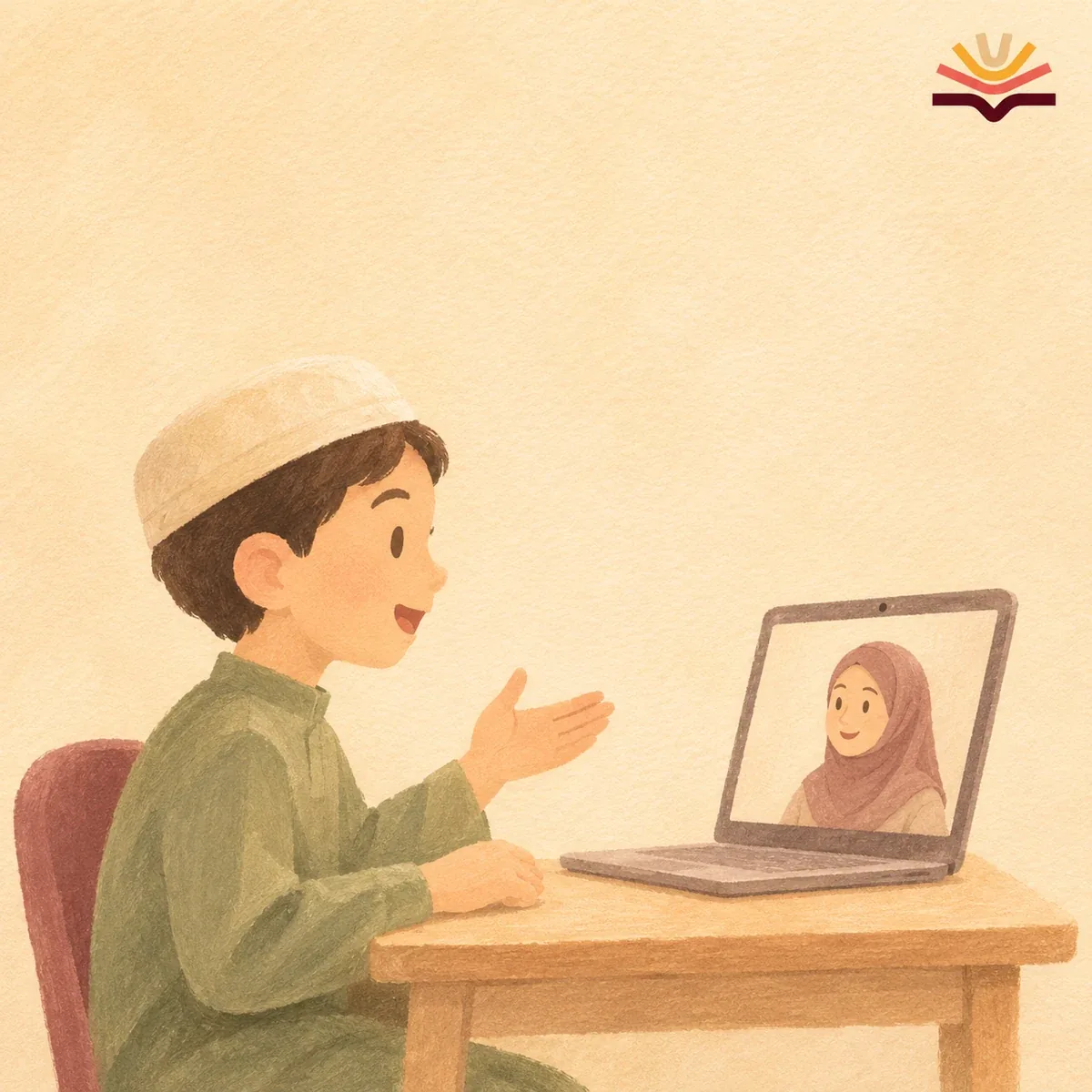
Live individual lessons give the teacher time to listen, correct mistakes, repeat difficult points and adjust the pace. English-supported explanations help children follow instructions even if Arabic is not their home language.
Parents can explore the available paths on our Online Quran Classes for Kids UK page.
What Should Happen During a Free Quran Trial?
A trial session can help identify whether your child needs beginner Arabic reading, Quran fluency, pronunciation correction, Tajweed, memorisation or revision.
The teacher may check letter recognition, reading ability, listening and repetition, previous memorisation and confidence. Not every child needs every skill assessed in the same way.
The goal is to recommend a useful starting point and give the family an opportunity to experience the teaching approach.
For more detail, see our Quran Trial Lesson UK: 9 Helpful Things Parents Should Expect guide.
Sibghah Teacher Note: When a child does not speak Arabic, the first question should not be how much Arabic they know in conversation. We need to understand how they listen, recognise sounds, read, recite and remember. One child may need letter foundations, while another may already be ready for Hifz or Tajweed. A good learning plan begins with those real differences.
Not Sure Where Your Child Should Start Quran?
Your child does not need to speak Arabic fluently before beginning Quran learning. Tell us about their age, current reading ability and Quran goals, and Sibghah Academy can help you explore an appropriate starting path.
Parent Checklist: Is Your Child Ready to Begin Quran Lessons?
Use this checklist when exploring Quran lessons for kids who don’t speak Arabic:
- I know whether my child recognises Arabic letters.
- I understand whether my child can read Arabic words independently.
- I know which short surahs my child has already memorised.
- I have considered whether pronunciation needs correction.
- I understand the difference between reading, recitation and memorisation.
- I know whether my child needs reading foundations such as Noor Al-Bayan.
- I want my child to learn suitable meanings as well as recitation.
- I have chosen a realistic practice routine.
- I know how the teacher will communicate progress.
- My child can make mistakes without feeling embarrassed.
- I understand the recommended next learning step.
- I know how to arrange a trial lesson before making a longer commitment.
You do not need every answer before speaking to a teacher. A useful trial can help clarify the areas you are unsure about.
Frequently Asked Questions About Quran Lessons for Kids Who Don’t Speak Arabic
Can my child learn Quran if we only speak English at home?
Yes. Your child can begin Quran learning while English remains their strongest language. A teacher can explain instructions in English while helping them develop Arabic reading, recitation, pronunciation and memorisation skills.
Does my child need to learn Arabic before starting Quran?
No. Conversational Arabic is not a prerequisite for Quran learning. Some children need Arabic reading foundations, but reading and suitable Quran activities can develop alongside one another.
Can children memorise Quran if they cannot read Arabic?
Some children can begin suitable memorisation through careful listening and repetition. A teacher should check pronunciation, support retention through revision and help the child develop reading skills according to their needs.
What is the difference between Noor Al-Bayan and Quran lessons?
Noor Al-Bayan is a reading-foundation pathway focused on Arabic letters, sounds, vowels and reading patterns. Quran lessons may focus on Quran reading, recitation, Tajweed, Hifz or revision. The two can complement each other.
Can a child learn Tajweed without understanding Arabic?
Yes. Tajweed concerns accurate pronunciation and recitation rules. These can be taught through listening, modelling and guided practice, even while the child is still developing Arabic comprehension.
Should Quran reading come before memorisation?
Not always. The right sequence depends on the child. Some beginners may work primarily on reading foundations, while others can begin suitable listening-based memorisation alongside reading development.
Are online Quran lessons suitable for non-Arabic-speaking children?
They can be, particularly when teaching is live, interactive, age-appropriate and delivered in a language the child understands. A teacher should adapt the lesson to the child’s reading and recitation ability rather than assuming a fixed starting level.
How often should my child have Quran lessons?
There is no single schedule that suits every child. The right frequency depends on age, learning goals, attention span, previous experience and opportunities for practice. Consistency and manageable revision are important.
How can I help if I cannot correct Arabic pronunciation?
Support your child’s routine, encourage practice and use teacher-approved listening materials. If you are uncertain about a sound, ask the teacher rather than trying to correct it from guesswork.
How long does it take a child to read Quran independently?
The timeline varies. Progress depends on the child’s starting level, Arabic exposure, teaching, practice and retention. Look for stronger letter recognition, more accurate reading, remembered corrections and growing independence rather than relying on a fixed number of weeks.
Can my child learn the meanings of Quran while memorising?
Yes. Teachers can introduce age-appropriate meanings and simple vocabulary alongside recitation or memorisation. Deeper Arabic language study can also be added according to the family’s goals.
Does Sibghah Academy offer Quran lessons for kids who don’t speak Arabic?
Yes. Sibghah Academy provides live one-to-one Quran lessons for Muslim children aged 5–15, including children whose main language is English. A free trial can help identify whether the most suitable starting point is reading foundations, recitation, Tajweed, memorisation or revision.
Final Thoughts: A Gentle Start Can Build Lasting Quran Confidence
Choosing Quran lessons for kids who don’t speak Arabic does not mean your child needs to overcome every language difficulty before they can begin.
What matters is understanding the difference between Arabic conversation, Arabic reading, Quran recitation, Tajweed, memorisation and understanding meanings.
One child may begin with letters and vowels. Another may benefit from listening and suitable Hifz. A child who already reads Quran might need pronunciation correction, revision or help understanding familiar verses.
There is no reason to force every child into the same starting point.
With structured teaching, patient correction, manageable home practice and realistic expectations, children can develop Quran skills while gradually becoming more confident with Arabic.
If you are unsure where your child should begin, explore Sibghah Academy’s Quran learning paths for kids in the UK or arrange a free trial to discuss their current level and next step.