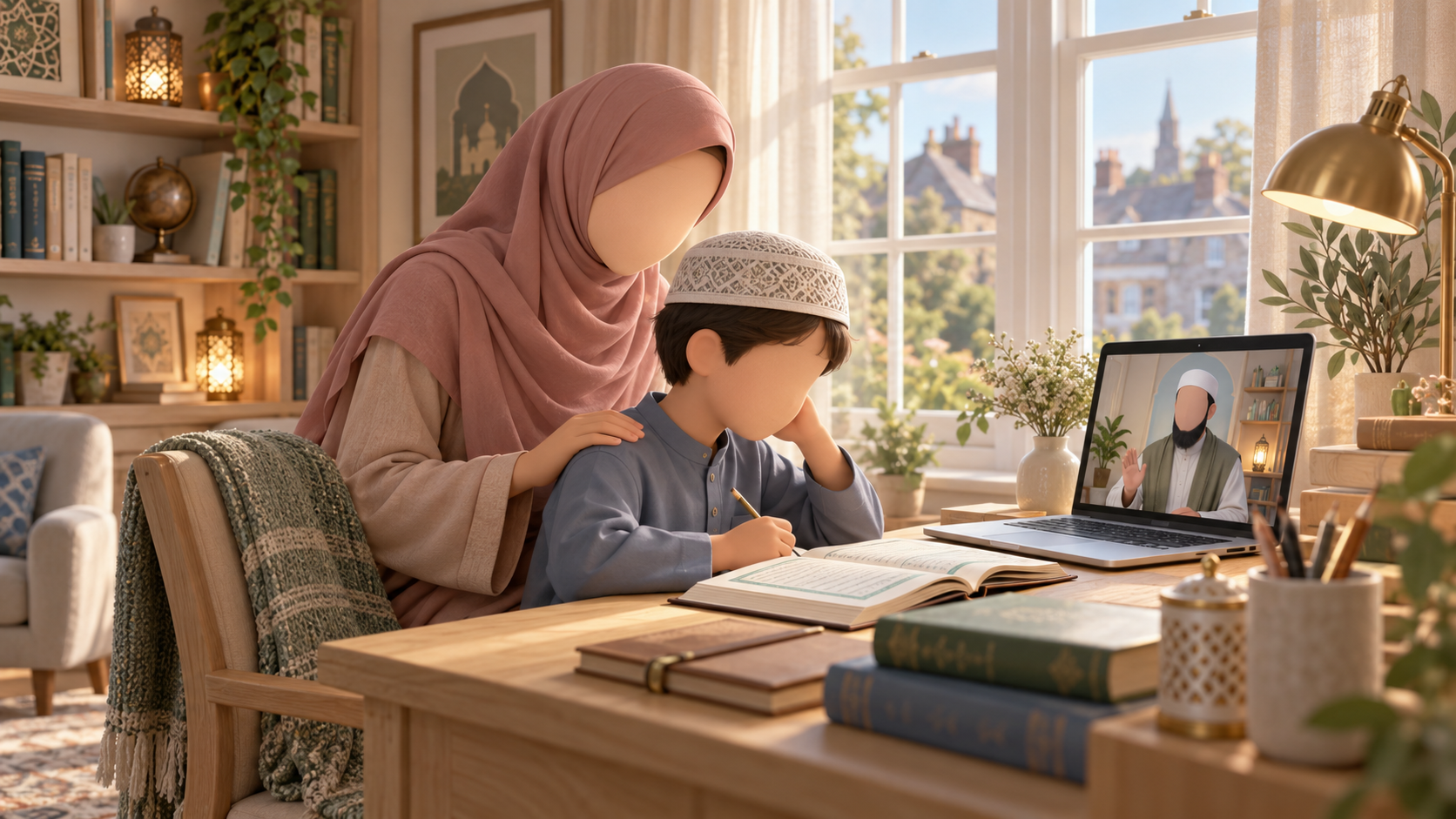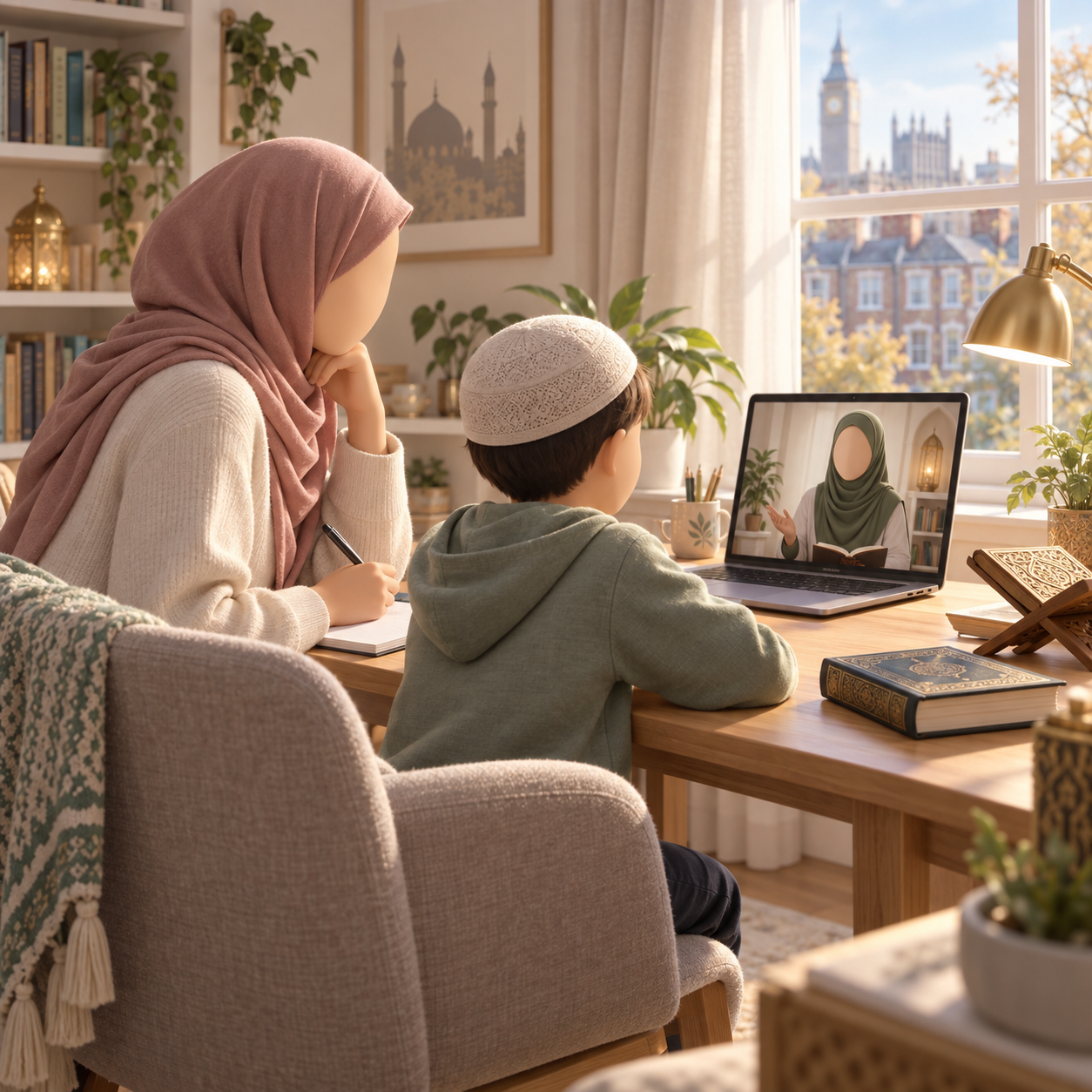
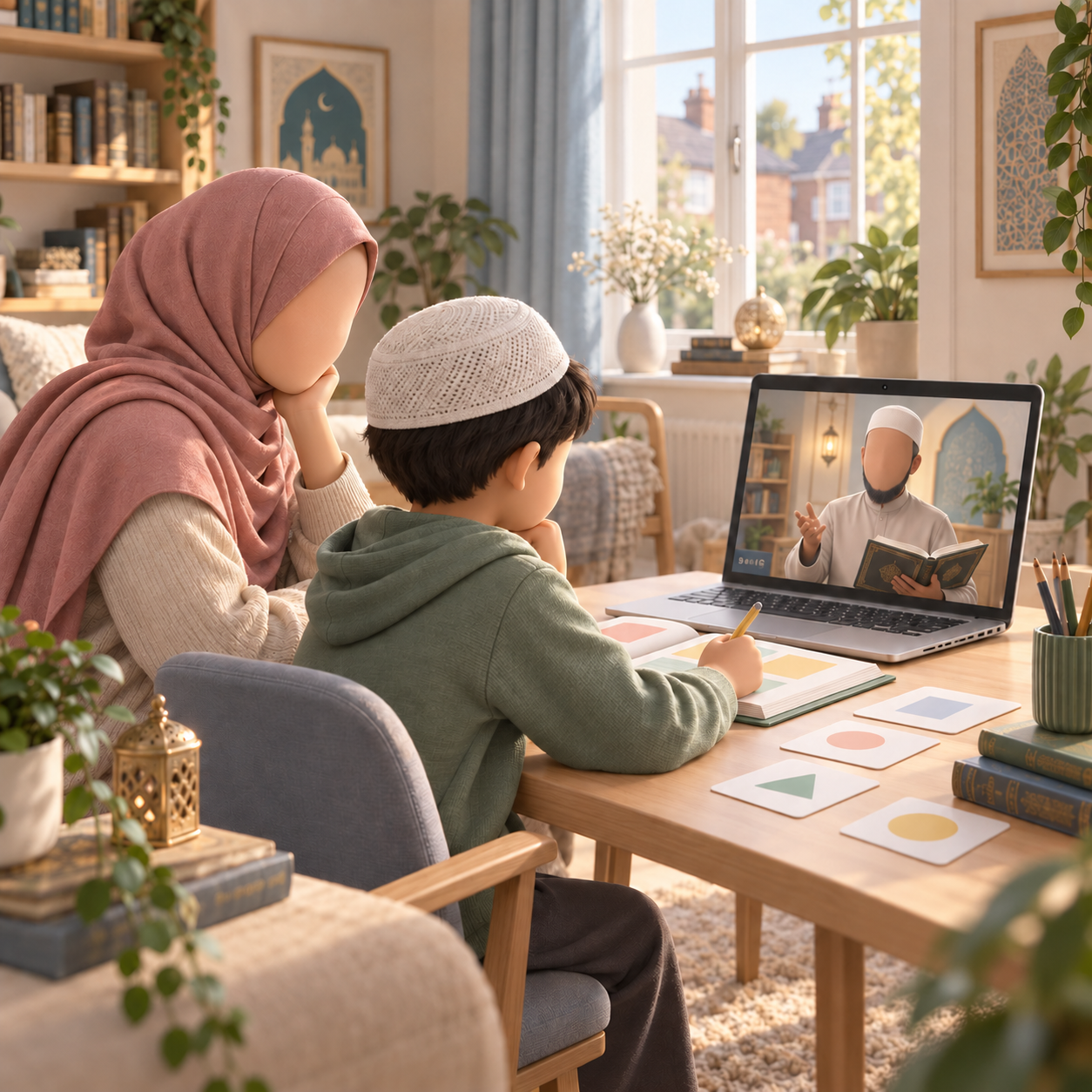

If you want to help your child learn to read the Quran, begin with the reading foundations rather than long pages or advanced Tajweed terminology. Most beginners first need secure Arabic letter sounds, short vowels, joined letters, simple word reading, and enough guided practice to read increasingly independently.
Children do not all learn to read the Quran at the same pace. One child may already recognise Arabic letters but struggle to blend them into words. Another may memorise short surahs by listening but still be unable to read those words independently. A third may read accurately but need help with fluency and pronunciation.
Quick answer: the most useful path to learn to read the Quran is usually: letter sounds → short vowels → joined letters → blending → common reading patterns → short Quranic words and phrases → accurate reading → fluency → gradual pronunciation and practical Tajweed. The exact starting point should depend on the child’s current level.
A Simple Quran Reading Roadmap for Children
Parents sometimes imagine that Quran reading begins by opening the Mushaf and asking a beginner to copy the teacher. For some children, especially those who already read Arabic, that may be appropriate. For a complete beginner, however, the journey usually starts earlier.
A practical progression can look like this:
| Stage | Main Skill | What Progress May Look Like |
|---|---|---|
| Foundation | Arabic letters and sounds | The child recognises target letters and connects them with their sounds. |
| Early reading | Short vowels | The child reads simple sound combinations without guessing. |
| Word building | Joined letters and blending | The child begins decoding short unfamiliar words. |
| Developing reading | Long vowels, Tanween, Sukoon and Shaddah | The child handles more complex reading patterns. |
| Quran readiness | Short Quranic words and phrases | The child transfers reading skills into Quranic text with support. |
| Growing independence | Accuracy, fluency and pronunciation | The child needs fewer prompts and remembers previous corrections. |
| Developing recitation | Practical Tajweed | The child applies age-appropriate correction during real recitation. |
This sequence should not be treated as a rigid timetable. Children may need to spend longer on one stage, move quickly through another, or return briefly to a previous skill when a gap becomes visible.
The Education Endowment Foundation’s phonics evidence summary highlights explicit letter-sound relationships and blending as important elements of early reading development. This evidence concerns general literacy instruction rather than Quran teaching, but the broad principle is useful: children need secure connections between written symbols and sounds before independent decoding becomes easier.
Is My Child Ready to Begin Quran Reading?
A child does not need to speak fluent Arabic before beginning Quran reading. Reading Arabic script and speaking Arabic are related but separate skills.
A complete beginner can start when the teaching is appropriate for their age and level.
Before beginning, ask:
- Can my child focus on a short learning activity?
- Can they listen to a sound and attempt to repeat it?
- Do they already recognise any Arabic letters?
- Have they learned Arabic before?
- Do they mainly speak English or another language at home?
- Can they memorise short surahs through listening?
- Do they become nervous when corrected?
These questions are not a pass-or-fail test. They help the teacher understand the child’s starting point and choose suitable teaching.
If you are unsure where your child should begin, a Quran Assessment for Kids can help separate Arabic reading foundations, Quran reading, pronunciation, Tajweed, Hifz and revision.
1. Learn to Read the Quran by Starting with Arabic Letter Sounds
For a complete beginner, the first step to learn to read the Quran is usually recognising Arabic letters and connecting each one with the correct sound.
Parents sometimes focus only on memorising letter names. Knowing the names is useful, but reading also requires the child to recognise the written form and produce its sound reliably.
At this stage, a child may need to develop:
- recognition of each target letter;
- the sound connected to that letter;
- awareness of similar-looking letters;
- the ability to hear differences between unfamiliar Arabic sounds;
- recognition of a letter when its visual form changes inside a word.
Children growing up in the UK may not hear every Arabic sound frequently in everyday life. That does not prevent them from learning. It may simply mean that some sounds require more careful modelling and repetition.
A longitudinal study indexed by PubMed examined how characteristics of spoken and standard Arabic can affect reading acquisition among Arabic-speaking children. The study is not Quran-specific and does not directly represent UK children who do not speak Arabic, but it is useful background showing that Arabic reading has language-specific demands.
For a beginner, mastering a smaller group of letters securely is often more useful than racing through the entire alphabet without dependable recognition.
2. Learn to Read the Quran by Building Short-Vowel Confidence
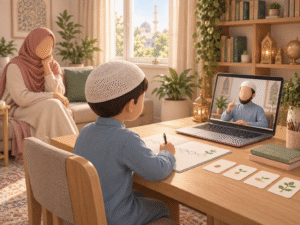
After letter recognition, children need to understand how short vowels change the sound they read.
Fatha, Kasra and Damma are basic reading tools. A child may recognise a letter perfectly and still be unable to decode a simple syllable if the short vowel is not secure.
A useful progression is:
- Introduce one short-vowel pattern clearly.
- Model the sound.
- Let the child repeat.
- Practise the same pattern with several familiar letters.
- Mix previously learned patterns only when each is becoming more secure.
Do not introduce every reading sign at once just because the child has memorised the alphabet.
Beginners need time to turn visual marks into reliable sounds. That recognition becomes the foundation for later word reading.
How do I know the short vowels are becoming secure?
Your child may be ready to move forward when they can:
- recognise the target vowel without constant reminders;
- produce the correct sound on different letters;
- switch between familiar short-vowel patterns with fewer guesses;
- notice and correct some mistakes after looking again.
The goal is not perfection before every new step. The goal is enough stability that the next skill does not overwhelm the child.
3. Understand How Arabic Letters Join
A common surprise for parents is that a child may know the Arabic alphabet but suddenly appear unsure when the same letters are inside a word.
This can happen because Arabic letters change visual form depending on their position.
The child now needs to recognise letters:
- in isolation;
- at the beginning of a word;
- in the middle;
- at the end;
- while also noticing the vowel or reading sign attached to them.
This is a new reading demand, not proof that previous alphabet learning has failed.
Gentle practice
Start with short joined combinations. Ask the child to identify each part, produce the sounds, and then read the combination more smoothly.
If the child only recognises a letter in isolation, compare its different forms before increasing the word length.
Children cannot learn to read the Quran independently through isolated-letter recognition alone. They eventually need to recognise those letters inside real written sequences.
4. Blend Sounds into Simple Words
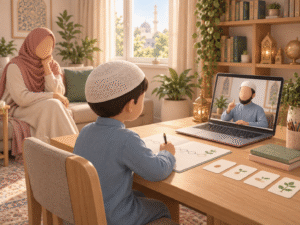
Blending is the point where separate sounds begin to become real reading for a child who wants to learn to read the Quran.
The child may correctly identify each letter and vowel but still read like this:
sound → pause → sound → pause → sound.
The next goal is to hold those sounds in mind and combine them into a complete word.
What can the teacher do?
- Use a short, manageable word.
- Guide the child through each sound.
- Model how the sounds join.
- Ask the child to blend them.
- Repeat the same pattern in another word.
- Gradually reduce help.
The EEF evidence on phonics also identifies blending sounds to read words as an important early literacy process. English phonics research should not be treated as direct evidence about Quran reading, but the broader instructional idea of moving from sound-symbol knowledge into independent decoding is relevant.
A major milestone appears when the child begins decoding unfamiliar simple words instead of only recognising words previously memorised.
5. Add Long Vowels, Tanween, Sukoon and Shaddah Gradually
As children learn to read the Quran, they gradually need a wider range of Arabic reading patterns.
This stage may include:
- long vowels;
- Tanween;
- Sukoon;
- Shaddah;
- increasingly complex sound combinations.
At Sibghah, the Noor Al-Bayan pathway for beginners is organised into four broad levels: short vowels and letter sounds; long vowels and Tanween; Sukoon and pronunciation rules; then Shaddah and fluent reading.
The value of this progression is not that every child must move at an identical speed. It is that reading complexity can be introduced in manageable layers.
Parents can explore the Noor Al-Bayan Course for Kids when a child needs a structured Arabic-reading foundation before stronger independent Quran reading.
Exposure is not the same as mastery
A child may have completed a lesson about Sukoon or Shaddah without being able to recognise that pattern independently in a new word.
Finishing a page does not necessarily mean the skill is secure.
Before adding much more complexity, observe whether the child can apply the current pattern without the teacher giving the answer first.
6. Move from Arabic Reading into Quranic Reading Carefully
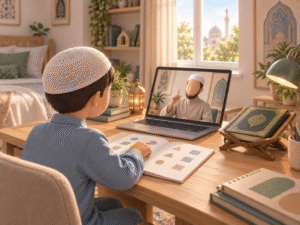
At some point, foundational reading skills need to transfer into actual Quran reading.
This is an exciting stage, but a child beginning to learn to read the Quran should not be expected to move suddenly from short exercises into a dense page with no support.
A gradual transition might look like:
- short familiar Quranic words;
- short phrases containing familiar reading patterns;
- very short passages with teacher guidance;
- rereading the same passage;
- new short passages with less help;
- increasingly independent reading.
A 2023 open-access study in Applied Psycholinguistics discusses the relationship between phonological, language and early reading skills in Arabic-speaking children. The study was not about Quran instruction and should not be generalised directly to every child learning Quran in the UK. It is useful background showing that Arabic reading development involves multiple connected skills.
The teacher should therefore observe whether earlier reading skills transfer successfully into Quranic text instead of assuming that finishing a beginner book automatically means the child is ready to read independently.
7. Learn to Read the Quran Accurately Before Chasing Speed
Once children begin to learn to read the Quran from real passages, parents often become concerned about slow reading.
Slow reading is not automatically bad reading.
If a child still needs conscious effort to decode each word, accuracy is usually a more useful priority than speed.
A practical progression is:
Accuracy → repeated reading → greater ease → fluency → gradually smoother pace.
What does useful fluency practice look like?
- The teacher models a short part when needed.
- The child reads it aloud.
- The teacher corrects the most important errors.
- The child tries again.
- The passage may be revisited later.
- Support is gradually reduced.
A child who wants to learn to read the Quran does not need to sound fast immediately. They need to become increasingly accurate, confident and independent.
Avoid praising speed when the child is guessing. Praise the reading behaviour you want to strengthen: careful attention, a remembered correction, an independently decoded word or a smoother second attempt.
Not sure whether your child’s reading level is ready for direct Quran work?
Ask Sibghah about a free one-to-one Quran assessment on WhatsApp
8. Add Pronunciation and Practical Tajweed at the Right Level
Correct pronunciation matters from the beginning, but children do not need to memorise a large body of Tajweed terminology before they can decode basic words.
As children learn to read the Quran, the teacher can model correct sounds and address important mistakes while keeping explanations suitable for the child’s level.
A practical cycle is:
Listen → Repeat → Read → Correct → Try Again → Revisit Later.
Practical Tajweed before heavy terminology
A beginner can hear and imitate correct recitation before learning the technical name of every rule.
As reading becomes stronger, explicit Tajweed knowledge can be added gradually.
This helps children learn to read the Quran while also developing better recitation, without making basic decoding compete with too many new technical terms.
9. Help Your Child Become an Independent Quran Reader
The long-term goal is not for the teacher to supply every sound forever.
As children learn to read the Quran, support should gradually decrease as independence grows.
You may notice progress when your child:
- starts an unfamiliar word without waiting for the teacher;
- recognises common reading patterns more quickly;
- needs fewer letter or vowel reminders;
- notices a mistake and tries the word again;
- remembers a correction from an earlier lesson;
- reads a short passage with fewer pauses;
- asks for help only at genuinely difficult points;
- rereads a familiar passage more smoothly.
A child does not need to be perfectly fluent before these signs appear.
Independence grows gradually.
For children who learn to read the Quran through one-to-one teaching, the teacher can reduce prompts according to the individual learner instead of according to the pace of a group.
If you want to see how a live one-to-one Quran lesson works in practice, you can also review Sibghah’s Online Quran Lessons for Kids.
How Long Does It Take a Child to Learn to Read the Quran?
There is no responsible single answer to how long it takes to learn to read the Quran.
The timeline depends on:
- the child’s age;
- their starting level;
- previous Arabic exposure;
- whether they already recognise letters;
- lesson frequency;
- practice consistency;
- pronunciation needs;
- how easily new patterns are retained;
- what level of independence the family means by “can read”.
Be cautious with programmes promising that every child will learn to read the Quran fluently within exactly the same number of weeks.
A more useful question is:
What can my child do independently now that they could not do before?
The answer may be stronger letter recognition, better blending, fewer guesses, smoother reading or remembered pronunciation corrections.
How Children Learn to Read the Quran at Different Ages
Ages 5–7
Young beginners can learn to read the Quran through short, focused lessons built around listening, sound recognition, repetition and simple reading tasks.
At this age, clear modelling and short practice may be more useful than long explanations.
Ages 8–11
Children in this age group may be ready for more structured decoding practice and may understand simple explanations about the reading patterns they are learning.
Some will begin from zero. Others may know letters but need help joining them, building fluency or transferring those skills into Quranic reading.
Ages 12–15
An older beginner can still learn to read the Quran from the foundations. The important difference is that teaching and materials should respect the learner’s age.
A thirteen-year-old who needs letter or vowel revision should not be spoken to as if they were five. The reading foundation may be basic, but the teaching style can remain age-appropriate.
Age affects how a lesson is taught. It does not automatically determine a child’s Quran reading level.
Can My Child Memorise Quran Before They Learn to Read the Quran Independently?
Yes. Some children can begin suitable memorisation through listening and repetition before they independently learn to read the Quran.
This is particularly common with short surahs that children hear frequently.
However, Hifz and independent reading are not the same skill.
| Hifz Through Listening | Independent Quran Reading |
|---|---|
| The child hears and remembers recitation. | The child decodes written text. |
| Can begin before fluent reading. | Requires reading foundations. |
| Needs listening, repetition and revision. | Needs letters, vowels, blending and fluency. |
| May strengthen familiarity with recitation. | Allows unfamiliar written passages to be approached independently. |
The two pathways can support each other, but memorising several surahs does not automatically mean the child can decode Quranic text independently.
Likewise, a child can learn to read the Quran while Hifz develops at a different pace.
Common Mistakes When Helping Children Learn to Read the Quran
1. Starting with material that is too difficult
If a child cannot reliably read short combinations, a long Quran passage may produce guessing rather than learning.
2. Teaching too many rules at once
A child trying to learn to read the Quran may already be concentrating on letters, vowels and blending. Adding several advanced Tajweed rules at the same time can make a basic reading task unnecessarily complex.
3. Pushing speed too early
Fast but inaccurate reading is not the goal. Secure decoding comes first.
4. Using very long practice sessions
More minutes do not automatically mean better learning. A focused short session may be more useful than a tired and frustrating one.
5. Comparing siblings
Children can begin at different levels and progress at different rates.
6. Correcting every error at once
Choose the most important target. Too many interruptions make it difficult for a child to remember what they are supposed to improve.
7. Measuring only pages completed
When children learn to read the Quran, progress may also mean fewer prompts, stronger vowel recognition, improved blending, greater accuracy or remembering an old correction.
8. Changing methods constantly
If a teaching approach suits the child, give them enough consistent practice before changing simply because progress is not immediate.
9. Assuming every beginner needs the same route
A child who already reads Arabic needs a different starting point from a child who has never learned Arabic script.
A Simple Home Routine to Help a Child Learn to Read the Quran
Parents can support a child who is beginning to learn to read the Quran without turning home practice into a second formal lesson.
A simple 10–15 minute routine might look like this:
| Time | Activity |
|---|---|
| 2–3 minutes | Review an already familiar reading pattern. |
| 4–5 minutes | Practise one current target skill. |
| 3–4 minutes | Read short words or phrases using that skill. |
| 2 minutes | Apply the skill to a suitable Quran-reading example if the child is ready. |
| 1 minute | Finish with something the child can do successfully. |
This is an example rather than a fixed prescription.
A younger child may need less time. An older learner may manage more.
The important point is that home practice should reinforce the current teaching goal instead of introducing several unrelated new skills.
Parent Milestone Checklist: Is Quran Reading Becoming More Independent?
As children learn to read the Quran, parents can watch for practical milestones rather than waiting for one dramatic moment when the child suddenly becomes “a reader”.
- My child recognises the target Arabic letters.
- My child connects familiar letters with their sounds.
- My child recognises short vowels more reliably.
- My child recognises familiar letters in joined forms.
- My child can blend short sound combinations.
- My child can decode some unfamiliar simple words.
- My child recognises familiar long-vowel patterns.
- My child handles familiar Tanween, Sukoon or Shaddah patterns.
- My child reads short Quranic words with less help.
- My child reads a short line more accurately on the second attempt.
- My child remembers some previous corrections.
- My child needs fewer teacher prompts.
- My child attempts unfamiliar words before asking for the answer.
- My child applies simple pronunciation corrections while reading.
- My child is becoming calmer and more confident when reading aloud.
A child does not need every box checked before progressing. The checklist helps parents notice the smaller skills that combine as children learn to read the Quran.
How Sibghah Helps Children Learn to Read the Quran
Sibghah Academy provides live one-to-one online lessons for Muslim children aged 5–15. Quran, Arabic and Islamic Studies are treated as separate learning paths so the starting point can reflect what the child actually needs.
For a complete beginner who needs Arabic reading foundations, Sibghah may use Noor Al-Bayan. The programme moves through:
- short vowels and letter sounds;
- long vowels and Tanween;
- Sukoon and pronunciation rules;
- Shaddah and increasingly fluent reading.
For a child who already has those foundations and is ready to learn to read the Quran directly, Quran lessons can focus more specifically on Quran reading, recitation, pronunciation, practical Tajweed, Hifz or revision according to the child’s level.
The one-to-one format allows the teacher to listen closely, correct mistakes and adjust the pace without requiring the learner to match a group.
If you are unsure whether your child should begin with Arabic reading foundations or direct Quran reading, a trial lesson can help identify the starting point.
Parents can read the Quran Trial Lesson UK guide to understand what may happen during the first session.
Book a free one-to-one Quran trial on WhatsApp
Sibghah Teacher Note
Sibghah Teacher Note: when children learn to read the Quran, we do not only ask how many pages they have finished. We look for independence. Can the child recognise a pattern they previously needed help with? Can they decode a new word? Can they remember yesterday’s correction? A small skill becoming independent is often a more useful sign of progress than quickly completing another page.
When Should a Parent Ask for Extra Support?
If your child is trying to learn to read the Quran but the same foundation remains unclear despite regular guided practice, a fresh assessment may help.
Consider extra teacher support if:
- letter recognition remains inconsistent;
- the child can say individual sounds but cannot blend them;
- the child guesses most unfamiliar words;
- reading has remained at the same level for a long period;
- pronunciation errors need more live correction;
- the child has become anxious about reading aloud;
- you are unsure whether the child needs Arabic foundations, Quran reading or Tajweed.
Parents do not need to diagnose the problem themselves. A useful teacher should be able to identify the first point where support is needed and explain the next priority clearly.
Ask Sibghah about your child’s Quran reading level
Frequently Asked Questions About How Children Learn to Read the Quran
What is the best age to begin Quran reading?
There is no single best age for every child. Young children can begin foundational Arabic reading, while older beginners can also learn to read the Quran successfully. Lesson length, teaching style and expectations should match the child’s age and current skill level.
How should a complete beginner start?
A complete beginner usually starts with Arabic letter sounds, short vowels, joined forms and simple blending before progressing into more complex reading patterns and Quranic text.
Does my child need to speak Arabic before learning Quran reading?
No. A child can learn to read the Quran without already speaking Arabic fluently. Reading, speaking, listening and vocabulary are different skills, although broader Arabic knowledge can support language understanding.
How long does it take to learn to read the Quran?
There is no reliable fixed timeline. Progress depends on the child’s age, starting level, Arabic exposure, lesson frequency, practice, retention and pronunciation needs. Skill milestones are more useful than promising the same number of weeks for every learner.
Can my child memorise Quran before learning to read?
Yes. Some children memorise suitable surahs through listening and repetition before independent reading develops. Hifz and reading can progress alongside each other, but memorisation does not automatically mean that the child can decode unfamiliar Quranic text.
Should Tajweed begin before fluent Quran reading?
Correct pronunciation and gentle recitation correction can begin immediately. More detailed Tajweed terminology should be introduced gradually and according to the child’s reading level so that theory does not overwhelm basic decoding.
How often should a child practise?
Regular short practice can be useful, but there is no single schedule suitable for every child. Consistency and a clear skill target are more important than forcing long sessions.
Why can my child recognise Arabic letters but not read words?
The child may still need to recognise joined forms and learn how to blend individual sounds into complete words. Knowing isolated letters is an important foundation, but it is not the final reading skill.
What is the difference between Noor Al-Bayan and Quran lessons?
At Sibghah, Noor Al-Bayan is an Arabic reading-foundation pathway for beginners, covering letters, sounds, vowels and early fluency. Quran lessons focus on the child’s Quran needs, which can include reading, recitation, pronunciation, Tajweed, Hifz and revision.
Are one-to-one lessons helpful for beginners?
They can help children learn to read the Quran because the teacher has more opportunity to hear individual reading, identify specific gaps, repeat difficult skills and adjust the pace. Suitable group teaching can also work well, so the best format depends on the learner.
How do I know my child is making progress?
Look beyond the number of pages completed. Useful signs include stronger letter recognition, more accurate vowels, better blending, fewer guesses, smoother reading, remembered corrections and greater independence.
Can Sibghah help a complete beginner?
Yes. Sibghah works with Muslim children aged 5–15. A beginner can first be assessed to determine whether they need Arabic reading foundations through Noor Al-Bayan or are ready for more direct Quran reading. Families can begin with a free one-to-one trial.
Final Thoughts: Help Your Child Learn to Read the Quran Step by Step
Helping a child begin Quran reading is not about rushing from the alphabet to long pages as quickly as possible.
The journey becomes much clearer when parents see the smaller skills underneath Quran reading.
Letters need sounds.
Sounds need vowels.
Letters need to be recognised in joined forms.
Separate sounds need to be blended into words.
Reading patterns such as long vowels, Tanween, Sukoon and Shaddah need time to become familiar.
Those skills then need to transfer into Quranic reading.
Accuracy develops before greater fluency.
Pronunciation and practical Tajweed grow through listening, correction and repetition.
And gradually, the teacher gives less help as the child becomes more independent.
The strongest way to learn to read the Quran is therefore not one fixed timetable for every learner. It is a structured pathway that begins at the child’s real level and moves forward as each foundation becomes secure enough for the next step.
If you are unsure where your child should start, Sibghah Academy offers a free live one-to-one trial for Muslim children aged 5–15.
Message Sibghah Academy and book your child’s free Quran trial