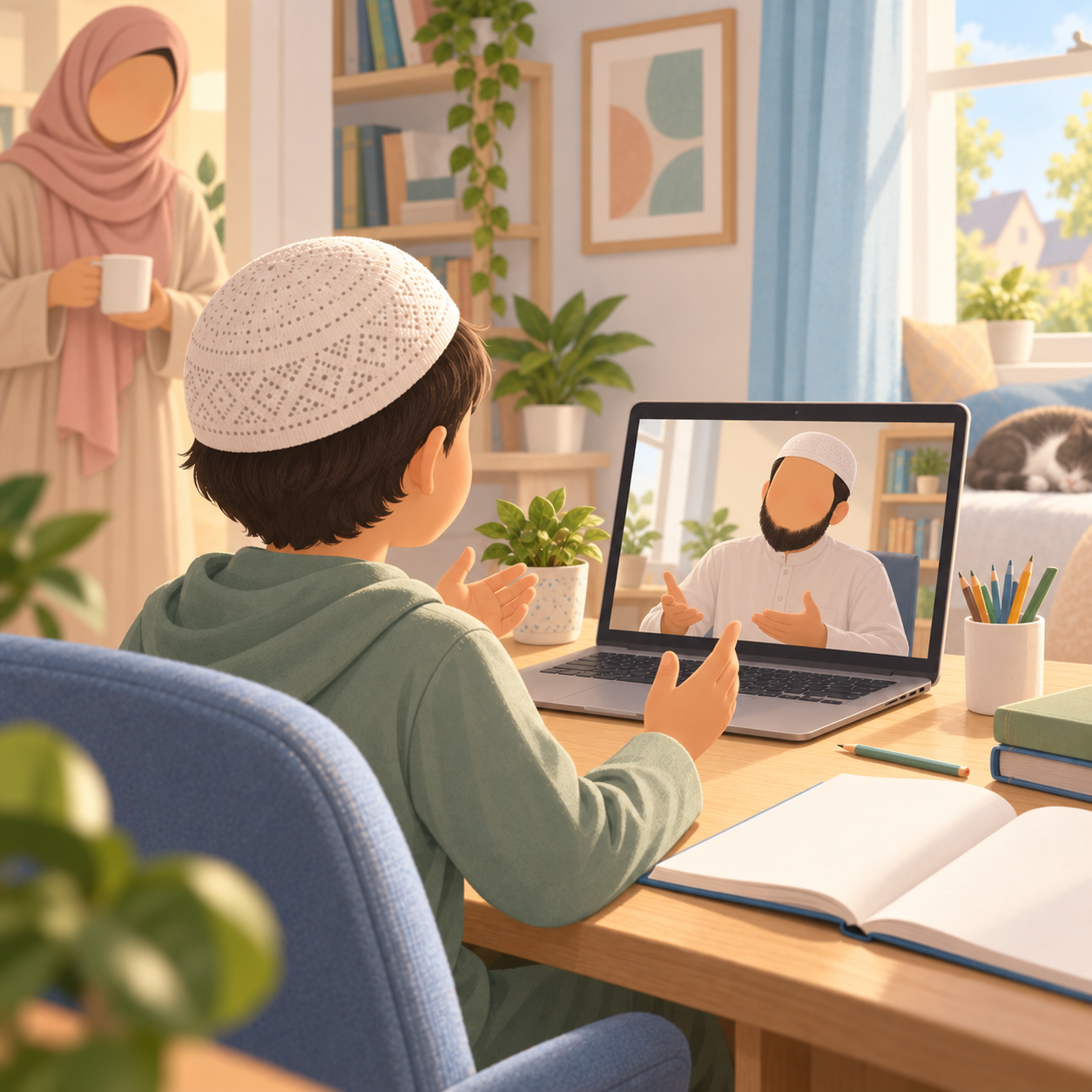
Online Islamic Classes for Kids UK can give Muslim children a structured way to learn about Allah, Islamic beliefs, worship, manners, the Prophets, the Companions, and Muslim identity while studying from home. For many families, however, the main question is not simply whether Islamic classes are available online. The real question is whether those lessons will help their child understand Islam in a clear, age-appropriate, and meaningful way.
Children growing up in the UK may know that they are Muslim while still having many questions about what Islam means in everyday life. They may ask why Muslims pray, why Ramadan matters, how to behave with friends, what Muslims believe about Allah, or how they should respond when classmates ask about their faith.
Good Online Islamic Classes for Kids UK should give children more than isolated facts. They should help the child build Islamic knowledge gradually, connect that knowledge to behaviour and worship, ask questions safely, and become more confident about their Muslim identity.
At Sibghah Academy, Islamic Studies is taught in English, making the meaning accessible to children who are more comfortable learning in English. Islamic Studies is also a separate learning area from Arabic language study. A child does not need to wait until they can speak or read Arabic fluently before beginning to learn about Islam.
Quick answer: Effective Online Islamic Classes for Kids UK should be live, structured, child-friendly, and suitable for the child’s age and understanding. Parents should look for lessons that teach faith, worship, manners, Islamic values, stories, and identity while allowing the child to ask questions and connect what they learn to real life. One-to-one lessons can make this learning even more personal because the teacher can adjust explanations, questions, and topics to the individual child.
Book a free one-to-one Islamic Studies trial session on WhatsApp
Table of Contents
- What Are Online Islamic Classes for Kids UK?
- School Religious Education and Islamic Studies: What Is the Difference?
- Online Islamic Classes for Kids UK: 9 Things Parents Should Know
- What Can Children Learn at Sibghah?
- Why One-to-One Islamic Studies Can Help
- What Should an Online Islamic Studies Lesson Look Like?
- Islamic Studies by Age and Understanding
- How Can Parents Recognise Progress?
- How Parents Can Support Islamic Learning at Home
- What Should Happen in a Trial Lesson?
- How Sibghah Approaches Online Islamic Studies
- Parent Checklist
- FAQ
What Are Online Islamic Classes for Kids UK?
Online Islamic Classes for Kids UK are live lessons designed to help Muslim children understand Islamic beliefs, worship, character, values, stories, and everyday Muslim life while learning online.
Islamic Studies should not be treated as a collection of disconnected facts to memorise. Children need to understand what they learn and gradually see how Islam relates to their own choices, family life, friendships, school experiences, worship, and character.
Depending on the child’s level, Islamic Studies may include:
- Knowing Allah and learning about His Names
- Basic Aqeedah and Islamic beliefs
- The Pillars of Islam
- The Pillars of Iman
- Wudu, salah, fasting, and other acts of worship
- Islamic manners and good character
- Daily Islamic etiquette
- Stories of the Prophets
- Lives and values of the Companions
- Dua and daily Muslim habits
- Islamic identity
- Questions children encounter while growing up in the UK
Parents looking for a broader overview can also read our Islamic Studies for Kids guide.
The aim of Online Islamic Classes for Kids UK should not be to overload a child with information. The aim is to build a foundation that becomes clearer and deeper as the child grows.
School Religious Education and Islamic Studies: What Is the Difference?
Some parents wonder whether Islamic Studies is still necessary when their child already has Religious Education at school.
For families in England, schools provide Religious Education, or RE. According to GOV.UK, RE is compulsory in schools up to the age of 18, while the syllabus can vary according to the type of school and the arrangements responsible for that school.
Read GOV.UK guidance on Religious Education in schools.
RE at school and Islamic Studies for a Muslim child do not necessarily serve the same purpose.
School RE may introduce children to religions, beliefs, and related topics within the school’s curriculum. Online Islamic Classes for Kids UK, by contrast, can focus specifically on helping a Muslim child understand and practise their own faith.
That may include questions such as:
- Why do we worship Allah?
- How do I make wudu correctly?
- Why do Muslims pray five times a day?
- What can I learn from a Prophet’s story?
- How should I treat my parents and friends?
- What does honesty mean in Islam?
- Why do Muslims fast in Ramadan?
- How should I respond when someone asks me about Islam?
This means Islamic learning can complement a child’s wider education without simply repeating what they learn at school.
Online Islamic Classes for Kids UK: 9 Helpful Things Parents Should Know
Before choosing Online Islamic Classes for Kids UK, parents should look beyond the course title and ask what the child will actually experience during lessons.
1. Islamic Studies should be understandable to the child
A child cannot benefit deeply from a lesson they do not understand.
At Sibghah Academy, Islamic Studies is taught in English. This is especially helpful for children whose strongest learning language is English, including many children growing up in the UK.
Important Arabic Islamic terms can still be introduced naturally. A child can learn words such as Salah, Wudu, Tawheed, Sabr, Shukr, and Dua while the meaning is explained clearly in English.
This helps avoid an important mistake: assuming that a child must first become fluent in Arabic before they can begin understanding their religion.
Arabic language learning and Islamic Studies can support a Muslim child’s development in different ways, but they are separate learning paths at Sibghah.
Good Online Islamic Classes for Kids UK should therefore prioritise understanding rather than making language itself a barrier to Islamic knowledge.
2. The course should follow a clear path, not random weekly topics
Children need structure.
If one week is about prayer, another is about a Prophet, another is about manners, and the next is an unrelated advanced topic, children may collect information without building a clear Islamic foundation.
Structured Online Islamic Classes for Kids UK should help the child progress step by step.
For example, a general Islamic Studies pathway might move gradually through:
- Knowing Allah and foundational faith
- Basic Islamic beliefs
- Worship and daily practice
- Islamic manners
- Stories and role models
- Islamic identity and practical life
Sibghah’s Minhaj Al-Muslim Course for Kids, for example, provides a structured path covering areas such as Aqeedah, Fiqh, worship, manners, and Islamic etiquette.
The important point is not that every child must study exactly the same sequence. The child should have a clear learning direction rather than receiving scattered information.
3. Children need to understand Allah through love, Tawheed, and gratitude
Islamic education begins with faith.
A child should learn that Allah is their Creator, Provider, and the One they worship. They should learn about Allah’s mercy, care, wisdom, knowledge, and blessings in a way suited to their age.
Learning about Allah should not be built only around fear or punishment.
Children also need:
- Love of Allah
- Hope in Allah
- Trust in Allah
- Gratitude for Allah’s blessings
- Understanding that worship belongs to Allah alone
One of Sibghah’s separate Islamic Studies pathways is the Names of Allah programme, which helps children learn about Allah’s Names and connect those meanings to faith and daily life.
Online Islamic Classes for Kids UK should help faith become meaningful to the child rather than merely giving them definitions to repeat.
4. Worship should include meaning as well as rules
Children need practical knowledge about worship.
They should learn how Muslims make wudu, how salah fits into Muslim life, what Ramadan means, and how Islamic practices are carried out appropriately for their stage of learning.
But children also benefit from understanding why Muslims worship.
A child who only learns a list of movements may know what to do without understanding why prayer matters. A child who only memorises fasting rules may not understand how Ramadan develops worship, patience, gratitude, and self-control.
Good Online Islamic Classes for Kids UK should connect practical learning with meaning.
This is especially helpful as children become older and begin asking more questions rather than simply accepting instructions.
5. Good character should be part of Islamic Studies
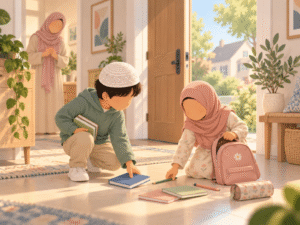
Islamic learning should appear in behaviour.
A child may know the answer to many Islamic questions while still needing help with honesty, patience, respect, kindness, gratitude, or controlling anger.
Character topics can include:
- Truthfulness
- Respect for parents
- Kindness to siblings
- Good friendship
- Patience
- Mercy
- Generosity
- Keeping promises
- Good speech
- Respect for others
The Prophet ﷺ said:
إِنَّ مِنْ خِيَارِكُمْ أَحْسَنَكُمْ أَخْلَاقًا
“The best among you are those who have the best manners and character.”
For this reason, effective Online Islamic Classes for Kids UK should help children connect Islamic knowledge with everyday conduct.
6. Stories should teach lessons, not only events
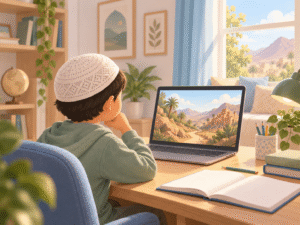
Children naturally remember stories. This makes the stories of the Prophets especially valuable for Islamic education.
But a good lesson should move beyond asking:
“What happened next?”
It should also ask:
- What can we learn from this?
- What quality did the Prophet show?
- How did he trust Allah?
- Where can we use this lesson in our own life?
- What would patience look like for a child today?
Sibghah’s Stories of the Prophets for Kids content explores how stories can teach faith, patience, courage, trust in Allah, and good character.
This helps Online Islamic Classes for Kids UK become practical rather than simply historical.
7. Children need space to ask sincere questions
As children grow, their questions often become more complex.
A young child may ask, “Why do we pray?”
An older child may ask:
- Why does Allah test people?
- Why do Muslims follow certain rules?
- Why are some things halal and others haram?
- Why do my friends believe something different?
- How can I explain my faith at school?
A useful Islamic Studies teacher should not make a child afraid to ask.
Instead, the teacher should listen carefully, understand what the child is really asking, and explain the topic at an appropriate level.
One-to-one Online Islamic Classes for Kids UK can be especially useful here because the child has direct time with the teacher and may feel more comfortable asking a personal question than they would in a larger group.
8. Islamic identity should connect to real life in the UK
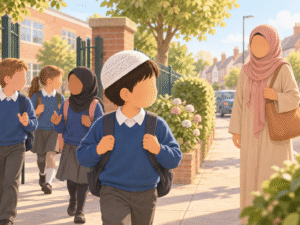
Children do not practise Islam only during Islamic Studies lessons.
They practise it at home, school, with friends, online, during sports, on family outings, and in everyday decisions.
For a Muslim child growing up in the UK, Islamic Studies can help them understand how their faith relates to situations they actually experience.
For example:
- How do I explain Ramadan to a friend?
- Why do I eat halal food?
- What should I do if a friend encourages me to do something wrong?
- How should a Muslim behave when someone disagrees with them?
- Why is salah important even when I am busy?
- How should I behave online?
Good Online Islamic Classes for Kids UK should help children see Islam as part of their daily life rather than a subject that exists only during one lesson each week.
9. Parents should know what their child is learning
Islamic education becomes stronger when lessons and home life support each other.
Parents do not need to repeat the entire lesson themselves. But they should understand the main topic and know what their child is working on.
A parent may reinforce a lesson through one simple conversation.
After a lesson about gratitude, the parent might ask:
“What blessing can we thank Allah for today?”
After a lesson about honesty:
“Can you remember one situation where telling the truth might feel difficult?”
After a Prophet story:
“What was the most important lesson you remember?”
Our guide on how to teach Islamic Studies at home gives parents more ideas for connecting lessons to family life.
The strongest Online Islamic Classes for Kids UK should make it easier for parents to continue Islamic learning naturally outside the lesson.
What Can Children Learn Through Sibghah’s Islamic Studies Programmes?
Islamic Studies at Sibghah is not one single all-in-one course. Children can learn through different programmes according to their needs, age, interests, and current Islamic knowledge.
| Programme | Main Focus | What It Can Help Build |
|---|---|---|
| Minhaj Al-Muslim | Aqeedah, Fiqh, worship, manners, Islamic etiquette | A structured general Islamic foundation |
| Names of Allah | Knowing Allah through His Names | Faith, love of Allah, trust, gratitude, reflection |
| Stories of the Prophets | Prophets’ stories and their lessons | Faith, patience, courage, Tawakkul, character |
| Lives of the Companions | Stories and examples from the Companions | Positive Muslim role models, courage, sacrifice, character |
This gives Online Islamic Classes for Kids UK more flexibility because a child who needs broad foundations may follow a different path from a child who would benefit from learning through stories or from a child who needs a stronger relationship with knowing Allah.
Why One-to-One Online Islamic Classes for Kids UK Can Help
At Sibghah Academy, lessons are built around one-to-one learning.
This is particularly valuable in Islamic Studies because children do not only differ in how much information they know. They also differ in their questions, maturity, confidence, family background, and understanding.
One child may already know how to pray but not understand why prayer matters.
Another may know many Prophets’ names but struggle to explain the lessons from their stories.
Another may have many questions about school, friends, and Muslim identity.
In one-to-one Online Islamic Classes for Kids UK, the teacher can:
- Adjust explanations to the child’s age
- Slow down when a concept is difficult
- Ask more questions to check understanding
- Give the child time to ask personal questions
- Use examples relevant to that child’s life
- Revisit an earlier topic when needed
- Adapt the learning path to the child’s existing knowledge
One-to-one learning does not mean the lesson should become intense or overly formal. The benefit is that the teacher can respond to the individual child rather than keeping everyone at one fixed pace.
What Should an Online Islamic Studies Lesson Look Like?
Good Online Islamic Classes for Kids UK should be interactive rather than long online lectures.
A lesson might include several simple stages.
1. Review
The teacher may begin by asking one or two questions from a previous topic.
2. Introduce the main idea
The teacher explains one clear topic in child-friendly language.
3. Discussion
The child is encouraged to answer, think, and ask questions.
4. Real-life example
The teacher connects the Islamic idea to something familiar to the child.
For example, a lesson about honesty could include a situation at school, at home, or while playing with friends.
5. Reflection
The teacher may ask:
“What could you do differently this week because of what we learned?”
6. Simple follow-up
The child may receive a small idea to remember, practise, discuss with parents, or observe during the week.
This helps Online Islamic Classes for Kids UK move from information to understanding and action.
Online Islamic Classes for Kids UK by Age and Understanding
Children should not all receive the same Islamic Studies lesson simply because they are Muslim.
Age matters, but understanding matters too.
Ages 5–6
Young children usually benefit from simple and warm ideas such as:
- Allah created us
- Allah gives us blessings
- Simple duas
- Basic manners
- Kindness
- Simple Prophet stories
- Love of good deeds
Ages 7–9
Children can begin learning more structured topics such as:
- The Pillars of Islam
- The Pillars of Iman
- Wudu
- Salah
- Basic Aqeedah
- Islamic manners
- Prophets’ stories and lessons
Ages 10–12
At this stage, children often benefit from deeper discussion about:
- Why Muslims worship
- Responsibility
- Friendship
- Character
- Online behaviour
- School-life situations
- Muslim identity
Ages 13–15
Older children may need more thoughtful conversations about:
- Faith
- Purpose
- Peer pressure
- Identity
- Responsibility
- Worship
- Personal choices
- Questions about the world around them
One advantage of one-to-one Online Islamic Classes for Kids UK is that teaching can reflect the child’s maturity rather than using age as the only guide.
Why Seeking Islamic Knowledge Matters
Children should understand that learning Islam is valuable in itself, not merely another subject added to their timetable.
The Prophet ﷺ said:
مَنْ سَلَكَ طَرِيقًا يَلْتَمِسُ فِيهِ عِلْمًا، سَهَّلَ اللَّهُ لَهُ بِهِ طَرِيقًا إِلَى الْجَنَّةِ
“Whoever follows a path in pursuit of knowledge, Allah will make easy for him a path to Paradise.”
Parents and teachers can use this meaning to help children see Islamic learning positively: learning about their religion is something valuable, meaningful, and connected to worship.
How Can Parents Recognise Progress in Online Islamic Classes for Kids UK?
Islamic Studies progress should not be measured only by how many lessons or pages a child completes.
Parents can look for changes in understanding, vocabulary, behaviour, confidence, and practical knowledge.
| Area | Possible Sign of Progress |
|---|---|
| Faith | The child can explain basic beliefs in their own words |
| Worship | The child understands more about why and how Muslims worship |
| Character | The child begins connecting lessons to behaviour |
| Stories | The child remembers lessons from stories, not only events |
| Vocabulary | The child understands Islamic terms and can explain them simply |
| Identity | The child becomes more comfortable explaining simple aspects of Islam |
| Questions | The child asks more thoughtful questions and engages in discussion |
Progress in Online Islamic Classes for Kids UK can also appear in small moments.
A child may remember to say Alhamdulillah because they understand gratitude better. They may recognise when honesty matters. They may explain Ramadan more confidently to a classmate. They may ask a more thoughtful question about something they learned.
These are meaningful signs that Islamic knowledge is beginning to connect with life.
How Parents Can Support Islamic Learning at Home
Parents do not need to turn the home into another classroom.
Small, natural reinforcement can be more useful.
Ask one good question
Instead of asking, “What did you learn?” every time, try something more specific:
“What was the most interesting thing your teacher explained today?”
Connect lessons to everyday life
If the child learned about patience, notice moments when patience is needed.
If the child learned about gratitude, talk about something the family can thank Allah for.
Practise worship naturally
If the child is learning wudu or salah, allow them to practise calmly and correct gradually.
Welcome questions
If a child asks something difficult, do not make them feel that asking is wrong. If you do not know the answer, it is fine to tell them that you will find out.
Avoid turning everything into a test
Islamic learning should build curiosity and love, not make children feel constantly examined.
This combination of home support and Online Islamic Classes for Kids UK can help learning remain present throughout the week.
What Should Happen in an Islamic Studies Trial Lesson?
A trial lesson should help the teacher understand the child rather than simply demonstrate a standard lesson.
During a trial session for Online Islamic Classes for Kids UK, it can be useful to explore:
- The child’s age
- Previous Islamic learning
- Topics they already understand
- Areas where their knowledge is limited
- Questions the child frequently asks
- Whether they enjoy stories, discussion, or structured learning
- Which Islamic Studies programme may suit them
The teacher should also observe how the child communicates and how much explanation they need.
Afterwards, parents should have a clearer idea of the child’s appropriate starting point.
Book a free Islamic Studies trial session
How Sibghah Provides Online Islamic Classes for Kids UK
Sibghah Academy provides live one-to-one Online Islamic Classes for Kids UK for Muslim children aged 5–15.
Islamic Studies lessons are taught in English so children can understand Islamic meanings clearly, especially when English is their stronger learning language.
The Islamic Studies branch includes different programmes rather than treating every child as if they need exactly the same course.
These include:
- Minhaj Al-Muslim for a structured foundation in Aqeedah, Fiqh, worship, manners, and Islamic etiquette.
- Names of Allah to help children know Allah through His Names and connect those meanings with faith and life.
- Stories of the Prophets to teach faith, patience, courage, trust in Allah, and character through meaningful stories.
- Lives of the Companions to introduce children to Muslim role models and values through the lives of the Companions.
The one-to-one format allows the teacher to adjust the level, explanation, discussion, and pace according to the individual child.
This is especially useful when a child already knows some topics but has gaps in others, or when they have questions that need more individual discussion.
The aim of Sibghah’s Online Islamic Classes for Kids UK is not simply to increase how many Islamic facts a child can repeat. The aim is to help children understand their faith, connect it to worship and character, and gradually develop confidence in living as Muslims.
Sibghah Teacher Note
Children often remember Islamic knowledge more deeply when they understand why it matters. Knowing that Muslims should tell the truth is important. Understanding that Allah loves truthfulness, recognising situations where honesty is difficult, and choosing truth even when it costs something takes the lesson further. Islamic Studies should help children move from knowing to understanding, and from understanding towards practice.
Parent Checklist for Online Islamic Classes for Kids UK
Before choosing Online Islamic Classes for Kids UK, ask:
- Will my child understand the language used in the lessons?
- Is the content appropriate for my child’s age and knowledge?
- Does the programme follow a clear learning path?
- Does it teach children about Allah and basic Aqeedah?
- Does it include practical worship?
- Does it teach Islamic manners and character?
- Does it help children learn from the Prophets and Muslim role models?
- Can my child ask questions comfortably?
- Does the teacher connect lessons to real life?
- Can the course support Muslim identity in a UK environment?
- Will I understand what my child is learning?
- Can teaching be adjusted to my child’s level?
- Does my child receive enough direct teacher interaction?
If these elements are present, the programme is more likely to provide meaningful Islamic learning rather than simply giving the child more information.
FAQ About Online Islamic Classes for Kids UK
What are Online Islamic Classes for Kids UK?
Online Islamic Classes for Kids UK are live Islamic Studies lessons delivered online for Muslim children. They can cover faith, worship, Aqeedah, Fiqh, manners, Prophets’ stories, Muslim role models, Islamic identity, and everyday Islamic behaviour.
Are Islamic Studies lessons at Sibghah taught in English?
Yes. Islamic Studies at Sibghah is taught in English so children can understand the meanings and discuss Islamic topics clearly. Important Arabic Islamic terms can still be introduced and explained during lessons.
Does my child need to know Arabic before starting Islamic Studies?
No. Islamic Studies and Arabic language learning are separate learning areas at Sibghah. A child can begin Islamic Studies in English even if they are only beginning Arabic or do not currently speak Arabic.
What age are Online Islamic Classes for Kids UK suitable for?
Sibghah provides Islamic learning for children aged 5–15. The teaching style, examples, depth, and programme should reflect the child’s age and understanding.
What does my child learn in Islamic Studies?
Depending on their programme, children may learn about Allah, Aqeedah, worship, Fiqh, manners, Islamic etiquette, stories of the Prophets, the Companions, Islamic values, and Muslim identity.
Are the Islamic Studies lessons one-to-one?
Yes. Sibghah’s Online Islamic Classes for Kids UK use a one-to-one format, allowing the teacher to adapt explanations, discussion, and pace to the individual child.
What is Minhaj Al-Muslim for kids?
Minhaj Al-Muslim is one of Sibghah’s Islamic Studies programmes. It provides a structured foundation covering areas including Aqeedah, Fiqh, worship, manners, and Islamic etiquette.
Does Sibghah teach Stories of the Prophets?
Yes. Stories of the Prophets is a separate Islamic Studies programme that helps children learn important events while also exploring lessons such as faith, patience, courage, trust in Allah, and good character.
How are Names of Allah taught to children?
The Names of Allah programme helps children understand selected Names of Allah in an age-appropriate way and connect their meanings to faith, gratitude, trust, worship, and everyday life.
How can Islamic Studies help a Muslim child growing up in the UK?
Online Islamic Classes for Kids UK can help children understand their beliefs and practices, develop Islamic character, ask questions, and become more confident explaining simple aspects of their faith in everyday situations.
How do I know whether my child is progressing?
Look for stronger understanding, better Islamic vocabulary, more thoughtful answers, greater confidence discussing Islamic topics, improved practical knowledge, and increasing ability to connect Islamic lessons with everyday behaviour.
Can my child try an Islamic Studies lesson first?
Yes. A trial lesson can help identify what your child already knows, which areas need development, and which Sibghah Islamic Studies programme may be the most appropriate starting point.
Final Thoughts on Online Islamic Classes for Kids UK
Choosing Online Islamic Classes for Kids UK is not simply about finding another class to add to your child’s schedule.
Islamic Studies can help a child understand who they worship, what they believe, why Muslims practise Islam, what good character looks like, and how their faith connects to real choices.
The strongest learning happens when Islamic knowledge is clear, age-appropriate, structured, and connected to life.
A young child may begin by learning that Allah is the Creator and that Muslims should be kind. An older child may need to understand worship more deeply, discuss identity, or ask questions about situations they experience at school.
One-to-one Online Islamic Classes for Kids UK can make this journey more personal because the teacher can respond to the child’s existing knowledge, maturity, questions, and learning needs.
At Sibghah Academy, Islamic Studies is taught in English through separate programmes including Minhaj Al-Muslim, Names of Allah, Stories of the Prophets, and Lives of the Companions. This allows families to choose a learning path according to what their child currently needs rather than treating Islamic Studies as one fixed course for every learner.
If you are unsure which path suits your child, a trial lesson can help identify an appropriate starting point.
Message Sibghah Academy on WhatsApp to book a free one-to-one Islamic Studies trial session