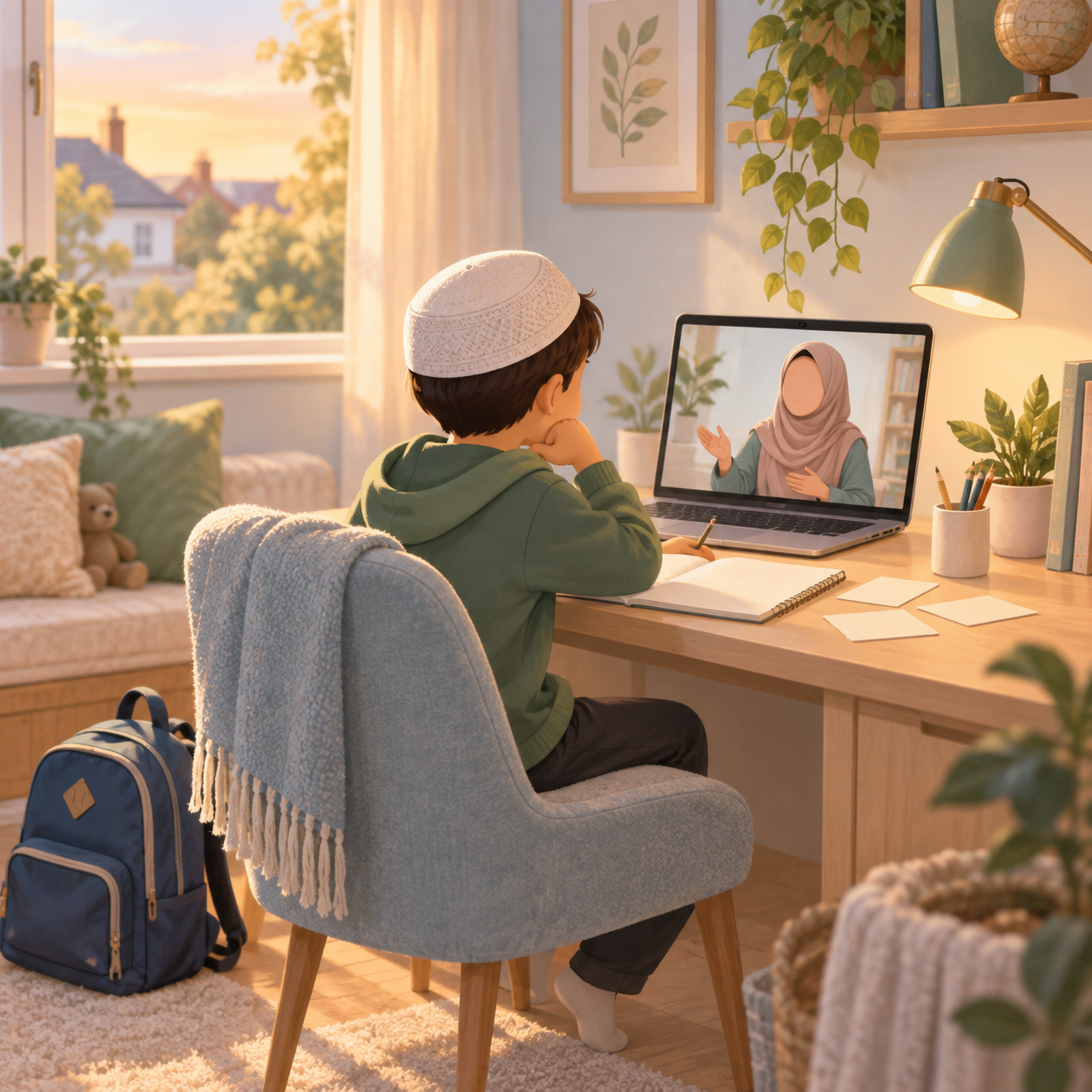
Online Arabic Tuition for Primary School Kids can give children a structured way to build Arabic reading, vocabulary, speaking, and confidence while learning from home. But primary-school-age children have particular learning needs. They have already spent hours concentrating at school, their attention can change from day to day, and they often learn better through short, active practice than through long explanations.
For Muslim families in the UK, Arabic ability can also vary greatly from one child to another. One child may hear Arabic at home but answer almost entirely in English. Another may be starting from zero. A third may know Arabic letters but still find reading difficult. This means effective Online Arabic Tuition for Primary School Kids cannot follow exactly the same plan for every learner.
The goal should not simply be to keep the child busy for the length of the lesson. A useful Arabic lesson should help the child do something better than before: recognise a sound, read more independently, remember useful vocabulary, form a sentence, understand an instruction, or speak with greater confidence.
This guide explains how parents can make Online Arabic Tuition for Primary School Kids work well alongside school life, what a suitable lesson can look like, how to manage a child’s attention during lessons, when one-to-one teaching may help, and how parents can recognise genuine Arabic progress.
Quick answer: Good Online Arabic Tuition for Primary School Kids should be live, interactive, personalised to the child’s level, and realistic for their age and school routine. Lessons should include active reading, listening, or speaking rather than long periods of passive watching. One-to-one tuition can be particularly useful because the teacher can adjust the pace, give immediate correction, and focus on the child’s specific Arabic gaps.
Book a free one-to-one Arabic trial session for your child
Table of Contents
- Why Arabic Tuition for Primary School Children Is Different
- What Does a Primary School Child Need from Arabic Tuition?
- Online Arabic Tuition for Primary School Kids: 8 Smart Tips
- What Should an Online Arabic Lesson Look Like?
- How to Make Arabic Work After a School Day
- Why One-to-One Arabic Tuition Can Help
- What Should Parents Do Between Lessons?
- How to Measure Arabic Progress
- What If My Child Is Starting Arabic from Zero?
- Online Learning and Safety
- How Sibghah Supports Primary School Children
- Parent Checklist
- FAQ
Why Online Arabic Tuition for Primary School Kids Is Different
Online Arabic Tuition for Primary School Kids needs to take account of the fact that children are still developing their concentration, language skills, confidence, and learning habits.
A primary-school-age child is not simply a smaller adult learner. Long explanations may lose their attention. Repeating the same activity for too long may make them disengage. On the other hand, moving constantly from one new topic to another can prevent skills from becoming secure.
Children at this stage usually benefit from:
- Clear and simple instructions
- Short learning steps
- Regular opportunities to respond
- Repetition without making the lesson feel repetitive
- Gentle correction
- Visible progress
- Encouragement to try even when unsure
Another important difference is that children in UK primary schools already use a lot of mental energy during the school day. Arabic tuition needs to work with that reality rather than compete with it.
A lesson after a busy school day may need a different pace from a lesson on a relaxed weekend morning. Effective Online Arabic Tuition for Primary School Kids should be flexible enough to respond to these differences.
What Does a Primary School Child Need from Arabic Tuition?
The answer depends less on school year and more on Arabic ability.
Two children in the same primary school class may need completely different Online Arabic Tuition for Primary School Kids.
| Child Profile | Possible Arabic Focus |
|---|---|
| Complete beginner | Sounds, basic vocabulary, listening, and Arabic letters |
| Knows letters but cannot read smoothly | Vowels, joining letters, words, and reading fluency |
| Understands family Arabic | Speaking, sentence-building, and active vocabulary |
| Speaks some Arabic but cannot read | Structured literacy foundations |
| Non-Arab Muslim beginner | Gentle language foundations with clear pronunciation |
| Child losing Arabic to English | Regular speaking, vocabulary, listening, and reading exposure |
| Shy learner | Low-pressure one-to-one participation and confidence |
That is why a level check is useful before deciding on a long-term learning plan.
A good teacher should try to understand what the child can already read, understand, and say before deciding what should come next.
Online Arabic Tuition for Primary School Kids: 8 Smart Tips for Parents
These eight practical principles can help families get more value from Online Arabic Tuition for Primary School Kids without making Arabic feel like another stressful school subject.
1. Choose the lesson according to level, not only age
Age is useful when deciding how to communicate with a child, but it should not be the only factor used to decide what Arabic they study.
A nine-year-old child from an Arabic-speaking home may understand everyday Arabic well but struggle to read. Another nine-year-old may be completely new to Arabic.
Giving both children the same material would not make sense.
Effective Online Arabic Tuition for Primary School Kids should therefore begin with the child’s actual Arabic ability.
A teacher may informally assess:
- Letter recognition
- Pronunciation
- Reading
- Listening comprehension
- Vocabulary
- Sentence-building
- Speaking confidence
Once the starting point is clear, tuition becomes much easier to personalise.
Parents who want to understand what teaching qualities matter can also read our Arabic Teacher for Kids UK guide.
2. Do not judge a lesson by its length
A longer lesson is not automatically a better lesson.
With primary-school children, the quality of attention matters more than simply keeping the child online for a certain number of minutes.
A useful session may contain several shorter stages:
- A quick review
- One focused new skill
- Active practice
- A short change of activity
- Another practice opportunity
- A simple recap
If a child spends much of the lesson tired, distracted, or passively watching, extra minutes add little value.
Good Online Arabic Tuition for Primary School Kids should keep the child mentally involved rather than simply keep them connected to a screen.
3. Make the child use Arabic during the lesson
Children learn languages by using them.
If the teacher talks for most of the lesson, the child may understand the explanation without developing enough independent language ability.
Depending on level, the child should regularly have opportunities to:
- Repeat
- Identify
- Read
- Answer
- Name
- Describe
- Build sentences
- Ask simple questions
A beginner may start with one-word responses. That is completely fine.
The important thing is that the teacher gradually helps the child move from listening to active Arabic use.
This is one of the most important features of Online Arabic Tuition for Primary School Kids.
4. Separate reading needs from speaking needs
Parents sometimes say, “My child is weak in Arabic,” when the difficulty is actually much more specific.
A child may read well but rarely speak. Another may speak naturally with relatives but be unable to read Arabic words.
These are different learning needs.
Arabic reading may require:
- Letter recognition
- Sounds
- Vowels
- Joining letters
- Word recognition
- Reading fluency
Arabic speaking may require:
- Listening
- Vocabulary
- Pronunciation
- Sentence-building
- Retrieving words quickly
- Conversation practice
Good Online Arabic Tuition for Primary School Kids should identify which of these skills needs more attention rather than assuming they all develop at exactly the same pace.
5. Repeat old Arabic before adding too much new Arabic
Children need repeated exposure before language becomes easy to remember and use.
If every lesson introduces many new words but rarely returns to old ones, the child may appear to learn quickly while retaining very little.
A teacher can revisit vocabulary naturally.
For example, a word first learned in one lesson can later appear in:
- A question
- A picture description
- A short sentence
- A reading task
- A conversation
This repeated use helps move vocabulary from short-term recognition towards more confident language use.
Online Arabic Tuition for Primary School Kids should therefore include revision as part of normal learning rather than treating it as something separate.
6. Match the lesson to your child’s energy after school
A child may be enthusiastic about Arabic and still find it difficult to concentrate immediately after a long school day.
This does not necessarily mean the child dislikes Arabic or that the teacher is ineffective.
Parents can experiment with:
- A short break after school
- A snack before the lesson
- A quieter study space
- A different lesson time
- Shorter activities at the start of the session
Children often participate better when basic tiredness and hunger are considered.
This is one reason flexible Online Arabic Tuition for Primary School Kids can suit UK families: the learning can take place from home without adding travel before and after the lesson.
7. Use one-to-one tuition when your child needs personal attention
One-to-one tuition can be particularly useful during primary school because children’s Arabic abilities often develop unevenly.
In a one-to-one lesson, the teacher does not have to divide speaking, reading, and correction time between several children.
The lesson can slow down when the child needs help and move forward when the child is ready.
This can be helpful for children who:
- Need more pronunciation correction
- Read slowly
- Feel shy in groups
- Understand Arabic but rarely speak
- Need more repetition
- Have a level different from children of the same age
At Sibghah, Online Arabic Tuition for Primary School Kids is provided through live one-to-one lessons so the teacher can focus directly on the individual child.
Our Arabic Tutor for Kids UK guide explains this personalised support in more detail.
8. Measure skills, not pages
Parents naturally want to know whether tuition is working.
But finishing a book or reaching a particular page does not necessarily show what the child can do independently.
Instead, ask practical questions.
Can my child:
- Recognise more letters without help?
- Read familiar words with less hesitation?
- Remember vocabulary from earlier lessons?
- Understand more Arabic instructions?
- Answer with a phrase instead of one word?
- Build simple sentences?
- Speak without immediately switching to English?
The strongest Online Arabic Tuition for Primary School Kids should lead to improvements parents and teachers can describe in real skills.
What Should Online Arabic Tuition for Primary School Kids Look Like?
A useful lesson does not need dozens of activities. It needs a clear learning purpose.
One possible structure for Online Arabic Tuition for Primary School Kids is:
1. Quick review
The teacher begins with something familiar from an earlier lesson. This helps reactivate vocabulary or reading patterns and gives the child an early feeling of success.
2. One main learning goal
The lesson introduces or develops one important skill rather than trying to teach everything at once.
This could be:
- A reading pattern
- A group of connected words
- A sentence form
- A pronunciation point
- A simple conversation topic
3. Guided practice
The teacher demonstrates and helps the child practise.
4. Independent attempt
The child tries with less support. This is important because it shows whether learning is beginning to become independent.
5. Correction and another attempt
When the child makes an error, the teacher corrects gently and gives them another opportunity.
6. Short recap
The lesson ends by revisiting what the child has achieved and identifying a simple next step.
The exact structure can change by age and level, but active participation should remain central.
How to Make Online Arabic Tuition Work After a School Day
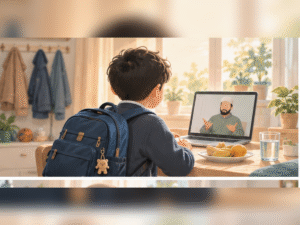
Parents sometimes worry that Online Arabic Tuition for Primary School Kids adds another academic demand to an already busy week.
It can feel that way when the routine is unrealistic.
Arabic learning should have structure, but that structure does not need to copy school.
Try to avoid turning every evening into:
school → homework → Arabic lesson → Arabic homework → bedtime.
Instead, look for a sustainable rhythm.
That might mean lessons on selected days rather than every day, very short review between lessons, or choosing times when the child is usually more alert.
Consistency over several months is generally more useful than an intense routine that the family stops after several weeks.
Why One-to-One Online Arabic Tuition for Primary School Kids Can Help
One-to-one Online Arabic Tuition for Primary School Kids gives the teacher something especially valuable: time to observe one child closely.
For example, the teacher may notice that a child:
- Reads accurately but extremely slowly
- Understands questions but answers in English
- Forgets one particular reading pattern
- Needs several seconds longer to formulate an answer
- Becomes quiet when corrected too quickly
These details can be harder to respond to when the teacher is also responsible for several other learners.
With one-to-one learning, the teacher can change the activity immediately.
This does not mean every minute needs intense teaching. Children still need a relaxed and encouraging atmosphere. Personalisation should make learning feel more manageable, not more pressured.
What Should Parents Do Between Arabic Lessons?
Parents can support Online Arabic Tuition for Primary School Kids without turning themselves into the child’s second Arabic teacher.
The most useful support is often simple and consistent.
Ask what the child learned
A brief conversation encourages recall and gives the child an opportunity to explain something in their own way.
Reuse familiar vocabulary
If the child learned words for food, clothes, toys, or household objects, use one or two of those words naturally during the week.
Encourage without constantly testing
A child may stop enjoying Arabic if every family interaction becomes a test of what they remember.
Keep practice short
Five focused minutes can sometimes be more useful than a long review the child resists.
Share useful observations with the teacher
If your child suddenly starts using a new Arabic phrase at home, tell the teacher. If they are repeatedly frustrated by a particular activity, that information can also help.
Parents looking for more general ideas can read our Learn Arabic for Kids guide.
How to Measure Progress in Online Arabic Tuition for Primary School Kids
Progress in Online Arabic Tuition for Primary School Kids is usually gradual rather than dramatic.
| Skill | Possible Sign of Progress |
|---|---|
| Letter recognition | The child recognises familiar letters more quickly |
| Reading | The child pauses less and needs less teacher help |
| Vocabulary | Previously learned words appear again naturally |
| Listening | The child understands more instructions without English |
| Speaking | One-word answers gradually become phrases and sentences |
| Pronunciation | Repeated mistakes become less frequent |
| Confidence | The child tries before asking for help |
Parents should look for trends over time rather than judging every individual lesson.
A tired weekday lesson may look weaker than the previous weekend session. That does not necessarily mean progress has stopped.
A useful question to ask the teacher is: “What can my child do now that they could not do several weeks ago?”
What If My Primary School Child Is Starting Arabic from Zero?
Online Arabic Tuition for Primary School Kids can also work for complete beginners.
The teacher should avoid assuming that the child already understands common Arabic words simply because they come from a Muslim family.
A beginner may start with:
- Listening to simple sounds
- Useful everyday vocabulary
- Basic responses
- Letter recognition
- Pronunciation
- Simple reading foundations
The exact order can vary depending on the child and learning path.
For children focusing on structured Arabic reading foundations, Sibghah may use Noor Al-Bayan.
Read our Noor Al-Bayan for Kids guide.
Online Learning and Safety for Primary School Children
Because Online Arabic Tuition for Primary School Kids happens through digital devices, parents should also think about the online environment.
Ofcom’s 2026 Children’s Media Use and Attitudes research covers children and young people in the UK and includes parents’ views on their children’s online and media use, including how families monitor and manage that use.
Read Ofcom research on children’s media use in the UK
For a live lesson, practical family habits can include:
- Knowing when and where the lesson takes place
- Using an appropriate space in the home
- Knowing which platform the lesson uses
- Keeping teacher-parent communication through clear channels
- Making sure the child knows they can tell a parent if anything online makes them uncomfortable
NSPCC also provides guidance for parents and carers on helping children stay safe online, including family approaches to technology and online risks.
Read NSPCC online safety guidance for parents
Online safety should be part of a normal family routine rather than something discussed only when a problem appears.
How Sibghah Provides Online Arabic Tuition for Primary School Kids
Sibghah Academy provides live one-to-one Online Arabic Tuition for Primary School Kids as part of its Arabic learning programmes for Muslim children aged 5–15.
The one-to-one format allows the teacher to understand the child first and then focus lessons on the areas that need development.
This may include:
- Arabic alphabet and sounds
- Reading foundations
- Reading fluency
- Vocabulary
- Listening
- Sentence-building
- Speaking confidence
Children who need reading foundations may work through Noor Al-Bayan. Children developing broader language skills may work through the Takallam Series, depending on their level and goals.
Because tuition is one-to-one, the teacher can spend more time on the child’s particular needs rather than asking them to follow a fixed group pace.
This makes Online Arabic Tuition for Primary School Kids at Sibghah both personal and structured: the child receives individual support while still following a meaningful Arabic learning path.
Sibghah Teacher Note
Primary school children often learn best when the next step feels achievable. If a reading task is too difficult, the answer is not always to push harder. Sometimes we need to make the step smaller. If speaking feels intimidating, we may begin with a choice, then a phrase, then a sentence. One-to-one teaching gives us room to notice when the child needs a challenge and when they need a smaller step.
Parent Checklist for Online Arabic Tuition for Primary School Kids
Before choosing Online Arabic Tuition for Primary School Kids, use this checklist:
- The teacher understands my child’s current Arabic level.
- The lesson is appropriate for a primary-school-age learner.
- My child actively participates rather than only watches.
- The teacher distinguishes reading needs from speaking needs.
- Previous material is reviewed regularly.
- The lesson time works with my child’s school routine.
- The teacher corrects mistakes gently.
- My child gets enough one-to-one practice.
- Parents receive useful feedback.
- Progress is measured through real skills.
- The online learning setup feels safe and professional.
- The routine is realistic enough to continue consistently.
FAQ About Online Arabic Tuition for Primary School Kids
What is Online Arabic Tuition for Primary School Kids?
Online Arabic Tuition for Primary School Kids is live Arabic instruction delivered online for primary-school-age children. It can support reading, vocabulary, listening, pronunciation, sentence-building, and speaking according to the child’s level.
Is Online Arabic Tuition for Primary School Kids suitable after school?
Yes, but timing matters. Children may need a break, snack, or quieter transition after school. The lesson should also use varied active practice rather than expecting long periods of passive concentration.
How long should an online Arabic lesson be for a primary school child?
There is no single ideal length for every child. Age, attention, level, lesson format, and time of day all matter. A focused lesson in which the child participates actively is more important than simply choosing the longest available session.
Is one-to-one Online Arabic Tuition for Primary School Kids helpful?
One-to-one Online Arabic Tuition for Primary School Kids can be especially useful when a child needs personal correction, more speaking or reading time, a flexible pace, or support with a specific Arabic skill.
Can Online Arabic Tuition for Primary School Kids help my child learn to read?
Yes. A teacher can support letter recognition, sounds, vowels, joining, word reading, and fluency through live correction and repeated practice.
Can online Arabic tuition help a child speak Arabic?
Yes. Lessons can include vocabulary recall, questions and answers, sentence-building, description, and guided conversation. The child needs regular opportunities to actually produce Arabic rather than only listen.
What if my child understands Arabic but replies in English?
The teacher can gradually build spoken output by modelling short Arabic answers, encouraging repetition, and then reducing support as the child becomes more confident retrieving Arabic independently.
Does my child need Arabic homework every day?
Not necessarily. A short and realistic review routine can be more sustainable than long daily homework. The teacher can recommend practice according to the child’s level and goal.
How can I tell if Online Arabic Tuition for Primary School Kids is working?
Look for practical improvements such as smoother reading, stronger vocabulary recall, better understanding, longer spoken responses, fewer repeated errors, and more confidence using Arabic.
Does Sibghah offer Online Arabic Tuition for Primary School Kids?
Yes. Sibghah Academy provides live one-to-one Online Arabic Tuition for Primary School Kids as part of its Arabic programmes for Muslim children aged 5–15. Lessons can support Arabic reading, vocabulary, listening, speaking, and confidence according to the child’s individual level.
Final Thoughts on Online Arabic Tuition for Primary School Kids
Online Arabic Tuition for Primary School Kids works best when it respects both sides of the child’s life: they are learning Arabic, but they are also primary school children with school days, changing energy levels, limited attention, and different personalities.
The aim should not be to squeeze the maximum amount of material into every lesson. The aim is to make the child’s Arabic stronger step by step.
That may mean reading one pattern more confidently, remembering vocabulary from last week, answering a question without switching to English, or finally speaking without worrying about making a mistake.
One-to-one Online Arabic Tuition for Primary School Kids can support this process because the teacher has the freedom to work at the child’s pace and respond to the skills that need the most attention.
At Sibghah Academy, Arabic lessons are live and one-to-one, helping primary-school-age children develop Arabic through a learning path suited to their level rather than a fixed group pace.
A trial session can help identify where your child currently stands and which Arabic skill should be the next priority.
Message Sibghah Academy on WhatsApp to book a free one-to-one Arabic trial session