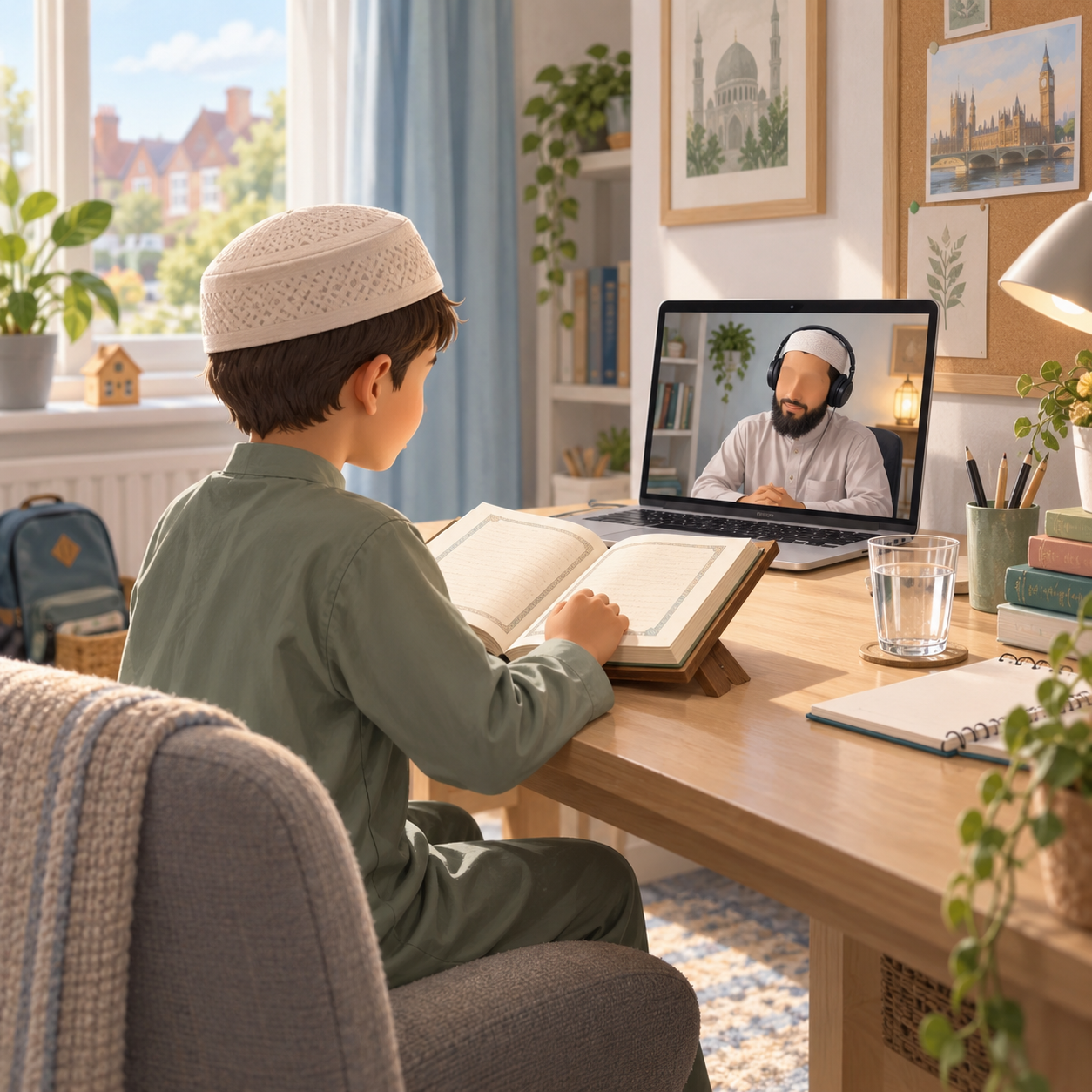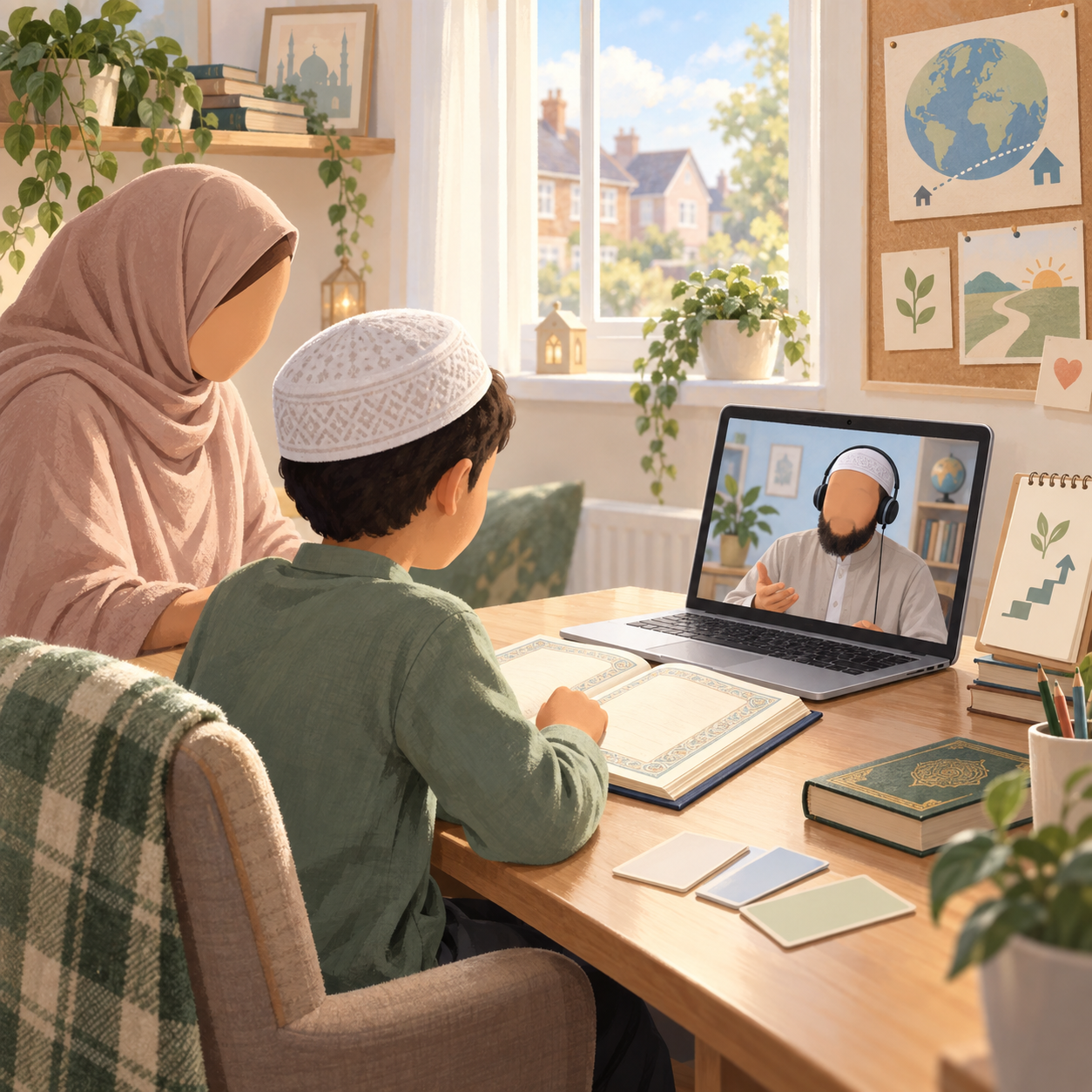
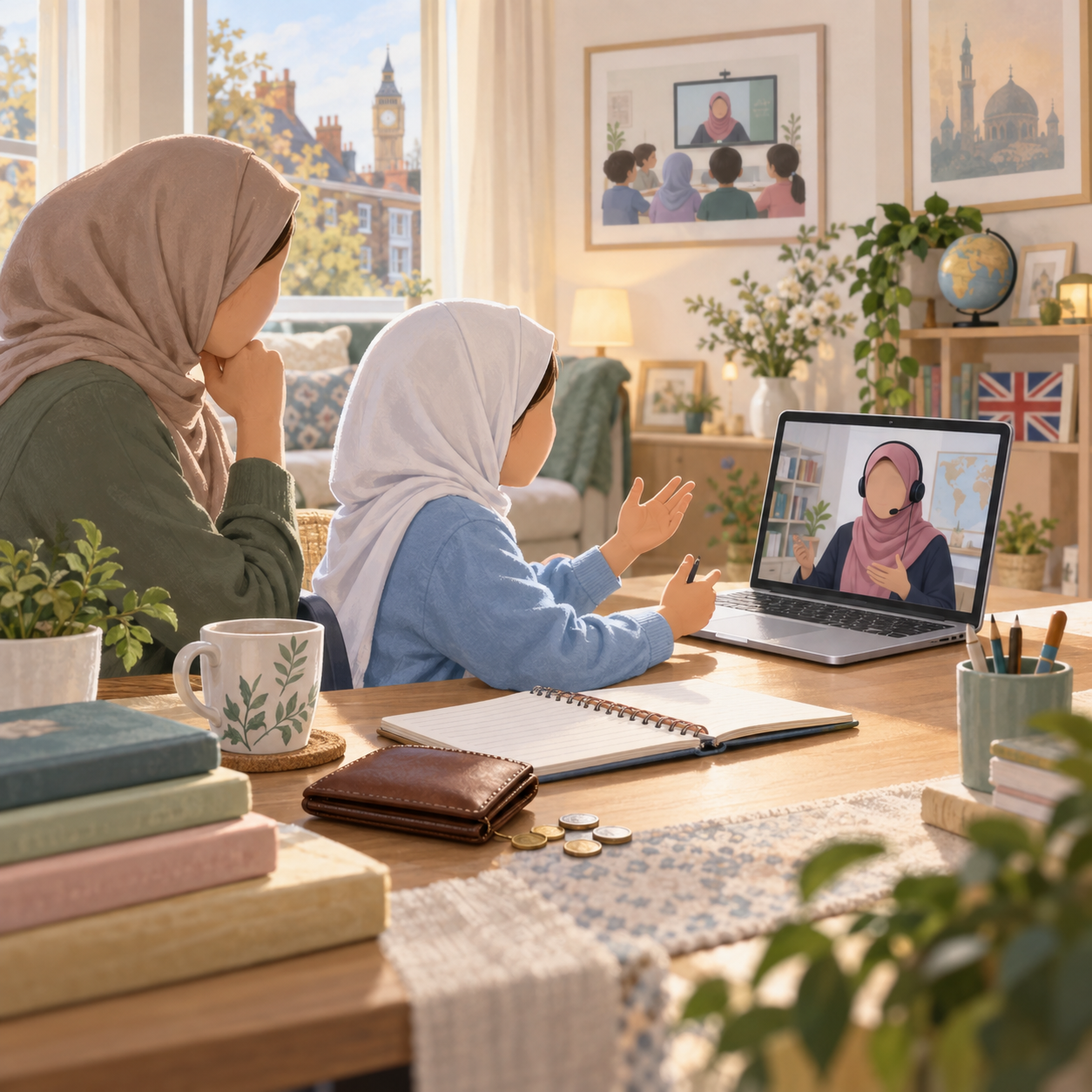

Online Arabic Classes for Kids UK can give Muslim children a practical way to learn Arabic from home while receiving live support from a teacher. But putting a child in front of a laptop is not automatically effective Arabic learning. The quality of the lesson, the teacher’s interaction, the child’s level, the amount of speaking and reading practice, and the follow-up between lessons all matter.
For some children, online Arabic learning works extremely well because they feel comfortable at home and receive more focused attention. Other children may need shorter sessions, more movement, or extra parent support to stay engaged. The important question is not simply whether online classes are good or bad. It is whether the format is being used in the right way for your child.
This guide to Online Arabic Classes for Kids UK explains what a good live online lesson should look like, which children may benefit most, what parents should realistically expect, how online lessons differ from apps and recorded videos, and how to recognise genuine progress.
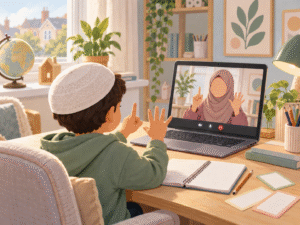
Quick answer: Good Online Arabic Classes for Kids UK should be live, interactive, appropriate for the child’s level, and focused on active learning rather than passive screen time. The teacher should listen to the child, encourage speaking and reading, correct gently, adapt the pace, and give parents clear feedback. One-to-one lessons can be especially useful when a child needs more personal practice or confidence-building.
Book a free Arabic trial session for your child on WhatsApp
Table of Contents
- How Do Online Arabic Classes for Kids UK Actually Work?
- Which Children Benefit Most from Online Arabic Learning?
- Online Arabic Classes for Kids UK: 7 Things Parents Should Know
- Live Lessons vs Apps and Recorded Videos
- What Changes in One-to-One Arabic Lessons?
- What Should a Good Online Arabic Lesson Look Like?
- How Can Parents Measure Real Arabic Progress?
- Online Lesson Safety for Children
- How Sibghah Supports Online Arabic Learning
- Parent Checklist
- FAQ
How Do Online Arabic Classes for Kids UK Actually Work?
Good Online Arabic Classes for Kids UK are not simply digital versions of a traditional classroom. A strong online lesson should use the advantages of live individual interaction rather than asking a child to sit quietly and watch a teacher speak.
In a live lesson, the child may listen to a sound, repeat it, read a word, answer a simple question, describe an object, practise vocabulary, build a short sentence, or read from suitable learning material. The teacher observes the child’s response and adjusts immediately.
This interaction is what makes live learning different from a video. If a child pronounces something incorrectly, the teacher can hear it. If the child already understands an activity, the teacher can move forward. If the child looks confused, the teacher can slow down.
For younger learners, a lesson may need several short activities rather than one long task. For older children, the teacher can gradually increase reading, conversation, vocabulary, and independent response.
The technology is only the delivery method. The real value comes from the teaching taking place through it.
Which Children Benefit Most from Online Arabic Learning?
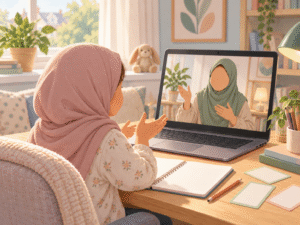
Online Arabic Classes for Kids UK can support children with very different Arabic backgrounds. The important point is that the learning path should change according to the child.
| Child Profile | What Online Arabic Lessons Can Focus On |
|---|---|
| Complete beginner | Arabic sounds, letters, simple vocabulary, listening and repetition |
| Knows letters but reads slowly | Vowels, joining, repeated reading, pronunciation and fluency |
| Understands Arabic but answers in English | Speaking confidence, vocabulary and sentence building |
| Heritage Arabic learner | Maintaining Arabic, speaking, reading and richer vocabulary |
| Non-Arab Muslim child | Beginner-friendly Arabic with clear pronunciation and useful language |
| Shy learner | Low-pressure speaking and reading with individual encouragement |
This is one reason parents should avoid judging Arabic programmes only by age labels such as “ages 7–10.” Two children of the same age can have completely different levels.
If you are also comparing different types of Arabic programmes, read our guide to Arabic classes for kids in the UK.
Online Arabic Classes for Kids UK: 7 Smart Things Parents Should Know
Before enrolling, these seven points will help parents understand what effective Online Arabic Classes for Kids UK should provide.
1. Live interaction matters more than screen time
Parents sometimes worry that online Arabic learning means adding more screen time to the child’s day. That concern makes sense, but not all screen use is the same.
A child passively watching a long video is doing something very different from a child speaking to a teacher, answering questions, reading aloud, listening carefully, and receiving immediate correction.
In good Online Arabic Classes for Kids UK, the child should regularly do something. They should not spend most of the lesson watching the teacher.
Useful activities can include:
- Repeating sounds or words
- Reading aloud
- Answering simple questions
- Naming familiar objects
- Building short sentences
- Listening and responding
- Correcting pronunciation
Parents can often judge lesson quality by a simple question: How much of the lesson is my child actively using Arabic?
2. Online learning still needs a level-based plan
A flexible online format should not mean random lessons. Children still need a clear learning path.
Before regular lessons begin, the teacher should understand what the child can already do. Can they recognise Arabic letters? Can they distinguish sounds? Can they read connected words? Can they understand simple spoken Arabic? Can they answer basic questions?
Strong Online Arabic Classes for Kids UK use this information to decide what should come next.
For example, a child struggling with letter recognition needs a very different lesson from a child who understands Arabic but avoids speaking it.
3. Short, focused practice can be more useful than long passive lessons
Children do not need a lesson filled with content simply to make it feel valuable. More material does not automatically mean more learning.
A child may benefit more from carefully practising a small number of sounds, words, or sentences than rushing through several pages.
This is particularly important after a full school day. A teacher working online needs to recognise when the child is mentally tired and adjust the pace accordingly.
A well-designed lesson should have a clear purpose. Parents should be able to understand what skill their child practised rather than only how many pages they completed.
4. Speaking needs real speaking time
One common problem in language learning is that children learn vocabulary but rarely use it. They may recognise words on a worksheet and still hesitate when asked a simple question.
If speaking is one of your goals, Online Arabic Classes for Kids UK should give the child frequent opportunities to respond aloud.
The teacher might use familiar topics such as:
- Home and family
- Food and drinks
- School objects
- Daily routines
- Clothes
- Animals
- Simple actions
- Likes and dislikes
The aim is not to force long conversations immediately. A child can begin with a word, progress to a short phrase, then move towards simple sentences.
5. Reading and speaking should not be confused
A child who can read Arabic is not automatically able to speak it. A child who understands spoken Arabic is not automatically able to read.
These skills can support each other, but they develop differently.
Reading may involve letter recognition, sounds, vowels, joining, and fluency. Speaking requires listening, vocabulary retrieval, sentence construction, pronunciation, and confidence.
Good Online Arabic Classes for Kids UK identify which skill needs attention instead of assuming progress in one means progress in all.
For children building early reading foundations, you can also read our Noor Al-Bayan for kids guide.
6. Parent feedback should be simple but useful
Parents do not need a long report after every class. But they should know what is happening.
Helpful feedback might tell you:
- What the child practised
- What improved
- What still needs support
- What to review briefly at home
- What the teacher plans to work on next
This makes Online Arabic Classes for Kids UK easier for parents to follow and helps prevent the feeling that lessons are happening behind a closed digital door.
7. The online format should fit your family, not control it
One of the biggest practical advantages of online learning is flexibility. Families do not need to travel to another location, and lessons can fit more easily around school and home routines.
But flexibility only helps when the schedule is realistic.
A child who is exhausted immediately after school may not learn well at that time. A younger child may struggle with an overly long lesson. A busy week may require a different rhythm from a quieter one.
The aim is consistency rather than pressure.
Live Online Arabic Lessons vs Apps and Recorded Videos
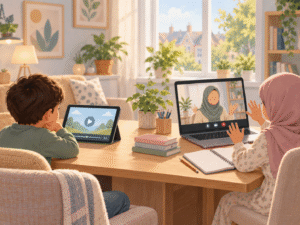
Parents looking for Online Arabic Classes for Kids UK often see many digital options: mobile apps, YouTube videos, recorded courses, learning games, and live classes.
These tools do not all serve the same purpose.
| Learning Format | Main Strength | Main Limitation |
|---|---|---|
| Arabic apps | Convenient repetition and simple practice | Cannot fully judge a child’s pronunciation or personal difficulty |
| Recorded videos | Children can replay explanations | No immediate correction or interaction |
| Group online classes | Interaction with several learners | Less individual speaking and reading time |
| One-to-one live lessons | Personal correction and adjustable pace | Requires active participation and a consistent routine |
Apps and videos can be useful supporting tools. For example, a child can revise vocabulary or hear a sound again between lessons. But they do not replace the role of a teacher who can listen to the child and respond to mistakes in real time.
Think of digital resources as part of a learning toolkit rather than expecting one tool to do everything.
What Changes in One-to-One Online Arabic Classes?
At Sibghah, the emphasis is on one-to-one learning because it allows the teacher to spend the lesson responding to one child rather than dividing attention across a group.
In one-to-one Online Arabic Classes for Kids UK, the teacher can change the lesson according to what happens in real time.
If a child reads confidently, the teacher can move forward. If the child repeatedly confuses a sound, they can stop and practise it. If the child knows vocabulary but avoids speaking, the lesson can include more conversation.
One-to-one lessons can be especially useful for:
- Children who are shy in groups
- Children who need extra correction
- Children learning Arabic from the beginning
- Heritage learners with uneven skills
- Children who need more speaking time
- Children working at a different pace from their age group
One-to-one is not automatically better in every situation. Some children enjoy group interaction. But when personal correction and individual pacing are priorities, private lessons can offer clear advantages.
What Should a Good Online Arabic Lesson Look Like?
A good lesson does not need to be complicated. It needs to be purposeful.
A typical live session may include several stages:
A short review
The teacher revisits something from the previous lesson. This helps check whether the child remembers it and creates continuity.
A focused new skill
This may be a sound, reading pattern, group of useful words, sentence structure, or conversation topic.
Active practice
The child reads, repeats, answers, speaks, listens, or identifies something. The important point is that they actively use the skill.
Correction
The teacher notices mistakes and corrects them gently. Children should have a chance to try again after correction.
A simple ending
The teacher reviews what the child achieved and may give a small practice task.
When evaluating Online Arabic Classes for Kids UK, this kind of structure matters more than flashy presentations or complicated technology.
How Can Parents Measure Real Arabic Progress?
Arabic progress is not only about finishing books or completing levels.
Parents can look for practical changes in what the child can actually do.
| Area | Possible Sign of Progress |
|---|---|
| Reading | The child hesitates less and joins letters more confidently |
| Pronunciation | Repeated sound mistakes become less frequent |
| Vocabulary | The child remembers and uses more familiar words |
| Speaking | The child gives longer answers or responds with less hesitation |
| Listening | The child understands more teacher instructions without translation |
| Confidence | The child is more willing to try even when unsure |
These changes may happen gradually. Language learning is cumulative, so parents should look for patterns over time rather than expecting dramatic improvement after a few sessions.
A useful question to ask the teacher is: “What can my child do now that they could not do before?”
When Online Arabic Classes May Need Extra Parent Support
Online Arabic Classes for Kids UK are convenient, but some children need help from a parent to make the format work well.
A younger child may need help opening the device or joining the lesson. A child who is easily distracted may need a quiet place with fewer toys around. Another child may need a reminder to review something between lessons.
Parents do not need to sit beside the child throughout every class. In fact, some children participate more independently when the parent is nearby but not constantly involved.
The goal is to create a learning environment where the child can focus while still knowing that a parent is available if needed.
Online Lesson Safety for Children
Online learning should also have clear boundaries. Parents should know which platform is being used, when the lesson takes place, how communication happens, and who they should contact if they have a concern.
Useful family habits include keeping younger children’s lessons in an appropriate home space, ensuring parent communication goes through clear channels, and talking regularly with children about their online experiences.
UK parents can also read the NSPCC online safety guidance for families.
Safety should feel like a normal part of online education rather than something parents think about only when a problem happens.
How Sibghah Supports Online Arabic Learning for Children
Sibghah Academy provides live one-to-one online Arabic lessons for Muslim children aged 5–15.
For families searching for Online Arabic Classes for Kids UK, the starting point should be understanding the child rather than putting every learner into the same programme.
A child may need support with:
- Arabic alphabet and pronunciation
- Reading foundations
- Reading fluency
- Vocabulary
- Listening
- Sentence building
- Speaking confidence
Sibghah uses Arabic learning paths including Noor Al-Bayan for reading foundations and the Takallam Series for broader language and communication development, depending on the child’s needs.
Because lessons are one-to-one, the teacher can adapt the pace and spend more time on the areas where the child needs support.
Parents who want a broader introduction to Arabic learning can also read our Learn Arabic for Kids guide.
Sibghah Teacher Note
In online Arabic teaching, we do not judge a lesson by how much material appears on the screen. We look at how much the child actually understands and uses. One child may need to repeat a sound several times. Another may need more time to form a sentence. Another may understand everything but need encouragement to speak. Good teaching notices these differences and responds to them.
Parent Checklist for Online Arabic Classes for Kids UK
Before choosing Online Arabic Classes for Kids UK, check whether the programme offers the following:
- Live interaction with a teacher
- A level check before or during the first sessions
- A lesson plan based on the child’s actual needs
- Enough reading or speaking time for the child
- Gentle correction
- A teacher experienced with children
- Age-appropriate lesson length and activities
- Clear parent feedback
- A consistent but realistic schedule
- Clear online communication and safety boundaries
The strongest online programme is not necessarily the one with the most features. It is the one that helps your child actively learn and steadily become more confident.
FAQ About Online Arabic Classes for Kids UK
Are Online Arabic Classes for Kids UK effective?
Online Arabic Classes for Kids UK can be effective when lessons are live, interactive, appropriate for the child’s level, and taught by a teacher who gives personal feedback and correction. The child should actively read, speak, listen, or respond during the lesson rather than only watch.
What age can a child start online Arabic classes?
Children can begin Arabic learning at a young age when lessons are short, gentle, and suited to their attention span. Sibghah works with children aged 5–15 and adjusts the learning path according to age and level.
Are one-to-one online Arabic lessons better than group classes?
They can be particularly helpful for children who need more personal correction, more speaking time, confidence-building, or a pace different from the group. Group classes can still suit children who enjoy learning alongside others.
Can my child learn to speak Arabic online?
Yes. Live online lessons can include listening, vocabulary, question-and-answer practice, sentence building, and conversation. The important point is that the child receives enough opportunities to actually speak during lessons.
Can Online Arabic Classes for Kids UK help with reading?
Yes. Online Arabic Classes for Kids UK can support letter recognition, sounds, vowels, joining letters, pronunciation, and reading fluency when the teacher follows a structured reading path.
Are Arabic apps enough instead of live classes?
Apps can support revision and practice, but they cannot fully replace a live teacher who listens to the child, notices repeated mistakes, adapts the lesson, and gives immediate feedback.
How long does it take a child to learn Arabic?
There is no single timeline. Progress depends on the child’s starting level, age, lesson frequency, home exposure, practice, and learning goal. It is better to track specific skills over time than expect a fixed fluency deadline.
Does Sibghah Academy offer Online Arabic Classes for Kids UK?
Yes. Sibghah Academy offers live one-to-one Online Arabic Classes for Kids UK for Muslim children aged 5–15, with learning paths that can support Arabic reading, vocabulary, listening, speaking, and confidence according to the child’s level.
Final Thoughts on Online Arabic Classes for Kids UK
Online Arabic Classes for Kids UK can make Arabic learning easier to fit into family life, but convenience should not be the only reason to choose them. The lesson still needs to be interactive, structured, personal, and appropriate for the child.
Look beyond the screen. Ask whether your child is reading more confidently, speaking more willingly, understanding more Arabic, and receiving useful correction. Those are stronger signs of quality than flashy activities or the number of pages completed.
For many children, one-to-one online Arabic learning offers something particularly valuable: time. Time to speak, time to read, time to make mistakes, and time for the teacher to respond to the child rather than the whole group.
Sibghah Academy supports Muslim children aged 5–15 through live one-to-one online Arabic lessons. A trial session can help identify your child’s current level and the Arabic learning path that may suit them.
Message Sibghah Academy on WhatsApp to book a free Arabic trial session