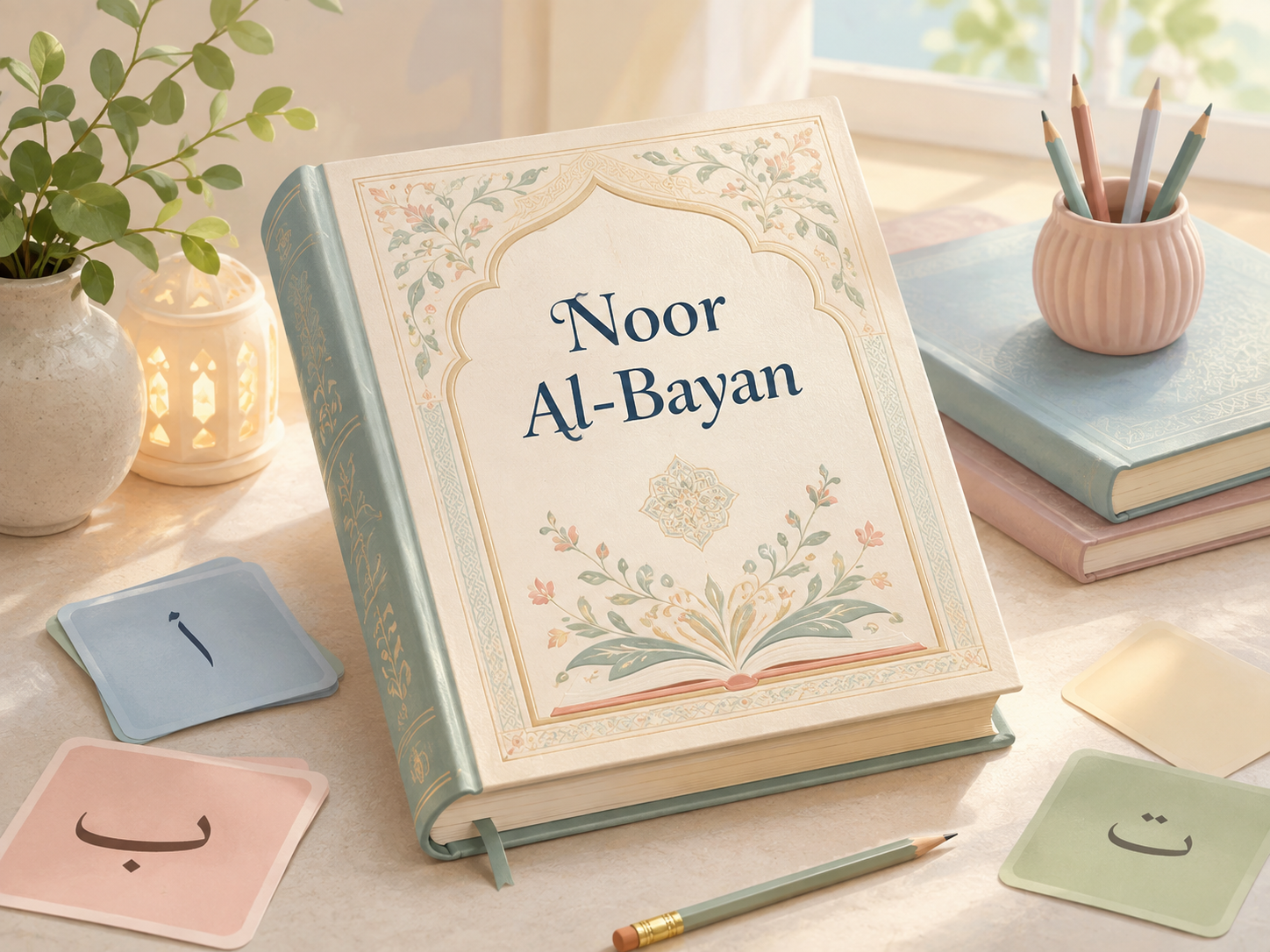
Noor al-bayan for kids is a helpful starting point for children who need Arabic reading foundations before moving into stronger Arabic reading, word reading, or wider Arabic language learning.
In these cases, the child may not need a general Arabic class yet. They may need a clear reading foundation. That is where noor al-bayan for kids can help.
The goal of Noor Al-Bayan is not to make the child memorise letters without understanding. The goal is to help the child connect Arabic letters, sounds, vowels, and word patterns step by step until reading becomes clearer and more confident.
This matters because early reading is built on sound-letter relationships. Reading Rockets explains that phonics helps children learn the relationship between written letters and spoken sounds, while the Education Endowment Foundation highlights the value of a systematic approach to teaching letter-sound relationships.
For Arabic, this idea is especially important. A child needs to recognise the letter, hear the sound, understand the vowel, blend the parts, and then read the word. If one of these steps is weak, reading can feel difficult.
This guide explains 4 clear signs that your child may need noor al-bayan for kids, how Noor Al-Bayan supports Arabic reading foundations, and when your child may be ready for the next step.
Quick answer: Your child may need noor al-bayan for kids if they cannot recognise Arabic letters confidently, confuse similar sounds, struggle with short and long vowels, or cannot read simple Arabic words without heavy support.
| Clear Sign | What You May Notice | Why Noor Al-Bayan Helps |
|---|---|---|
| Your child does not know Arabic letters clearly | They forget letters, guess randomly, or mix up letter shapes. | Noor Al-Bayan builds letter recognition step by step. |
| Your child confuses letters or sounds | They mix similar letters, sounds, or positions in words. | Noor Al-Bayan gives repeated sound and reading practice. |
| Your child struggles with vowels | They do not know how short or long vowels change reading. | Noor Al-Bayan teaches vowels gradually and practically. |
| Your child cannot read simple words confidently | They read very slowly, stop often, or need constant help. | Noor Al-Bayan helps children move from letters to words. |
Table of Contents
- What Is Noor Al-Bayan for Kids?
- Why Arabic Reading Foundations Matter
- Noor Al-Bayan for Kids: 4 Clear Signs Your Child Needs It
- Why One-to-One Noor Al-Bayan Lessons Help
- When Is Your Child Ready for the Next Step?
- Common Mistakes Parents Should Avoid
- How Sibghah Academy Supports Noor Al-Bayan Learning
- FAQ
What Is Noor Al-Bayan for Kids?
noor al-bayan for kids is a structured Arabic reading foundation method that helps children move gradually from Arabic letters and sounds to vowels, joined letters, and simple word reading.
For many children, Arabic reading becomes difficult when they are asked to read words before they have mastered the building blocks. A child may see Arabic letters, but not know how to connect the letter shape to the sound. Another child may know the letter alone but not recognise it when it appears at the beginning, middle, or end of a word.
Noor Al-Bayan helps by slowing the process down and building reading in small steps. Instead of jumping into long words or full sentences too early, the child learns how Arabic reading works.
A typical noor al-bayan for kids path may include:
- Recognising Arabic letters.
- Understanding Arabic sounds.
- Reading letters with short vowels.
- Reading letters with long vowels.
- Understanding Sukoon.
- Understanding Shaddah.
- Reading joined letters.
- Reading short Arabic words.
- Building reading confidence gradually.
At Sibghah Academy, the Noor Al-Bayan Course is taught through one-to-one online lessons. This helps the teacher focus on the child’s exact reading level, correct mistakes gently, and move at the right pace.
This is important because children do not all struggle in the same place. Some children need letters. Some need vowels. Some need blending. Some need confidence. A one-to-one approach allows the teacher to see where the child is stuck.
Why Arabic Reading Foundations Matter
Arabic reading foundations matter because children cannot read confidently if the early building blocks are weak.
Reading Rockets explains that phonics teaches the relationship between letters and sounds in an organised way. The Education Endowment Foundation also highlights that systematic phonics instruction uses an explicit and organised sequence to teach letter-sound relationships.
Although Arabic is different from English, the general principle is useful for parents: beginning readers need a clear path from symbol to sound to word.
In Arabic, the child needs to understand:
- The shape of each letter.
- The sound of each letter.
- How vowels change the sound.
- How long vowels stretch the sound.
- How letters join inside words.
- How to blend sounds to read words.
- How to read slowly without guessing.
If these foundations are weak, the child may appear careless or uninterested, but the real problem may be that reading feels unclear. The child is trying to read without having enough tools.
This is why noor al-bayan for kids can be helpful. It gives the child a structured way to understand Arabic reading instead of depending on guessing or memorisation.
Helpful external references:
Noor Al-Bayan for Kids: 4 Clear Signs Your Child Needs It
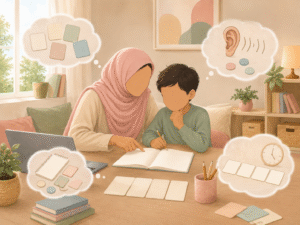
Here are 4 clear signs that your child may need noor al-bayan for kids before moving into wider Arabic reading or language work.
1. Your Child Does Not Know Arabic Letters Clearly
The first sign your child may need noor al-bayan for kids is unclear letter recognition.
Your child may know some Arabic letters, but not all of them. They may recognise the letter when it is written alone, but not when it appears inside a word. They may guess the letter based on memory rather than truly recognising it.
You may notice signs like:
- Your child forgets letters they learned before.
- Your child mixes letters that look similar.
- Your child recognises the letter alone but not in a word.
- Your child needs repeated help with the same letter.
- Your child guesses instead of reading carefully.
- Your child becomes frustrated when asked to read.
This does not mean your child is lazy. It usually means the foundation is not stable yet.
A structured noor al-bayan for kids class can help the child revisit letters in a clearer way. The teacher can check which letters are known, which ones are confused, and which ones need more practice.
For some children, the issue is not the letter name. It is the letter sound. A child may know what the letter is called but still struggle to read it with a vowel or inside a word.
This is why the teacher should not rush. The goal is not to finish letters quickly. The goal is to make letters clear enough for reading.
2. Your Child Confuses Arabic Letters or Sounds
The second sign your child may need noor al-bayan for kids is confusion between letters or sounds.
Arabic has letters that may look similar to a beginner. Some letters also have sounds that may be unfamiliar to children who mostly speak English. This can make reading difficult.
Your child may confuse:
- Letters that share the same basic shape.
- Letters with dots in different places.
- Letters that change shape depending on position.
- Sounds that are close or unfamiliar.
- Letters when they appear joined in words.
When a child confuses letters, reading becomes slow and tiring. The child has to stop often and think. Sometimes they guess. Sometimes they avoid reading altogether.
A good noor al-bayan for kids lesson should give repeated, calm practice. The teacher can show the difference between similar letters, repeat the sound, ask the child to read slowly, and correct gently.
This is where one-to-one lessons are helpful. In a group, the teacher may not catch every small confusion. In a one-to-one lesson, the teacher can hear the child clearly and correct the exact mistake.
If pronunciation is a major issue, this guide may also help: Arabic Alphabet with Pronunciation.
3. Your Child Struggles with Short and Long Vowels
The third sign your child may need noor al-bayan for kids is vowel confusion.
In Arabic, vowels are not a small detail. They change how the letter is read and how the word sounds. A child who does not understand short vowels, long vowels, Sukoon, and Shaddah may struggle to read even simple words.
You may notice that your child:
- Reads the letter sound without the vowel.
- Mixes short vowels.
- Does not stretch long vowels correctly.
- Stops when they see Sukoon.
- Does not know what Shaddah does.
- Reads the same word differently each time.
This is one of the main reasons children need a structured reading foundation. If vowels are weak, the child may not be ready for longer words or faster reading.
A good noor al-bayan for kids class teaches vowels gradually. The child should not only memorise vowel names. They should practise reading with them repeatedly until the pattern becomes familiar.
For example, the child needs to see how the same letter changes with different vowels. Then the child needs to read those patterns inside short words. This repeated practice builds confidence.
Parents should not panic if vowels take time. Many children need repetition before vowel reading becomes natural.
4. Your Child Cannot Read Simple Arabic Words Confidently
The fourth sign your child may need noor al-bayan for kids is difficulty reading simple Arabic words.
This is often the moment parents notice the problem clearly. The child may know some letters, but when a word appears, everything becomes difficult. They read very slowly, stop after every letter, or wait for the parent to help.
You may notice that your child:
- Reads one letter at a time without blending.
- Cannot move smoothly from letter to word.
- Forgets the beginning of the word by the time they reach the end.
- Needs constant help to finish a word.
- Reads the same word differently each time.
- Feels nervous when asked to read aloud.
This usually means the child needs more practice moving from individual letters to connected reading.
A structured noor al-bayan for kids class can help the child read slowly, blend sounds, recognise patterns, and gain confidence with short words before moving to longer reading.
After the child begins reading words more confidently, parents can add simple practice at home. This guide may be useful at that stage: Arabic Reading Practice for Kids.
Does your child struggle with Arabic reading foundations?
Sibghah Academy offers one-to-one Noor Al-Bayan lessons for children who need help with Arabic letters, sounds, vowels, joined letters, and word reading.
Why One-to-One Noor Al-Bayan Lessons Help
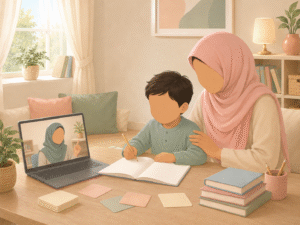
One-to-one noor al-bayan for kids lessons can be especially helpful because Arabic reading mistakes are often personal and specific.
One child may confuse sounds. Another may struggle with vowels. Another may read letters correctly but cannot blend them into words. Another may feel shy and needs encouragement before reading aloud.
In a one-to-one lesson, the teacher can focus on exactly what the child needs.
| One-to-One Benefit | How It Helps Noor Al-Bayan Learning |
|---|---|
| Personal level check | The teacher identifies which letters, sounds, or vowels are weak. |
| More reading time | The child reads more often than they would in a group class. |
| Gentle correction | The teacher corrects mistakes immediately without pressure. |
| Flexible pace | The lesson can slow down until the child understands. |
| Better confidence | The child practises without comparison to other children. |
| Clear parent feedback | Parents know what to practise and what comes next. |
This is why noor al-bayan for kids works best when the teacher listens carefully to the child’s reading and corrects mistakes step by step.
Parents often try to help at home, but Arabic reading correction can be difficult if the child is frustrated or if the parent is not sure where the problem is. A teacher can identify the exact reading gap and guide the child calmly.
When Is Your Child Ready for the Next Step?
Your child may be ready to move beyond noor al-bayan for kids when Arabic reading foundations become more stable.
This does not mean the child reads perfectly. It means the child can read simple Arabic words with more confidence and less guessing.
Signs of readiness may include:
- Your child recognises Arabic letters clearly.
- Your child reads short vowels more accurately.
- Your child understands long vowels better.
- Your child can read simple joined letters.
- Your child can read short Arabic words slowly but correctly.
- Your child makes fewer repeated mistakes.
- Your child feels less nervous when reading aloud.
After Noor Al-Bayan, some children need more reading practice. Others may be ready to begin wider Arabic language learning, including vocabulary, comprehension, writing, and speaking.
For parents thinking about the next stage, this guide explains the transition clearly: After Noor Al-Bayan.
Common Mistakes Parents Should Avoid
Parents often search for noor al-bayan for kids because they want to help their child read Arabic. Avoiding these mistakes can make the learning journey easier.
Starting too advanced
If your child cannot read letters and vowels clearly, starting with long words or advanced Arabic reading may cause frustration.
Repeating letters without sounds
Children need to connect letters to sounds. Letter names alone are not enough for reading.
Rushing vowels
Short vowels, long vowels, Sukoon, and Shaddah need time. If the child does not understand them, word reading becomes difficult.
Expecting fast reading too early
Beginning readers may read slowly. Slow reading is normal when the child is still building foundations.
Correcting harshly
Correction is important, but harsh correction can make the child avoid reading. Gentle correction works better.
Using random materials
A child who is still building Arabic reading needs a clear sequence, not scattered pages from different levels.
A good noor al-bayan for kids path should be structured, calm, repeated, and matched to the child’s level.
How Sibghah Academy Supports Noor Al-Bayan Learning
Sibghah Academy offers live one-to-one Noor Al-Bayan lessons for children who need Arabic reading foundations.
In Sibghah’s noor al-bayan for kids lessons, the teacher can support your child with:
- Arabic letter recognition.
- Arabic sound practice.
- Short vowels.
- Long vowels.
- Sukoon.
- Shaddah.
- Joined letter reading.
- Simple word reading.
- Reading confidence.
- Parent feedback.
Because the lessons are one-to-one, your child gets more reading time and more personal correction. The teacher can slow down when your child struggles and move forward when the foundation becomes stronger.
This makes noor al-bayan for kids a suitable starting point for children who need Arabic reading basics before moving into wider Arabic learning.
Book your child’s free Noor Al-Bayan trial
If your child struggles with Arabic letters, sounds, vowels, or simple word reading, Sibghah Academy can help through one-to-one Noor Al-Bayan lessons.
Send us your child’s age and current Arabic reading level, and we will recommend the right starting point.
Quick Parent Checklist
Use this checklist to decide whether your child may need noor al-bayan for kids:
- Does my child recognise Arabic letters clearly?
- Does my child confuse similar-looking letters?
- Does my child know the sound of each letter?
- Does my child understand short vowels?
- Does my child understand long vowels?
- Does my child struggle with Sukoon or Shaddah?
- Can my child read joined letters?
- Can my child read simple Arabic words without guessing?
- Does my child feel nervous when reading aloud?
- Would one-to-one correction help my child?
FAQ: Noor Al-Bayan for Kids
1. What is noor al-bayan for kids?
noor al-bayan for kids is a structured Arabic reading foundation method that helps children learn Arabic letters, sounds, vowels, joined letters, and simple word reading step by step.
2. How do I know if my child needs Noor Al-Bayan?
Your child may need Noor Al-Bayan if they struggle with Arabic letters, confuse sounds, do not understand vowels, or cannot read simple Arabic words confidently.
3. Is Noor Al-Bayan only for very young children?
No. Noor Al-Bayan can help any child who needs Arabic reading foundations, even if they are older than the beginner age range.
4. Can Noor Al-Bayan help my child read Arabic words?
Yes. noor al-bayan for kids helps children move gradually from letters and vowels to joined letters and simple Arabic word reading.
5. What if my child knows Arabic letters but still cannot read?
Your child may need more work on vowels, joined letters, blending, and word reading. Noor Al-Bayan can help strengthen these areas.
6. Are one-to-one Noor Al-Bayan lessons better than group lessons?
One-to-one lessons can be better for many children because the teacher can hear mistakes clearly, correct gently, and move at the child’s pace.
7. How long does Noor Al-Bayan take?
This depends on the child’s age, current level, consistency, and how much practice they need. A trial or level check can help estimate the right path.
8. What comes after Noor Al-Bayan?
After Noor Al-Bayan, some children need more Arabic reading practice, while others may be ready for wider Arabic language learning, including vocabulary, comprehension, writing, and speaking.
9. Does Sibghah Academy offer noor al-bayan for kids?
Yes. Sibghah Academy offers one-to-one noor al-bayan for kids lessons to help children build Arabic reading foundations with personal correction and parent feedback.
10. What is the best next step?
The best next step is to book a trial or level check so the teacher can see whether your child needs letters, sounds, vowels, joined letters, or word reading support.