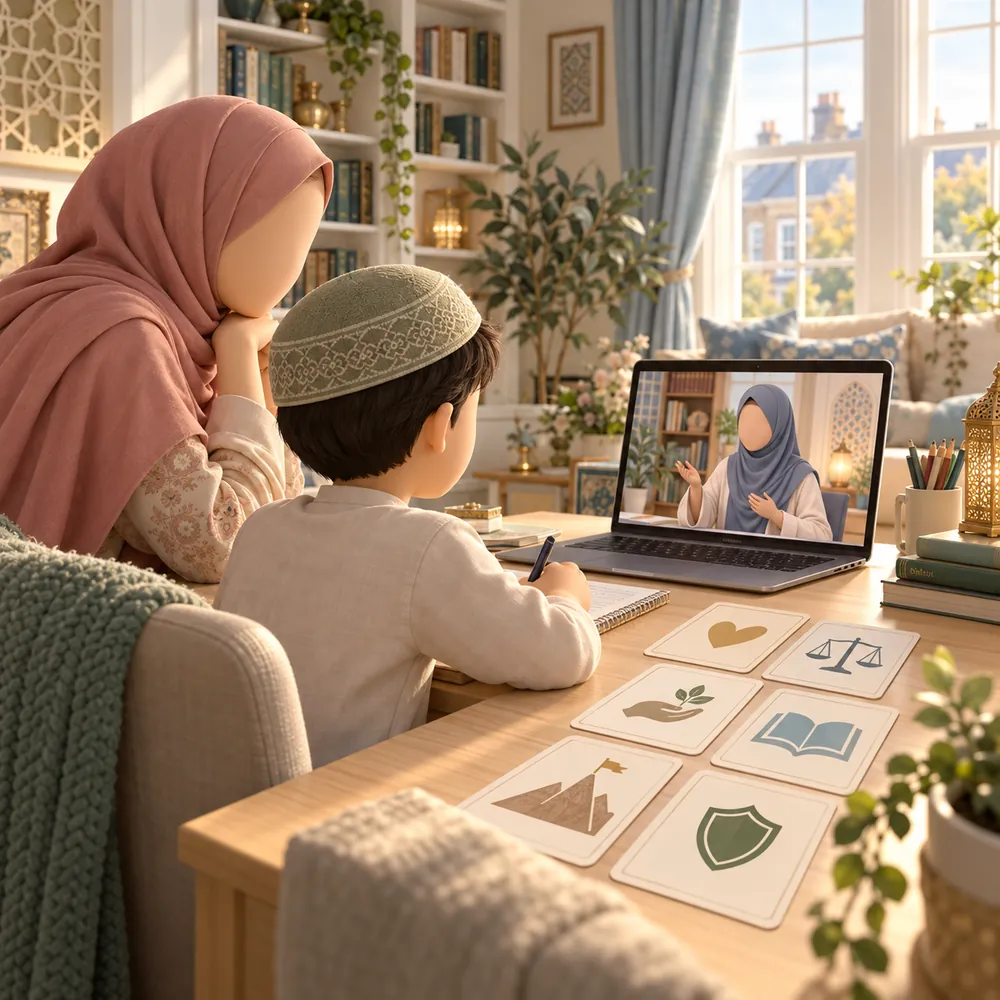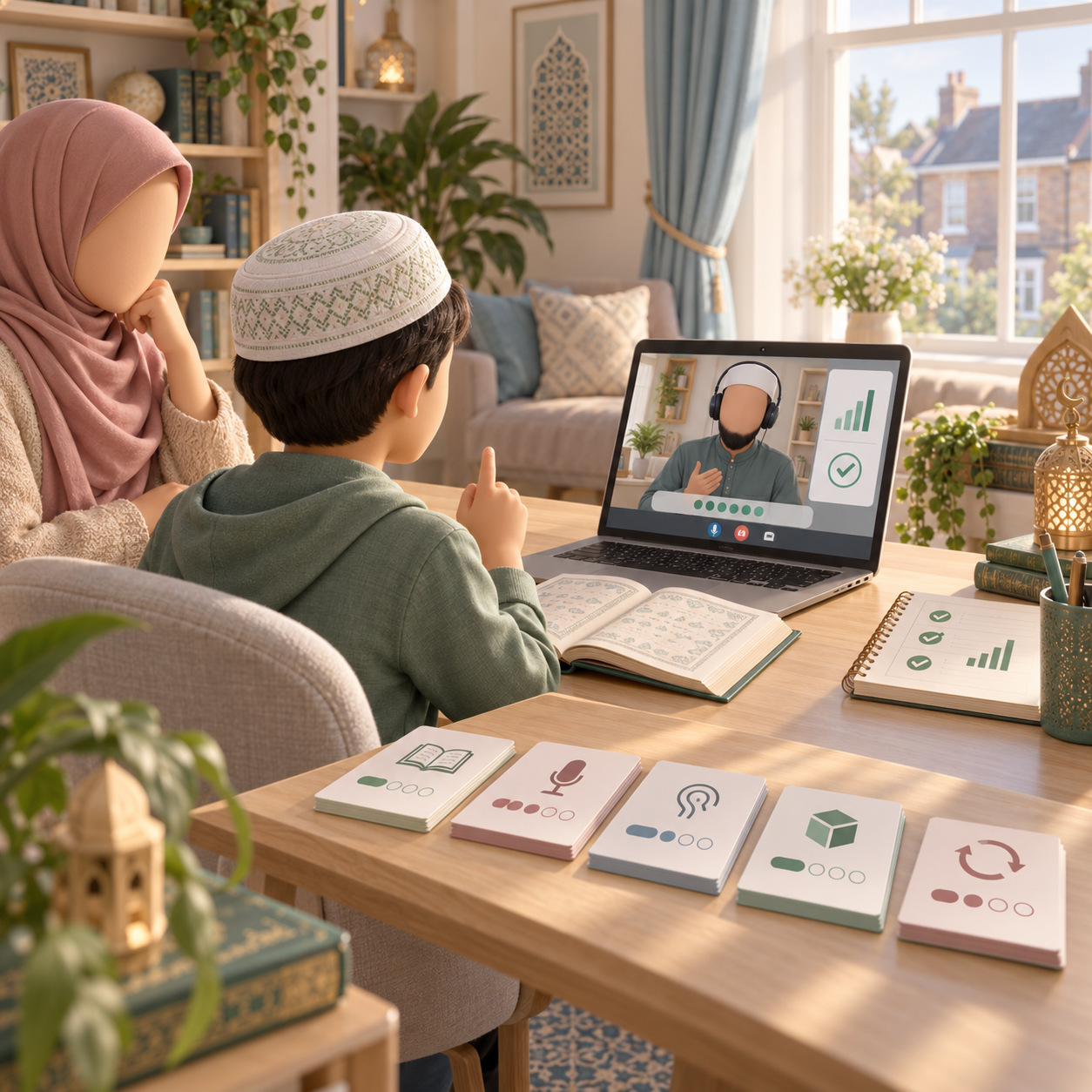
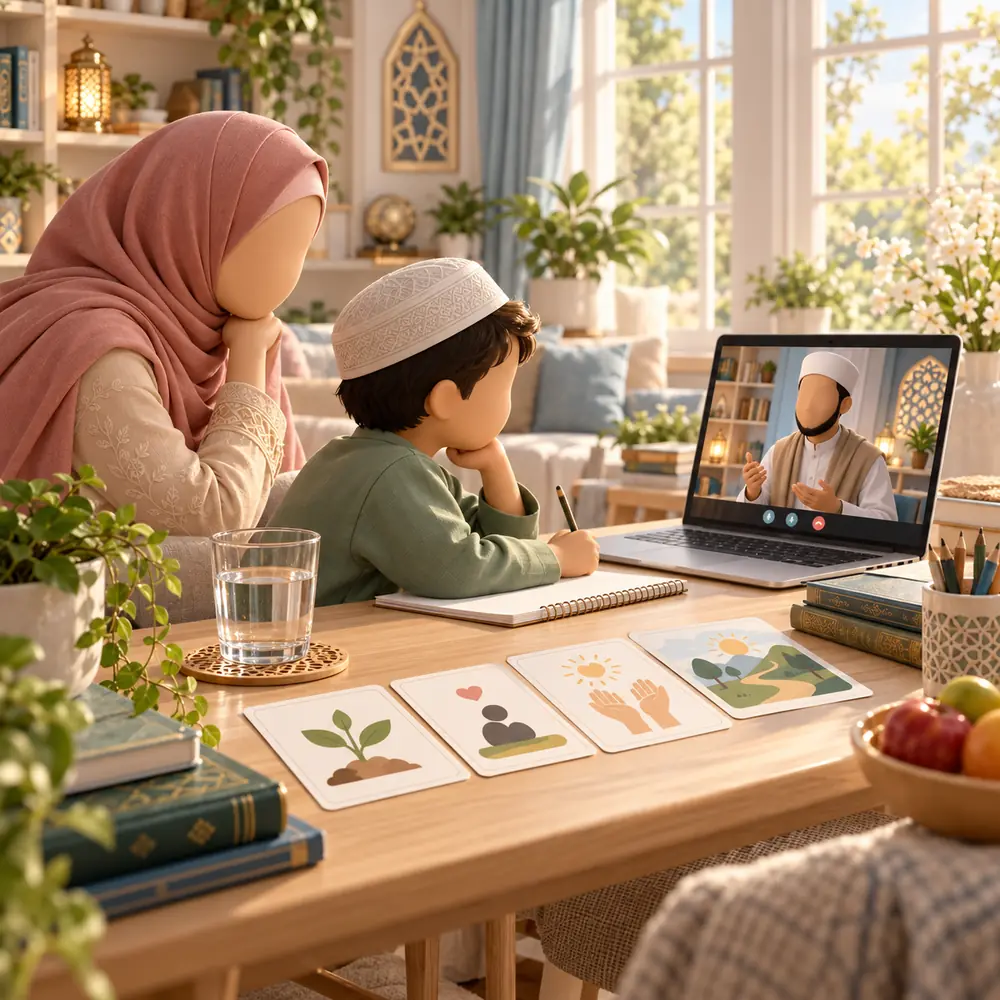
A good Names of Allah Course for Kids should help children do much more than memorise a list of names. Children need to understand who Allah is through the Names He has revealed, learn simple and accurate meanings, connect those meanings to dua and worship, and gradually understand how knowing Allah should affect gratitude, trust, sincerity and everyday behaviour.
For parents choosing a Names of Allah Course for Kids, the most important question is therefore not simply, “Will my child memorise the 99 Names?” A stronger question is: “Will my child understand what these Names teach us about Allah and know how that knowledge belongs in real Muslim life?”
Quick answer: a strong Names of Allah Course for Kids should include sound Aqeedah foundations, age-appropriate explanations of Allah’s Beautiful Names, Quran and authentic Sunnah, practical reflection, dua, character development and meaningful review. The goal should be knowledge that strengthens faith rather than memorisation without meaning.
What Is a Names of Allah Course for Kids?
A Names of Allah Course for Kids is an Islamic Studies programme that helps children know Allah through His Beautiful Names and understand what those Names mean for their faith, worship and daily life.
That makes it different from a simple printable list of the 99 Names.
A well-designed course may help children:
- understand basic questions about Allah and worship;
- learn selected Beautiful Names of Allah;
- understand simple meanings;
- see how those meanings are rooted in Quran and authentic Sunnah;
- make dua using Allah’s Names;
- reflect on Allah’s blessings;
- develop trust, gratitude and awareness of Allah;
- connect Islamic knowledge with behaviour.
The purpose of a Names of Allah Course for Kids should therefore be deeper than completing a vocabulary list.
If your child is still building wider Islamic foundations, Sibghah’s Pillars of Iman and Islam for Kids guide explains how belief in Allah fits within the wider foundations of Iman and Islam.
Why Choose a Structured Names of Allah Course for Kids?
Parents can certainly introduce Allah’s Names at home. In fact, short family conversations can be extremely valuable.
So why might a structured Names of Allah Course for Kids still help?
Structure can make sure the learning does not become random.
Instead of teaching whichever Name happens to appear on a worksheet that week, a course can connect:
Foundation → Name → Meaning → Evidence → Reflection → Dua → Application.
This allows a teacher to return to previous ideas, answer questions and gradually add depth.
A structured Names of Allah Course for Kids can also help parents avoid two extremes:
- teaching theology in language that is too advanced for the child;
- reducing Aqeedah to colourful flashcards without meaningful understanding.
Parents who want additional ideas for conversations outside formal lessons can also read Sibghah’s Teach Children About Allah guide.
1. A Names of Allah Course for Kids Should Build the Right Aqeedah Foundation
Before exploring many individual Names, a Names of Allah Course for Kids should establish some basic ideas.
Children need simple answers to questions such as:
- Who is Allah?
- Who created us?
- Why were we created?
- What is worship?
- Why do Muslims worship Allah alone?
- How do we learn about Allah?
- What are Allah’s Beautiful Names?
This matters because learning individual Names without a foundation can turn the subject into disconnected facts.
Children should also learn a simple and important principle:
Allah is unlike His creation, and we learn about Him through revelation rather than imagining Him like created things.
This principle is central to teaching Aqeedah for kids carefully.
The goal is not to overwhelm children with difficult theological terminology. It is to establish a clear foundation before adding depth.
Sibghah’s own teaching material begins with foundational questions before moving into individual Names, helping children understand the subject as part of Aqeedah rather than isolated memorisation.
2. A Names of Allah Course for Kids Should Teach Meaning Before Speed
The next priority in a Names of Allah Course for Kids is understanding.
A child may be able to recite several Names correctly but still struggle to explain what any of them means.
This is why names of Allah lessons for kids should include simple explanations, questions and familiar examples.
Example: Ar-Razzaq — The Provider
A lesson can begin by explaining that Allah provides for His creation.
Then the teacher can ask:
- Is rizq only money?
- Who provided the water you drank today?
- Can knowledge be a blessing?
- Can parents and good friends be blessings?
- Is having health and safety a form of provision?
Now the child begins to see provision differently.
This reflects an important principle in a good Names of Allah Course for Kids: a Name should change how the child understands something about Allah and the world around them.
3. A Names of Allah Course for Kids Should Use Quran and Authentic Sunnah
Islamic belief should not be built on invented stories or unsupported descriptions.
A trustworthy Names of Allah Course for Kids should teach children that Muslims learn about Allah from revelation.
The Quran says:
وَلِلَّهِ الْأَسْمَاءُ الْحُسْنَىٰ فَادْعُوهُ بِهَا
“Allah has the Most Beautiful Names, so call upon Him by them.”
Parents and older learners can read the verse in context in Surah Al-A’raf 7:180.
A teacher can also use passages such as Surah Al-Hashr 59:22–24, where several of Allah’s Names appear together.
A child-friendly discussion might ask:
- Which Names appear in the passage?
- What simple meaning did we learn?
- What does this teach us about Allah?
- How could knowing this affect worship?
Using evidence helps a Names of Allah Course for Kids teach more than content. It teaches children where Islamic knowledge comes from.
4. A Names of Allah Course for Kids Should Teach Children to Make Dua
Allah’s Names belong in worship.
That means a Names of Allah Course for Kids should not stop after definitions.
Children can gradually learn:
Name → Meaning → Need → Dua.
For example, after learning that Allah hears His servants, the child can understand why they can make sincere dua even when nobody else knows what they are feeling.
After learning about Allah’s provision, they can ask Him for good and beneficial provision.
After learning about forgiveness, they can understand why Muslims return to Allah after mistakes.
The Quran also connects Allah’s Beautiful Names with calling upon Him in Surah Al-Isra 17:110.
This makes dua one of the most practical outcomes of an effective Names of Allah Course for Kids.
| Learning Stage | Example |
|---|---|
| Name | Ar-Razzaq |
| Meaning | Allah provides for His creation. |
| Reflection | Many things in my life are blessings and provision. |
| Response | I should be grateful. |
| Dua | I can ask Allah for good and beneficial provision. |
5. A Names of Allah Course for Kids Should Connect Faith to Daily Life
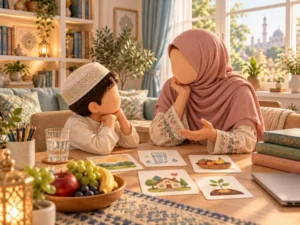
One of the strongest signs of good Islamic teaching is that children recognise the lesson outside class.
A Names of Allah Course for Kids should help children connect faith to situations such as:
- receiving something they wanted;
- feeling worried about school;
- making a mistake;
- being tempted to behave badly when nobody is watching;
- feeling disappointed;
- helping another person;
- making dua;
- noticing everyday blessings.
At school
A child who understands that Allah knows what people do can connect this knowledge to honesty even when a teacher is not watching.
When worried
A child can remember that they can turn to Allah in dua.
When comparing possessions
Learning about provision can help parents discuss gratitude rather than constant comparison.
After making a mistake
Learning about Allah’s mercy and forgiveness can lead to repentance rather than hopelessness.
This daily-life connection is especially valuable in an online Names of Allah Course for Kids, because children need Islamic learning that makes sense beyond the lesson itself.
6. A Names of Allah Course for Kids Should Connect Faith with Character and Reflection
Knowing Allah should influence how a Muslim worships and lives.
A good Names of Allah Course for Kids can help children ask:
“If I know this about Allah, what should that change in me?”
For example:
- knowing Allah provides can strengthen gratitude;
- knowing Allah hears can strengthen dua and careful speech;
- knowing Allah sees can strengthen sincerity;
- learning about mercy can encourage merciful behaviour;
- learning about forgiveness can encourage repentance;
- learning about Allah’s knowledge can strengthen honesty and awareness.
This must still be explained carefully. Allah’s divine attributes are unique to Him. Children should not be taught that human beings possess Allah’s attributes in the same way.
The educational point is to understand the appropriate response to what we learn about Allah.
Reflection can then continue through simple review questions:
- What Name did we learn?
- What does it teach us about Allah?
- How could knowing this change our dua?
- What everyday situation does it remind you of?
- What should this knowledge change in our behaviour?
This allows a Names of Allah Course for Kids to support Aqeedah, worship and character together.
Families looking for a broader pathway can explore Sibghah’s verified Islamic Studies Program, which includes wider learning in belief, worship, manners and Islamic values.
Should a Names of Allah Course for Kids Teach All 99 Names?
This is one of the most common questions parents ask when comparing a Names of Allah Course for Kids.
The Prophet ﷺ taught that Allah has ninety-nine Names and that whoever ahsaha will enter Paradise. The hadith is recorded in Sahih al-Bukhari 7392.
However, parents should not assume that the best children’s course is automatically the one that moves through ninety-nine Names fastest.
A course may focus on selected Names so children have enough time to:
- understand;
- ask questions;
- reflect;
- connect meanings to Quran;
- make dua;
- apply the lesson.
This is why parents comparing a 99 names of Allah for kids programme should ask about the depth of teaching as well as the quantity covered.
What Could a Names of Allah Course for Kids Lesson Look Like?
A well-structured Names of Allah Course for Kids does not need to feel like a long lecture.
A child-friendly lesson might include:
- Short review: remember one idea from the previous lesson.
- Introduce the Name: pronounce and explain it clearly.
- Simple meaning: explain what the child needs to understand.
- Evidence: connect the lesson to Quran or authentic Sunnah.
- Questions: invite the child to think and respond.
- Daily-life example: connect the Name to something familiar.
- Dua: help the child see how the Name belongs in worship.
- Reflection: ask what the lesson should change in thought or behaviour.
- Review: finish with one memorable takeaway.
This approach makes names of Allah lessons for kids interactive while keeping them spiritually meaningful.
What Children Can Benefit from a Names of Allah Course for Kids?
There is no single age that determines whether a child is ready for a Names of Allah Course for Kids.
Children develop at different rates and may have very different levels of previous Islamic knowledge.
The better questions are:
- Can the child understand simple Islamic meanings?
- Can they listen and respond to questions?
- Can they connect an idea with an everyday example?
- Are they beginning to ask questions about Allah, dua or worship?
- Can the teacher adapt explanations to their level?
A child who is new to Islamic Studies may need very simple explanations, while another child with more previous learning may be ready for deeper discussion.
The teaching should adapt to the learner rather than forcing every child into the same age-based level.
Can Children Take an Online Names of Allah Course for Kids?
Yes. The subject can work well online when the lesson remains interactive.
An online Names of Allah Course for Kids should not mean a child sitting silently while a teacher talks for the entire session.
Useful online teaching can include:
- questions;
- discussion;
- short scenarios;
- visual prompts;
- reflection;
- simple activities;
- dua;
- review.
The teacher should notice whether the child actually understands the concept rather than assuming that silence means comprehension.
For children who mainly use English in daily life, clear English explanations can also help them engage with Islamic meanings while still learning important Arabic terms.
How to Choose a Names of Allah Course for Kids
Before registering, parents can ask several practical questions.
1. Is the teaching grounded in Quran and authentic Sunnah?
A Names of Allah Course for Kids teaches Aqeedah, so accuracy matters.
2. Does the course explain meaning?
Ask whether children are expected only to memorise or whether the teacher explores meanings and application.
3. Is the teaching adapted to the child?
The explanation should match the learner’s understanding and previous Islamic knowledge rather than relying only on age.
4. Can children ask questions?
Questions about Allah should be treated seriously and calmly.
5. Does the course include dua?
Learning Allah’s Names should lead naturally toward worship.
6. Is there practical application?
Parents should be able to see how lessons connect to gratitude, trust, honesty, patience, repentance and other parts of Muslim life.
7. How is progress reviewed?
Ask whether progress means only remembering Names or also understanding meanings and applying ideas.
8. Is the lesson format suitable for your child?
Some children benefit from individual discussion. Others enjoy learning in a small group.
The strongest Names of Allah Course for Kids for your family is one that combines sound content with a teaching format your child can genuinely engage with.
Warning Signs When Choosing a Names of Allah Course for Kids
Parents should be cautious if a course:
- focuses almost entirely on speed memorisation;
- makes unsupported statements about Allah;
- encourages children to imagine Allah physically;
- uses complicated theological language without explanation;
- presents Allah mainly through fear and punishment;
- does not connect learning to dua or worship;
- discourages sincere questions;
- uses exactly the same explanation for every learner;
- cannot explain what children are expected to understand.
Beautiful design and colourful worksheets can be useful additions, but they are not enough to make a strong Names of Allah Course for Kids.
The foundation still needs to be correct knowledge taught clearly and thoughtfully.
What Does Sibghah’s Names of Allah Course for Kids Include?
Sibghah Academy offers a dedicated Names of Allah Course for Kids within its Islamic Studies programmes. The current course page describes a live online programme focused on understanding selected Names of Allah, their meanings, faith, trust, dua and practical application rather than memorisation alone.
The programme focuses on areas such as:
- foundational questions in Aqeedah;
- understanding Allah’s Beautiful Names and their meanings;
- learning how knowledge of Allah strengthens faith;
- connecting the Names to worship and daily life;
- using questions, examples and reflection;
- building gratitude, trust and awareness of Allah;
- connecting faith with good character.
The teaching material begins with foundational questions before exploring individual Names.
Examples include learning about Ar-Razzaq and recognising that provision is wider than money, as well as reflecting on Names connected with Allah’s hearing, seeing, knowledge and preservation.
The programme is not tied to a fixed number of sessions. The learning pace can follow the child’s understanding and progress.
Each live lesson lasts 60 minutes.
Lessons can be delivered in an interactive format that allows children to listen, answer questions, reflect, discuss examples and connect what they learn with daily life.
Parents can visit Sibghah’s current verified Names of Allah Course for Kids page for the latest programme information.
Families who want a wider structured pathway can also explore Sibghah’s Islamic Studies Program.
A free trial is available for families who want to experience the learning format before deciding whether it is suitable for their child.
Book a free trial for the Names of Allah Course for Kids
Sibghah Teacher Note
Sibghah Teacher Note: a Names of Allah Course for Kids should not be measured only by how many Names the child can repeat. After a lesson, ask whether the child can explain the meaning simply, connect it to authentic Islamic teaching, identify one way it affects worship or behaviour, and remember the idea when a similar situation appears in daily life. Understanding should grow alongside memorisation.
Names of Allah Course for Kids: Parent Checklist
Before choosing a Names of Allah Course for Kids, ask:
- Is Quran and authentic Sunnah the foundation?
- Does the teacher explain basic Aqeedah clearly?
- Does my child learn meanings rather than Names alone?
- Are explanations appropriate for my child’s level?
- Can children ask questions?
- Does the course connect Allah’s Names to dua?
- Does it include everyday examples?
- Does it balance love, hope, trust, reverence and accountability?
- Does the teacher avoid unsupported descriptions of Allah?
- Does review test understanding as well as memory?
- Does the course connect faith with character?
- Is the lesson format suitable for my child?
- Can the provider clearly explain what the child should learn?
Frequently Asked Questions About a Names of Allah Course for Kids
What is a Names of Allah Course for Kids?
A Names of Allah Course for Kids is an Islamic Studies programme that helps children learn Allah’s Beautiful Names, understand their meanings and connect that knowledge with Aqeedah, worship, dua and everyday life.
Is the course mainly about memorising 99 Names?
No. Memorisation can be part of learning, but children also need meaning, reflection, authentic evidence and practical application.
Should children learn all 99 Names of Allah?
Children can gradually learn Allah’s Names, but a course does not need to rush through all ninety-nine at the expense of understanding. A focused study of selected Names can allow more time for meaning and reflection.
What should children learn first?
A good Names of Allah Course for Kids can begin with basic Aqeedah questions: who Allah is, why He alone deserves worship, what worship means and how Muslims learn about Allah.
What age is suitable for a Names of Allah Course for Kids?
There is no single age that fits every child. Readiness depends on the child’s understanding, previous Islamic learning and ability to engage with the lesson. Teaching should be adapted to the learner rather than based on age alone.
Can children learn Allah’s Names online?
Yes. Live online teaching can work well when children can interact, answer questions, discuss meanings and receive explanations suited to their level.
How should Allah’s Names be explained to children?
Use accurate but simple meanings, Quran and authentic Sunnah, everyday examples and thoughtful questions. Avoid unnecessary complexity and avoid imagining Allah like His creation.
Can a Names of Allah Course for Kids help with dua?
Yes. The Quran specifically connects Allah’s Beautiful Names with calling upon Him. Understanding the Names can make children’s dua more meaningful.
What is the difference between memorising and understanding Allah’s Names?
Memorisation answers, “What is the Name?” Understanding also asks, “What does this teach me about Allah, and how should it affect my worship and life?”
Is learning the Names of Allah part of Aqeedah for kids?
Yes. Knowing Allah is a central part of Islamic belief. Learning Allah’s Names can support a child’s understanding of Tawheed, worship and Iman.
Does Sibghah offer an online Names of Allah Course for Kids?
Yes. Sibghah offers a dedicated live online Names of Allah Course for Kids within its Islamic Studies programmes. The focus is on understanding Allah’s Names, strengthening faith and connecting Islamic meanings with daily life.
How long is each Sibghah Names of Allah lesson?
Each live Sibghah Names of Allah lesson lasts 60 minutes.
Is there a fixed number of sessions?
No. The programme is not tied to a fixed number of sessions. The learning pace can follow the child’s understanding, progress and learning needs.
Can my child try the course before enrolling?
Yes. Sibghah offers a free trial so families can experience the learning format and decide whether it is suitable for their child.
Is the Names of Allah Course for Kids part of wider Islamic Studies?
Yes. Knowing Allah is one important area within children’s Islamic Studies. Other learning can include Aqeedah, worship, Fiqh, manners, Prophets’ stories and Muslim role models.
Final Thoughts: What Makes a Good Names of Allah Course for Kids?
A meaningful Names of Allah Course for Kids should leave a child with more than a list.
The child should gradually understand:
- who Allah is;
- why Allah alone is worshipped;
- what selected Beautiful Names mean;
- how we know these Names;
- how Allah’s Names belong in dua;
- how knowing Allah builds gratitude and trust;
- how belief should affect everyday choices.
The strongest Names of Allah Course for Kids is therefore not necessarily the course that promises to cover the largest number of Names in the shortest time.
Parents should look for accuracy, understanding, reflection, appropriate teaching and meaningful application.
Children can memorise, but they should also understand.
They can learn definitions, but they should also make dua.
They can answer questions in class, but they should also begin recognising what those lessons mean at home, at school and in their relationship with Allah.
That is when a Names of Allah Course for Kids becomes more than another Islamic Studies subject. It becomes part of building a child’s faith foundation.
If you would like your child to experience Sibghah’s programme before deciding, you can begin with a free trial and speak with the academy about the most suitable learning approach for your child.