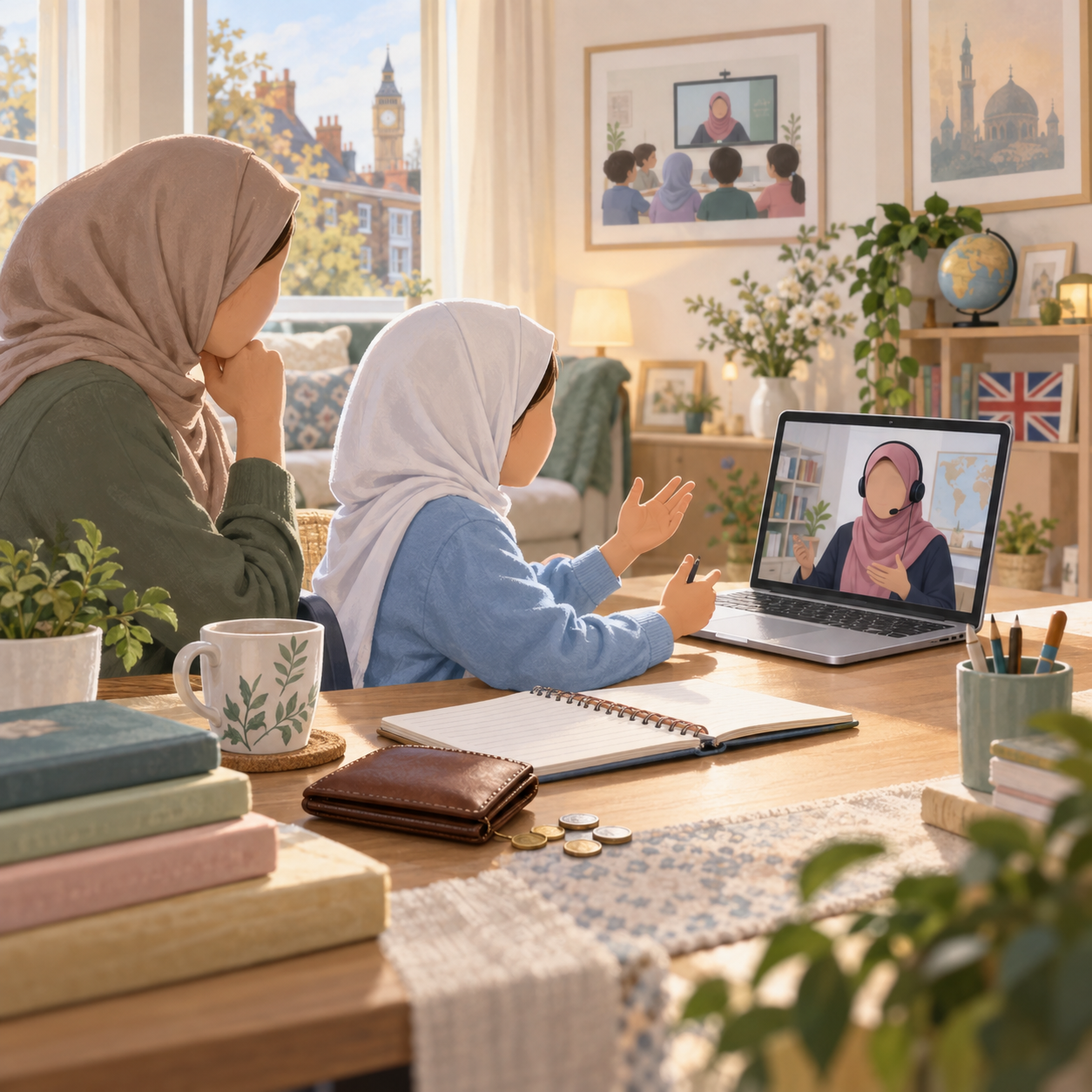


Arabic Teacher for Kids UK is a search many Muslim parents make when they realise that choosing the right teacher matters just as much as choosing the right Arabic programme. A teacher may speak excellent Arabic, but teaching a five-year-old beginner, a shy heritage learner, or a child who understands Arabic but always answers in English requires a different set of skills.
The right Arabic teacher should understand your child’s current level, know how to teach children patiently, give them enough time to speak and read, correct mistakes without embarrassment, and explain progress clearly to parents.
This Arabic Teacher for Kids UK guide focuses on the teacher rather than the course. It will help you understand what to observe during a trial lesson, what questions to ask, which teaching behaviours matter, and how to know whether a teacher is genuinely helping your child develop Arabic skills and confidence.
Quick answer: A good Arabic Teacher for Kids UK should combine strong Arabic knowledge with child-friendly teaching skills. Look for a teacher who assesses your child first, adapts the lesson to their level, balances correction with encouragement, gives the child plenty of active Arabic practice, understands reading and speaking as different skills, and keeps parents informed.
Book a free Arabic trial session for your child on WhatsApp
Table of Contents
- Arabic Speaker vs Arabic Teacher: What Is the Difference?
- Arabic Teacher for Kids UK: 9 Smart Checks
- How Should a Teacher Adapt to Different Children?
- Can One Teacher Support Reading and Speaking?
- What If Your Child Understands Arabic but Answers in English?
- Why One-to-One Teaching Can Help
- What to Watch During an Arabic Trial Lesson
- Arabic Teacher Red Flags
- How Sibghah Approaches Arabic Teaching
- Parent Checklist
- FAQ
Arabic Speaker vs Arabic Teacher: What Is the Difference?

One of the first things parents should understand when looking for an Arabic Teacher for Kids UK is that speaking Arabic fluently does not automatically make someone a good teacher for children.
A fluent speaker knows the language. A skilled teacher knows how to help another person learn it.
Teaching a child requires the teacher to break language into manageable steps. They need to notice why the child is struggling, decide what to practise next, repeat without becoming impatient, and adjust explanations when the first approach does not work.
For example, a child may repeatedly confuse two sounds. Simply saying the correct word again may not solve the problem. A good teacher notices the pattern, slows the sound down, demonstrates it clearly, gives the child another attempt, and returns to it later.
A child may also know an answer but feel too shy to speak. In that case, the teacher needs confidence-building skills, not only Arabic knowledge.
| Arabic Speaker | Child-Friendly Arabic Teacher |
|---|---|
| Speaks Arabic well | Can explain Arabic at the child’s level |
| Knows correct pronunciation | Can identify why the child is pronouncing something incorrectly |
| Understands vocabulary | Knows how to introduce vocabulary gradually |
| Can hold a conversation | Can build a child from one-word answers to simple sentences |
| Uses Arabic naturally | Knows when to simplify, repeat, model and encourage |
This distinction is essential when choosing an Arabic Teacher for Kids UK.
Arabic Teacher for Kids UK: 9 Smart Checks for Parents

Use these nine checks when evaluating an Arabic Teacher for Kids UK. They focus on what actually happens between the teacher and the child rather than qualifications or marketing language alone.
1. Does the teacher assess your child before deciding what to teach?
A good teacher should first understand what your child can already do.
The teacher may check whether the child:
- Recognises Arabic letters
- Can pronounce common sounds
- Reads isolated or connected words
- Understands simple Arabic instructions
- Knows everyday vocabulary
- Can answer simple questions
- Can build a short Arabic sentence
This does not need to feel like a formal exam. With younger children, assessment can happen naturally through simple activities and conversation.
A strong Arabic Teacher for Kids UK should use this information to decide what the child needs next rather than putting every student into the same starting point.
2. Does the teacher know how to explain Arabic simply?
Children do not need complicated explanations. They need explanations they can understand and use.
A teacher should be able to turn a difficult skill into small steps. If the child does not understand the first explanation, the teacher should try another approach rather than simply repeat the same instruction louder or more slowly.
This becomes especially important with children learning Arabic as an additional language. They may not understand grammatical terminology, but they can still learn patterns through examples, repetition, listening, and guided practice.
When evaluating an Arabic Teacher for Kids UK, notice whether the teacher makes Arabic feel clearer or more confusing.
3. How does the teacher correct mistakes?
Mistakes are a normal part of learning another language. Children need correction, but correction should help them improve rather than make them afraid to try.
Imagine a child says a word incorrectly.
A helpful teacher may:
- Repeat the correct version naturally.
- Ask the child to listen.
- Break the word into smaller sounds if needed.
- Let the child try again.
- Encourage the improved attempt.
An effective Arabic Teacher for Kids UK does not ignore repeated mistakes, but they also do not turn every mistake into a stressful interruption.
Parents should especially watch whether the teacher uses embarrassment, comparison, or excessive criticism. Those methods can quickly reduce a child’s confidence.
4. Does your child actually get enough time to speak?
A language lesson should not be dominated by the teacher.
If your goal includes spoken Arabic, your child needs opportunities to use Arabic themselves.
The teacher might ask the child to:
- Name familiar objects
- Answer short questions
- Describe a picture
- Choose between two options
- Build a sentence
- Talk about their routine
- Ask the teacher a simple question
A good Arabic Teacher for Kids UK gradually increases the amount the child says. A beginner may begin with one word. Later that becomes a phrase, then a sentence, then a short exchange.
The important point is that the child is using Arabic rather than spending the whole lesson listening to someone else use it.
5. Can the teacher recognise whether the problem is reading, speaking or confidence?
Children often have uneven Arabic abilities.
A child may understand Arabic but avoid speaking. Another may speak comfortably with family but struggle to read. Another may recognise letters but read very slowly. A fourth child may know more Arabic than they show because they are nervous.
An experienced Arabic Teacher for Kids UK should notice these differences.
| What You Notice | What the Child May Need |
|---|---|
| Understands but answers in English | Speaking confidence and sentence-building |
| Knows letters but reads slowly | Reading fluency and repeated practice |
| Can speak but cannot read | Structured reading foundations |
| Knows the answer but stays silent | Confidence and low-pressure participation |
| Forgets vocabulary quickly | Repetition and meaningful reuse |
This is why simply labelling a child “beginner” is often not enough.
6. Does the teacher adapt the pace to the child?
Children do not all learn at the same speed.
A child may understand new vocabulary quickly but need more time with reading. Another may read well but hesitate when speaking. A younger child may need shorter activities and more frequent changes of task.
The advantage of a good Arabic Teacher for Kids UK is that the teacher can notice these differences and adapt.
Moving too quickly can create gaps. Moving too slowly can make the child bored. Good teaching sits between the two.
This is one reason one-to-one lessons can be useful for children whose level does not fit neatly into a standard age group.
7. Does the teacher reuse vocabulary instead of constantly introducing new words?
More vocabulary does not always mean more progress.
A child may learn ten new words today and forget most of them next week if the words are never used again.
A thoughtful teacher brings familiar vocabulary back into later lessons. A word first introduced through a picture might later appear in a question, a sentence, a reading activity, and then a short conversation.
The Arabic Teacher for Kids UK you choose should help the child move from recognising vocabulary to actually using it.
This is particularly important for speaking. Knowing that a word exists and being able to retrieve it naturally are different stages of language learning.
8. Does the teacher give parents useful feedback?
Parents should know what their child is working on without needing to sit through every lesson.
Useful feedback might include:
- What was practised today
- What your child did well
- Which area still needs support
- What can be reviewed briefly at home
- What the teacher plans to introduce next
A professional Arabic Teacher for Kids UK should be able to explain progress in language parents can understand.
“We finished page 20” is not enough. A more useful update would be that the child can now distinguish certain sounds, read a type of word more independently, or answer particular questions with less prompting.
9. Does your child feel comfortable making mistakes?
This may be one of the most important checks of all.
A child learning a language will make many mistakes. If they become afraid of being wrong, they may stop participating. Once that happens, speaking practice becomes much harder.
Watch your child during the lesson.
Do they attempt an answer even when unsure? Can they laugh gently at a mistake and try again? Do they speak more freely as the lesson continues? Or do they become quieter every time they are corrected?
The right Arabic Teacher for Kids UK should create an environment where mistakes are corrected but trying still feels safe.
How Should an Arabic Teacher Adapt to Different Children?

One reason finding an Arabic Teacher for Kids UK can be difficult is that children in UK Muslim families can have very different relationships with Arabic.
The complete beginner
This child may have little or no Arabic exposure. The teacher needs to introduce sounds, simple vocabulary, and early reading gradually. Too much Arabic too quickly may overwhelm the child.
The heritage learner
This child may hear Arabic from parents or grandparents but use English for most daily communication. They may understand much more than they can say.
The teacher should avoid treating them like a complete beginner while still filling gaps in vocabulary, sentence-building, and reading.
The reader who cannot speak confidently
This child may have learned Arabic letters and can read simple text but struggles with conversation.
The teacher needs to create more opportunities for listening and spoken responses rather than simply giving more reading exercises.
The speaker who cannot read well
This child may communicate naturally with family but have weak literacy skills. They may need a structured reading path.
Parents interested in Arabic reading foundations can also read our Noor Al-Bayan for Kids guide.
The shy learner
This child may know the answer but dislike performing in front of others. One-to-one learning, slower questioning, and plenty of encouragement can help.
A capable Arabic Teacher for Kids UK should recognise which learner is sitting in front of them rather than teaching every child in exactly the same way.
Can One Arabic Teacher Support Reading and Speaking?
Yes, but the teacher needs to understand that reading and speaking are different skills.
Reading Arabic may involve:
- Letter recognition
- Letter sounds
- Short and long vowels
- Joining letters
- Word recognition
- Reading fluency
Speaking involves:
- Listening
- Vocabulary
- Pronunciation
- Remembering words quickly
- Building sentences
- Responding in conversation
A good Arabic Teacher for Kids UK may work on both, but the balance should depend on the child’s goal.
For example, a child with weak reading may spend more lesson time on literacy foundations. A child who can already read but always answers in English may need far more spoken interaction.
This is also why parents should be clear about what they want their child to achieve.
For a broader comparison of Arabic learning options, see our Arabic Classes for Kids UK guide.
What If Your Child Understands Arabic but Answers in English?

This is a common situation in multilingual families.
The child may understand a parent or teacher perfectly but automatically answer in English because English is faster and more comfortable.
A good Arabic Teacher for Kids UK should not treat this as if the child knows no Arabic.
Instead, the teacher can gradually encourage output.
For example:
- The teacher asks a simple Arabic question.
- The child answers in English.
- The teacher models the short Arabic answer.
- The child repeats it.
- The teacher later asks a similar question.
- The child gradually begins retrieving the Arabic answer independently.
The goal is not to create pressure every time the child uses English. The goal is to make Arabic responses easier and more familiar over time.
Parents can support this process at home through small, repeated opportunities to use familiar Arabic rather than turning every family conversation into a lesson.
Why One-to-One Teaching Can Help
At Sibghah Academy, Arabic lessons are one-to-one because individual teaching gives the teacher more time to observe and respond to one child.
In a group, a teacher may need to move on even when one child needs more repetition. Speaking time also has to be shared.
With a one-to-one Arabic Teacher for Kids UK, the child can receive:
- More speaking time
- More reading time
- Immediate correction
- A pace based on their level
- Activities chosen for their specific needs
- More opportunities to ask questions
- A quieter environment for shy learners
One-to-one teaching is not necessary for every child in every situation, but it can be particularly useful when personal correction, confidence, or an individual pace matters.
You can also explore our guide to choosing online Arabic classes for children in the UK.
What to Watch During a Trial Lesson with an Arabic Teacher for Kids UK
A trial session is one of the most useful ways to evaluate an Arabic Teacher for Kids UK because you can see how the teacher interacts with your actual child rather than relying only on descriptions.
During the lesson, pay attention to these questions:
| What to Observe | Positive Sign |
|---|---|
| Beginning of lesson | The teacher tries to understand the child’s level |
| Questions | The child receives enough time to answer |
| Mistakes | Correction is calm and clear |
| Difficulty | The teacher changes the approach when needed |
| Participation | The child actively reads, speaks or responds |
| End of lesson | The parent receives a useful recommendation |
After the trial, ask your child a few simple questions too:
- Did you understand the teacher?
- Did you feel comfortable asking questions?
- Was anything too easy or too difficult?
- Would you be happy to have another lesson?
The child’s answer should not be the only factor, but their comfort is useful information.
Book a free Arabic trial session
Arabic Teacher Red Flags Parents Should Notice
When comparing options for an Arabic Teacher for Kids UK, parents should also know which behaviours deserve closer attention.
- The teacher starts teaching without trying to understand the child’s level.
- The child spends most of the lesson listening silently.
- The teacher becomes visibly impatient when the child needs repetition.
- Every child appears to follow exactly the same pace.
- The teacher embarrasses or compares the child.
- The child receives constant correction but little encouragement.
- The teacher cannot explain what the child is working towards.
- Parents receive no meaningful feedback.
- The child repeatedly becomes anxious before lessons.
- The teacher makes unrealistic promises about rapid fluency.
A single difficult lesson does not necessarily mean the teacher is unsuitable. Children can have tired or distracted days. Look for patterns over time.
How Sibghah Approaches Arabic Teaching for Children
Sibghah Academy provides live one-to-one Arabic lessons for Muslim children aged 5–15.
When a family comes to Sibghah looking for an Arabic Teacher for Kids UK, the aim is first to understand the child’s level and goal rather than assume that every child needs the same Arabic programme.
Depending on the child, Arabic lessons may focus on:
- Arabic sounds and alphabet foundations
- Reading skills
- Reading fluency
- Vocabulary
- Listening comprehension
- Sentence-building
- Speaking confidence
For children who need reading foundations, the learning path may use Noor Al-Bayan. For children developing broader language and communication skills, the Takallam Series can support vocabulary, listening, sentence-building and speaking.
The one-to-one format means the teacher can spend more time on the area where that particular child needs support rather than keeping the child tied to a group pace.
Parents looking for an Arabic Teacher for Kids UK should ultimately look for a teacher-child relationship that combines structure, patience, useful correction, and steady opportunities to use Arabic.
Sibghah Teacher Note
Children often show us what they need through their mistakes. Repeated hesitation may show that a reading pattern needs more practice. Answering in English may show that the child understands but cannot retrieve the Arabic sentence quickly. Silence may sometimes mean uncertainty, but it can also mean shyness. Good Arabic teaching is not only delivering material. It is noticing what is happening and choosing the right next step.
Parent Checklist for Choosing an Arabic Teacher for Kids UK
Use this checklist before choosing an Arabic Teacher for Kids UK:
- The teacher checks my child’s current level.
- The teacher has experience working with children.
- Explanations are simple and age-appropriate.
- My child receives enough time to answer.
- Mistakes are corrected gently.
- The teacher understands whether my child needs reading, speaking or both.
- The lesson pace fits my child.
- Vocabulary is reviewed and reused.
- My child actively uses Arabic during lessons.
- I receive clear parent feedback.
- The teacher can explain the next learning goal.
- My child feels increasingly confident participating.
If most of these points are present, the teacher may be a strong fit for your child.
FAQ About Arabic Teacher for Kids UK
What should I look for in an Arabic Teacher for Kids UK?
Look for an Arabic Teacher for Kids UK who understands children, assesses your child’s level, explains Arabic simply, corrects gently, gives plenty of active practice, adapts the lesson pace, and provides clear feedback to parents.
Does an Arabic teacher need experience with children?
Experience teaching children is very valuable because children learn differently from adults. A teacher needs to understand attention span, confidence, repetition, simple explanations, and age-appropriate expectations.
Should an Arabic teacher speak English?
This depends on the child’s level and teaching approach. Beginners may sometimes benefit from brief English support, but the teacher should gradually create meaningful opportunities for the child to hear and use Arabic rather than translating everything.
Can an Arabic Teacher for Kids UK teach both reading and speaking?
Yes. A skilled Arabic Teacher for Kids UK can support both reading and speaking, but the lesson balance should depend on the child. Reading needs literacy foundations, while speaking needs listening, vocabulary, sentence-building and regular conversation practice.
What if my child understands Arabic but always answers in English?
This often means the child’s understanding is stronger than their spoken Arabic. A teacher can model short Arabic responses, give the child repeated opportunities to use them, and gradually build from words to phrases and sentences.
Are one-to-one Arabic teachers better for shy children?
One-to-one lessons can help shy children because they do not need to speak in front of a group. The teacher can give them more time to answer and gradually build confidence, although the best format still depends on the individual child.
How do I know whether an Arabic teacher is helping my child?
Look for practical changes over time: smoother reading, better pronunciation, stronger vocabulary recall, longer spoken responses, less dependence on English, and greater confidence using Arabic.
Should I book a trial lesson before choosing a teacher?
A trial lesson is useful because it lets you see how the teacher assesses, explains, corrects and interacts with your child. It can also help the teacher recommend an appropriate learning path.
Does Sibghah Academy provide an Arabic Teacher for Kids UK?
Yes. Sibghah Academy provides live one-to-one Arabic lessons for Muslim children aged 5–15. An Arabic Teacher for Kids UK at Sibghah can support reading foundations, vocabulary, listening, sentence-building, speaking and confidence according to the child’s level and learning goal.
Final Thoughts on Choosing an Arabic Teacher for Kids UK
Choosing an Arabic Teacher for Kids UK is about more than finding someone who speaks Arabic fluently. Your child needs someone who can teach Arabic at their level, understand how they learn, recognise where they are struggling, and encourage them to keep trying.
Watch what happens inside the lesson. Does your child speak? Do they read? Do they receive time to think? Does the teacher adapt? Are mistakes corrected without embarrassment? Can the teacher explain what progress looks like?
The right Arabic Teacher for Kids UK should help your child gradually become more capable and more confident. The goal is not to rush through material. It is to build skills the child can actually use.
Sibghah Academy supports Muslim children aged 5–15 through live one-to-one Arabic lessons. A trial session can help identify whether your child currently needs reading foundations, speaking practice, vocabulary development, or a combination of skills.
Message Sibghah Academy on WhatsApp to book a free Arabic trial session