The truth is that teaching Islamic Studies at home does not need to feel heavy or complicated. Children learn Islam through small repeated moments: a short conversation about Allah, one dua before sleep, a story with a lesson, a gentle reminder about honesty, or a weekly family routine.
At the same time, how to teach islamic studies at home should not mean random topics with no structure. A child needs a clear path. They need to learn who Allah is, why Muslims worship, how manners shape daily life, how the Quran guides us, and how to feel confident as Muslim children.
This is especially important for children growing up in the UK or in English-speaking environments. They may study Religious Education at school, but school RE is not the same as personal Islamic learning from a Muslim perspective. GOV.UK explains that Religious Education is compulsory in schools in England up to age 18, but Muslim families often need additional support to build faith, worship, Quran connection, Arabic awareness, and identity.
This guide explains how to teach islamic studies at home in 7 helpful steps, with a simple weekly plan, common mistakes to avoid, and guidance on when one-to-one Islamic Studies lessons may help your child.
Quick answer: To understand how to teach islamic studies at home, start with knowing Allah, teach worship gradually, use Prophet stories, practise Islamic manners, connect Quran meanings to life, add simple Arabic Islamic words, and follow a short weekly routine.
| Home Islamic Studies Area | What It Helps Your Child Build |
|---|---|
| Knowing Allah | Faith, love, trust, gratitude, and purpose. |
| Worship | Prayer, dua, wudu, Ramadan awareness, and daily Islamic habits. |
| Stories of the Prophets | Patience, courage, hope, trust in Allah, and strong values. |
| Islamic manners | Honesty, respect, kindness, mercy, responsibility, and self-control. |
| Quran connection | Love for Quran, simple meanings, reflection, and guidance. |
| Arabic Islamic words | Understanding Islamic vocabulary, duas, salah words, and Quran-related language. |
| Weekly routine | Consistency without pressure. |
Table of Contents
- Why Teaching Islamic Studies at Home Matters
- Home Islamic Studies vs School Religious Education
- How to Teach Islamic Studies at Home: 7 Helpful Steps
- A Simple Weekly Islamic Studies Routine at Home
- What Should You Teach by Age and Level?
- When One-to-One Islamic Studies Lessons Can Help
- Common Mistakes Parents Should Avoid
- How Sibghah Academy Supports Islamic Studies at Home
- FAQ
Why Teaching Islamic Studies at Home Matters
Before asking how to teach islamic studies at home, it helps to understand why the home matters so much.
Children do not only learn Islam from formal lessons. They learn Islam from what they see, hear, repeat, and practise. They notice how parents speak about Allah, how the family treats prayer, how adults apologise, how people speak when angry, and how Islamic values appear in daily life.
This is why home Islamic Studies should not feel like a school subject only. It should feel like a way of understanding life.
Islam values seeking knowledge. The Prophet ﷺ said:
Hadith — Sahih Muslim 2699a
وَمَنْ سَلَكَ طَرِيقًا يَلْتَمِسُ فِيهِ عِلْمًا، سَهَّلَ اللَّهُ لَهُ بِهِ طَرِيقًا إِلَى الْجَنَّةِ
English meaning: “Whoever follows a path in pursuit of knowledge, Allah will make easy for him a path to Paradise.”
This hadith gives parents a beautiful motivation. Teaching your child Islam at home is not a small thing. It is part of helping them walk a path of beneficial knowledge.
When parents think about how to teach islamic studies at home, the goal should not be to copy a classroom. The goal is to make Islam understandable, loved, and practised in everyday moments.
Home Islamic Studies can help children:
- Know Allah in a loving and clear way.
- Understand basic beliefs.
- Learn worship gradually.
- Practise Islamic manners.
- Connect Quran meanings to daily life.
- Understand Islamic Arabic words.
- Ask questions safely.
- Build Muslim identity and confidence.
A parent does not need to teach everything at once. The best way to approach how to teach islamic studies at home is to use short, repeated, meaningful moments.
Home Islamic Studies vs School Religious Education
Many Muslim children in the UK study Religious Education at school. This can help them understand different religions and worldviews. However, it is different from Islamic Studies at home.
School RE may teach about Islam as one religion among others. Home Islamic Studies teaches Islam as the child’s own faith, worship, manners, and identity.
| School Religious Education | Islamic Studies at Home |
|---|---|
| May be comparative and general. | Builds the child’s own Islamic belief and practice. |
| May follow a school or local syllabus. | Can be shaped around your child’s age, questions, and needs. |
| May not include Quran, duas, Arabic, or worship practice in detail. | Can include Quran connection, duas, salah, Islamic manners, and Arabic words. |
| May not answer personal faith questions deeply. | Gives your child a safe family space to ask and understand. |
This is why how to teach islamic studies at home matters even if your child already studies RE at school. Home learning gives your child personal connection, Islamic meaning, and daily practice.
Helpful external references:
How to Teach Islamic Studies at Home: 7 Helpful Steps
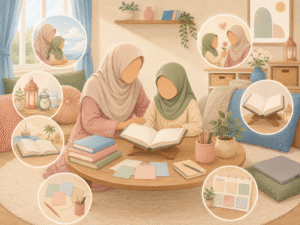
The following steps give parents a simple framework for how to teach islamic studies at home without making learning feel heavy.
1. Start with Knowing Allah
The first step in how to teach islamic studies at home is helping your child know Allah. Children should not only hear rules. They should also learn about Allah’s mercy, care, wisdom, knowledge, power, and love for good deeds.
The Quran gives us the example of Luqman advising his son. He begins with tawheed and belief in Allah:
Quran — Surah Luqman 31:13
وَإِذْ قَالَ لُقْمَانُ لِابْنِهِ وَهُوَ يَعِظُهُ يَا بُنَيَّ لَا تُشْرِكْ بِاللَّهِ ۖ إِنَّ الشِّرْكَ لَظُلْمٌ عَظِيمٌ
English meaning: “And ˹remember˺ when Luqmân said to his son, while advising him, ‘O my dear son! Never associate ˹anything˺ with Allah ˹in worship˺, for associating ˹others with Him˺ is truly the worst of all wrongs.’”
This shows parents that Islamic Studies should begin with faith. Children need to know who Allah is before they can understand why Muslims worship Him.
At home, you can teach this through short conversations:
- “Allah created us and cares for us.”
- “Allah hears our duas.”
- “Allah loves kindness and honesty.”
- “We thank Allah for food, family, health, and safety.”
- “When we feel worried, we can ask Allah for help.”
You can also choose one Name of Allah each week and connect it to daily life. For example, when teaching Ar-Razzaq, talk about food, provision, gratitude, and trust.
Helpful course: Names of Allah Course for Kids.
2. Teach Worship Gradually
The second step in how to teach islamic studies at home is worship. Children need to learn salah, wudu, duas, Ramadan, and daily Islamic habits gradually.
Luqman also advised his son about prayer, good action, and patience:
Quran — Surah Luqman 31:17
يَا بُنَيَّ أَقِمِ الصَّلَاةَ وَأْمُرْ بِالْمَعْرُوفِ وَانْهَ عَنِ الْمُنكَرِ وَاصْبِرْ عَلَىٰ مَا أَصَابَكَ ۖ إِنَّ ذَٰلِكَ مِنْ عَزْمِ الْأُمُورِ
English meaning: “O my dear son! Establish prayer, encourage what is good and forbid what is evil, and endure patiently whatever befalls you. Surely this is a resolve to aspire to.”
This verse gives parents a balanced view of Islamic teaching: prayer, good action, avoiding wrong, and patience.
When teaching worship at home, start small:
- Teach the names of the five prayers.
- Let your child watch you pray calmly.
- Practise wudu step by step.
- Teach one short dua at a time.
- Explain Ramadan before it arrives.
- Connect worship to love of Allah, not only obligation.
One of the mistakes parents make when thinking about how to teach islamic studies at home is expecting perfect practice too early. Worship should be taught with repetition, patience, and encouragement.
Helpful course: Minhaj Al-Muslim Course.
3. Use Short Prophet Stories
The third step in how to teach islamic studies at home is using stories. Children often remember stories better than direct instructions.
Stories of the Prophets help children understand faith, patience, courage, dua, trust in Allah, and good character. They also give children examples they can return to when facing real-life situations.
For example:
- Prophet Nuh عليه السلام teaches patience and calling to Allah.
- Prophet Ibrahim عليه السلام teaches trust and tawheed.
- Prophet Musa عليه السلام teaches courage and reliance on Allah.
- Prophet Yunus عليه السلام teaches repentance and dua.
- Prophet Muhammad ﷺ teaches mercy, honesty, and beautiful character.
When using stories, do not only ask, “What happened?” Ask:
- What can we learn from this story?
- How did the Prophet trust Allah?
- What good character do we see?
- How can we use this lesson at home or school?
This makes stories a powerful part of how to teach islamic studies at home. The story becomes a lesson for life, not only information to remember.
Helpful course: Stories of the Prophets Course.
4. Make Islamic Manners Part of Daily Life
The fourth step in how to teach islamic studies at home is Islamic manners. Manners should not be a separate topic children only hear about in lessons. They should appear in daily behaviour.
Islamic manners include honesty, kindness, respect, patience, mercy, gratitude, cleanliness, responsibility, and good speech.
Parents can teach manners through daily moments:
- When a child tells the truth even after a mistake, praise honesty.
- When siblings argue, teach apology and forgiveness.
- When the child helps at home, connect it to responsibility.
- When the child speaks harshly, practise softer words.
- When someone gives a gift, practise gratitude.
A strong approach to how to teach islamic studies at home should always connect knowledge to behaviour. A child should not only learn that honesty is good; they should practise honesty when it is hard.
Helpful guide: Islamic Manners for Kids.
5. Connect Quran Meanings to Simple Life Lessons
The fifth step in how to teach islamic studies at home is Quran connection. Children should not only hear Quran during memorization or recitation. They should also hear simple meanings that connect Quran to life.
For young children, this can be very simple. You do not need long tafsir sessions. You can choose one short meaning and connect it to something your child understands.
Examples:
- When discussing gratitude, mention that Allah loves thankfulness.
- When discussing patience, connect it to waiting calmly or trying again.
- When discussing kindness, connect it to helping siblings or classmates.
- When discussing dua, explain that Allah hears us.
Quran connection is important because children should see the Quran as guidance, not only memorized text. This is a key part of how to teach islamic studies at home.
The Prophet ﷺ said:
Hadith — Sahih al-Bukhari 5027
خَيْرُكُمْ مَنْ تَعَلَّمَ الْقُرْآنَ وَعَلَّمَهُ
English meaning: “The best among you are those who learn the Qur’an and teach it.”
For parents, this hadith is a reminder that Quran learning has great value. At home, Quran connection can include listening, memorization, revision, simple meanings, and love for Quran.
Helpful guides: Quran for Kids and Help Your Child Love Quran.
6. Add Simple Arabic Islamic Words
The sixth step in how to teach islamic studies at home is adding simple Arabic Islamic words. Children do not need to become fluent immediately, but they should become familiar with Islamic vocabulary.
Arabic helps children understand words they hear in Quran, salah, duas, and Islamic conversations. Words like salah, dua, rahmah, sabr, iman, masjid, Quran, zakah, and halal can become more meaningful when children understand them.
Arabic at Our Children’s Hands highlights the importance of integrating language skills such as listening, speaking, reading, and writing, with grammar and vocabulary. This reminds parents that language learning is more than memorising letters.
At home, choose one Arabic Islamic word each week:
- Rahmah: mercy.
- Sabr: patience.
- Shukr: gratitude.
- Dua: calling upon Allah.
- Salah: prayer.
- Masjid: mosque.
- Iman: faith.
Use the word in a sentence. Connect it to a story or daily action. This makes Arabic part of Islamic learning, not a separate subject only.
Helpful guides: Arabic Language for Kids and Arabic Words for Kids.
7. Build a Simple Weekly Routine
The seventh step in how to teach islamic studies at home is routine. Children do not need long Islamic Studies lessons every day. They need consistency.
A simple weekly routine is easier for parents and children. It also prevents Islamic learning from becoming stressful.
Your routine can include:
- One Name of Allah.
- One short dua.
- One Islamic manner.
- One story or role model.
- One Quran meaning.
- One Arabic Islamic word.
- One family reflection question.
This gives structure to how to teach islamic studies at home without turning the home into a strict classroom.
Children learn well when learning feels repeated, warm, and connected to life.
Sibghah Teacher Note: Islamic Studies at home should be simple, regular, and connected to real life. The goal is not to finish many topics quickly. The goal is to help the child understand Islam and practise it with love and confidence.
A Simple Weekly Islamic Studies Routine at Home
Parents who ask how to teach islamic studies at home often need a practical plan. Here is a simple weekly structure.
| Day | Home Activity | Purpose |
|---|---|---|
| Monday | Teach one Name of Allah. | Build faith and love of Allah. |
| Tuesday | Practise one short dua. | Connect worship to daily life. |
| Wednesday | Read one short Prophet story. | Build values through examples. |
| Thursday | Choose one Islamic manner to practise. | Turn knowledge into behaviour. |
| Friday | Discuss one simple Quran meaning. | Connect the Quran to life. |
| Weekend | Review one Arabic Islamic word and ask one reflection question. | Strengthen memory and understanding. |
This plan is flexible. If your child is young, keep it to 5 minutes. If your child is older, you can discuss more. The key is not length. The key is consistency.
A useful question to ask at the end of the week is:
“What is one Islamic lesson we can practise this week?”
This keeps how to teach islamic studies at home connected to behaviour, not only information.
What Should You Teach by Age and Level?
Another important part of how to teach islamic studies at home is matching topics to your child’s age and level.
| Child’s Stage | Helpful Islamic Studies Focus | Suggested Sibghah Path |
|---|---|---|
| Young beginner | Allah loves good deeds, simple duas, basic manners, short stories. | Names of Allah Course |
| Beginner with some Islamic awareness | Prayer basics, wudu, manners, simple Aqeedah, daily Islamic habits. | Minhaj Al-Muslim Course |
| Child who loves stories | Stories of the Prophets, lessons, values, and reflection questions. | Stories of the Prophets Course |
| Child needing role models | Companions, courage, honesty, sacrifice, love for the Prophet ﷺ. | Lives of the Companions Course |
| Child who asks deeper questions | Faith, identity, worship meaning, Islamic worldview, personal questions. | Online Islamic Classes for Kids |
This table shows why how to teach islamic studies at home depends on your child. Some children need basics. Some need stories. Some need worship practice. Some need confidence and questions answered.
When One-to-One Islamic Studies Lessons Can Help
Teaching at home is powerful, but some children need extra support. If you are wondering how to teach islamic studies at home and still feel stuck, one-to-one Islamic Studies lessons may help.
One-to-one lessons can help when your child:
- Asks questions you are not sure how to answer.
- Needs a structured Islamic Studies path.
- Feels shy in group classes.
- Needs more personal attention.
- Needs Islamic identity support in the UK.
- Does not respond well to random home reminders.
- Needs regular accountability and follow-up.
- Needs topics explained at their age level.
In one-to-one lessons, the teacher can understand your child’s level and questions. This is different from a group class where every child follows the same pace.
| One-to-One Benefit | How It Helps Islamic Studies at Home |
|---|---|
| Personal level check | The teacher knows what your child already understands. |
| Safe space for questions | Your child can ask without group pressure. |
| Structured path | The teacher can recommend what to learn next. |
| Parent feedback | You know what to continue at home. |
| Flexible pace | The lesson matches your child, not a fixed group speed. |
A strong home routine plus one-to-one Islamic Studies lessons can work beautifully together. The teacher provides structure, and the parent brings the lesson into daily life.
Need help building an Islamic Studies path for your child?
Sibghah Academy offers live one-to-one Islamic Studies lessons for Muslim children. We can help your child build faith, worship habits, manners, stories, Quran connection, Arabic awareness, and Muslim identity step by step.
Common Mistakes Parents Should Avoid
Parents who search for how to teach islamic studies at home usually want the best for their children. Avoiding these mistakes can make the journey calmer and more effective.
Teaching too many topics at once
Do not try to teach Aqeedah, Fiqh, Quran, Arabic, seerah, and manners all in one week. Choose a small routine and build gradually.
Using fear more than love
Children need to know Allah’s greatness, but they also need to know Allah’s mercy, care, and generosity.
Turning every moment into a lecture
Short meaningful conversations are often better than long lectures.
Focusing only on memorization
Memorization is valuable, but children also need understanding, manners, and practice.
Ignoring the child’s questions
Questions need calm answers. If you do not know the answer, say that you will check with a trusted source or teacher.
Not connecting lessons to real life
Islamic Studies should appear in prayer, honesty, gratitude, kindness, and daily choices.
Expecting home teaching to be perfect
The goal is consistency, not perfection. Small weekly steps matter.
A balanced approach to how to teach islamic studies at home should feel clear, loving, and realistic.
How Sibghah Academy Supports Islamic Studies at Home
Sibghah Academy offers live one-to-one Quran, Arabic, and Islamic Studies lessons for Muslim children aged 5–15.
For parents asking how to teach islamic studies at home, Sibghah Academy can support the home routine with structured one-to-one lessons.
Sibghah Islamic Studies can help your child with:
- Knowing Allah through the Names of Allah.
- Islamic Studies foundations through Minhaj Al-Muslim.
- Stories of the Prophets.
- Lives of the Companions.
- Islamic manners and daily values.
- Worship and basic Fiqh.
- Quran connection.
- Arabic Islamic vocabulary.
- Muslim identity and confidence.
- Safe questions and age-appropriate answers.
Because lessons are one-to-one, the teacher can adapt to your child’s needs. If your child needs faith-building, the teacher can focus on that. If your child needs worship basics, the teacher can slow down. If your child loves stories, the teacher can use stories to build values. If your child asks questions, the teacher can give them space.
This makes one-to-one lessons a strong support for parents learning how to teach islamic studies at home. The parent continues the learning in daily life, while the teacher provides structure and guidance.
Quick Parent Checklist
Use this checklist when planning how to teach islamic studies at home:
- Did I start with knowing Allah?
- Am I teaching worship gradually?
- Do I use short stories with clear lessons?
- Do I connect manners to daily behaviour?
- Do I include simple Quran meanings?
- Do I introduce Arabic Islamic words gently?
- Do I have a short weekly routine?
- Does my child have space to ask questions?
- Am I avoiding pressure and comparison?
- Would one-to-one Islamic Studies support help my child?
FAQ: How to Teach Islamic Studies at Home
1. What is the best way to start learning how to teach islamic studies at home?
The best way to start how to teach islamic studies at home is to begin with knowing Allah, then add worship, manners, stories, Quran meanings, and simple weekly practice.
2. What should I teach my child first in Islamic Studies?
Start with who Allah is, why Muslims worship Him, simple duas, basic manners, and short stories that build faith and good character.
3. How often should I teach Islamic Studies at home?
Short regular moments are better than long rare lessons. Five to ten minutes a few times a week can be very helpful.
4. Can parents teach Islamic Studies at home without being scholars?
Parents can teach simple age-appropriate Islamic habits, manners, stories, and duas. For deeper questions, it is wise to use trusted teachers and sources.
5. Is school Religious Education enough for Muslim children?
School Religious Education can help children understand religions, but Muslim children often need home Islamic learning that builds their own faith, worship, Quran connection, and identity.
6. How can I make Islamic Studies fun at home?
Use short stories, questions, role-play, simple activities, weekly themes, and real-life examples instead of long lectures.
7. Should I include Quran when teaching Islamic Studies at home?
Yes. Include Quran through listening, short meanings, simple reflections, memorization, or connecting one verse meaning to daily life.
8. How can I teach Islamic manners at home?
Choose one manner each week, such as honesty or kindness, then notice it in real life and praise your child when they practise it.
9. What if my child asks difficult Islamic questions?
Listen calmly, do not shame the question, answer at the child’s level, and seek help from a trusted teacher if needed.
10. When should I use one-to-one Islamic Studies lessons?
Use one-to-one Islamic Studies lessons when your child needs structure, personal attention, safe questions, or age-appropriate explanations beyond what you can manage at home.
11. Does Sibghah Academy help parents with how to teach islamic studies at home?
Yes. Sibghah Academy supports families through one-to-one Islamic Studies lessons that help children build faith, worship, manners, stories, Quran connection, and identity.
12. What is the best next step?
The best next step is to choose one simple weekly routine, then decide whether your child needs extra one-to-one support in faith, worship, manners, stories, or Islamic identity.
Book your child’s free one-to-one Islamic Studies trial
If you want support with how to teach islamic studies at home, Sibghah Academy can help your child learn Islam through live one-to-one lessons matched to their age, level, and questions.
Send us your child’s age, current level, and main goal, and we will recommend the right starting point.