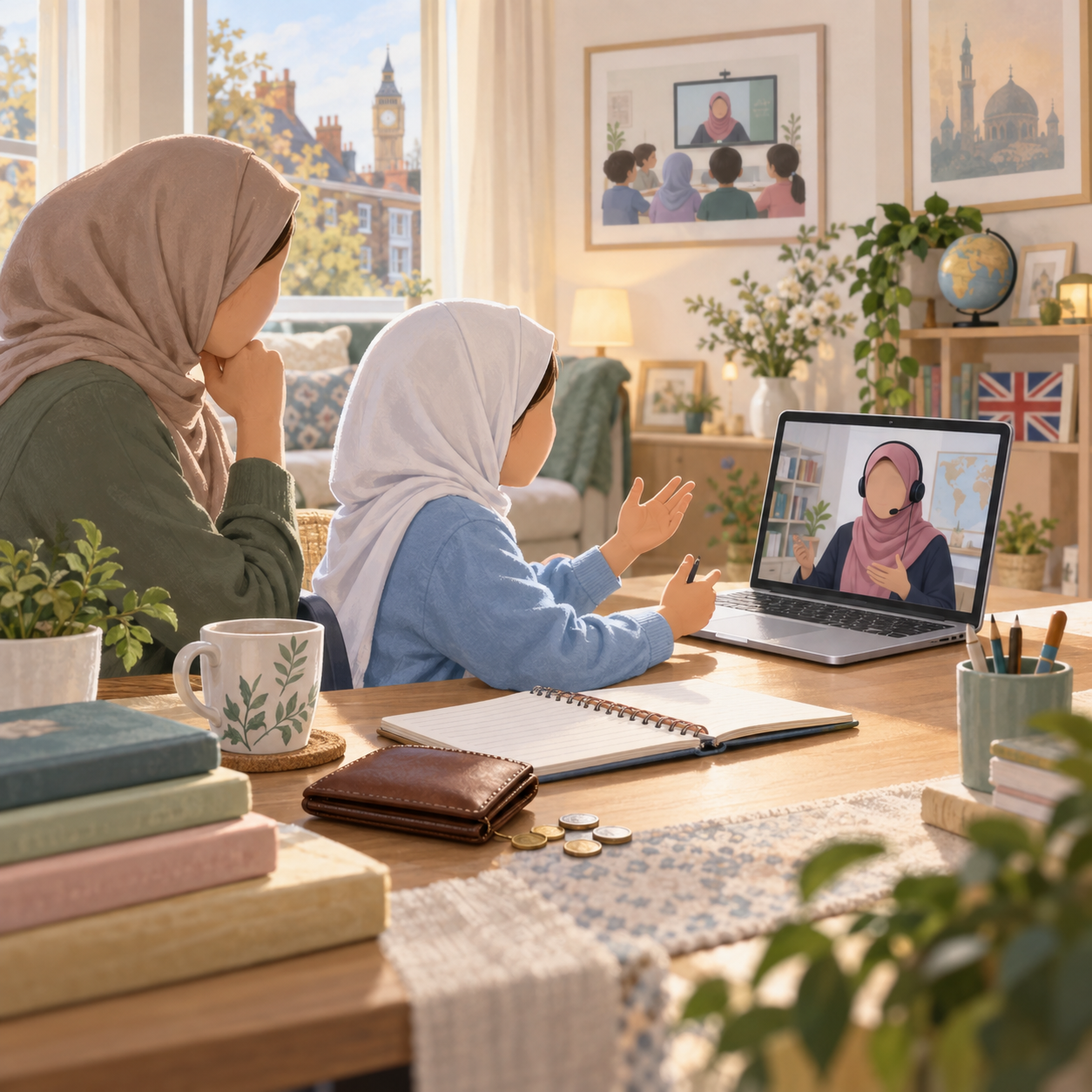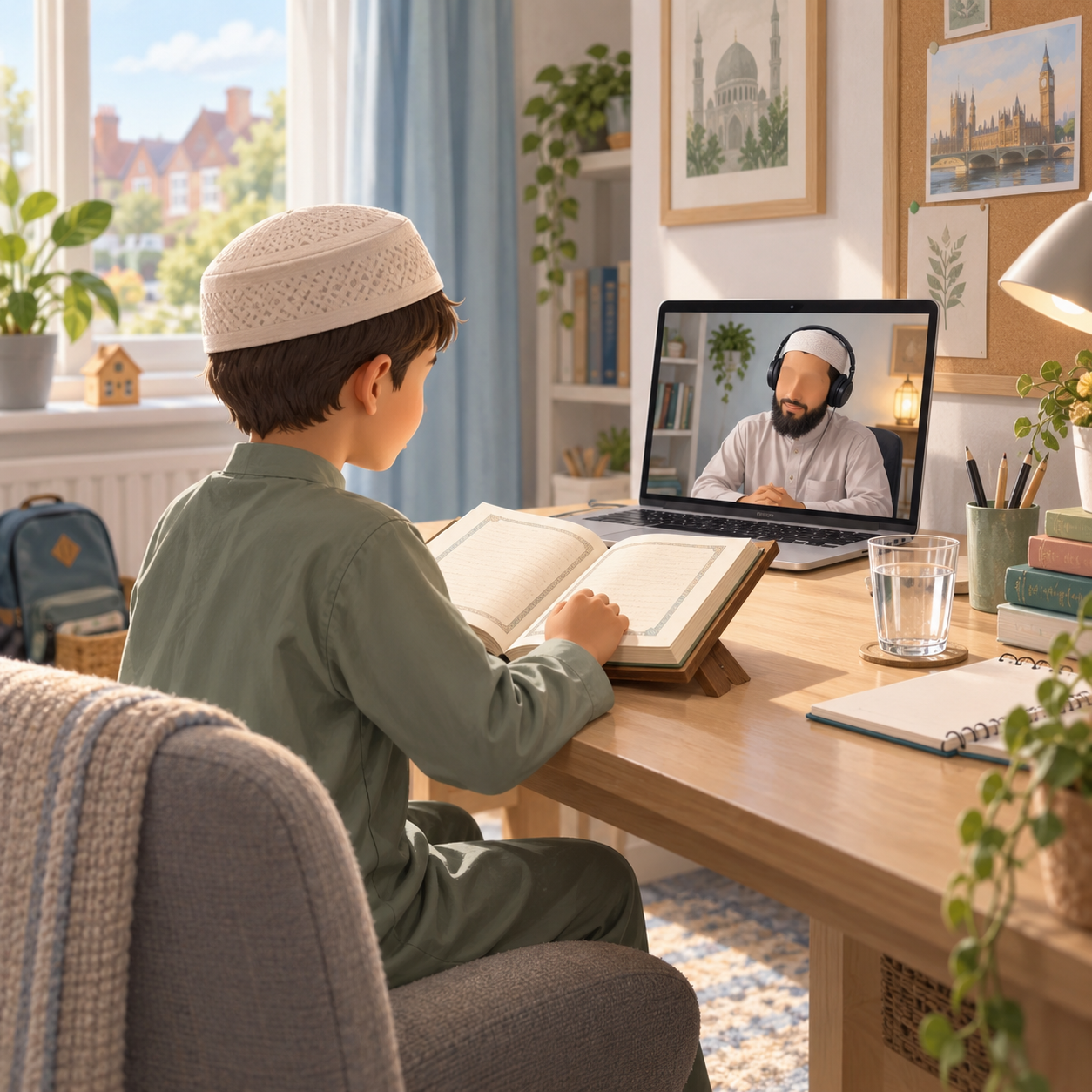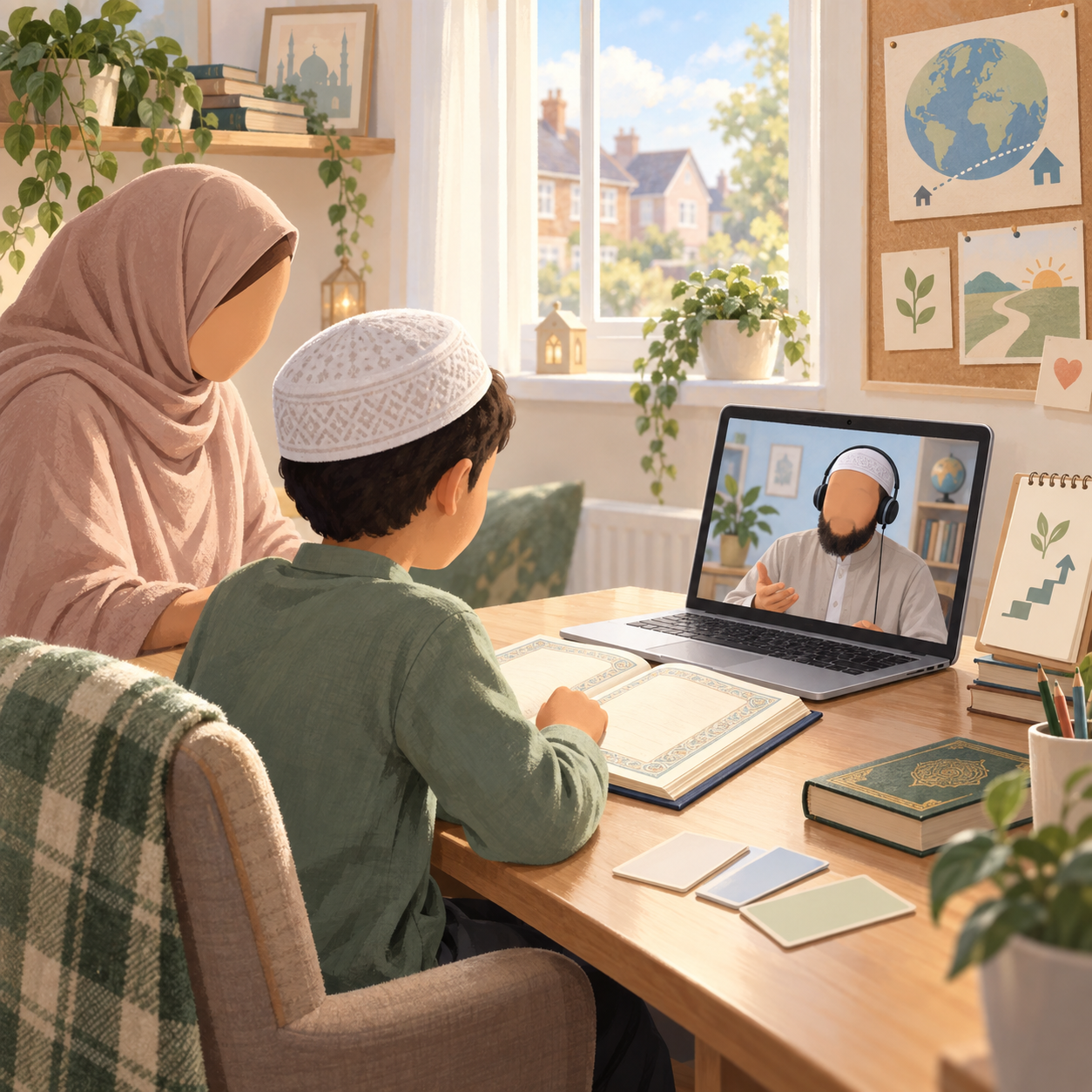
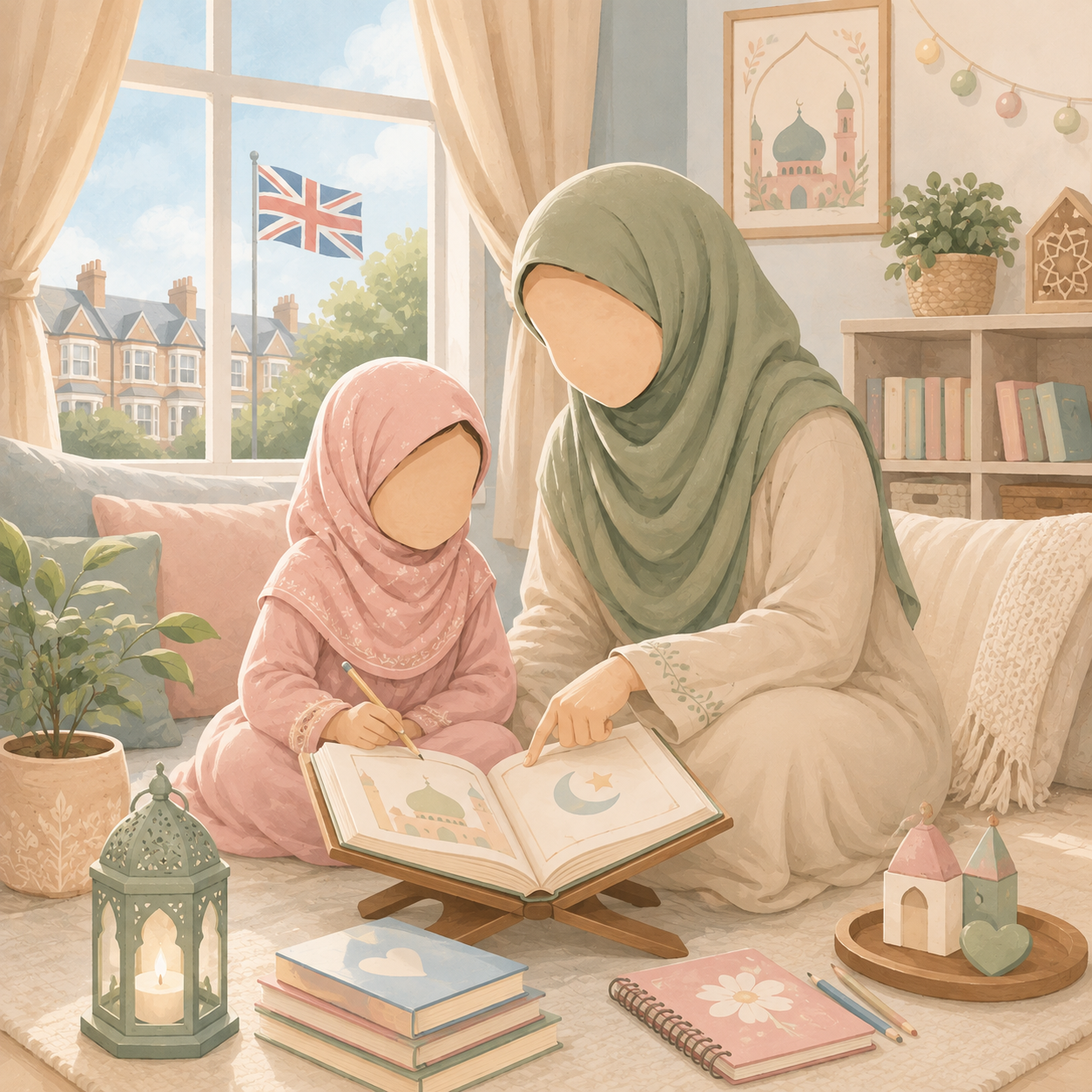
This guide explains 8 helpful ways parents can support islamic education uk for children at home and through suitable one-to-one online Islamic learning.
Quick answer: A strong islamic education uk path helps Muslim children build faith, worship habits, manners, Quran connection, Arabic awareness, Islamic identity, confidence at school, and answers to their real questions.
| Area of Islamic Education | What It Helps Your Child Build |
|---|---|
| Faith and belief | Understanding Allah, tawheed, trust, gratitude, and purpose. |
| Worship | Prayer, dua, fasting awareness, and daily Islamic habits. |
| Islamic manners | Mercy, honesty, respect, kindness, patience, and responsibility. |
| Quran connection | Love for Quran, simple meanings, recitation, and reflection. |
| Arabic awareness | Understanding Islamic words and feeling closer to Quran and salah. |
| Muslim identity | Confidence, belonging, and pride without isolation or confusion. |
| School confidence | Knowing how to handle questions, prayer needs, and faith-related situations. |
| Personal questions | Safe space for children to ask and understand Islam clearly. |
Table of Contents
- What Does Islamic Education UK Mean for Muslim Parents?
- Islamic Education UK vs Religious Education at School
- Islamic Education UK: 8 Helpful Ways to Support Kids
- Why One-to-One Islamic Lessons Help Children
- A Simple Weekly Islamic Education Routine at Home
- Which Islamic Education Path Does Your Child Need?
- Common Mistakes Parents Should Avoid
- How Sibghah Academy Supports Islamic Education UK
- FAQ
What Does Islamic Education UK Mean for Muslim Parents?
islamic education uk means helping Muslim children learn Islam in a way that fits their life in the UK. It is not only about memorising facts. It is about helping children understand what they believe, how they worship, how they behave, and how they carry their Muslim identity with confidence.
For parents, islamic education uk often includes several connected areas:
- Teaching children about Allah in a loving and clear way.
- Helping children understand the basics of Islam and Iman.
- Teaching prayer, duas, and worship gradually.
- Building Islamic manners and good character.
- Connecting children with Quran and Arabic.
- Helping children feel confident as Muslims at school.
- Answering questions children hear from friends, school, or online content.
- Giving children positive Muslim role models.
A child in the UK may learn about Islam in school Religious Education, but Muslim families usually need more than information. Children need faith-building, daily practice, and a safe space to ask questions from within an Islamic worldview.
This is why islamic education uk should involve both home and structured learning. Parents create the environment, and a good teacher can provide clarity, order, correction, and age-appropriate explanation.
Islamic Education UK vs Religious Education at School
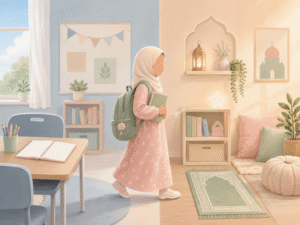
It is helpful to understand the difference between school Religious Education and Islamic education for Muslim children.
GOV.UK states that Religious Education is compulsory in schools in England up to age 18, and that local councils are responsible for deciding the RE syllabus, while faith schools and academies can have different arrangements.
This means school RE may teach children about different religions, beliefs, practices, and worldviews. That can be valuable for general understanding. But it is not the same as a Muslim child learning Islam as their own faith, practice, and identity.
| School Religious Education | Islamic Education for Muslim Children |
|---|---|
| May introduce different religions and worldviews. | Builds the child’s own Islamic belief and practice. |
| Usually follows a school or local syllabus. | Can be personalised to the child’s age, questions, and level. |
| May be taught from a comparative or academic angle. | Teaches Islam as guidance for life, manners, worship, and identity. |
| May not include Quran reading, Arabic, or detailed worship practice. | Can include Quran connection, Arabic words, salah, dua, and Islamic manners. |
| May not answer personal faith questions deeply. | Gives children a safe space to ask and understand. |
So, when parents search for islamic education uk, they are often looking for something more personal than school RE. They want their child to know Islam, love Islam, practise Islam, and feel confident as a Muslim.
Helpful external references:
Islamic Education UK: 8 Helpful Ways to Support Kids
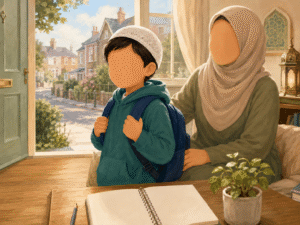
The following 8 areas can help parents build a stronger islamic education uk path for their children.
1. Begin with Loving Faith, Not Only Rules
The first part of islamic education uk is helping children know Allah in a loving, clear, and age-appropriate way. Children should not only hear “halal” and “haram”. They should also hear about Allah’s mercy, wisdom, kindness, knowledge, and care.
One of the most powerful examples of Islamic education in the Quran is Luqman teaching his son. He begins with tawheed: teaching his child not to associate anything with Allah.
Quran — Surah Luqman 31:13
وَإِذْ قَالَ لُقْمَانُ لِابْنِهِ وَهُوَ يَعِظُهُ يَا بُنَيَّ لَا تُشْرِكْ بِاللَّهِ ۖ إِنَّ الشِّرْكَ لَظُلْمٌ عَظِيمٌ
English meaning: “And ˹remember˺ when Luqmân said to his son, while advising him, ‘O my dear son! Never associate ˹anything˺ with Allah ˹in worship˺, for associating ˹others with Him˺ is truly the worst of all wrongs.’”
This shows parents that Islamic teaching should begin with belief. Children need to know who Allah is, why we worship Him, why we trust Him, and why Islam gives life meaning.
At home, parents can support this by saying simple things like:
- “Allah sees you and cares for you.”
- “We thank Allah for our food, family, and safety.”
- “Allah loves kindness and honesty.”
- “We pray because we need Allah.”
- “When we make dua, we speak to Allah.”
A strong islamic education uk path should help children feel that Islam is not a set of disconnected rules. It is a relationship with Allah, a way of living, and a source of comfort and guidance.
2. Teach Worship Gradually and Practically
The second part of islamic education uk is worship. Children need to learn prayer, dua, fasting awareness, wudu, and basic Islamic practice gradually.
Many parents worry because their child does not pray consistently or does not understand salah yet. The answer is not pressure alone. Children need explanation, modelling, repetition, and encouragement.
Luqman’s advice to his son also includes prayer, good action, and patience.
Quran — Surah Luqman 31:17
يَا بُنَيَّ أَقِمِ الصَّلَاةَ وَأْمُرْ بِالْمَعْرُوفِ وَانْهَ عَنِ الْمُنكَرِ وَاصْبِرْ عَلَىٰ مَا أَصَابَكَ ۖ إِنَّ ذَٰلِكَ مِنْ عَزْمِ الْأُمُورِ
English meaning: “O my dear son! Establish prayer, encourage what is good and forbid what is evil, and endure patiently whatever befalls you. Surely this is a resolve to aspire to.”
This verse gives parents a beautiful structure: prayer, good character, moral courage, and patience. These are central parts of islamic education uk.
Practical worship education can include:
- Learning the names and times of prayers.
- Practising wudu step by step.
- Learning short duas with meaning.
- Joining parents for one prayer at home.
- Understanding why Muslims fast in Ramadan.
- Learning adab of the masjid.
- Building gratitude after meals and before sleep.
Children need worship to feel achievable. A one-to-one teacher can help by explaining worship at the child’s level and answering practical questions gently.
3. Make Islamic Manners Part of Daily Life
The third part of islamic education uk is manners. Islamic education should shape how children speak, treat people, handle mistakes, and behave at home and school.
Islamic manners include mercy, respect, honesty, patience, cleanliness, gratitude, responsibility, and kindness. These are not side topics. They are at the heart of Islamic tarbiyah.
Hadith — Jami` at-Tirmidhi 1921
لَيْسَ مِنَّا مَنْ لَمْ يَرْحَمْ صَغِيرَنَا وَيُوَقِّرْ كَبِيرَنَا وَيَأْمُرْ بِالْمَعْرُوفِ وَيَنْهَ عَنِ الْمُنْكَرِ
English meaning: “He is not one of us who does not have mercy upon our young, respect our elders, and command good and forbid evil.”
This hadith shows that Islamic education is not only information. It is mercy, respect, and good behaviour.
Parents can teach manners through small daily moments:
- How to say sorry sincerely.
- How to speak respectfully to parents and siblings.
- How to be honest even when afraid.
- How to share and be generous.
- How to control anger.
- How to help at home.
- How to treat classmates kindly.
A strong islamic education uk plan should connect manners to real situations children face in the UK: school friendships, online behaviour, sports, family life, and social pressure.
Helpful guide: Islamic Manners for Kids.
4. Build Quran Connection Without Pressure
The fourth part of islamic education uk is Quran connection. Muslim children should not only see Quran as something difficult to memorise. They should gradually love Quran, listen to it, understand simple meanings, and feel that it is guidance.
Parents can support Quran connection by:
- Playing short Quran recitation at calm times.
- Explaining one simple meaning from a short surah.
- Praising effort, not only perfect memorisation.
- Keeping Quran practice short and consistent.
- Connecting Quran verses to daily life.
- Helping children revise gently.
For some children, Quran learning becomes stressful because they are corrected too harshly or pushed too quickly. A healthy islamic education uk approach should protect the child’s love for Quran while still building skill.
If your child is ready, Quran reading, memorisation, Tajweed, and revision can be added gradually. But the emotional connection should not be ignored.
Helpful guides: Help Your Child Love Quran, Quran for Kids, and Quran Revision Plan for Kids.
5. Use Arabic to Support Islamic Understanding
The fifth part of islamic education uk is Arabic awareness. Children do not need to become fluent immediately, but Arabic can help them feel closer to Quran, salah, duas, and Islamic vocabulary.
Many Muslim children in the UK hear Arabic words in Islamic contexts but do not always understand them. Words such as salah, dua, rahmah, iman, sabr, zakah, masjid, and Quran can become more meaningful when children learn their meanings and uses.
Arabic supports islamic education uk because it helps children:
- Recognise Islamic words.
- Understand simple Quranic vocabulary.
- Follow salah words more meaningfully.
- Read Arabic letters and short words.
- Feel that Islamic language is familiar, not distant.
Parents can begin with simple Arabic words used in daily Islamic life. The goal is not to overwhelm the child. The goal is to make Islamic vocabulary more familiar.
Helpful guides: Arabic Language for Kids, Arabic Words for Kids, and Arabic Alphabet for Kids.
6. Strengthen Muslim Identity in a British Environment
The sixth part of islamic education uk is identity. Muslim children in the UK may sometimes feel different because of their name, food, prayer, fasting, clothing, family values, or religious practices.
Children need to understand that being Muslim is not something to hide. They also need to learn how to live confidently and respectfully in a diverse society.
Parents can support Muslim identity by:
- Speaking positively about Islam at home.
- Explaining Muslim practices before children feel embarrassed by them.
- Helping children answer simple questions from classmates.
- Connecting children with Muslim role models.
- Celebrating Ramadan and Eid meaningfully.
- Teaching children that good manners represent Islam beautifully.
- Making the home feel warmly Islamic without constant pressure.
Some children may face questions or comments at school. GOV.UK has guidance for schools on preventing and responding to race and faith targeted bullying. The Muslim Council of Britain also provides guidance for schools around reflection spaces and prayer rooms, which can be relevant for Muslim pupils in secondary school settings.
This does not mean every child will face difficulty. But a good islamic education uk approach prepares children with confidence, language, and emotional safety.
Helpful guide: Islamic Identity for Muslim Children in the UK.
7. Give Children a Safe Space for Questions
The seventh part of islamic education uk is questions. Children in the UK may hear many different ideas at school, online, or from friends. They may ask questions about Allah, prayer, hijab, halal food, other religions, gender discussions, fairness, death, Jannah, or why Muslims do certain things.
Parents should not panic when children ask questions. Questions are often a sign that the child is thinking. What matters is how adults respond.
A helpful response usually includes:
- Listening calmly first.
- Not shaming the child for asking.
- Answering according to the child’s age.
- Admitting when you need to check before answering.
- Returning to Quran and Sunnah carefully.
- Connecting the answer to Allah’s wisdom and mercy.
This is where one-to-one Islamic lessons can help. In a group class, a child may feel shy asking. In a one-to-one lesson, the teacher can give more space to the child’s real questions.
A strong islamic education uk path should not only deliver information. It should help children think, understand, and feel safe asking.
8. Choose Structured Support, Not Random Learning
The eighth part of islamic education uk is structure. Many parents try to teach Islam at home, but they are not sure what to teach first.
One week they discuss prayer. Another week they watch a story. Another week they try Quran. Then they stop because the plan feels unclear.
A structured Islamic education path helps because it organises learning into clear areas:
- Aqeedah and faith.
- Worship and daily practice.
- Islamic manners.
- Stories of the Prophets.
- Lives of the Companions.
- Names of Allah.
- Quran connection.
- Arabic and Islamic vocabulary.
- Muslim identity and real-life questions.
Structured support is especially useful when the teacher can adjust the path to the child. Some children need basic Islamic Studies. Some need identity and confidence. Some ask deep questions. Some need stories and role models. Some need worship practice.
This is why one-to-one support can be powerful for islamic education uk. The child is not forced into a fixed group pace. The teacher can understand the child’s level and move step by step.
Want a clearer Islamic learning path for your child?
Sibghah Academy offers live one-to-one Islamic Studies lessons for Muslim children, helping them build faith, worship, manners, Quran connection, Arabic awareness, and Islamic identity step by step.
Why One-to-One Islamic Lessons Help Children
One-to-one lessons can be especially helpful for islamic education uk because children differ in knowledge, confidence, questions, family background, Arabic level, and Islamic practice.
In a group class, one child may already know the basics while another child is hearing them for the first time. One child may ask many questions while another feels shy. One child may need manners and identity support while another needs worship practice.
One-to-one lessons help because the teacher can focus on the child’s real needs.
| One-to-One Benefit | How It Helps Islamic Education UK |
|---|---|
| Personal attention | The teacher understands your child’s exact level and questions. |
| Safe space | Your child can ask sensitive or personal questions more comfortably. |
| Flexible pace | The teacher can slow down or move forward based on your child. |
| Better discussion | The child gets more time to speak and explain what they understand. |
| Parent feedback | Parents know what was covered and how to support at home. |
| Confidence building | Shy children can learn without feeling compared to a group. |
This makes one-to-one lessons a strong option for families who want islamic education uk that feels personal, calm, and relevant to the child’s life.
A Simple Weekly Islamic Education Routine at Home
Parents can support islamic education uk with a simple weekly routine. It does not need to be long.
| Day | Simple Home Activity | Purpose |
|---|---|---|
| Day 1 | Discuss one Name of Allah. | Build faith and love of Allah. |
| Day 2 | Practise one short dua with meaning. | Connect worship to daily life. |
| Day 3 | Read one short Islamic story. | Build values through examples. |
| Day 4 | Choose one Islamic manner to practise. | Turn knowledge into behaviour. |
| Day 5 | Review one Arabic Islamic word. | Build Islamic vocabulary. |
| Weekend | Ask: “What did we learn about Islam this week?” | Encourage reflection and conversation. |
This routine makes islamic education uk practical. Your child does not need a long lecture. Short, repeated moments can shape understanding over time.
The key is consistency. A five-minute conversation repeated often may be more effective than one long session that happens rarely.
Which Islamic Education Path Does Your Child Need?
Not every child needs the same starting point. A good islamic education uk path should begin with your child’s current need.
| Your Child’s Situation | Helpful Starting Point | Related Sibghah Guide |
|---|---|---|
| Your child needs basic beliefs and worship. | Minhaj Al-Muslim style Islamic Studies. | Islamic Studies for Kids |
| Your child needs confidence as a Muslim in the UK. | Islamic identity and real-life discussions. | Islamic Identity for Muslim Children in the UK |
| Your child needs better manners and values. | Islamic manners and daily character lessons. | Islamic Manners for Kids |
| Your child learns better through stories. | Stories of the Prophets and role models. | Stories of the Prophets for Kids |
| Your child needs to know Allah in a loving way. | Names of Allah and faith-building conversations. | Teach Children About Allah |
| Your child needs Quran and Arabic connection. | Quran, Arabic words, and simple meanings. | Arabic Language for Kids |
This is why islamic education uk works best when the child’s level is checked first. A personalised path prevents repetition, confusion, and pressure.
Common Mistakes Parents Should Avoid
Parents usually care deeply about islamic education uk, but some mistakes can make learning feel heavy or disconnected.
Focusing only on rules
Children need rules, but they also need love of Allah, meaning, stories, mercy, and wisdom.
Comparing children to others
Every child learns differently. Comparison can create shame instead of motivation.
Leaving Islamic education only to school RE
School RE is not a replacement for Muslim faith-building, worship practice, Quran connection, and Islamic identity.
Ignoring children’s questions
If children ask questions, they need calm answers. Silence or anger may make them search elsewhere.
Teaching too much at once
A child needs gradual learning. Choose one topic, one value, or one habit at a time.
Separating knowledge from behaviour
Islamic education should appear in manners, honesty, prayer, gratitude, and daily choices.
Using group learning when the child needs personal support
Some children need one-to-one attention because their questions, level, or confidence need a more personal approach.
Avoiding these mistakes helps islamic education uk feel warmer, clearer, and more effective for children.
How Sibghah Academy Supports Islamic Education UK
Sibghah Academy offers live one-to-one Quran, Arabic, and Islamic Studies lessons for Muslim children aged 5–15.
For families searching for islamic education uk, Sibghah Academy helps children build Islamic knowledge and identity through personalised one-to-one online lessons.
Sibghah can support children with:
- Basic Islamic Studies.
- Aqeedah and faith-building.
- Prayer, worship, and daily Islamic habits.
- Islamic manners and character.
- Stories of the Prophets.
- Names of Allah.
- Lives of the Companions.
- Quran connection.
- Arabic and Islamic vocabulary.
- Muslim identity and confidence in the UK.
Because the lessons are one-to-one, the teacher can adapt to your child’s age, level, pace, and questions. This makes Sibghah suitable for children who need more personal attention than a group class can provide.
A child who is shy can speak more comfortably. A child who asks many questions can receive more time. A child who needs basic Islamic Studies can start from the beginning. A child who already knows some topics can move into deeper understanding.
The goal is to make islamic education uk meaningful for your child, not only informational.
Quick Parent Checklist
Use this checklist when planning islamic education uk for your child:
- Does my child understand basic belief in Allah?
- Does my child know why Muslims pray?
- Does my child know simple duas and their meanings?
- Does my child practise Islamic manners at home and school?
- Does my child feel positive about being Muslim?
- Does my child know how to answer simple questions about Islam?
- Does my child have a calm space to ask questions?
- Does my child understand some Islamic Arabic words?
- Does my child have Quran connection without pressure?
- Does my child need one-to-one support rather than a group class?
FAQ: Islamic Education UK
1. What does islamic education uk mean?
islamic education uk means helping Muslim children in the UK learn Islam in a way that builds faith, worship, manners, Quran connection, Arabic awareness, and Muslim identity.
2. Is school Religious Education enough for Muslim children?
School Religious Education can help children learn about religions, but it is not the same as personal Islamic education that builds a Muslim child’s belief, worship, manners, and identity.
3. What should Islamic education for children include?
It should include faith, worship, manners, Quran connection, Arabic vocabulary, stories, role models, Islamic identity, and space for questions.
4. Why is islamic education uk important for Muslim families?
islamic education uk is important because Muslim children in the UK need to understand Islam clearly while growing up in a diverse, English-speaking environment.
5. How can parents support Islamic education at home?
Parents can support Islamic education through short conversations, duas, stories, manners practice, Quran listening, Arabic words, and positive Muslim identity at home.
6. Are one-to-one Islamic lessons better than group lessons?
One-to-one Islamic lessons can be better for many children because the teacher can focus on the child’s level, questions, pace, and confidence.
7. What age should children start Islamic education?
Children can start early with simple faith conversations, manners, duas, and stories. Structured lessons can then grow according to age and readiness.
8. How does Arabic support Islamic education?
Arabic helps children understand Islamic words, Quran vocabulary, salah phrases, duas, and Muslim identity more deeply.
9. What if my child asks difficult questions about Islam?
Listen calmly, avoid shaming the child, answer according to their age, and seek help from a trusted teacher if needed.
10. How can Islamic education build confidence at school?
It helps children understand their faith, answer simple questions, practise good manners, and feel comfortable with their Muslim identity.
11. Does Sibghah Academy support islamic education uk?
Yes. Sibghah Academy supports islamic education uk through live one-to-one Quran, Arabic, and Islamic Studies lessons for Muslim children aged 5–15.
12. What is the best next step for parents?
The best next step is to check your child’s current level and choose whether they need faith basics, worship, manners, Quran connection, Arabic, or Islamic identity support.
Book your child’s free one-to-one Islamic Studies trial
If you are looking for islamic education uk support for your child, Sibghah Academy can help through live one-to-one Islamic Studies lessons matched to your child’s age, level, and questions.
Send us your child’s age, current level, and main goal, and we will recommend the right starting point.