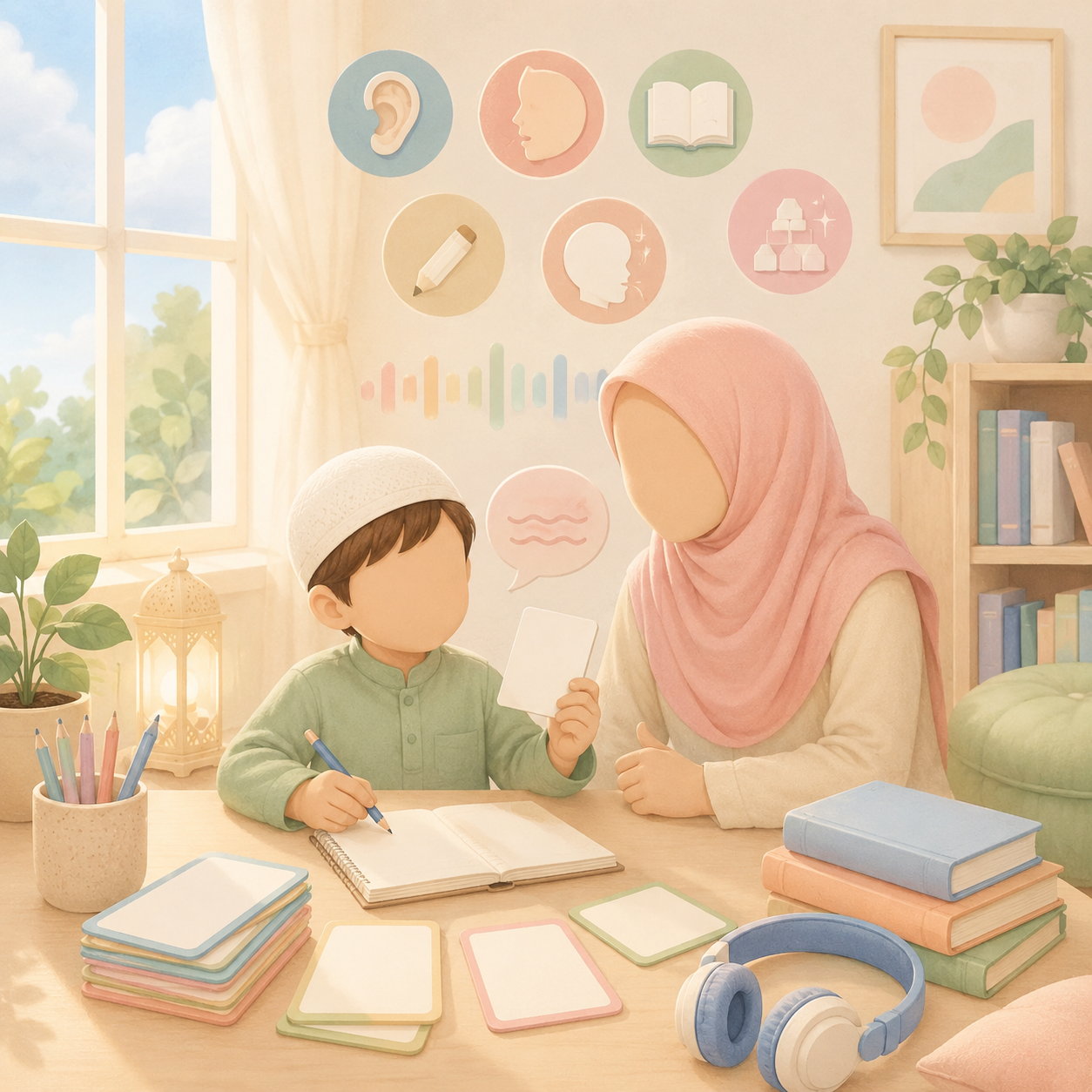
Arabic language for kids is not only about memorising letters or reading a few words. A child who is learning Arabic needs several connected skills: recognising letters, hearing sounds, reading words, understanding vocabulary, listening, speaking, writing, and using Arabic with confidence.
This is why arabic language for kids should be built as a complete language path, not as separate random activities. Children need a clear order, patient repetition, and a teacher who understands their exact level.
For children growing up in the UK or in English-speaking homes, Arabic often needs extra care. English may be the language of school, friends, cartoons, and daily conversation. Arabic may only appear during Quran lessons, family calls, or weekend learning. That is why a structured approach to arabic language for kids matters.
This guide explains the 7 helpful skills parents should build when teaching Arabic. It also explains why one-to-one Arabic lessons can be especially useful, because every child has different strengths and gaps.
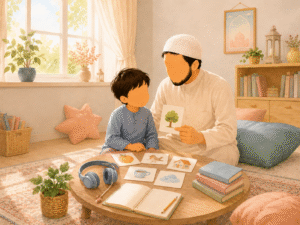
Quick answer: A strong arabic language for kids path should build 7 skills step by step: letter recognition, pronunciation, reading, vocabulary, listening, speaking, and writing, with gentle correction and consistent practice.
| Arabic Skill | Why It Matters |
|---|---|
| Letter recognition | Helps children identify Arabic letters and prepare for reading. |
| Pronunciation and sounds | Helps children say Arabic sounds clearly and avoid common mistakes. |
| Reading | Helps children move from letters to words, sentences, stories, and Quran readiness. |
| Vocabulary | Helps children understand and use meaningful Arabic words. |
| Listening | Helps children hear Arabic naturally before speaking. |
| Speaking | Helps children use Arabic in simple sentences and real situations. |
| Writing | Helps children practise letter shapes, words, and simple expression. |
Table of Contents
- Why Arabic Language for Kids Needs a Complete Path
- Arabic Language for Kids: 7 Helpful Skills to Build
- Why One-to-One Arabic Lessons Help Children
- Which Arabic Skill Does Your Child Need First?
- Simple Home Routine for Arabic Language Practice
- Common Mistakes Parents Should Avoid
- How Sibghah Academy Supports Arabic Language for Kids
- FAQ
Why Arabic Language for Kids Needs a Complete Path
arabic language for kids works best when parents understand that Arabic is made of several skills. If one skill is missing, the child may struggle later.
For example, a child who only memorises letter names may not be able to read words. A child who only reads from a page may not be able to speak. A child who only hears Arabic may understand some words but feel shy using them.
Many Arabic learning programs for non-native speakers are built around connected skills. For example, Arabic at Our Children’s Hands highlights the integration of listening, speaking, reading, and writing in communicative situations. At-Takallum describes its Arabic learning series as a comprehensive Arabic course for non-native speakers. Al Jazeera Learning Arabic also presents Arabic learning through an easy interactive format.
Helpful external resources:
For parents, this means one thing: arabic language for kids should not be treated as letters only. Letters matter, but the child also needs sound, meaning, listening, speaking, and gradual writing.
A complete path helps parents avoid common confusion. Instead of asking, “Why can my child read but not speak?” the parent understands that reading and speaking are different skills. Instead of asking, “Why does my child know words but not use them?” the parent understands that vocabulary needs sentence practice.
The goal of arabic language for kids is not to rush the child. The goal is to build Arabic in a way that feels steady, useful, and possible.
Not sure which Arabic skill your child needs first?
Sibghah Academy offers live one-to-one Arabic lessons, so the teacher can check your child’s level and recommend the right path: letters, pronunciation, reading, vocabulary, speaking, or writing.
Arabic Language for Kids: 7 Helpful Skills to Build
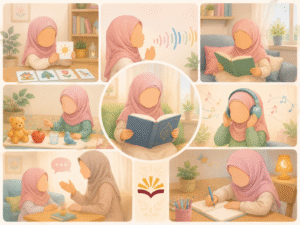
The following 7 skills give parents a clear picture of what arabic language for kids should include.
1. Arabic Letter Recognition
The first skill in arabic language for kids is letter recognition. Children need to recognise Arabic letters by shape, direction, dots, and position.
Arabic letters can be confusing for beginners because many letters look similar. For example, ب، ت، ث share a similar shape but have different dots. ج، ح، خ also look related but are different letters.
At this stage, the child should learn:
- The shape of each Arabic letter.
- The direction of Arabic reading.
- The importance of dots.
- Similar letter groups.
- Letters in isolation first.
- Later, letters in beginning, middle, and end positions.
Parents can support this skill with short games, matching cards, letter hunts, and simple review. But the goal is not only to recognise the letter once. The child should recognise it repeatedly until it becomes familiar.
Letter recognition is the foundation of arabic language for kids, but it should not be the only foundation. Once the child recognises letters, the next step is sound.
Helpful guides: Arabic Alphabet for Kids and Arabic Alphabet Game.
2. Arabic Pronunciation and Sounds
The second skill in arabic language for kids is pronunciation. A child may know a letter visually but still say its sound incorrectly.
This is very common for children who speak English most of the day. Some Arabic sounds are unfamiliar, especially ح، خ، ع، غ، ق، ص، ض، ط، ظ.
Good pronunciation practice should include:
- Listening before repeating.
- Saying letters with short vowels.
- Comparing similar sounds.
- Repeating difficult sounds gently.
- Teacher correction when needed.
- Using sounds in simple words.
Pronunciation is a major part of arabic language for kids because it affects reading, speaking, and later Quran readiness. If a child says ق like ك or ح like ه, gentle correction can help before the mistake becomes a habit.
One-to-one lessons are especially helpful for pronunciation. The teacher can hear your child clearly and correct the exact sound. In a group class, individual pronunciation mistakes may be missed.
Helpful guide: Arabic Alphabet with Pronunciation.
3. Arabic Reading
The third skill in arabic language for kids is reading. Reading begins when the child can connect letters, sounds, and vowels into simple words.
Arabic reading should be gradual. Children should not jump from isolated letters straight to long texts. They need a clear path:
- Letters.
- Short vowels.
- Long vowels.
- Joined letters.
- Simple words.
- Short phrases.
- Simple sentences.
- Short stories.
Some children can recognise Arabic letters but cannot read because they have not learned how sounds join together. This is why reading practice is an essential skill in arabic language for kids.
For Muslim children, Arabic reading can also support Quran readiness. A child who reads Arabic more confidently may later find Quran reading easier, especially when combined with proper recitation and Tajweed correction.
One-to-one Arabic lessons can help because the teacher can listen to the child’s reading, catch mistakes, and slow down when needed. If the child guesses words, the teacher can return to sounds and vowels.
Helpful guide: Arabic Reading Practice for Kids.
4. Arabic Vocabulary
The fourth skill in arabic language for kids is vocabulary. Children need words they can understand and use.
Vocabulary should begin with meaningful categories:
- Family words.
- Home objects.
- Food and drink.
- School items.
- Feelings.
- Actions.
- Colours and descriptions.
- Islamic daily words.
- Nature and animals.
Parents should avoid teaching vocabulary as a long list only. A child may memorise 20 words and forget them quickly if they never use them.
A better way is to use words in short sentences. For example, instead of only teaching “كتاب”, use:
- هذا كتاب.
- أين الكتاب؟
- الكتاب على الطاولة.
This turns vocabulary into language. It helps the child understand that Arabic words can be used to communicate.
Vocabulary is an important bridge in arabic language for kids. Without vocabulary, a child may read sounds but not understand meaning. With vocabulary, Arabic becomes more useful and alive.
Helpful guide: Arabic Words for Kids.
5. Arabic Listening
The fifth skill in arabic language for kids is listening. Children need to hear Arabic often before they can use it comfortably.
Listening helps children absorb sounds, rhythm, vocabulary, sentence patterns, and pronunciation. It also helps children who are not ready to speak yet.
Parents can support listening with:
- Short Arabic stories.
- Teacher audio clips.
- Simple repeated phrases.
- Parent-child commands in Arabic.
- Listening and pointing activities.
- Short question-and-answer practice.
Listening is especially important for children who can read Arabic but cannot speak it. Reading from a page and understanding spoken Arabic are not the same skill.
In a complete arabic language for kids path, listening should not be left until later. It should be included from the beginning in short, simple, repeated ways.
For example, before asking your child to say “أريد ماء”, let them hear it several times. Then ask them to repeat. Then use it in a real situation.
This makes Arabic feel like a living language, not only written symbols.
6. Arabic Speaking
The sixth skill in arabic language for kids is speaking. Many parents worry because their child can read Arabic but cannot speak it.
This happens because speaking needs separate practice. Reading does not automatically produce speaking confidence. A child needs vocabulary, listening, sentence patterns, and opportunities to answer.
Start with simple speaking patterns:
- أنا أريد…
- أنا أحب…
- عندي…
- هذا…
- هذه…
- أين…؟
- ماذا تريد؟
- هل تحب…؟
Speaking practice should be small and repeated. Do not expect full conversation immediately. The goal is for the child to answer simple questions and build confidence gradually.
One-to-one Arabic lessons are very helpful for speaking because the child gets more speaking time. In a group class, one child may answer once or twice. In a one-to-one lesson, the teacher can ask repeated questions and help the child form answers.
This is why speaking is a key part of arabic language for kids, especially for children growing up in English-speaking environments.
Helpful guide: Child Can Read Arabic but Cannot Speak.
7. Arabic Writing
The seventh skill in arabic language for kids is writing. Writing does not need to come before reading, but it should be built gradually.
For children, Arabic writing may include:
- Tracing letters.
- Copying letters.
- Writing simple words.
- Completing missing letters.
- Writing short phrases.
- Writing simple sentences later.
Writing helps children remember shapes and spelling. It also supports hand-eye coordination and attention to letter direction.
But writing should not become too heavy too early. If a child is still learning letter recognition and sounds, long writing tasks may create frustration.
In a balanced arabic language for kids path, writing should support reading and vocabulary. For example, after learning the word “قلم”, the child can trace it, copy it, then use it in a simple sentence.
One-to-one lessons can help the teacher decide whether your child is ready for writing or still needs more reading and sound practice first.
Sibghah Teacher Note: Arabic is not one skill. A child may be strong in letters but weak in speaking, or strong in reading but weak in vocabulary. A good Arabic path checks each skill separately and builds the next step gently.
Why One-to-One Arabic Lessons Help Children
One-to-one Arabic lessons can make a big difference in arabic language for kids because children rarely have the same level in every skill.
One child may need letter recognition. Another child may need pronunciation correction. Another may read well but cannot speak. Another may understand words but cannot write them. A fixed group class may not give each child enough attention.
In one-to-one lessons, the teacher can focus on your child’s exact needs.
| One-to-One Benefit | How It Helps Arabic Language for Kids |
|---|---|
| Personal level check | The teacher knows which Arabic skill your child needs first. |
| More speaking time | Your child answers more questions and practises more sentences. |
| Direct pronunciation correction | The teacher hears difficult sounds and corrects them gently. |
| Flexible pace | The teacher slows down or moves forward based on your child. |
| Better confidence | Shy children may feel safer speaking without a group watching. |
| Clear parent feedback | Parents know what to practise at home between lessons. |
This is especially important for arabic language for kids because Arabic has sounds, letter shapes, and reading rules that may be unfamiliar to children who mostly use English.
One-to-one support also helps children who previously struggled in group Arabic classes. If a group moved too quickly, your child may need a teacher who can return to the missing skill and rebuild confidence.
Want one-to-one Arabic lessons for your child?
Sibghah Academy offers live one-to-one Arabic lessons that help children build letters, pronunciation, reading, vocabulary, listening, speaking, writing, and confidence step by step.
Which Arabic Skill Does Your Child Need First?
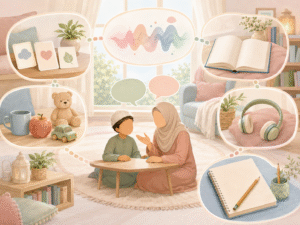
Before choosing a course for arabic language for kids, identify your child’s current level. This helps you choose the right next step.
| Your Child’s Situation | Skill to Build First | Helpful Resource |
|---|---|---|
| Does not know Arabic letters | Letter recognition | Arabic Alphabet for Kids |
| Knows letters but says sounds unclearly | Pronunciation and sounds | Arabic Alphabet with Pronunciation |
| Knows letters but cannot read words | Vowels and reading | Arabic Reading Practice for Kids |
| Reads words but does not understand | Vocabulary | Arabic Words for Kids |
| Understands some Arabic but cannot answer | Listening and speaking | Child Can Read Arabic but Cannot Speak |
| Finished Noor Al-Bayan | Broader Arabic language path | After Noor Al-Bayan |
| Ready for structured Arabic | Reading, writing, vocabulary, speaking | Takallam Series |
This table shows why arabic language for kids should be personalised. The child’s next step depends on what they already can and cannot do.
If your child is still confused with letters, do not rush into speaking. If your child reads well but cannot speak, do not keep repeating only alphabet lessons. If your child has finished Noor Al-Bayan, they may need a wider Arabic language program like Takallam.
Simple Home Routine for Arabic Language Practice
Parents can support arabic language for kids with a short home routine. The routine should not be long or stressful.
Try this 15-minute routine a few times a week:
| Time | Activity | Skill |
|---|---|---|
| 3 minutes | Review 3 Arabic letters or sounds. | Letter recognition and pronunciation. |
| 3 minutes | Read 3–5 short words. | Reading practice. |
| 3 minutes | Review 3 useful Arabic words. | Vocabulary. |
| 3 minutes | Listen and repeat one sentence. | Listening and speaking. |
| 3 minutes | Trace or write one word. | Writing and memory. |
You can adjust this routine based on your child’s age. Younger children may need only 5–10 minutes. Older children may be ready for more reading or speaking.
The important thing is consistency. arabic language for kids grows through small repeated practice, not one heavy session every few weeks.
Parents should also keep Arabic positive. Praise effort, use simple words, repeat familiar sentences, and avoid turning every practice session into a test.
How Arabic Language Supports Quran and Islamic Identity
Many Muslim parents want arabic language for kids because Arabic helps children connect with Quran, salah words, duas, Islamic vocabulary, and Muslim identity.
Arabic language learning can help children recognise words they hear in Islamic contexts. Words like صلاة، مسجد، قرآن، دعاء، صيام، رحمة, and سلام become more meaningful when the child understands them.
This does not mean every child must become fluent quickly. It means Arabic can become less distant and more familiar.
When arabic language for kids includes reading, vocabulary, listening, and speaking, children begin to see Arabic as a language they can use, not only a language they see in a book.
This is especially important for Muslim children growing up in English-speaking environments. Arabic can support faith, family connection, Quran readiness, and confidence in Islamic identity.
Common Mistakes Parents Should Avoid
Parents usually begin arabic language for kids with good intentions, but some mistakes can slow progress.
Focusing only on the alphabet
The alphabet is important, but Arabic learning should also include sounds, words, listening, speaking, and meaning.
Ignoring pronunciation
Some Arabic sounds are difficult for English-speaking children. They need listening and correction.
Expecting speaking without listening
Children usually need to hear Arabic many times before speaking confidently.
Teaching vocabulary as lists only
Words should be used in short sentences and real situations.
Making writing too difficult too early
Writing should support learning, not create stress before the child is ready.
Using group pace for every child
Some children need more time with sounds, reading, or speaking. One-to-one lessons can help because the pace is personal.
Stopping after Noor Al-Bayan
Noor Al-Bayan can build reading foundations, but many children still need vocabulary, speaking, stories, and wider Arabic language practice.
Avoiding these mistakes helps parents build arabic language for kids in a calmer and more effective way.
How Sibghah Academy Supports Arabic Language for Kids
Sibghah Academy offers live one-to-one Quran, Arabic, and Islamic Studies lessons for Muslim children aged 5–15.
For families who want arabic language for kids, Sibghah Academy helps children build Arabic step by step through one-to-one lessons matched to each child’s level.
Sibghah Arabic learning can support:
- Arabic letter recognition.
- Arabic pronunciation and sounds.
- Short vowels and early reading.
- Noor Al-Bayan for reading foundations.
- Arabic vocabulary.
- Arabic listening and speaking.
- Simple Arabic writing.
- Takallam Series after reading foundations.
Because lessons are one-to-one, the teacher can focus on your child’s needs. If your child needs pronunciation correction, the teacher can slow down. If your child can read but cannot speak, the teacher can add sentence practice. If your child needs more reading fluency, the teacher can focus on words and short texts.
This makes one-to-one lessons a strong option for arabic language for kids, especially for children who have different gaps across reading, speaking, listening, and writing.
Sibghah Academy also offers the Noor Al-Bayan Course for Arabic reading foundations and Quran readiness, and the Takallam Series for children who are ready to build wider Arabic language skills.
The goal is to help children build Arabic with clarity, confidence, and a path that makes sense for their level.
Quick Parent Checklist
Use this checklist when planning arabic language for kids:
- Can my child recognise Arabic letters?
- Can my child pronounce difficult Arabic sounds?
- Can my child read letters with vowels?
- Can my child read short Arabic words?
- Does my child understand useful vocabulary?
- Does my child hear Arabic regularly?
- Can my child answer simple Arabic questions?
- Can my child trace or write simple letters or words?
- Does my child need Noor Al-Bayan?
- Is my child ready for Takallam or a broader Arabic language path?
- Would one-to-one lessons help my child receive more attention?
FAQ: Arabic Language for Kids
1. What is arabic language for kids?
arabic language for kids means teaching children Arabic in a structured way that includes letters, pronunciation, reading, vocabulary, listening, speaking, writing, and confidence.
2. What should children learn first in Arabic?
Most children begin with Arabic letter recognition and sounds. After that, they move to vowels, simple words, reading, vocabulary, and speaking.
3. Is Arabic alphabet enough for kids?
No. The alphabet is important, but arabic language for kids should also include pronunciation, reading, vocabulary, listening, speaking, and writing.
4. Why can my child read Arabic but not speak it?
Reading and speaking are different skills. Your child may need listening, vocabulary, sentence patterns, and one-to-one speaking practice.
5. How can I help my child build Arabic vocabulary?
Use useful daily words, repeat them often, connect them to pictures or objects, and use them in short sentences.
6. Are one-to-one Arabic lessons better for children?
One-to-one Arabic lessons can be better for many children because the teacher can focus on the child’s exact level, correct mistakes, and give more speaking time.
7. How does Arabic help Quran reading?
Arabic letter recognition, pronunciation, vowels, and reading fluency can help children prepare for Quran reading and later Tajweed correction.
8. What comes after Noor Al-Bayan?
After Noor Al-Bayan, children may need Arabic reading fluency, vocabulary, stories, speaking, writing, and a structured Arabic language path such as Takallam.
9. How often should children practise Arabic?
Short regular practice is best. A few minutes several times a week can help children build Arabic without pressure.
10. Can parents support Arabic at home?
Yes. Parents can review letters, read simple words, use Arabic games, repeat useful phrases, and encourage short listening and speaking practice.
11. What if my child refuses Arabic lessons?
Make practice shorter, reduce pressure, use games and stories, praise effort, and consider one-to-one lessons to rebuild confidence gently.
12. Does Sibghah Academy teach arabic language for kids?
Yes. Sibghah Academy supports arabic language for kids through live one-to-one Arabic lessons, including letters, reading, vocabulary, speaking, writing, Noor Al-Bayan, and Takallam.
13. What is the best next step for parents?
The best next step is to check your child’s current Arabic level, then choose the skill they need first: letters, pronunciation, reading, vocabulary, speaking, or writing.
Book your child’s free one-to-one Arabic trial on WhatsApp
If you want a clear path for arabic language for kids, Sibghah Academy can help your child start from the right level through live one-to-one Arabic lessons.
Send us your child’s age, current Arabic level, and main goal, and we will recommend the right starting point.