
But Arabic learning can feel confusing for families. Should your child begin with the Arabic alphabet? Should they start with Noor Al-Bayan? Should they focus on reading first or speaking first? What if your child can read Arabic but cannot speak it? What if they forget words quickly? What if they refuse Arabic lessons because they feel difficult?
The best way to learn arabic for kids is not to push every child through the same path. Children have different starting points. Some need letters and sounds. Some need reading fluency. Some need vocabulary. Some need speaking practice. Some need a structured Arabic course after Noor Al-Bayan. Others need gentle one-to-one support because group classes move too quickly or do not give enough individual practice.
This guide explains how parents can help children learn arabic for kids step by step. It also shows why one-to-one Arabic lessons can be especially useful for children who need personal attention, pronunciation correction, reading support, speaking practice, and a learning path matched to their level.
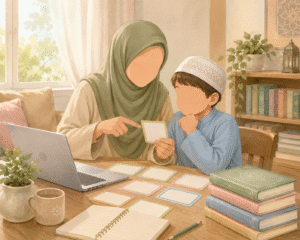
Quick answer: To learn arabic for kids successfully, children need a clear path: Arabic letters, sounds, vowels, simple words, reading practice, vocabulary, listening, speaking, stories, and consistent one-to-one teacher support.
| Child’s Current Level | What They Need Next |
|---|---|
| Does not know Arabic letters | Arabic alphabet, sounds, direction, and recognition. |
| Knows letters but cannot read words | Vowels, blending, Noor Al-Bayan, and short word practice. |
| Can read Arabic but slowly | Reading fluency, repeated practice, and simple stories. |
| Can read but cannot speak | Vocabulary, sentence patterns, listening, and speaking practice. |
| Loses focus in Arabic class | Shorter one-to-one lessons matched to the child’s pace. |
Table of Contents
Why Arabic Matters for Muslim Children
Arabic matters because it connects children to Quran, Islamic words, duas, Muslim identity, family heritage, and a wider world of Arabic books, stories, and communication.
For many children in the UK, Arabic is not the main language of school or daily conversation. They may hear Arabic at home sometimes, but English often becomes stronger. That is why parents need a structured plan if they want their child to learn arabic for kids in a way that lasts.
Arabic is not one skill. It includes several connected skills:
- Recognizing letters.
- Hearing sounds.
- Reading with vowels.
- Building vocabulary.
- Understanding short sentences.
- Listening to Arabic.
- Speaking simple Arabic.
- Writing gradually.
- Reading Quran more confidently.
This is why a child may be good at one part and weak in another. A child may know the alphabet but not read. Another child may read Arabic but not speak. Another child may memorize Quran by listening but still struggle with Arabic words.
When parents search for learn arabic for kids, the real goal is usually not only “Arabic lessons.” The real goal is confidence: the child can recognize Arabic, use Arabic, and feel that Arabic is not strange or impossible.
External Arabic-learning resources also show that Arabic learning is usually built gradually. For example, At-Takallum describes its Arabic learning series as a modern comprehensive course for non-native speakers, while Arabic at Our Children’s Hands presents a graded program for young non-native learners. Al Jazeera Learning Arabic is also presented as a free open educational source for Arabic learners.
For children, this gradual approach matters. Arabic should not be rushed. It should be built step by step.
Not sure where your child should start Arabic?
Sibghah Academy offers one-to-one Arabic lessons for children, so the teacher can check your child’s level and recommend the right path: letters, reading, vocabulary, speaking, Noor Al-Bayan, or Takallam.
Learn Arabic for Kids: 10 Helpful Steps

The following steps will help parents understand how to learn arabic for kids in a practical and child-friendly way.
1. Start with the Child’s Real Level
The first step is assessment. Do not begin with a book, app, or class before knowing your child’s current Arabic level.
Ask:
- Can my child recognize Arabic letters?
- Can my child hear the difference between similar sounds?
- Can my child read letters with Fatha, Kasra, and Damma?
- Can my child read simple words?
- Can my child understand any Arabic words?
- Can my child answer simple Arabic questions?
- Does my child need Arabic for Quran reading?
A one-to-one teacher can help here because the lesson can begin with your child’s actual level, not the level of a whole group. If your child already knows letters, the teacher can move forward. If your child confuses letters, the teacher can slow down and focus on the weak point.
This is one of the biggest reasons one-to-one lessons are useful when parents want to learn arabic for kids.
2. Build the Arabic Alphabet Foundation
Arabic letters are the door to Arabic reading. Children need to recognize letter shapes, hear sounds, understand dots, and notice that Arabic is written from right to left.
The alphabet stage should include:
- Letter recognition.
- Letter sounds.
- Dot placement.
- Similar letters.
- Writing direction.
- Beginning, middle, and end letter shapes.
Parents sometimes think that if a child can sing the alphabet, they can read Arabic. But this is not always true. A child can know the order of letters but still struggle to read words.
To learn arabic for kids properly, the alphabet should move toward sounds and reading, not only memorization of letter names.
Useful guide: Arabic Alphabet for Kids.
3. Add Sounds and Vowels Early
Arabic reading depends on sounds. Children need to know what happens when a letter takes Fatha, Kasra, or Damma.
For example, the child should learn that:
- بَ sounds different from بِ.
- بِ sounds different from بُ.
- Changing the vowel changes the sound.
This stage helps children move from recognizing letters to reading real words. If vowels are ignored, children may guess words or depend only on memory.
In one-to-one Arabic lessons, the teacher can listen to the child’s sound production carefully. This is important because some Arabic sounds may not exist in English, and children may need repeated gentle correction.
Strong sound practice makes it easier to learn arabic for kids and prepares the child for Quran reading later.
4. Move from Letters to Short Words
After letters and vowels, children need short words. This is where Arabic starts to feel useful.
Start with simple words that match the letters and vowels the child already knows. Avoid giving difficult words too early.
Examples of early word practice may include:
- باب
- قلم
- ولد
- كتب
- أكل
- بيت
When children read words, ask them to break the word into letters and sounds. Then help them blend the sounds together.
This stage is essential when families want to learn arabic for kids because children begin to see that Arabic letters form meaningful words.
Useful guide: Arabic Reading Practice for Kids.
5. Build Useful Vocabulary
Arabic vocabulary helps children understand and use the language. Without vocabulary, children may read words but not know what they mean.
Start with words connected to the child’s real life:
- Family words.
- Home objects.
- Food and drink.
- School items.
- Feelings.
- Actions.
- Islamic daily words.
- Nature and animals.
For children, vocabulary should not be taught as a long list only. It should be used in small sentences, questions, games, pictures, and real situations.
For example, instead of teaching “قلم” only, use it in a sentence:
- هذا قلم.
- أين القلم؟
- القلم على الطاولة.
This helps children learn arabic for kids as a living language, not only isolated words.
Useful guide: Arabic Words for Kids.
6. Use Short Sentences Before Full Conversation
Some parents want their child to speak Arabic quickly. But speaking develops through small sentence patterns before full conversation.
Start with simple patterns:
- أنا أريد…
- هذا…
- هذه…
- أين…؟
- عندي…
- أحب…
- لا أحب…
Once a child knows a pattern, they can change one word and create many sentences.
For example:
- أنا أحب التفاح.
- أنا أحب الماء.
- أنا أحب الكتاب.
This is much better than asking a child to speak freely before they have enough language.
One-to-one lessons help because the child gets more speaking time. In a group class, one child may speak for only a short moment. In a one-to-one class, the teacher can ask repeated questions and help the child answer again and again.
This makes one-to-one support very useful for parents who want to learn arabic for kids beyond reading only.
7. Add Listening Before Speaking
Children often need to hear Arabic many times before they can speak it. Listening prepares the ear and helps the child understand sentence rhythm, pronunciation, and vocabulary.
Use simple listening activities:
- Listen to short Arabic stories.
- Repeat simple phrases after the teacher.
- Listen to Arabic questions and point to the answer.
- Use short audio clips with familiar words.
- Repeat the same sentence pattern across several days.
Listening is especially important for children who can read Arabic but cannot speak it. They may know letters on the page, but they need more exposure to real Arabic sounds and sentence patterns.
If the goal is to learn arabic for kids with speaking confidence, listening should be part of the plan from the beginning.
8. Use Stories to Connect Reading and Meaning
Stories help children connect Arabic reading, vocabulary, meaning, and emotion. A short story can make Arabic feel more enjoyable and memorable.
For beginners, stories should be simple. They can include repeated words, short sentences, pictures, and familiar topics.
After reading a story, ask:
- Who is in the story?
- What happened?
- Can you find this word?
- Can you say one sentence from the story?
- What did the character do?
This helps children move from reading sounds to understanding meaning.
Stories are also helpful when parents want to learn arabic for kids in a warmer way. Instead of making Arabic feel like a worksheet, stories make it feel like a language with people, actions, feelings, and lessons.
Useful guides: Arabic Stories for Kids with English Translation and Arabic Moral Stories for Kids.
9. Choose the Right Path After Noor Al-Bayan
Noor Al-Bayan can help children build Arabic reading foundations, especially when the goal is Quran readiness. But after Noor Al-Bayan, children may need a broader Arabic language path.
Some children should continue with:
- Arabic reading fluency.
- Short stories.
- Vocabulary building.
- Speaking practice.
- Writing practice.
- Quran reading.
- Takallam Series or another structured Arabic language program.
The right next step depends on the child. One-to-one lessons help here because the teacher can decide whether the child needs more reading, more vocabulary, or more speaking.
If parents want to learn arabic for kids beyond letter reading, they should not stop after the child finishes basic reading. Arabic should continue into language use.
Useful guide: After Noor Al-Bayan.
10. Keep Arabic Learning Gentle and Consistent
Arabic learning takes time. Children need repetition, encouragement, and a plan they can continue.
A gentle approach includes:
- Short lessons.
- Clear goals.
- Regular review.
- Praise for effort.
- No comparison with siblings.
- One main skill at a time.
- Teacher feedback.
- Parent support at home.
If Arabic becomes stressful, children may resist it. If Arabic feels achievable, they are more likely to continue.
This is why one-to-one lessons can make a big difference. The teacher can slow down, repeat, adjust, and focus on your child’s needs instead of forcing the child to follow a group pace.
To learn arabic for kids, consistency is more important than rushing. A child who learns a little every week with confidence may progress better than a child who does too much and then stops.
Sibghah Teacher Note: Arabic learning should not be one fixed path for every child. Some children need letters, some need reading, some need speaking, and some need confidence. One-to-one lessons allow the teacher to choose the right step for the child.
Why One-to-One Arabic Lessons Help Children

One-to-one Arabic lessons are especially helpful when the goal is to learn arabic for kids because children rarely have the exact same level.
In a group class, one child may already read while another child still struggles with letters. One child may want to speak, while another cannot read vowels yet. The teacher has to divide attention between several students.
In a one-to-one class, the teacher can focus fully on your child.
| One-to-One Advantage | How It Helps the Child |
|---|---|
| Personal level check | The teacher starts from the child’s real Arabic level. |
| More speaking time | The child answers more questions and practises more sentences. |
| Focused correction | The teacher corrects letters, sounds, reading, and pronunciation directly. |
| Flexible pace | The lesson slows down or moves forward based on the child’s progress. |
| Better confidence | Shy children may feel safer speaking without a group watching. |
| Clear parent feedback | Parents know what their child learned and what to practise next. |
For children who are learning Arabic as a second language, one-to-one support can be very important. They may need repeated listening, more pronunciation practice, and extra time to answer.
That is why Sibghah Academy focuses on one-to-one lessons for children. The goal is not only to teach a topic. The goal is to help each child learn arabic for kids in the right order and at the right pace.
Want one-to-one Arabic lessons for your child?
Sibghah Academy offers live one-to-one Arabic lessons for children, helping each child build Arabic letters, reading, vocabulary, speaking, and confidence at their own pace.
Which Arabic Path Does Your Child Need?

The best way to learn arabic for kids is to choose the right path. Use this guide before choosing a course.
| Your Child’s Situation | Recommended Path | Helpful Sibghah Resource |
|---|---|---|
| Does not know Arabic letters | Arabic alphabet, sounds, dot placement, direction. | Arabic Alphabet for Kids |
| Knows letters but cannot read | Vowels, blending, Noor Al-Bayan. | Noor Al-Bayan Course |
| Can read but needs fluency | Repeated reading, short words, simple sentences. | Arabic Reading Practice for Kids |
| Knows words but cannot speak | Sentence patterns, listening, speaking practice. | Child Can Read Arabic but Cannot Speak |
| Finished Noor Al-Bayan | Takallam, vocabulary, reading, writing, speaking. | Takallam Series |
This path prevents confusion. Instead of asking your child to do everything at once, you choose the next right step.
A child who needs letters should not be pushed into conversation. A child who reads well should not stay only on alphabet practice. A child who understands words should begin using sentences.
This is how parents can learn arabic for kids in a way that feels structured and realistic.
Simple Arabic Routine for Kids
A simple routine helps children learn arabic for kids without feeling overwhelmed.
Here is a 15-minute routine parents can use at home between one-to-one Arabic lessons:
| Time | Activity | Goal |
|---|---|---|
| 3 minutes | Review letters or words from the last lesson. | Keep memory strong. |
| 3 minutes | Listen and repeat one sentence. | Improve pronunciation and listening. |
| 4 minutes | Read 3–5 short words or one short sentence. | Build reading confidence. |
| 3 minutes | Answer simple Arabic questions. | Build speaking confidence. |
| 2 minutes | Praise effort and review one success. | Keep Arabic positive. |
For younger children, make the routine shorter. For older children, add more reading or speaking practice.
The key is consistency. Short Arabic practice several times a week is better than one long stressful session.
How Arabic Supports Quran Reading
Many parents want their children to learn arabic for kids because they want them to read Quran more confidently.
This is a good goal, but Quran reading needs a clear foundation. Children usually need:
- Arabic letters.
- Correct sounds.
- Short vowels.
- Long vowels.
- Joined letters.
- Sukoon and Shaddah.
- Reading fluency.
- Tajweed correction later.
If a child is rushed into Quran reading before Arabic foundations are ready, the child may guess words or feel stressed. But when Arabic reading is built carefully, Quran reading becomes easier.
This is why one-to-one Arabic lessons can help children prepare for Quran. The teacher can see exactly which reading skill is missing and fix it before moving forward.
Useful guides: Quran for Kids and Online Quran Classes for Kids.
Common Mistakes Parents Should Avoid
Parents usually want the best for their children, but some mistakes can make it harder to learn arabic for kids.
Starting with speaking before foundations
Speaking is important, but some children need vocabulary, listening, and sentence patterns first. Do not expect full conversation too early.
Only teaching the alphabet song
Alphabet songs may help with order, but they do not teach reading by themselves. Children need sounds, vowels, and word practice.
Ignoring pronunciation
Arabic has sounds that may be unfamiliar to English-speaking children. Pronunciation needs listening and correction.
Moving too quickly in group classes
Some children fall behind because the group moves faster than their level. One-to-one lessons can help the teacher slow down and focus on weak areas.
Not reviewing old words
Vocabulary needs repetition. A child may learn a word once and forget it if it is not used again.
Separating reading from meaning
Children should not only read sounds. They should gradually understand words and sentences.
Making Arabic feel like pressure
If every lesson feels like a test, children may resist Arabic. Keep practice short, warm, and achievable.
How Sibghah Academy Helps Children Learn Arabic
Sibghah Academy offers live one-to-one Quran, Arabic, and Islamic Studies lessons for Muslim children aged 5–15.
For families who want to learn arabic for kids, Sibghah Academy helps children start from the right level and move step by step through Arabic letters, reading, vocabulary, speaking, and confidence.
Because Sibghah lessons are one-to-one, the teacher can focus on your child’s exact needs. If your child needs Arabic letters, the lesson can focus on letters. If your child reads but cannot speak, the teacher can add vocabulary, sentence patterns, and speaking practice. If your child is ready after Noor Al-Bayan, the teacher can guide them into the Takallam Series.
Sibghah Arabic learning may include:
- Noor Al-Bayan Course for Arabic reading foundations and Quran readiness.
- Takallam Series for children ready to build wider Arabic language skills.
- One-to-one reading practice for children who need fluency.
- One-to-one speaking practice for children who need confidence using Arabic.
- Parent follow-up so families know what to practise between lessons.
The goal is not only to finish pages. The goal is to help each child build a strong Arabic foundation and feel confident using Arabic gradually.
If your child has struggled in group Arabic classes, one-to-one lessons may be a better fit because the teacher can give your child more attention, more correction, more speaking time, and a pace that matches their level.
Quick Parent Checklist
Use this checklist if you want to learn arabic for kids with a clear plan:
- Do I know my child’s current Arabic level?
- Can my child recognize Arabic letters?
- Can my child read letters with vowels?
- Can my child read simple words?
- Does my child understand basic Arabic vocabulary?
- Can my child answer simple Arabic questions?
- Does my child need Noor Al-Bayan?
- Does my child need Takallam after reading foundations?
- Would one-to-one lessons help my child get more speaking time?
- Do we have a simple review routine at home?
FAQ: Learn Arabic for Kids
1. What is the best way to learn arabic for kids?
The best way to learn arabic for kids is to start from the child’s real level, then build Arabic letters, sounds, vowels, words, reading, vocabulary, listening, and speaking step by step.
2. What age should children start learning Arabic?
Children can begin hearing Arabic and learning simple words early. Structured Arabic lessons often work well from around age 5, depending on attention span and readiness.
3. Should my child learn Arabic letters first?
If the goal is Arabic reading or Quran reading, Arabic letters and sounds are usually the first foundation.
4. Is Noor Al-Bayan enough to learn Arabic?
Noor Al-Bayan helps with Arabic reading foundations, but children may need vocabulary, speaking, stories, and a broader Arabic course after that.
5. What if my child can read Arabic but cannot speak?
Your child may need listening, vocabulary, sentence patterns, and one-to-one speaking practice to move from reading into communication.
6. Are one-to-one Arabic lessons better for kids?
One-to-one Arabic lessons can be very helpful because the teacher can focus on your child’s level, correct mistakes directly, and give more speaking and reading practice.
7. How can I help my child practise Arabic at home?
Use short daily review, simple words, repeated sentences, Arabic stories, listening practice, and questions connected to daily life.
8. How long does it take children to learn Arabic?
It depends on the child’s age, level, exposure, consistency, and goals. Arabic learning is gradual, especially for children who mostly speak English.
9. Should my child learn Arabic for Quran reading?
Arabic reading foundations can help children read Quran more confidently, especially when combined with Noor Al-Bayan and teacher correction.
10. What is the difference between Arabic reading and Arabic speaking?
Reading means recognizing and reading written Arabic. Speaking means using Arabic words and sentences in conversation. Children may need separate practice for both.
11. Can online Arabic lessons work for children?
Yes, online one-to-one Arabic lessons can work well when they are live, structured, child-friendly, and matched to the child’s level.
12. What if my child refuses Arabic lessons?
Make lessons shorter, reduce pressure, use easier activities, praise effort, and choose one-to-one support so the teacher can rebuild confidence slowly.
13. What comes after Arabic alphabet learning?
After the Arabic alphabet, children usually move to vowels, simple words, Noor Al-Bayan, reading practice, vocabulary, and eventually speaking.
14. Does Sibghah Academy help children learn Arabic?
Yes. Sibghah Academy helps children learn arabic for kids through live one-to-one lessons covering Arabic letters, reading, vocabulary, speaking, Noor Al-Bayan, and Takallam.
15. What is the first step for parents?
The first step is to check your child’s current Arabic level, then choose the right one-to-one Arabic path based on letters, reading, speaking, or Quran readiness.
Book your child’s free one-to-one Arabic trial on WhatsApp
If you want to learn arabic for kids in a structured and gentle way, Sibghah Academy can help your child start from the right level through one-to-one Arabic lessons.
Send us your child’s age, Arabic level, and main goal, and we will recommend the right Arabic path.