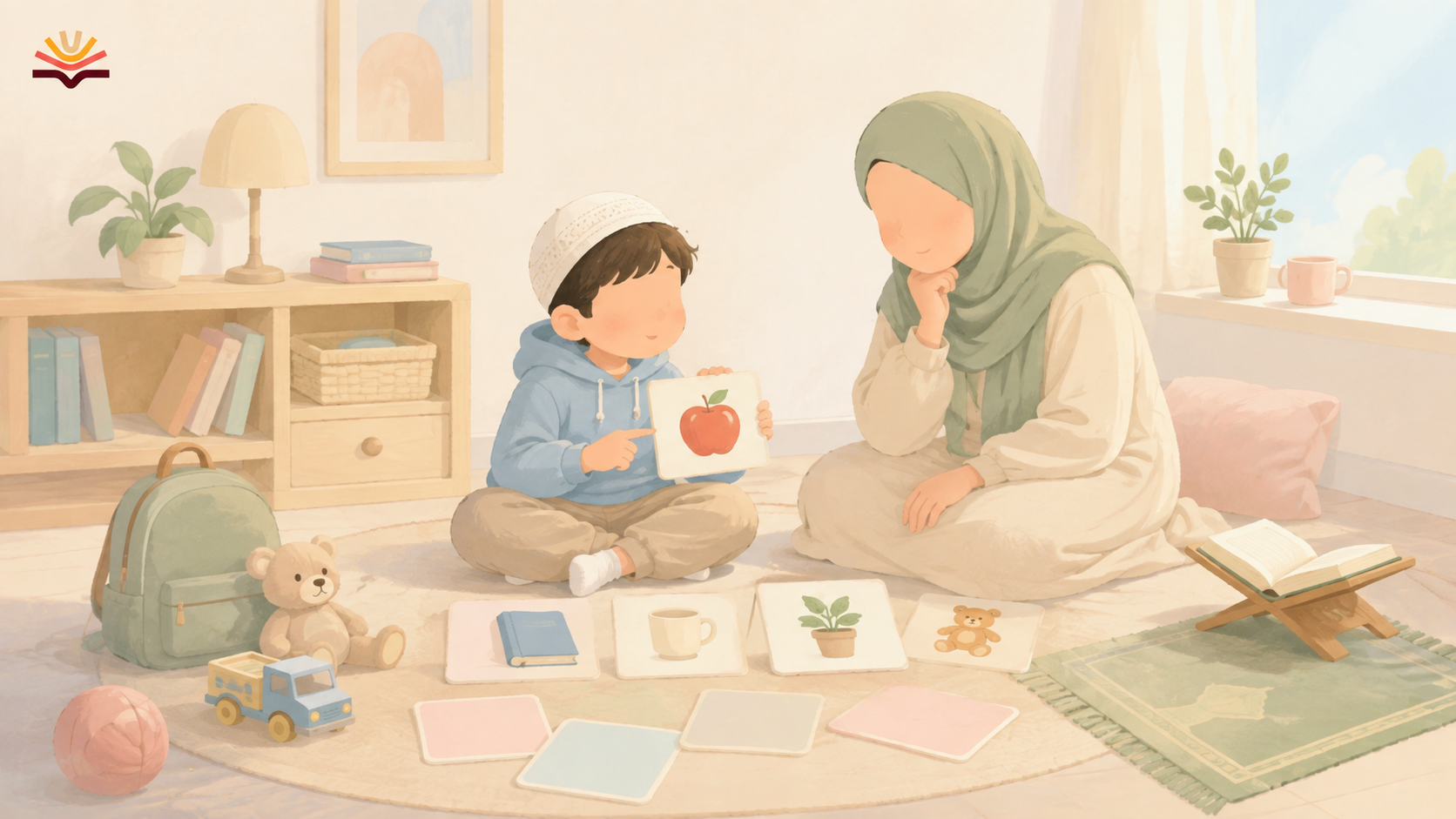
Many Muslim parents in the UK want their children to learn Arabic, but they are not always sure which words to start with. Should children learn family words first? Food words? School words? Islamic words? Or simple action words they can use in short sentences?
This guide gives you 100 practical Arabic Words for Kids with English meanings. The words are grouped into easy categories so your child can learn them step by step without feeling overwhelmed.
The goal is not to memorize 100 words in one day. The goal is to help your child build a useful Arabic vocabulary slowly. When children learn words they can see, use, hear, and repeat, Arabic begins to feel more familiar and less difficult.
These Arabic Words for Kids are especially useful for children who speak English most of the day, children who are learning Arabic as a second language, and Muslim children who need a gentle bridge between English and Arabic.
Quick answer: the best Arabic Words for Kids are simple daily words connected to family, home, food, school, feelings, actions, nature, and Islamic life. Start with a few words, repeat them often, and use them in short sentences.
| Parent Question | Simple Answer |
|---|---|
| How many Arabic words should my child learn first? | Start with 5–10 useful words, then add more slowly. |
| Should children memorize word lists? | Word lists help, but children also need examples, repetition, and real use. |
| Should I teach Arabic with English meaning? | Yes, English can help children understand meaning, especially if they are beginners. |
| What words should come first? | Begin with words your child sees every day: family, home, food, school, and simple actions. |
Table of Contents
Why Arabic Words Matter for Children
Vocabulary is one of the first bridges into a language. When a child knows useful words, they can begin to understand simple instructions, short stories, Quran-related words, and daily Arabic phrases.
Arabic Words for Kids should not be random. Children learn better when words are connected to things they already know. For example, family words are easier because the child sees family every day. Food words are easier because the child eats every day. School words are easier because the child uses school items regularly.
For children in the UK, Arabic may not be the language of school or friends. This means parents need to make Arabic visible and meaningful at home. Simple words can help Arabic become part of normal life.
When you teach Arabic Words for Kids, you are not only helping your child memorize vocabulary. You are helping them build confidence. A child who knows a few words can begin to answer simple questions, understand short stories, and feel that Arabic is possible.
This is also important for Quran and Islamic Studies. Children often hear words such as Allah, Quran, salah, dua, mercy, patience, and gratitude. When they understand simple Arabic words, Islamic learning becomes more meaningful.
If your child is still learning letters and sounds, start here first: Teach Arabic Letters to Kids.
Not sure which Arabic words your child should learn first?
Sibghah Academy can help you understand whether your child needs letters, vocabulary, sentence reading, speaking, or Arabic stories.
How to Use These Arabic Words for Kids
Before you start the word lists, remember that Arabic Words for Kids should be taught gently. Do not ask your child to memorize all 100 words at once.
Use this simple method:
- Choose one category.
- Pick 5 words from that category.
- Say each Arabic word slowly.
- Give the English meaning.
- Ask your child to repeat the word.
- Use the word in a short phrase.
- Review the same words again later in the week.
If your child is a beginner, English meaning is helpful. But do not let the child only read English. Keep returning to the Arabic word.
For example, if the word is “ماء” meaning “water,” you can point to water, say “ماء,” ask your child to repeat it, then use it in a simple phrase like “أُريدُ ماءً” if they are ready.
Good Arabic Words for Kids should move gradually from single words to short phrases, then to simple sentences. This is how vocabulary becomes real language.
Sibghah Teacher Note: do not measure success by how many words your child memorizes in one day. Measure success by how many words your child can recognize, understand, and use calmly over time.
Family Words
Family words are some of the most useful Arabic Words for Kids because children can use them every day at home.
| No. | Arabic Word | English Meaning |
|---|---|---|
| 1 | أُمّ | Mother |
| 2 | أَب | Father |
| 3 | أَخ | Brother |
| 4 | أُخْت | Sister |
| 5 | جَدّ | Grandfather |
| 6 | جَدَّة | Grandmother |
| 7 | طِفْل | Child |
| 8 | بِنْت | Girl |
| 9 | وَلَد | Boy |
| 10 | عائِلَة | Family |
To practise these words, ask your child simple questions such as: “Who is أُمّ?” or “Point to أَخ.” You can also use family photos to make the words more personal.
These Arabic Words for Kids are also useful for early speaking because children can begin to say simple phrases about their family.
Home Words
Home words are practical because children can see the objects around them. This makes Arabic Words for Kids easier to remember.
| No. | Arabic Word | English Meaning |
|---|---|---|
| 11 | بَيْت | House / home |
| 12 | غُرْفَة | Room |
| 13 | باب | Door |
| 14 | نافِذَة | Window |
| 15 | كُرْسِيّ | Chair |
| 16 | طاوِلَة | Table |
| 17 | سَرير | Bed |
| 18 | كِتاب | Book |
| 19 | قَلَم | Pen |
| 20 | حَقيبَة | Bag |
A good practice game is “Find the word.” Say “باب” and ask your child to point to the door. Say “كِتاب” and ask your child to find a book.
When Arabic Words for Kids are connected to real objects, children often remember faster because the meaning is visible.
Food and Drink Words
Food words are useful because children hear and use them every day. They are also easy to practise during meals.
| No. | Arabic Word | English Meaning |
|---|---|---|
| 21 | ماء | Water |
| 22 | حَليب | Milk |
| 23 | خُبْز | Bread |
| 24 | أُرْز | Rice |
| 25 | تُفّاح | Apple |
| 26 | مَوْز | Banana |
| 27 | تَمْر | Dates |
| 28 | عَصير | Juice |
| 29 | طَعام | Food |
| 30 | حَلْوى | Sweets |
You can practise these Arabic Words for Kids at breakfast, lunch, or snack time. Ask your child to say one Arabic food word before eating.
For example, you can say: “This is ماء,” “This is تُفّاح,” or “Do you want حَليب?” Keep it light and natural.
Want your child to start using Arabic words at home?
Sibghah Academy can help your child learn useful Arabic words, understand simple meanings, and build confidence step by step.
School Words
School words are helpful for children because they connect Arabic to learning, books, writing, and classroom routines.
| No. | Arabic Word | English Meaning |
|---|---|---|
| 31 | مَدْرَسَة | School |
| 32 | مُعَلِّم | Teacher |
| 33 | طالِب | Student |
| 34 | دَرْس | Lesson |
| 35 | واجِب | Homework |
| 36 | قِراءَة | Reading |
| 37 | كِتابَة | Writing |
| 38 | سُؤال | Question |
| 39 | جَواب | Answer |
| 40 | صَفّ | Class |
These Arabic Words for Kids can be used before or after online Arabic lessons. For example, your child can learn that “دَرْس” means lesson and “مُعَلِّم” means teacher.
If your child already knows Arabic letters and needs to build reading confidence, you may also find this useful: Arabic Reading Practice for Kids.
Feelings Words
Feelings words are important because children need language to express themselves. These Arabic Words for Kids can help children say how they feel in simple Arabic.
| No. | Arabic Word | English Meaning |
|---|---|---|
| 41 | سَعيد | Happy |
| 42 | حَزين | Sad |
| 43 | غاضِب | Angry |
| 44 | خائِف | Afraid |
| 45 | تَعْبان | Tired |
| 46 | مُتَحَمِّس | Excited |
| 47 | هادِئ | Calm |
| 48 | جائِع | Hungry |
| 49 | عَطْشان | Thirsty |
| 50 | مَشْغول | Busy |
Try asking your child: “Are you سَعيد?” or “Are you تَعْبان?” You can also use facial expression cards, but keep the practice gentle and playful.
Feelings vocabulary can also help when children resist Arabic. If your child says Arabic is hard, you can help them name the feeling instead of arguing. This can make learning calmer.
Action Words
Action words help children move from vocabulary to sentences. These Arabic Words for Kids are useful because they describe things children actually do.
| No. | Arabic Word | English Meaning |
|---|---|---|
| 51 | أَكَلَ | He ate |
| 52 | شَرِبَ | He drank |
| 53 | قَرَأَ | He read |
| 54 | كَتَبَ | He wrote |
| 55 | ذَهَبَ | He went |
| 56 | جَلَسَ | He sat |
| 57 | لَعِبَ | He played |
| 58 | نامَ | He slept |
| 59 | سَمِعَ | He heard |
| 60 | رَأى | He saw |
Action words are powerful because they help children build very short Arabic sentences. For example: “قَرَأَ الوَلَدُ” means “The boy read.”
When teaching action Arabic Words for Kids, you can act them out. Pretend to read, write, sit, sleep, or drink, then say the Arabic word.
Islamic Daily Words
Islamic daily words are especially important for Muslim children. These Arabic Words for Kids help children understand common Islamic language used at home, in Quran learning, and in Islamic Studies.
| No. | Arabic Word | English Meaning |
|---|---|---|
| 61 | الله | Allah |
| 62 | قُرْآن | Quran |
| 63 | صَلاة | Prayer |
| 64 | دُعاء | Dua |
| 65 | مَسْجِد | Mosque |
| 66 | رَحْمَة | Mercy |
| 67 | صَبْر | Patience |
| 68 | شُكْر | Gratitude |
| 69 | خَيْر | Goodness |
| 70 | سَلام | Peace |
These words can be connected to Islamic learning gently. For example, when your child makes dua, you can say, “This is دُعاء.” When your child learns Quran, you can point to the word “قُرْآن.”
If you want your child to understand Islamic meanings more deeply, you may also read: Teach Children About Allah.
Nature and Animal Words
Nature words make Arabic more visual and enjoyable. Children can practise these words during walks, storytime, or picture-based activities.
| No. | Arabic Word | English Meaning |
|---|---|---|
| 71 | شَمْس | Sun |
| 72 | قَمَر | Moon |
| 73 | نَجْم | Star |
| 74 | سَماء | Sky |
| 75 | مَطَر | Rain |
| 76 | شَجَرَة | Tree |
| 77 | زَهْرَة | Flower |
| 78 | قِطّ | Cat |
| 79 | طائِر | Bird |
| 80 | سَمَكَة | Fish |
Nature Arabic Words for Kids can also support Islamic reflection. You can connect the sky, rain, sun, moon, trees, and animals to Allah’s creation in a simple and loving way.
Useful Daily Words
The final group includes everyday words that children can use in many situations. These Arabic Words for Kids can help with basic conversation and simple instructions.
| No. | Arabic Word | English Meaning |
|---|---|---|
| 81 | نَعَم | Yes |
| 82 | لا | No |
| 83 | مِنْ فَضْلِك | Please |
| 84 | شُكْرًا | Thank you |
| 85 | آسِف | Sorry |
| 86 | مَرْحَبًا | Hello |
| 87 | جَيِّد | Good |
| 88 | كَبير | Big |
| 89 | صَغير | Small |
| 90 | جَميل | Beautiful |
| 91 | سَريع | Fast |
| 92 | بَطيء | Slow |
| 93 | قَريب | Near |
| 94 | بَعيد | Far |
| 95 | اليَوْم | Today |
| 96 | غَدًا | Tomorrow |
| 97 | الآن | Now |
| 98 | هُنا | Here |
| 99 | هُناك | There |
| 100 | مَعًا | Together |
These everyday Arabic Words for Kids are useful because they can appear in many short conversations. Words like “please,” “thank you,” “today,” “now,” and “together” can be used naturally at home.
Simple Practice Plan for Arabic Words for Kids
A clear plan helps children review vocabulary without pressure. Use this simple weekly routine for Arabic Words for Kids.
| Day | Practice Task | Goal |
|---|---|---|
| Monday | Choose 5 new Arabic words. | Understand meaning. |
| Tuesday | Review the same 5 words. | Recognize and repeat. |
| Wednesday | Use 2 words in short phrases. | Move toward simple use. |
| Thursday | Play a matching or pointing game. | Make review enjoyable. |
| Friday | Ask your child to remember the 5 words. | Check retention gently. |
| Weekend | Use the words in a story or conversation. | Connect vocabulary to real language. |
This plan works because it keeps the number of words small. A child who learns five words well can build stronger confidence than a child who sees 30 words and remembers none.
If your child enjoys stories, use vocabulary from simple Arabic stories. This helps Arabic Words for Kids become part of meaning, not just memorization. You can use this guide: Arabic Stories for Kids with English Translation.
How to Turn Arabic Words into Sentences
After your child learns some Arabic Words for Kids, the next step is using them in short phrases and sentences.
Start with simple sentence patterns:
| Arabic Sentence | English Meaning |
|---|---|
| هذا كِتاب. | This is a book. |
| أُريدُ ماءً. | I want water. |
| أَنا سَعيد. | I am happy. |
| أَنا أَقْرَأُ. | I am reading. |
| شُكْرًا يا أُمّي. | Thank you, my mother. |
Do not rush into long sentences. Start with short, useful phrases. The goal is to help your child feel that Arabic words can become real communication.
When Arabic Words for Kids are used in sentences, the child begins to understand how Arabic works. This prepares them for reading, speaking, and story understanding.
Want your child to move from Arabic words to sentences?
Sibghah Academy can help your child build vocabulary, reading confidence, and simple Arabic expression through live one-to-one lessons.
Common Mistakes Parents Should Avoid
Parents often use word lists because they want to help. But when teaching Arabic Words for Kids, some mistakes can make learning harder.
Teaching too many words at once
Seeing 100 words at once can overwhelm a child. Use this article as a resource, but choose only a few words each week.
Only asking children to memorize
Memorization alone is not enough. Children need to hear, repeat, see, point, act, and use words.
Not reviewing old words
Children forget quickly if words are not reviewed. Review is part of learning.
Using words that are not useful
Begin with words your child can use in daily life. Useful words are easier to remember.
Correcting too harshly
Pronunciation matters, but children also need confidence. Correct gently and praise effort.
Not moving from words to phrases
Once your child knows a few words, start using them in short phrases. This makes Arabic more meaningful.
How Sibghah Academy Supports Arabic Vocabulary
Sibghah Academy offers live online Quran, Arabic, and Islamic Studies lessons for Muslim children aged 5–15.
When children learn Arabic Words for Kids, they need more than a list. They need a teacher who can help them understand, pronounce, repeat, and use words in age-appropriate ways.
Sibghah Academy supports children through structured Arabic learning, starting from letters and sounds for beginners, then moving into words, sentences, reading, vocabulary, stories, and speaking.
Some children need the Noor Al-Bayan Course first to build Arabic reading foundations. Other children are ready for the Takallam Series, where they can build Arabic vocabulary, reading, listening, speaking, and confidence step by step.
For Muslim families in the UK, one-to-one online Arabic lessons can help children learn at a suitable pace. A teacher can choose the right words, connect them to reading, and help the child gradually use Arabic with more confidence.
The aim is not only to teach isolated vocabulary. The aim is to help children understand Arabic, enjoy it, and use it as a meaningful language.
Quick Parent Checklist
Use this checklist when teaching Arabic Words for Kids at home:
- Am I choosing only a few words at a time?
- Are the words useful in my child’s daily life?
- Did I say the Arabic word clearly?
- Did I explain the English meaning?
- Did my child repeat the word?
- Did we review old words?
- Did we use the word in a phrase or sentence?
- Can I connect the word to a story, object, or action?
- Does my child need teacher support to move forward?
FAQ: Arabic Words for Kids
1. What are the best Arabic Words for Kids to learn first?
The best Arabic Words for Kids to learn first are useful daily words connected to family, home, food, school, feelings, actions, and Islamic life.
2. How many Arabic words should children learn at a time?
Start with 5–10 words at a time. Children usually learn better when the number is small and the words are repeated often.
3. Should I teach Arabic words with English meaning?
Yes. For children who speak English, English meanings can help them understand the Arabic word clearly before using it.
4. Are word lists enough to teach Arabic?
No. Word lists are useful, but children also need listening, repetition, examples, stories, phrases, and conversation practice.
5. How can I help my child remember Arabic Words for Kids?
You can help your child remember Arabic Words for Kids by using the words in daily life, reviewing them weekly, and connecting them to objects or stories.
6. Should children learn Arabic nouns or verbs first?
Both are useful. Nouns help children name things, while verbs help them build simple sentences.
7. Can Arabic words help with Quran learning?
Yes. Arabic vocabulary can support Quran learning by making some words and meanings more familiar to the child.
8. What if my child forgets Arabic words quickly?
Forgetting is normal. Use fewer words, review more often, and practise the words in short phrases.
9. How can I make Arabic vocabulary fun?
Use matching games, pointing games, storytime, drawing, acting, audio repetition, and family routines.
10. Can children learn Arabic words before reading Arabic?
Yes. Children can learn spoken vocabulary before reading, but reading Arabic letters will help them recognize and use words more confidently later.
11. How do I turn Arabic Words for Kids into sentences?
Start with simple patterns such as “This is a book,” “I want water,” or “I am happy,” then add more words gradually.
12. Are Islamic words important for Muslim children?
Yes. Words such as Allah, Quran, salah, dua, mercy, patience, and gratitude help children connect Arabic with Islamic learning.
13. What is the best age to start Arabic vocabulary?
Children can hear Arabic words from an early age. The method should match their age, attention span, and language level.
14. Can Sibghah Academy help my child learn Arabic vocabulary?
Yes. Sibghah Academy helps children learn Arabic vocabulary through live online lessons, reading practice, stories, speaking, and structured Arabic courses.
15. What comes after learning Arabic Words for Kids?
After learning Arabic Words for Kids, children should practise short phrases, simple sentences, reading, listening, and speaking.
16. How should parents use this list of 100 Arabic words?
Parents should use this list slowly. Choose one category, practise a few words, review them, and use them in daily life before adding more.
Book your child’s free Arabic trial on WhatsApp
Arabic Words for Kids can help your child build vocabulary, understand simple Arabic, and move gradually toward reading, speaking, and confidence.
Send Sibghah Academy a WhatsApp message with your child’s age, Arabic level, and main goal, and we will help you choose the right Arabic learning path.