
To Teach Children About Allah in a loving way, parents need more than information. Children need warmth, simple examples, daily reminders, gentle answers, and a home environment where learning about Allah feels safe, beautiful, and meaningful.
These are important questions. The way we Teach Children About Allah can shape how they feel about Islam, worship, Quran, salah, dua, and their Muslim identity as they grow.
For Muslim children living in the UK and other English-speaking environments, this can be even more important. Children may hear many different ideas at school, online, or from friends. They need a clear, loving, age-appropriate understanding of who Allah is and why knowing Allah matters.
This guide gives parents practical and gentle ways to Teach Children About Allah through everyday life, the Names of Allah, stories, dua, gratitude, and calm conversations.
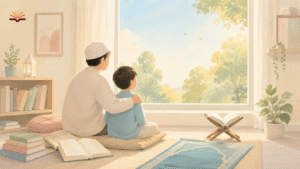
Quick answer: to Teach Children About Allah in a loving way, begin with Allah’s mercy, care, creation, generosity, and nearness through dua. Use simple examples, answer questions calmly, and connect learning to daily life.
| Parent Question | Gentle Answer |
|---|---|
| What should children learn first about Allah? | Start with Allah as the Creator, the Most Merciful, the One who gives, protects, hears, knows, and guides. |
| Should I teach fear of Allah? | Yes, but in a balanced way. Children should first feel love, mercy, gratitude, and trust, not panic or anxiety. |
| How can I explain Allah to young children? | Use simple examples from creation, daily blessings, dua, kindness, and the Names of Allah. |
| What if my child asks difficult questions? | Stay calm. Give a simple answer, admit when something is beyond us, and keep the conversation safe. |
Table of Contents
- Why Children Need a Loving Way to Learn About Allah
- Teach Children About Allah: 7 Loving Ways
- Using the Names of Allah with Children
- How to Connect Allah to Daily Life
- How to Answer Children’s Questions About Allah
- How to Teach Children About Allah by Age
- Common Mistakes Parents Should Avoid
- How Sibghah Academy Supports Islamic Learning
- FAQ
Why Children Need a Loving Way to Learn About Allah

Children do not only learn from words. They learn from feelings, tone, routine, examples, and the way adults speak about Allah in everyday life.
If a child only hears about Allah when they are being corrected, warned, or frightened, they may begin to connect Islamic learning with stress. But if a child hears about Allah through mercy, gratitude, dua, care, and beautiful reminders, their heart can become more open.
This does not mean we remove seriousness from Islamic learning. Children should learn that Allah sees us, knows us, commands us, and will hold us accountable. But the foundation should be balanced and age-appropriate.
When parents Teach Children About Allah, they are not only teaching facts. They are helping children build a relationship with their Creator.
A child who learns that Allah is Ar-Rahman, Ar-Raheem, Al-Khaliq, Ar-Razzaq, As-Samee, Al-Baseer, and Al-Hafeedh can begin to understand that Allah is not distant from their life. Allah created them, gives them blessings, hears their dua, knows their feelings, and guides them.
This is why it is important to Teach Children About Allah in a way that brings love, trust, humility, and gratitude together.
You can also explore Quran meanings with your child through trusted Quran resources such as Quran.com, while keeping explanations suitable for their age.
Want your child to know Allah in a loving way?
Sibghah Academy can help your child learn about Allah’s Names, Islamic values, and daily faith in a gentle, age-appropriate way.
Teach Children About Allah: 7 Loving Ways
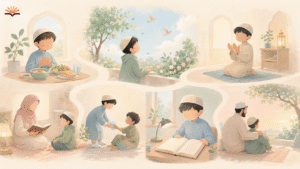
There are many ways to Teach Children About Allah, but the most effective ways are often simple and repeated. Children need small meanings they can understand, remember, and connect to their own life.
1. Start with Allah’s Mercy and Care
One of the best ways to Teach Children About Allah is to begin with mercy. Children need to know that Allah is Merciful, Kind, Generous, and Caring.
You can say:
- “Allah gave us food because He provides for us.”
- “Allah hears your dua.”
- “Allah knows when you are happy and when you are sad.”
- “Allah loves good actions.”
- “Allah is Merciful and loves when we return to Him.”
This helps the child feel that learning about Allah is not only about rules. It is about knowing the One who created them, cares for them, and guides them.
2. Use the World Around Them
Children understand through what they can see. The sky, rain, trees, animals, food, family, and their own bodies can become simple reminders of Allah’s creation.
You can say:
- “Who made the rain?”
- “Look how Allah made the flowers different colors.”
- “Allah gave us eyes to see and ears to hear.”
- “Allah made the sun useful for us.”
This is a natural way to Teach Children About Allah without turning every moment into a formal lesson. The child learns that signs of Allah are around them every day.
3. Teach One Name of Allah at a Time
The Names of Allah can help children know Allah in a clear and beautiful way. But children should not only memorize the Names. They should understand simple meanings.
For example, when teaching Ar-Razzaq, you can explain that Allah is the Provider. Then connect this to food, water, family care, and daily blessings.
When teaching As-Samee, explain that Allah hears everything, including quiet dua. This can make dua feel meaningful for the child.
When parents Teach Children About Allah through His Names, children begin to connect belief with real life.
If you want a structured path, Sibghah Academy offers a Names of Allah Course for Kids.
4. Connect Dua to Allah’s Nearness
Dua is one of the warmest ways to Teach Children About Allah. Children can learn that they can speak to Allah, ask Allah, thank Allah, and turn to Allah.
When your child is worried, you can say, “Let’s make dua.” When your child is happy, you can say, “Let’s thank Allah.” When your child wants something good, you can teach them to ask Allah first.
For children, dua should not feel complicated. It can be simple and sincere:
- “O Allah, help me.”
- “O Allah, make me kind.”
- “O Allah, help me learn.”
- “O Allah, protect my family.”
Through dua, children learn that Allah is not only spoken about in lessons. Allah is the One we turn to in life.
5. Use Stories That Show Trust in Allah
Stories help children understand deep meanings. Stories of the Prophets can show children patience, trust, courage, gratitude, and reliance on Allah.
When you tell a story, do not only focus on events. Ask: “What does this story teach us about Allah?”
For example:
- The story of Prophet Nuh عليه السلام can teach patience and trust.
- The story of Prophet Ibrahim عليه السلام can teach obedience and certainty.
- The story of Prophet Musa عليه السلام can teach that Allah helps and guides.
- The story of Prophet Yunus عليه السلام can teach turning back to Allah.
This is a powerful way to Teach Children About Allah because the child sees faith through real examples.
You can also read: Stories of the Prophets for Kids.
6. Balance Love, Respect, and Accountability
Children should learn to love Allah, hope in Allah’s mercy, respect Allah’s commands, and understand that actions matter. But balance is important.
If we only speak about fear, a child may become anxious. If we only speak about love without guidance, a child may not understand responsibility.
A balanced way to Teach Children About Allah is to say:
- “Allah is Merciful, and He wants us to do what is good.”
- “Allah loves truthfulness, so we try to be honest.”
- “Allah forgives when we return to Him.”
- “When we make a mistake, we say sorry, fix it, and ask Allah to forgive us.”
This teaches the child that Islam is not about perfection. It is about knowing Allah, trying to obey Him, and returning to Him when we make mistakes.
7. Let Your Own Tone Teach
Parents often focus on what to say, but how you say it matters too. A calm, loving tone can make Islamic learning feel safe.
If you only mention Allah when angry, the child may connect Allah with fear. But if you mention Allah during gratitude, beauty, comfort, dua, and everyday blessings, the child’s heart receives a fuller picture.
You can Teach Children About Allah through simple daily phrases:
- “Alhamdulillah, Allah gave us this blessing.”
- “Let’s ask Allah to help us.”
- “Allah loves kindness.”
- “Allah sees your good effort.”
- “Allah is Merciful when we make mistakes and return to Him.”
Over time, these small phrases can shape how children feel about Allah.
Sibghah Teacher Note: children need repeated, simple, loving meanings. One calm sentence repeated often can be more powerful than a long lecture.
Using the Names of Allah with Children
The Names of Allah are one of the most beautiful ways to Teach Children About Allah. Each Name helps the child understand a meaning that can touch daily life.
However, parents should not rush. Children need time to understand, not only memorize.
| Name of Allah | Simple Meaning for Children | Daily-Life Example |
|---|---|---|
| Ar-Rahman | Allah is full of mercy. | Allah gives us blessings even before we ask. |
| Ar-Razzaq | Allah is the Provider. | Food, water, family care, and provision are from Allah. |
| As-Samee | Allah hears everything. | Allah hears our dua, even when it is quiet. |
| Al-Baseer | Allah sees everything. | Allah sees our good actions, even when people do not. |
| Al-Hafeedh | Allah protects and preserves. | We ask Allah to protect us and our family. |
When you Teach Children About Allah through His Names, use a simple pattern:
- Say the Name.
- Explain the meaning simply.
- Give one daily-life example.
- Ask one gentle question.
- Make a short dua connected to the Name.
For example, with As-Samee, you can say: “Allah is As-Samee. He hears everything. He hears your dua. What would you like to ask Allah today?”
This makes the Names of Allah personal and meaningful for the child.
Want your child to learn the Names of Allah properly?
Sibghah Academy can help your child understand Allah’s Names through simple meanings, examples, stories, and gentle Islamic reflection.
How to Connect Allah to Daily Life
Children learn best when Islamic meanings are connected to moments they already understand. You do not need a formal lesson every time you want to Teach Children About Allah.
Here are simple daily moments you can use:
| Daily Moment | What to Say | Meaning Taught |
|---|---|---|
| Eating food | “Allah is Ar-Razzaq. He gave us this food.” | Gratitude and provision |
| Seeing rain | “Allah sends rain and gives life to the earth.” | Creation and mercy |
| Feeling scared | “Let’s ask Allah to protect us.” | Trust and dua |
| Making a mistake | “We can say sorry, fix it, and ask Allah to forgive us.” | Repentance and hope |
| Helping someone | “Allah loves kindness.” | Good manners |
This approach helps parents Teach Children About Allah naturally. The child begins to see that belief is not only something studied in a class. It is part of eating, playing, helping, praying, asking, and thanking.
Try to keep your words short. Children do not need a long explanation every time. A short, sincere reminder can be enough.
How to Answer Children’s Questions About Allah
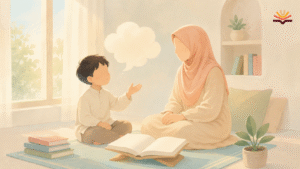
Children may ask big questions. This is normal. Questions do not always mean doubt. Sometimes they mean curiosity, growth, or a desire to understand.
When you Teach Children About Allah, your response to questions matters. If a child feels shamed for asking, they may stop asking you and look elsewhere.
Here are some principles:
- Stay calm when your child asks.
- Do not laugh at the question.
- Do not make the child feel guilty for asking.
- Give a short answer suitable for their age.
- Say “I will check” if you are unsure.
- Return to what we know clearly about Allah from Islam.
Some questions need simple answers. Some questions need a teacher. Some questions should be answered gradually as the child grows.
For example, if a child asks, “Does Allah hear me?” you can say, “Yes, Allah is As-Samee. He hears everything, even your quiet dua.”
If a child asks something too abstract, keep the answer simple and avoid overcomplicating it. Children do not need adult-level theological detail.
A safe home environment makes it easier to Teach Children About Allah because the child knows they can ask and learn without fear.
How to Teach Children About Allah by Age
The way you Teach Children About Allah should match your child’s age and understanding. Young children need simple meanings. Older children can handle deeper explanations and more discussion.
Ages 4–6
At this age, keep things simple, warm, and concrete. Focus on Allah as the Creator, the One who gives us blessings, hears our dua, and loves good actions.
Use short phrases, stories, nature, gratitude, and simple duas.
Ages 7–9
Children at this age can understand more examples. You can introduce more Names of Allah, connect them to daily life, and ask simple reflection questions.
For example: “Allah is Al-Baseer. What good action can you do even if nobody sees?”
Ages 10–12
Children may begin asking deeper questions. They need calm answers, clear Islamic foundations, and space to think.
You can connect learning about Allah to Quran, Prophets’ stories, Islamic manners, and personal responsibility.
Ages 13–15
Teenagers need respect and thoughtful discussion. They may not respond well to childish explanations or pressure.
Help them connect belief in Allah to identity, choices, purpose, online life, friendships, salah, and future goals.
At every age, when parents Teach Children About Allah, the goal is not only information. The goal is faith, love, understanding, and connection.
How Stories Help Children Know Allah
Stories are one of the best ways to Teach Children About Allah because children remember people, emotions, choices, and outcomes.
Stories of the Prophets help children see how believers trusted Allah in different situations. Stories also show that Allah guides, provides, protects, forgives, and answers dua in the way He wills.
After each story, ask a simple question:
- “What did this story teach us about Allah?”
- “How did the Prophet trust Allah?”
- “What beautiful Name of Allah can we remember from this story?”
- “What can we do when we feel worried?”
You can also use simple moral stories to teach values like honesty, kindness, patience, and responsibility. These values help children understand what Allah loves.
You may find this useful: Arabic Moral Stories for Kids.
Common Mistakes Parents Should Avoid
Parents usually want good for their children. But when trying to Teach Children About Allah, some approaches can make children feel confused or afraid.
Only mentioning Allah when correcting behavior
If a child only hears “Allah sees you” when they do something wrong, they may connect Allah’s knowledge with fear only. Balance this with reminders that Allah sees their kindness, effort, dua, and good choices too.
Using fear before love is established
Children should learn accountability, but fear-based teaching should not be the foundation. Build love, gratitude, trust, and mercy first.
Giving answers that are too complicated
Children need age-appropriate answers. A simple answer that is true and clear is better than a long answer they cannot understand.
Ignoring children’s questions
Questions are an opportunity. If we shut them down, children may stop asking us.
Teaching Names without meanings
Memorizing the Names of Allah is good, but children also need simple meanings and examples.
Separating belief from daily life
If Islamic learning only happens in a lesson, children may not connect it to real life. Use daily moments gently.
Making faith feel heavy
Faith includes responsibility, but children also need beauty, hope, mercy, gratitude, and love.
Need a gentle Islamic Studies path for your child?
Sibghah Academy can help your child learn about Allah, Islamic manners, worship, Prophets’ stories, and Muslim identity in a structured and loving way.
How Sibghah Academy Supports Islamic Learning
Sibghah Academy offers live online Quran, Arabic, and Islamic Studies lessons for Muslim children aged 5–15.
When we Teach Children About Allah, we believe children need clear Islamic knowledge, warm teaching, age-appropriate examples, and practical connection to daily life.
Sibghah Academy supports children through Islamic Studies programs that include Aqeedah, worship, manners, stories, Islamic identity, and the Names of Allah.
The Names of Allah Course for Kids helps children understand selected Names of Allah through simple meanings, examples, questions, and reflection. This can help children know Allah with love, trust, and gratitude.
For children who need a wider Islamic Studies path, the Minhaj Al-Muslim Course for Kids introduces Islamic beliefs, worship, manners, and daily Islamic values in a structured way.
Children can also benefit from Stories of the Prophets for Kids, where they learn faith lessons through the lives of the Prophets عليهم السلام.
For Muslim families in the UK, online one-to-one Islamic Studies lessons can help children ask questions, build confidence, and connect Islam to their daily life while learning at a suitable pace.
Quick Parent Checklist
Use this checklist when you Teach Children About Allah at home:
- Am I starting with Allah’s mercy, care, and blessings?
- Am I using simple examples from daily life?
- Am I teaching the Names of Allah with meanings, not only memorization?
- Am I making dua feel natural and personal?
- Am I answering questions calmly?
- Am I balancing love, respect, hope, and accountability?
- Am I avoiding fear-only language?
- Am I connecting learning about Allah to stories and good manners?
- Does my child need a structured Islamic Studies path?
FAQ: Teach Children About Allah
1. What is the best way to Teach Children About Allah?
The best way to Teach Children About Allah is to start with simple meanings, Allah’s mercy, daily blessings, dua, the Names of Allah, and calm conversations that match the child’s age.
2. At what age should parents Teach Children About Allah?
Parents can begin very early with simple phrases such as “Allah made us,” “Allah gives us food,” and “Allah hears our dua.” The depth can grow as the child grows.
3. Should children learn the Names of Allah?
Yes. The Names of Allah are a beautiful way to help children know Allah, especially when each Name is explained with a simple meaning and daily-life example.
4. How do I explain Allah’s mercy to a child?
You can explain that Allah is Merciful, gives us blessings, forgives us when we return to Him, and wants what is good for us.
5. Should I teach fear of Allah to young children?
Children should learn respect and accountability, but fear should be balanced with love, mercy, hope, gratitude, and trust in Allah.
6. How can I Teach Children About Allah through nature?
You can point to the sky, rain, trees, animals, food, and the human body as signs of Allah’s creation, care, wisdom, and mercy.
7. What if my child asks difficult questions about Allah?
Stay calm, answer simply, avoid shaming the child, and seek help from a knowledgeable teacher if the question needs deeper explanation.
8. Can stories help children know Allah?
Yes. Stories of the Prophets and moral stories can help children understand trust in Allah, patience, gratitude, obedience, and good character.
9. How can dua help children connect with Allah?
Dua teaches children that Allah hears them, knows their needs, and is the One they can turn to in happiness, worry, need, and gratitude.
10. How can parents Teach Children About Allah without making religion feel heavy?
Parents can keep reminders short, loving, and connected to daily life. Use gratitude, stories, dua, and gentle examples instead of long lectures.
11. Is it enough to memorize the Names of Allah?
Memorization is good, but children also need to understand the meanings and connect them to real life.
12. How can I Teach Children About Allah if they mostly speak English?
You can explain meanings in English while gradually introducing Islamic Arabic words such as Allah, dua, salah, rahmah, rizq, and shukr.
13. What should I avoid when teaching children about Allah?
Avoid fear-only language, complicated explanations, ignoring questions, and only mentioning Allah when correcting behavior.
14. Can Sibghah Academy help my child learn about Allah?
Yes. Sibghah Academy offers Islamic Studies courses that help children learn about Allah, the Names of Allah, Islamic values, worship, and stories in an age-appropriate way.
15. What course helps children learn the Names of Allah?
The Names of Allah Course for Kids at Sibghah Academy helps children understand selected Names of Allah through simple meanings, examples, reflection, and daily-life connection.
16. Why is it important to Teach Children About Allah lovingly?
It is important to Teach Children About Allah lovingly because children are building their first emotional connection with faith, worship, Quran, dua, and Islamic identity.
Book your child’s free Islamic Studies trial on WhatsApp
When you Teach Children About Allah with love, clarity, and gentle structure, your child can build a stronger connection to faith and Islamic identity.
Send Sibghah Academy a WhatsApp message with your child’s age and learning goal, and we will help you choose the right Islamic Studies path.