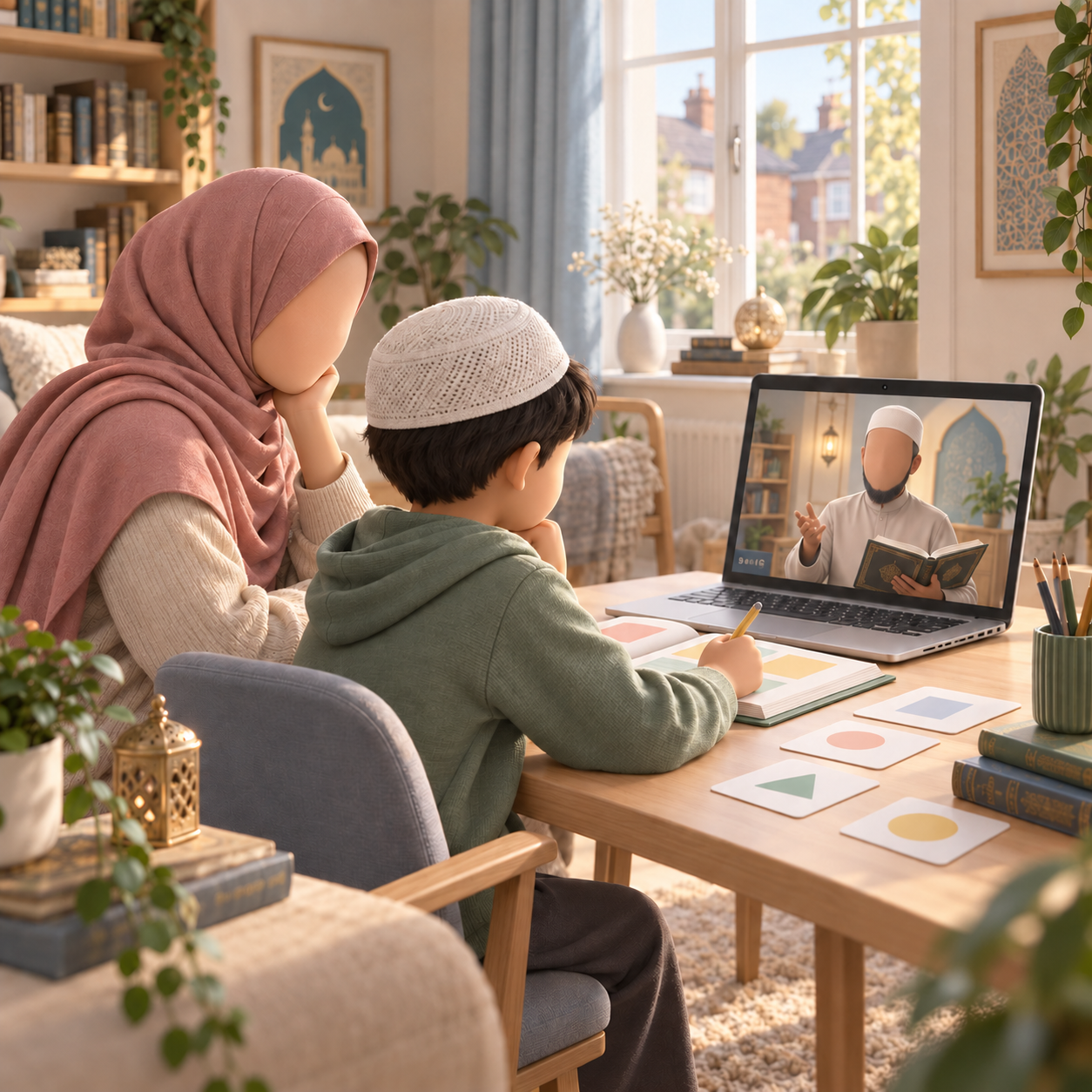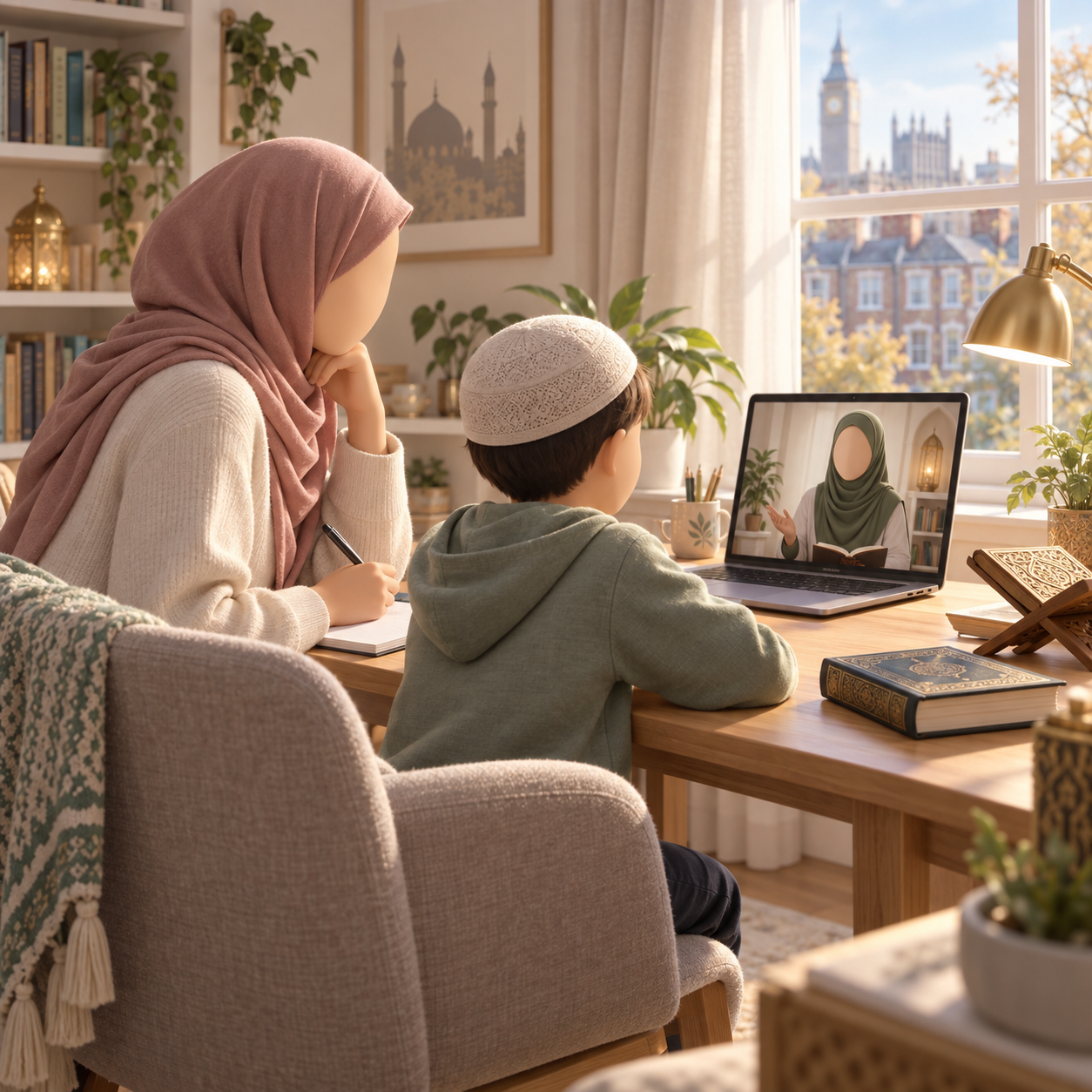

Many parents want their child to learn quran online, but they are not sure where to start. Should the child begin with Noor Al-Bayan? Should they memorize short surahs? Should they focus on reading from the Mushaf? Should they learn Tajweed from the beginning? What if the child memorizes by listening but cannot read Arabic yet?
The right answer depends on the child’s level. This is why one-to-one Quran lessons are so important. In a group class, the teacher often has to follow one pace for many children. In a one-to-one lesson, the teacher can listen to your child directly, correct mistakes, adjust the pace, and build a path that fits your child’s real needs.
This guide explains how children can learn quran online step by step. It is not only about finding a Quran class. It is about understanding the full journey: Arabic foundations, Quran reading, Tajweed, memorization, revision, confidence, and parent follow-up.
If you want your child to learn quran online in a structured and gentle way, this article will help you understand the right starting point and what progress should look like.

Quick answer: To learn quran online successfully, a child needs a clear path: level assessment, Arabic reading foundations if needed, Quran recitation, Tajweed correction, memorization, revision, and live one-to-one teacher support.
| Child’s Current Level | Best Next Step |
|---|---|
| Does not know Arabic letters | Start with Arabic alphabet and Noor Al-Bayan foundations. |
| Knows letters but cannot read Quran words | Build Arabic reading fluency before full Quran recitation. |
| Can read Quran slowly | Practise recitation with one-to-one teacher correction. |
| Reads but makes repeated mistakes | Focus on Tajweed and pronunciation correction. |
| Memorizes but forgets | Add a regular Quran revision plan. |
Table of Contents
- Why Learn Quran Online Can Work for Children
- Learn Quran Online: 8 Helpful Steps for Muslim Kids
- Why One-to-One Quran Lessons Are Better for Many Children
- Which Quran Path Does Your Child Need?
- Simple Weekly Quran Routine
- How to Know Your Child Is Making Progress
- Common Mistakes Parents Should Avoid
- How Sibghah Academy Helps Children Learn Quran Online
- FAQ
Why Learn Quran Online Can Work for Children
When parents choose to learn quran online, they are often looking for flexibility, structure, and a trusted teacher who can guide the child from home. This can be especially helpful for Muslim families living in the UK, where children may have busy school routines and limited access to suitable local Quran teachers.
Online Quran learning works best when it is live, teacher-led, and personal. A child should not simply watch videos and repeat alone. They need a teacher who can hear their recitation, notice mistakes, correct pronunciation, explain the next step, and support revision.
The Quran is not just a subject. It is guidance from Allah:
Arabic: إِنَّ هَٰذَا الْقُرْآنَ يَهْدِي لِلَّتِي هِيَ أَقْوَمُ وَيُبَشِّرُ الْمُؤْمِنِينَ الَّذِينَ يَعْمَلُونَ الصَّالِحَاتِ أَنَّ لَهُمْ أَجْرًا كَبِيرًا
English: “Surely this Quran guides to what is most upright, and gives good news to the believers—who do good—that they will have a mighty reward.”
Source: Quran.com — Surah Al-Isra 17:9
This is why helping a child learn quran online should be done with care. The child should not feel that Quran is only a task to finish. They should feel that Quran is something they are learning with respect, love, and confidence.
The Prophet ﷺ also said:
Arabic: خَيْرُكُمْ مَنْ تَعَلَّمَ الْقُرْآنَ وَعَلَّمَهُ
English: “The best among you are those who learn the Qur’an and teach it.”
For parents, choosing to learn quran online is a valuable step. The important part is choosing a method that fits the child’s level, not just a class that fits the timetable.
Not sure where your child should start?
Sibghah Academy offers live one-to-one Quran lessons, so the teacher can check your child’s level and recommend the right path: Arabic foundations, Quran reading, Tajweed, memorization, or revision.
Learn Quran Online: 8 Helpful Steps for Muslim Kids

The journey to learn quran online should be clear and gradual. These 8 steps help parents understand what their child may need first.
1. Start with a Quran Level Assessment
Before your child begins to learn quran online, they need a simple level assessment. This helps the teacher understand where the child should start.
A good assessment should check:
- Can the child recognize Arabic letters?
- Can the child read letters with vowels?
- Can the child read Arabic words?
- Can the child read from the Mushaf?
- Does the child already know short surahs?
- Does the child need Tajweed correction?
- Does the child revise old memorization?
This is where one-to-one lessons are stronger than group lessons. In a group, the teacher may not have enough time to check every child deeply. In a one-to-one Quran lesson, the teacher listens to your child directly and builds the next step around their level.
If you want your child to learn quran online, do not skip this first step. A clear starting point prevents confusion later.
2. Build Arabic Reading Foundations if Needed
Some children can memorize Quran by listening, but they cannot read Arabic yet. This is common. However, if the long-term goal is Quran reading from the Mushaf, Arabic foundations matter.
Your child may need:
- Arabic letter recognition.
- Letter sounds.
- Short vowels.
- Long vowels.
- Sukoon and Shaddah.
- Joined letters.
- Simple Arabic words.
If a child tries to learn quran online without these foundations, Quran reading may feel difficult. The child may guess words, skip vowels, or depend only on memory.
This does not mean the child cannot listen to Quran or memorize short surahs. It means the reading path should be prepared properly.
Helpful resources: Arabic Alphabet for Kids and Noor Al-Bayan Course.
3. Begin Quran Reading with Short, Clear Practice
Once the child has enough Arabic reading foundation, they can begin Quran reading practice. This should start with short and clear portions, not long passages that overwhelm the child.
When children learn quran online, the teacher should help them read slowly, notice vowels, repeat difficult words, and avoid guessing.
A good Quran reading lesson may include:
- Warm-up reading.
- Teacher model recitation.
- Child reading aloud.
- Correction of repeated mistakes.
- Short homework for practice.
- Parent feedback after the class.
The goal is not to finish many pages quickly. The goal is to help the child read more correctly and confidently.
If parents want their child to learn quran online properly, reading should be accurate before it becomes fast.
4. Add Tajweed Step by Step
Tajweed should be introduced gradually. Children do not need every rule at once. They need practical correction that helps their recitation improve.
Allah says:
Arabic: أَوْ زِدْ عَلَيْهِ وَرَتِّلِ الْقُرْآنَ تَرْتِيلًا
English: “or a little more—and recite the Quran ˹properly˺ in a measured way.”
This ayah reminds parents that Quran recitation should be careful and measured.
When children learn quran online, Tajweed can be taught through practice. The teacher may focus on one mistake at a time, such as Madd, Qalqalah, stopping, or a specific letter sound.
One-to-one lessons are especially helpful here because the teacher can hear your child’s exact mistakes. In a group class, the child may read only a small amount, and some mistakes may be missed.
Helpful guide: Tajweed for Kids.
5. Start Memorization with Realistic Portions
Many parents want their child to learn quran online because they want Quran memorization. This is a beautiful goal, but memorization should be realistic.
A child should not be pushed to memorize too much too quickly. The right portion depends on age, reading level, attention span, and revision strength.
A good memorization plan should include:
- Listening before memorizing.
- Repeating with the teacher.
- Correcting mistakes early.
- Memorizing a small portion well.
- Reviewing the same portion during the week.
- Testing old memorization regularly.
When children learn quran online in one-to-one lessons, the teacher can choose a portion that fits the child. Some children may memorize one short ayah. Others may memorize more. The plan should serve the child, not pressure the child.
Helpful guide: Quran Memorization Schedule for Kids.
6. Protect Memorization with Revision
Revision is not optional. It is the part that protects what the child has already learned.
Some children memorize new surahs, but they forget older ones. This can make the child feel disappointed. Parents may also feel that progress is not stable.
If your child will learn quran online, ask whether revision is included in the plan.
A simple revision plan can include:
- Old surah review every class.
- Short home revision between lessons.
- Teacher listening checks.
- Regular correction of repeated mistakes.
- Balancing new memorization with old memorization.
One-to-one lessons make revision easier to personalize. If your child forgets a certain surah, the teacher can return to it. If your child is strong in one section, the teacher can move forward carefully.
Parents who want their child to learn quran online should look for revision from the beginning, not only after the child forgets.
Helpful guide: Quran Revision Plan for Kids.
7. Build Confidence and Love for Quran
Children do not only need correction. They need encouragement. A child who feels afraid of mistakes may stop enjoying Quran lessons.
When children learn quran online, the teacher should help them feel safe to try, repeat, and improve. Correction should be clear, but not harsh.
Confidence grows when:
- The teacher praises effort.
- The lesson is matched to the child’s level.
- The child receives patient correction.
- The parent avoids comparison with siblings.
- Practice is short and consistent.
- The child understands that mistakes are part of learning.
One-to-one Quran lessons can help shy children because they are not reading in front of a group. The teacher can focus on the child gently and build confidence over time.
If the goal is to learn quran online for the long term, love and confidence matter as much as structure.
Helpful guide: Help Your Child Love Quran.
8. Keep Parents Involved with Clear Follow-Up
Parent follow-up is essential when children learn quran online. A child may attend the class, but parents need to know what to review during the week.
After a good Quran lesson, parents should know:
- What the child read today.
- What mistakes need practice.
- What should be memorized.
- What should be revised.
- Whether the child is ready to move forward.
- How to help at home without pressure.
In one-to-one lessons, feedback is more useful because it is about your child specifically. You are not receiving a general class update. You are receiving guidance based on your child’s reading, memorization, Tajweed, and confidence.
This makes the decision to learn quran online more effective for families who want real progress, not just attendance.
Sibghah Teacher Note: A child does not need the fastest Quran path. A child needs the right Quran path: clear assessment, gentle correction, steady memorization, regular revision, and one-to-one attention.
Why One-to-One Quran Lessons Are Better for Many Children

One-to-one Quran lessons can be especially helpful when children learn quran online because Quran learning needs careful listening and correction.
In a group class, the teacher may only hear your child for a short time. Your child may wait while others read. The teacher may not catch every repeated mistake. Shy children may also avoid participating.
In a one-to-one lesson, the whole session is built around your child.
| One-to-One Benefit | How It Helps Quran Learning |
|---|---|
| More recitation time | The child reads more and receives more correction. |
| Personal Tajweed correction | The teacher focuses on your child’s exact mistakes. |
| Flexible memorization pace | The portion is chosen based on the child’s ability. |
| Better revision plan | Old memorization can be reviewed based on your child’s needs. |
| Less pressure for shy children | The child can read without feeling watched by a group. |
| Clear parent feedback | Parents receive updates about their own child’s progress. |
This is why Sibghah Academy focuses on live one-to-one lessons. When parents want their child to learn quran online, personal attention can make the difference between simply attending class and actually improving.
Want one-to-one Quran lessons for your child?
Sibghah Academy offers live one-to-one Quran lessons for children, with personal recitation correction, memorization support, revision, and parent follow-up.
Which Quran Path Does Your Child Need?
Not every child who wants to learn quran online needs the same path. Use this table to understand the likely starting point.
| Your Child’s Situation | Recommended Path | Helpful Resource |
|---|---|---|
| Does not know Arabic letters | Arabic alphabet and letter sounds. | Arabic Alphabet for Kids |
| Knows letters but cannot read Quran words | Noor Al-Bayan and Arabic reading practice. | Noor Al-Bayan Course |
| Can read slowly from the Mushaf | Quran reading with teacher correction. | Online Quran Classes for Kids |
| Reads but makes Tajweed mistakes | Tajweed and careful recitation. | Tajweed for Kids |
| Wants to memorize Quran | Memorization with regular revision. | Quran Memorization Schedule for Kids |
| Forgets memorized surahs | Revision plan before adding too much new memorization. | Quran Revision Plan for Kids |
A one-to-one teacher can help you choose the right path. This is important because a child who needs Arabic foundations should not be pushed into difficult Quran reading, and a child who already reads should not remain stuck at beginner level.
The best way to learn quran online is to move from the child’s current level to the next realistic step.
Simple Weekly Quran Routine
A simple routine helps children learn quran online without pressure. The class gives structure, but home revision keeps progress steady.
| Day | Practice | Goal |
|---|---|---|
| Lesson day | Attend one-to-one Quran lesson with teacher correction. | Learn the new step clearly. |
| Next day | Listen to the assigned ayat or section. | Strengthen pronunciation. |
| Midweek | Read or repeat for 10–15 minutes. | Build consistency. |
| Revision day | Review old surahs or previous lesson. | Protect memorization. |
| Before next lesson | Quick parent listening check. | Prepare for the teacher’s feedback. |
Younger children may need shorter practice. Older children may handle longer revision. The key is not to make Quran feel heavy. A few calm minutes can be better than a long stressful session.
When children learn quran online, parents do not need to become Quran teachers. They only need to support the routine, encourage the child, and follow the teacher’s guidance.
How to Know Your Child Is Making Progress
Progress is not only measured by how much Quran the child finishes. When children learn quran online, progress can appear in many ways.
Good signs include:
- The child reads more carefully.
- The child makes fewer repeated mistakes.
- The child remembers old surahs better.
- The child is less nervous when reading aloud.
- The child understands the lesson routine.
- The child listens before repeating.
- The child accepts correction more calmly.
- The parent knows what to practise at home.
If your child is a beginner, progress may mean recognizing letters and reading short words. If your child is already reading Quran, progress may mean better pronunciation and fewer mistakes. If your child is memorizing, progress may mean stronger revision.
A strong one-to-one Quran program should help parents see these signs clearly. This is one of the benefits when children learn quran online with personal teacher follow-up.
Common Mistakes Parents Should Avoid
Parents usually choose to learn quran online with good intentions, but some mistakes can slow the child down.
Starting Quran reading before Arabic foundations
If the child cannot read Arabic letters and vowels, Quran reading may feel difficult. Start with foundations if needed.
Choosing group lessons when the child needs personal correction
Some children need more teacher attention than a group can provide. One-to-one Quran lessons may be better for recitation and Tajweed correction.
Focusing only on memorization
Memorization is important, but reading, Tajweed, and revision also matter.
Ignoring revision
If revision is weak, children may forget old memorization. A good plan should protect what the child already learned.
Expecting fast results
Quran learning is gradual. Children need time, repetition, correction, and encouragement.
Making every practice session stressful
If Quran becomes a daily battle, children may resist it. Keep practice short, calm, and consistent.
Not asking for teacher feedback
Parents should know what changed in each lesson and what to practise next.
Avoiding these mistakes helps children learn quran online in a healthier and more stable way.
How Sibghah Academy Helps Children Learn Quran Online
Sibghah Academy offers live one-to-one Quran, Arabic, and Islamic Studies lessons for Muslim children aged 5–15.
For parents who want their child to learn quran online, Sibghah Academy provides a personal Quran path matched to the child’s level. The lesson is not a general group class where every child follows the same pace. It is one-to-one, so the teacher can listen to your child directly and adjust the lesson.
Sibghah Academy can support children with:
- Quran reading from the Mushaf.
- Tajweed correction.
- Quran memorization.
- Revision planning.
- Noor Al-Bayan for Arabic reading foundations.
- Parent follow-up after lessons.
- Gentle teacher support for shy or nervous children.
The Quran Memorization Program for Kids helps children with Quran reading, memorization, Tajweed, and revision. For children who need Arabic foundations first, the Noor Al-Bayan Course can help prepare them for Quran reading.
If your child has struggled in group classes, one-to-one Quran lessons may be a better fit. Your child gets more reading time, more correction, more attention, and a clearer plan.
That is the kind of support many children need when they learn quran online: not pressure, not rushing, but a teacher who understands their level and helps them move forward with confidence.
Quick Parent Checklist
Use this checklist before helping your child learn quran online:
- Do I know my child’s current Quran level?
- Can my child read Arabic letters and vowels?
- Does my child need Noor Al-Bayan first?
- Does my child need Quran reading or memorization?
- Does my child need Tajweed correction?
- Is there a revision plan?
- Will the lesson be one-to-one?
- Will the teacher listen to my child directly?
- Will I receive feedback after lessons?
- Is the plan gentle enough for my child to continue?
FAQ: Learn Quran Online
1. What is the best way to learn quran online for kids?
The best way to learn quran online for kids is through live one-to-one lessons that check the child’s level, correct recitation, support memorization, include revision, and give parents clear feedback.
2. Can children learn Quran online effectively?
Yes, children can learn quran online effectively when the lessons are live, teacher-led, child-friendly, and matched to the child’s Quran and Arabic level.
3. Does my child need Arabic before learning Quran online?
If your child wants to read from the Mushaf, Arabic reading foundations are important. Some children may need Arabic letters, vowels, or Noor Al-Bayan before full Quran reading.
4. Should my child start with Quran reading or memorization?
It depends on the child. Some children begin with listening and short surah memorization, while others need reading foundations first.
5. Are one-to-one Quran lessons better than group classes?
One-to-one Quran lessons can be better for many children because the teacher gives direct attention, listens more, corrects mistakes personally, and adapts the pace to the child.
6. How does Tajweed fit into online Quran learning?
Tajweed should be added gradually. When children learn quran online, the teacher can correct pronunciation, Madd, stopping, and repeated mistakes step by step.
7. How much Quran should my child memorize each week?
This depends on age, level, attention span, and revision strength. It is better to memorize a small portion well than to memorize too much and forget.
8. How important is Quran revision?
Revision is very important. Without revision, children may forget old memorization. A good online Quran plan should include regular review.
9. What if my child feels nervous reading Quran aloud?
Choose a gentle one-to-one teacher, keep practice short, praise effort, and let the child build confidence gradually.
10. What age should children start learning Quran online?
Children can listen to Quran early, but structured online Quran lessons depend on attention span, Arabic readiness, and the child’s ability to interact with a teacher.
11. How can parents support Quran learning at home?
Parents can support by keeping short revision sessions, listening to assigned ayat, praising effort, and following the teacher’s homework guidance.
12. Can online Quran lessons help with memorization?
Yes. When children learn quran online with a live teacher, they can memorize through listening, repetition, correction, and regular revision.
13. What if my child cannot read Arabic yet?
Your child may need Arabic alphabet, vowels, or Noor Al-Bayan before reading Quran from the Mushaf.
14. Can Sibghah Academy help my child learn quran online?
Yes. Sibghah Academy helps children learn quran online through live one-to-one Quran lessons, including reading, Tajweed, memorization, revision, and parent follow-up.
15. What is the first step for parents?
The first step is to book a level check or free trial so the teacher can recommend the right Quran path for your child.
Book your child’s free one-to-one Quran trial on WhatsApp
If you want your child to learn quran online, Sibghah Academy can help them start from the right level through live one-to-one Quran lessons.
Send us your child’s age, current Quran level, and main goal, and we will recommend the right starting point.