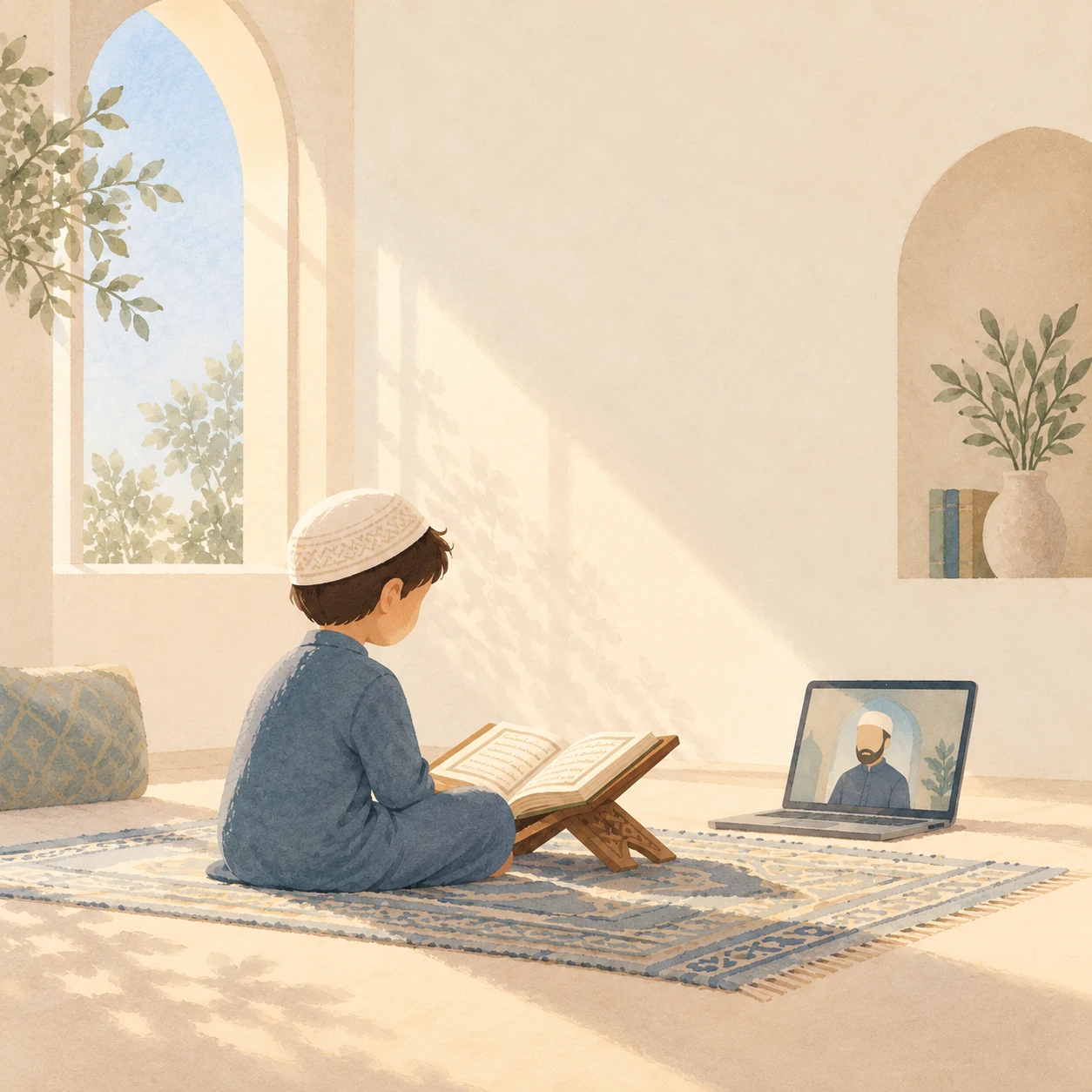
Will the teacher listen to their child read? What if the child cannot recognise Arabic letters yet? How are Tajweed mistakes corrected? Will the lesson include memorisation, and how will parents know whether their child is progressing?
For families in the UK, these questions matter. Children may have busy school routines, different levels of Arabic exposure, and very different Quran learning goals. A five-year-old beginning to recognise Arabic sounds should not be expected to follow the same lesson as a teenager working on Quran recitation or Hifz revision.
This guide explains how individual Quran lessons online in the UK can work, from preparing for the first session to practising with a teacher, reviewing mistakes, and following a personalised learning plan.

Table of Contents
- What Are Individual Quran Lessons Online?
- What Happens Before the First Lesson?
- What Happens Inside a Live Quran Lesson?
- Example of a Structured Quran Lesson
- How Lessons Change for Different Quran Levels
- Example of a Four-Week Learning Journey
- How to Prepare for Online Quran Lessons at Home
- How Parents Can Follow Their Child’s Progress
- Making Quran Learning Work for UK Families
- Individual Quran Lessons at Sibghah Academy
- Parent Checklist
- Frequently Asked Questions
What Are Individual Quran Lessons Online?
Individual Quran lessons online are live teaching sessions in which one Quran teacher works directly with one student through an online learning platform.
The key word is individual. Instead of asking every child to complete the same activity at the same speed, the teacher can respond to the child’s current ability.
For example, one child may be learning to join Arabic letters. Another may already read the Quran but need help with pronunciation. A third may be memorising short surahs and struggling to remember older portions.
These children do not need identical lessons.
Individual teaching makes it possible to focus on the skill that matters most at that moment.
Parents who are still deciding whether private teaching is suitable can also read our One-to-One Quran Tutor UK guide, which explores the types of children who may benefit from personal support.
What Happens Before the First Individual Quran Lesson?
Before regular lessons begin, it is useful for the teacher to understand the child’s learning background.
Parents can share a few simple details:
- The child’s age and previous Quran learning experience.
- Whether the child recognises Arabic letters or reads independently.
- Any previous Tajweed learning.
- Surahs the child has already memorised.
- Whether older memorisation needs revision.
- The family’s main goal for Quran learning.
- Any concerns about confidence, concentration, or previous lessons.
The first session may then include a gentle level check. This is not about putting pressure on the child or trying to obtain the highest possible score.
It is about discovering the most useful starting point.
For example, if a child recognises individual letters but struggles to read joined words, the teacher may recommend strengthening reading foundations before moving into longer Quran passages.
If the child already reads confidently, the teacher may focus more on recitation accuracy, pronunciation, and practical Tajweed.
Our Quran Assessment for Kids guide explains the level-checking process in greater detail.
Not Sure Where Your Child Should Start?
Sibghah Academy offers a free trial session to help understand your child’s current Quran level and recommend a suitable one-to-one learning path.
What Happens Inside a Live Quran Lesson?
Once the child joins an individual Quran lesson, the teacher can adapt the activities according to the child’s level and progress.
A well-structured session usually includes several connected stages.
Step 1: A Gentle Welcome and Quick Review
The teacher begins by helping the child feel comfortable and recalling something familiar from the previous lesson.
For a beginner, this might mean recognising a few Arabic letters or repeating familiar sounds.
For a child learning Hifz, it might mean reciting a previously memorised passage.
This stage helps the teacher see what the child remembers before moving forward.
Step 2: Listening to the Child
One of the most important parts of a live individual lesson is giving the child time to read or recite aloud.
The teacher listens carefully for specific difficulties rather than correcting everything in the same way.
For example, the child may:
- Confuse two similar Arabic letters.
- Forget a short vowel.
- Pause frequently between words.
- Rush through a Quranic phrase.
- Repeat the same pronunciation mistake.
- Forget part of a memorised surah.
The teacher can then choose which difficulty needs attention first.
Step 3: Teaching One Manageable Skill
Instead of introducing many new rules at once, the teacher can focus on one clear learning goal.
A beginner might practise joining two or three letters. A more confident reader might work on one recurring pronunciation issue.
The teacher can explain, demonstrate, listen, and repeat the activity until the child has had meaningful practice.
Step 4: Applying the Correction
Understanding an explanation does not always mean the child can use it independently.
That is why the teacher should give the child another opportunity to apply the correction.
For example, after modelling the correct sound, the teacher may ask the child to read the same word again and then attempt it in a new phrase.
The aim is to move from hearing the correct answer to producing it with growing confidence.
Step 5: Revision and a Clear Next Step
At the end of the lesson, the teacher can review the main skill and identify a small amount of suitable practice.
Parents should be able to understand what the child worked on, what still needs attention, and what the next lesson is likely to focus on.
Example of a Structured Individual Quran Lesson

What might an individual Quran session look like from beginning to end?
The following is an illustrative lesson structure, not a fixed timetable that every teacher or child must follow.
| Lesson Stage | Possible Activity | Learning Purpose |
|---|---|---|
| Welcome and recall | Brief conversation and revision of familiar material | Help the child settle and remember previous learning |
| Listening check | Child reads or recites a suitable portion | Identify the main difficulty that needs attention |
| Focused teaching | Teacher explains and models one targeted skill | Build understanding and accuracy |
| Guided practice | Child repeats, applies corrections, and tries again | Strengthen independent performance |
| Review and feedback | Recap learning and agree on a manageable practice task | Connect the lesson with future progress |
The balance between these stages will vary. A beginner may need more time on letters and short words, while a Hifz student may spend more of the session reciting, checking memorisation, and reviewing older surahs.
How Individual Quran Lessons Change for Different Learning Levels
One of the most useful features of individual Quran learning is that the lesson can follow the child’s actual needs.
Here are four possible learning paths.
1. Complete Beginners: Arabic Reading Foundations
A child who cannot read Arabic yet may begin with letter recognition, correct sounds, short vowels, and joining letters.
The teacher can use small reading activities and repeated practice before moving into longer words and Quranic passages.
Some children may benefit from a structured foundation such as Noor Al-Bayan, depending on their starting level.
2. Developing Readers: Quran Reading and Fluency
A child who recognises letters may still need support reading complete words and sentences smoothly.
Lessons can focus on reading accuracy, joining sounds, correcting repeated mistakes, and gradually reading longer passages.
The teacher may revisit an earlier skill whenever a difficulty appears.
3. Confident Readers: Recitation and Practical Tajweed
Children who can read independently may need more detailed correction during Quran recitation.
Rather than focusing only on memorising the names of Tajweed rules, the teacher can help children hear and apply those rules while reciting.
This might include correct articulation, appropriate lengthening, and other rules relevant to the child’s recitation.
4. Hifz Students: Memorisation and Revision
For children learning Hifz, individual lessons can combine new memorisation with revision of recent and older portions.
A child who forgets previously memorised surahs may need more revision before increasing the amount of new memorisation.
Suitable early Hifz can also begin through listening and teacher-led repetition when a child is not yet an independent reader.
Parents can explore Sibghah’s Online Quran Memorization Program for Kids for more information about memorisation and revision.
| Child’s Current Level | Main Lesson Focus | Example of Progress to Look For |
|---|---|---|
| Beginning Arabic reader | Letters, sounds, vowels and joining | Recognising and reading simple combinations more independently |
| Developing Quran reader | Accuracy, repeated reading and fluency | Fewer recurring mistakes and more confident reading |
| Independent Quran reader | Pronunciation and practical Tajweed | Applying corrections in unfamiliar passages |
| Hifz student | New memorisation and structured revision | More reliable recall of previously memorised portions |

Which Quran Learning Path Suits Your Child?
Whether your child is beginning Arabic reading, improving Tajweed, or revising Hifz, Sibghah Academy can help you understand a suitable starting point.
Example of a Four-Week Individual Quran Learning Journey
Parents sometimes wonder how individual lessons connect from one week to the next.
Here is a simple example for a child who recognises Arabic letters but is still developing word-reading skills.
| Week | Possible Teaching Focus | What the Teacher Checks |
|---|---|---|
| Week 1 | Review familiar letters and identify difficulty with joining | Which letters and sound combinations cause hesitation? |
| Week 2 | Practise joining letters in short words | Can the child read some combinations without prompting? |
| Week 3 | Use familiar combinations in new words | Can the child transfer the skill beyond memorised examples? |
| Week 4 | Review recurring mistakes and adjust the next goal | Which skills are secure, and which still need support? |
This is an example, not a promise of what every child will achieve in four weeks. Some children need more repetition, and others may already be ready for more advanced material.
The important principle is that each lesson should respond to the child’s progress rather than simply moving to the next page.
How to Prepare for Individual Quran Lessons at Home
Families do not need an elaborate classroom to support online Quran learning.
A simple, reliable setup can help children concentrate and participate comfortably.
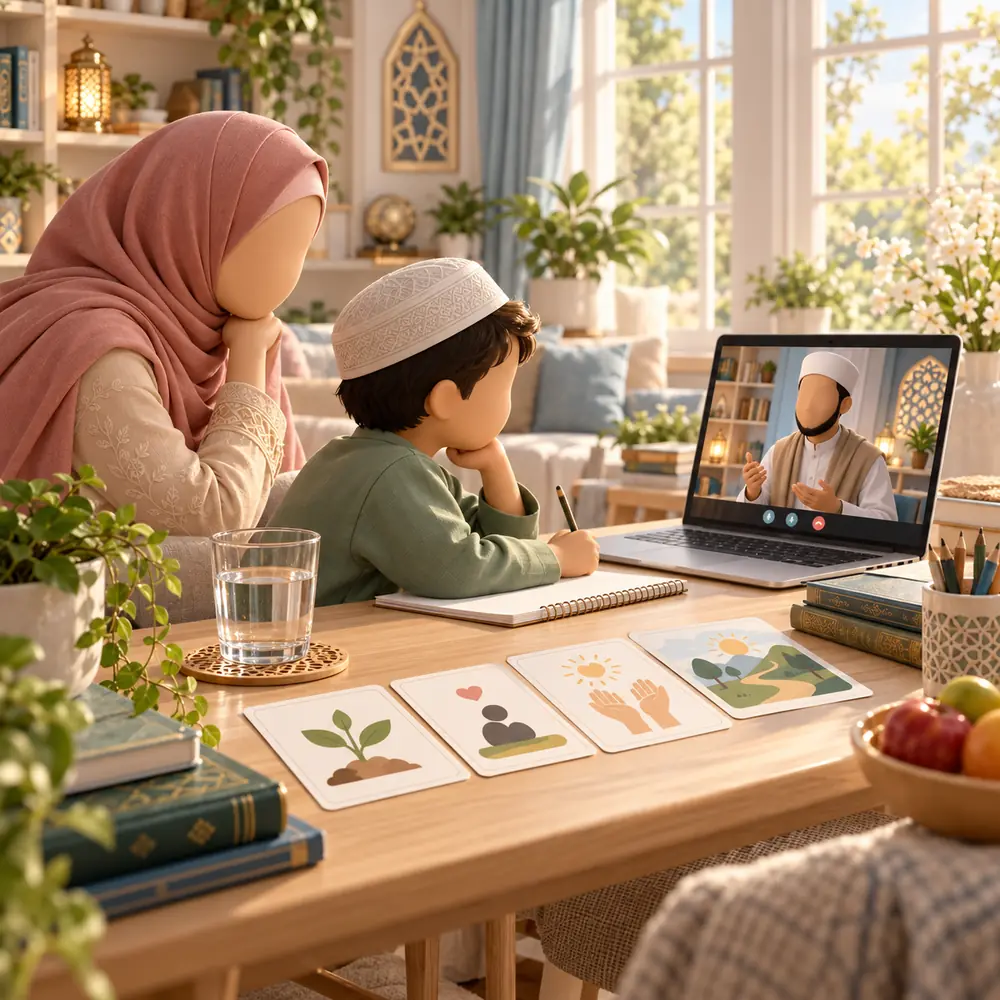
Before the Lesson: A Simple Home Checklist
- Choose a reasonably quiet place with good lighting.
- Prepare the device used for the live lesson.
- Check the internet connection, microphone and audio.
- Keep the Quran, reading book or lesson material nearby.
- Have a pencil or notebook available if needed.
- Reduce unnecessary distractions during the session.
- Make sure a parent or responsible adult can provide help when needed, especially for younger children.
- Agree on an appropriate online learning and safeguarding arrangement with the provider.
For younger children, a parent may need to help with joining the session or handling the device. Older children may be more independent, depending on their maturity and the family’s arrangements.
It is also helpful to avoid turning every home practice session into a test. A calm routine and manageable expectations can make Quran learning easier to maintain.
How Can Parents Follow Their Child’s Quran Progress?
Progress in Quran learning is not only about counting completed pages or memorised surahs.
A child may be making meaningful progress when they recognise more letters independently, read with fewer repeated mistakes, apply a Tajweed correction, or remember an older surah more reliably.
After a lesson, parents can ask four practical questions:
- What did my child practise today? Ask for the main skill rather than only the page number.
- What improved? Look for a specific example of stronger reading, recitation, or revision.
- What still needs work? One clear priority is often more useful than a long list of mistakes.
- What should we practise before the next lesson? Agree on something suitable for the child’s level and family routine.
At Sibghah Academy, parents can receive progress follow-up to understand their child’s learning level, current focus, and areas that need further practice.
Making Individual Quran Lessons Work for UK Families
Muslim families in the UK often fit Quran learning around school, homework, family commitments and other activities.
When choosing online lessons, it helps to consider the routine as carefully as the learning content.
Choose a Sustainable Lesson Schedule
A timetable that works comfortably for the family is easier to maintain than an ambitious plan that frequently gets interrupted.
Ask about available lesson times in UK local time, and confirm how scheduling works during school holidays and daylight-saving changes.
Keep Practice Small and Consistent
Between lessons, short, focused practice can reinforce what the teacher has covered.
For example, a beginner might revisit a few letter combinations, while a Hifz student might revise a familiar surah.
The most suitable amount depends on the child’s level, attention and learning plan.
Keep the Child’s Main Goal Clear
Not every child needs to study reading, Tajweed, and Hifz with equal emphasis at the same time.
If the immediate priority is accurate Quran reading, focus the routine around that goal. If it is Hifz retention, make revision a central part of the plan.
Arabic Language and Islamic Studies can also be studied separately according to the family’s needs. Children do not have to enrol in every subject together.
How Individual Quran Lessons Work at Sibghah Academy
Sibghah Academy provides live one-to-one online Quran lessons for Muslim children aged 5–15, including families living in the UK.
The learning process starts with understanding the child’s current level and goals.
Depending on the assessment, the recommended focus may include:
- Arabic reading foundations for beginners.
- Quran reading and fluency.
- Pronunciation and practical Tajweed.
- Hifz through suitable listening, repetition and memorisation.
- Revision of previously memorised surahs.
- Confidence and steady progress through personalised teaching.
Because sessions are one-to-one, the teacher can spend the lesson listening to the individual child and adjusting the focus when necessary.
Families can begin with a free trial session before deciding on regular lessons.
The trial offers an opportunity to experience the teaching format, discuss the child’s current level, and understand an appropriate next step.
For more details about the wider trial experience, read our Quran Trial Lesson UK guide.
Experience a Live One-to-One Quran Lesson
See how individual Quran learning can support your child’s reading, recitation, Tajweed or Hifz goals from home.
Parent Checklist Before Booking Individual Quran Lessons Online UK
Before enrolling your child, check whether you can answer these questions:
- Do I understand my child’s current Quran level?
- Is the teaching live and genuinely one-to-one?
- Will the teacher listen to my child read or recite?
- Will the lesson focus change according to my child’s needs?
- Is there a suitable approach for beginners?
- Is Tajweed taught through practical correction?
- Will Hifz lessons include appropriate revision?
- Will I receive understandable feedback about progress?
- Is the timetable suitable for our UK family routine?
- Have I asked about online safety and safeguarding arrangements?
- Can my child experience a trial lesson before enrolling?
These questions are more useful than choosing a course based only on how many pages or surahs it promises to cover.
Frequently Asked Questions About Individual Quran Lessons Online UK
What are individual Quran lessons online?
Individual Quran lessons online are live teaching sessions where one teacher works with one student at a time. The lesson can focus on Quran reading, pronunciation, Tajweed, memorisation or revision according to the child’s level.
Does my child need to know Arabic before starting?
No. A complete beginner can start with Arabic reading foundations. A teacher can help identify whether the child needs letter recognition, vowels and reading practice before moving into independent Quran reading.
Can my child start memorising Quran before reading fluently?
Yes, suitable early Hifz can begin through listening and teacher-led repetition when appropriate. The learning plan should reflect the child’s age, ability, pronunciation and revision needs.
Are individual online Quran lessons suitable for young children?
They can be, provided the teaching activities, communication and pace suit the child. Younger learners may need shorter activities, more repetition and help from a parent when joining the session.
How long is a Quran lesson at Sibghah Academy?
Sibghah Academy’s published FAQ describes lessons as 60 minutes. Parents can ask how activities are adapted to their child’s age and attention during that time, and confirm available lesson arrangements with the academy.
How will I know my child is making progress?
Look for specific improvements such as stronger reading accuracy, better pronunciation, more confident recitation, fewer recurring mistakes or more reliable Hifz revision. Parents should also ask what their child needs to practise next.
How often should my child have individual Quran lessons?
There is no single frequency that suits every child. The right routine depends on the learning goal, available time, current level and the amount of useful practice possible between sessions.
Can we try a lesson before enrolling?
Yes. Sibghah Academy offers a free trial session so families can experience the live one-to-one teaching format and discuss a suitable starting point before enrolment.
Final Thoughts: Choosing the Right Individual Quran Lessons Online UK
Good individual Quran lessons are not simply private classes delivered through a screen.
They should give a child the opportunity to learn at an appropriate level, read or recite aloud, receive meaningful correction, practise a manageable skill, and understand what comes next.
For some children, the next step is recognising Arabic letters. For others, it is reading with greater accuracy, applying Tajweed, or strengthening Hifz revision.
The aim is not to rush through a fixed amount of material. It is to help each child make steady progress with confidence and a clearer connection to the Quran.
If you are considering Individual Quran Lessons Online UK for your child, starting with an assessment and a free trial can help you make a more informed decision.
Ready to Start Your Child’s Quran Learning Journey?
Contact Sibghah Academy to discuss your child’s current level and book a free one-to-one Quran trial session.