


If you are searching for an Online Quran Academy UK Review, do not rely on star ratings or positive comments alone. A useful review should help you understand who teaches your child, how lessons work, how Quran progress is assessed, whether safeguarding is clear, how parents receive feedback, and whether your child can try the teaching before committing.
The most helpful Online Quran Academy UK Review is therefore not simply “this academy is good” or “this teacher is amazing”. Parents need evidence that the learning model fits their own child.
A five-year-old beginning Arabic sounds needs something very different from a twelve-year-old improving Tajweed or revising Hifz. The right academy should recognise that difference rather than placing both children into the same standard programme.
Quick answer: when reading an Online Quran Academy UK Review, check nine things: whether the review is independent or first-party, teacher quality, level assessment, lesson format, real recitation time, Hifz and Tajweed structure, safeguarding, parent progress follow-up, and the quality of the trial lesson.
Transparency note: this article is published by Sibghah Academy. It is not an independent ranking of Quran academies. Any description of Sibghah Academy or testimonials hosted by Sibghah should be understood as first-party information, not independent third-party reviews.
What Does an Online Quran Academy UK Review Really Tell You?

An Online Quran Academy UK Review can be helpful, but parents need to understand what kind of information they are reading.
There is an important difference between:
- An independent review written by someone with no connection to the academy.
- A verified customer review on a third-party platform.
- A testimonial supplied directly by a parent or student.
- A testimonial selected and published by the academy itself.
- A promotional statement written by the academy.
These can all provide information, but they do not carry the same weight.
For example, an academy may publish genuine parent feedback on its own website. That feedback can tell you what some families experienced, but because the academy selected and published it, it should be understood as first-party testimonial content.
UK guidance around online reviews also places increasing emphasis on transparency and preventing fake or misleading reviews. Parents who want to understand why the source of a review matters can read the Competition and Markets Authority guidance on consumer reviews.
The UK Advertising Standards Authority also explains that businesses using testimonials should be able to show that they are genuine and should not present commercial interests in a misleading way. You can read the ASA guidance on testimonials and endorsements.
This does not mean you should ignore academy testimonials.
It means you should read them in the correct context.
Instead of asking only, “Are the reviews positive?” ask:
- Where did these reviews come from?
- Are they first-party or independent?
- Do they describe specific experiences?
- Do they mention teaching quality, communication or progress?
- Can I verify important claims another way?
- Can I experience the teaching myself through a trial?
This is the starting point for a more useful Online Quran Academy UK Review.
1. Online Quran Academy UK Review: Check Where the Reviews Come From
The first check in any Online Quran Academy UK Review is the source of the feedback.
Imagine two comments:
Comment A: “Best academy ever. Amazing teachers.”
Comment B: “My daughter was struggling with Quran reading, and the teacher slowed the lessons down, repeated difficult sounds and gave us clear practice between sessions.”
The second comment is more useful because it tells you something about the actual teaching experience.
Look for reviews that mention specific areas such as:
- How the teacher corrects mistakes.
- Whether the child feels comfortable.
- How lessons are adapted to the child’s level.
- Whether parents receive feedback.
- How Hifz revision is handled.
- Whether the teacher is patient.
- What happened when the child struggled.
Specific detail is often more useful to a parent than enthusiastic language alone.
Do not treat every star rating as proof
A five-star score may look reassuring, but it does not answer important questions about your child.
A family may have had an excellent experience because their child needed Hifz support.
Your child may need early Arabic reading foundations.
The academy may still be good, but the review may not tell you whether it is good for your situation.
A strong Online Quran Academy UK Review therefore looks beyond the rating and searches for evidence relevant to the child’s own needs.
2. Review the Quran Teachers, Not Just the Academy
An academy can have an attractive website, clear branding and many positive comments, but your child’s weekly experience depends heavily on the individual teacher.
For this reason, an Online Quran Academy UK Review should include teacher quality.
Parents should consider two areas:
Quran knowledge
- Accurate recitation.
- Ability to identify pronunciation mistakes.
- Understanding of Tajweed.
- Ability to guide memorisation and revision.
- Ability to model correct recitation clearly.
Ability to teach children
- Patience.
- Gentle correction.
- Age-appropriate explanations.
- Ability to maintain attention online.
- Understanding of different learning speeds.
- Clear communication with parents.
A person can be a strong Quran reader without automatically being the right teacher for a young child.
Likewise, a friendly teacher still needs enough Quran knowledge to correct recitation accurately.
Parents can use our Online Quran Teacher in the UK guide to explore teacher selection in more detail.
Useful review question: does the academy tell you enough about how teachers are selected and matched with children?
3. A Good Online Quran Academy UK Review Should Check Level Assessment
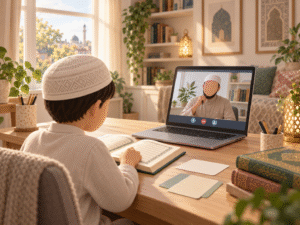
Before an academy recommends a programme, it should understand what the child can already do.
This is one of the most important parts of an Online Quran Academy UK Review.
A proper starting assessment may consider:
- Arabic letter recognition.
- Short and long vowels.
- Ability to join letters.
- Reading Quranic words.
- Reading fluency.
- Makharij and pronunciation.
- Current Tajweed application.
- Previously memorised surahs.
- Strength of Hifz revision.
- Listening and repetition skills.
Age should influence teaching style, but age alone should not determine Quran level.
Two children of the same age can have completely different learning needs.
If an academy places every eight-year-old at the same starting point without checking their actual reading and recitation ability, parents should ask more questions.
Our Quran Assessment for Kids guide explains what parents can reasonably expect from an initial assessment.
What should you know after the assessment?
At minimum, the academy should be able to explain:
- Your child’s current starting point.
- The main learning gap.
- The first priority.
- The recommended lesson focus.
- What progress will be reviewed later.
That information makes an Online Quran Academy UK Review far more meaningful than a general promise of “personalised learning”.
4. Online Quran Academy UK Review: Is the Lesson Really One-to-One?
The words “online Quran academy” can describe very different lesson formats.
Some academies provide genuine one-to-one teaching.
Others teach small groups.
Some combine recorded materials with occasional live sessions.
Parents should know what they are actually buying.
| Format | Potential Strength | What to Review |
|---|---|---|
| Live one-to-one | Full teacher attention on one child | Teacher fit, quality of correction and structure |
| Small group | Peer interaction and shared learning | How much individual reading time each child receives |
| Larger group | Community atmosphere | Whether teacher attention is sufficient for Quran correction |
| Recorded learning | Flexible practice | How mistakes are identified without live listening |
For Quran learning, this distinction matters because reading and recitation require the teacher to listen.
A child who needs pronunciation correction may benefit greatly from having the teacher focused on every attempt.
One-to-one teaching can also help when the child:
- Reads more slowly than peers.
- Needs repeated correction.
- Is shy in groups.
- Has gaps from previous Quran learning.
- Needs a personalised Hifz plan.
- Requires more revision than new memorisation.
If your family is deciding between individual online learning and a traditional group environment, our Online Quran vs Local Madrasa UK comparison explains both formats in more detail.
Want to experience the one-to-one format rather than judge it from reviews alone?
Book a free one-to-one Quran trial on WhatsApp
5. Review What Actually Happens During the Quran Lesson
An Online Quran Academy UK Review should not stop at words such as “interactive”, “engaging” or “personalised”.
Ask what the child actually does during the lesson.
Does your child spend meaningful time:
- Reading aloud?
- Reciting memorised Quran?
- Listening to the teacher model pronunciation?
- Repeating difficult sounds?
- Correcting mistakes?
- Reviewing older Hifz?
- Practising Tajweed in real recitation?
For Quran learning, active participation matters.
A beautifully presented lesson may still be weak if the child spends most of the session listening passively.
Likewise, a lesson can look simple but be highly useful if the teacher listens carefully, identifies the exact error and gives the child several opportunities to correct it.
Ask one practical question
“How much of the lesson will my child actually spend reading or reciting to the teacher?”
This question can reveal more than many promotional claims.
6. Check the Tajweed, Hifz and Revision Approach

Parents reading an Online Quran Academy UK Review often focus on whether the academy offers Tajweed and Hifz.
A better question is how those areas are taught.
Tajweed should connect to real recitation
Children can learn rule names, but knowing a rule is not the same as applying it while reading Quran.
A useful lesson allows the child to:
- Hear the correct sound.
- Try it themselves.
- Receive correction.
- Repeat the word or phrase.
- Apply the same correction later.
For younger learners especially, practical correction can be more useful than long theoretical explanations.
Hifz should include revision
A child who memorises new material quickly but forgets older surahs may need a stronger revision plan rather than a larger new portion.
Ask how the academy balances:
- New memorisation.
- Recent revision.
- Older revision.
- Pronunciation correction.
- Retention checks.
A thoughtful Online Quran Academy UK Review should therefore look at the learning process, not just how many surahs a child is expected to complete.
7. Safeguarding Belongs in Every Online Quran Academy UK Review

When children learn online, safeguarding and professional boundaries deserve the same attention as teaching quality.
Parents reviewing an academy should understand:
- How teachers are recruited.
- What safeguarding procedures exist.
- Which platform is used for lessons.
- How teachers communicate with children and parents.
- Whether private communication outside approved channels is restricted.
- Who parents contact if they have a concern.
- What checks and references are used where relevant.
The UK Safer Internet Centre guidance on online tutoring highlights the importance of tutor suitability, appropriate checks and a clear method for delivering online teaching safely.
Parents should also remain involved in younger children’s online learning.
During the lesson, the Quran teacher should be present only through the laptop or tablet screen, not physically beside the child. Parents should know when lessons take place, what platform is being used and how to raise concerns.
Safeguarding should never be treated as a small detail hidden behind the quality of Quran teaching.
8. Review How the Academy Communicates Progress to Parents
A useful Online Quran Academy UK Review should also consider what happens after the lesson ends.
Parents should not need to ask every few months:
“Is my child actually improving?”
Progress feedback does not have to be complicated.
Useful feedback may explain:
- What the child worked on.
- Which mistakes are recurring.
- What needs practice before the next lesson.
- Which Tajweed point is being developed.
- What new Hifz was completed.
- What old Hifz needs revision.
- Whether the current learning goal should change.
Different children will show progress differently.
One child may read more independently.
Another may make fewer pronunciation mistakes.
Another may memorise less new Quran but retain previous Hifz more securely.
This is why meaningful feedback should focus on the child’s individual goal rather than only pages completed.
9. Use a Trial Lesson as Your Own Online Quran Academy UK Review

Perhaps the most useful Online Quran Academy UK Review is the one you conduct yourself during a real trial lesson.
Reviews from other families can help you create a shortlist.
A trial helps you decide whether the academy works for your child.
During the session, observe:
- Does the teacher make your child comfortable?
- Does the teacher check the child’s current level?
- Does your child get enough opportunity to read or recite?
- Are mistakes corrected patiently?
- Does the teacher adjust the pace when necessary?
- Does your child understand what they are being asked to do?
- Does the teacher notice repeated difficulties?
- Can the teacher explain the recommended next step afterwards?
A trial session should contain some real teaching.
It should not be only a sales conversation.
Parents can read our Quran Trial Lesson UK guide before attending a first session.
Already comparing Quran academies? Use Sibghah’s free trial as your own practical review of the teacher, lesson format and one-to-one experience.
Book your child’s free Quran trial on WhatsApp
What Different Online Quran Academy Reviews Can and Cannot Tell You
| Review Type | What It Can Tell You | What It Cannot Prove |
|---|---|---|
| Independent editorial review | Outside assessment of the academy | Whether your individual child will match the teacher |
| Third-party customer review | A customer’s reported experience | That every family will have the same experience |
| First-party testimonial | Feedback received and published by the academy | Independent verification or complete representation of all customer experiences |
| Academy website | What the academy says it offers | How your child will respond in practice |
| Free trial lesson | Your child’s direct experience of the teacher and format | Long-term results after only one session |
The best decision usually comes from combining these sources rather than depending on one.
For example:
- Read the academy’s website.
- Check available reviews and understand their source.
- Ask practical questions.
- Check teacher suitability and safeguarding.
- Attend a trial lesson.
- Observe your own child’s response.
This gives parents a much stronger basis for decision-making than simply searching “best Quran academy” and choosing the provider with the most enthusiastic headline.
Online Quran Academy UK Review Red Flags
When conducting your own Online Quran Academy UK Review, investigate further if you notice several of these signs:
- Reviews that are all extremely vague and repetitive.
- Testimonials presented as if they were independent reviews when they are not.
- No information about who teaches the child.
- No meaningful level assessment.
- The same programme for every learner.
- No clear explanation of one-to-one versus group teaching.
- Little opportunity for the child to recite.
- Promises of extremely fast Quran mastery.
- Pressure to memorise more even when revision is weak.
- No clear safeguarding information.
- No clear route for parents to raise concerns.
- No progress communication.
- Pressure to make a large commitment before experiencing the teaching.
One warning sign does not automatically mean an academy is unsuitable.
But unanswered questions should lead to more investigation before payment or long-term enrolment.
12 Questions to Ask After Reading an Online Quran Academy UK Review
- Are these independent reviews or testimonials published by the academy?
- How are Quran teachers selected?
- How do you assess my child’s starting level?
- Will my child learn one-to-one or in a group?
- How much of each lesson is spent reading or reciting?
- How do teachers correct Tajweed and pronunciation?
- How do you balance new Hifz and revision?
- How are online lessons safeguarded?
- How do teachers communicate with children outside lessons?
- How will I know whether my child is progressing?
- Can we try a lesson before making a longer commitment?
- What happens if the teacher is not a good match for my child?
An academy does not need to give the answer you expected to every question.
What matters is whether the answers are clear, realistic and appropriate for your family.
How to Review Sibghah Academy Fairly
Because this Online Quran Academy UK Review is published on Sibghah Academy’s own website, it is important to be clear about what we can and cannot claim.
This section is first-party information from Sibghah Academy. It is not an independent review.
Sibghah Academy currently provides live one-to-one online Quran lessons for Muslim children aged 5–15.
Quran, Arabic and Islamic Studies are offered as separate learning paths, so a child can focus specifically on Quran without being required to take every subject.
Depending on the child’s starting point, Quran learning may focus on:
- Reading foundations.
- Quran reading fluency.
- Recitation.
- Pronunciation correction.
- Practical Tajweed.
- Hifz.
- Revision.
The one-to-one lesson format means one teacher works directly with one child during the live session.
Sibghah also offers a free trial so parents can experience the teaching format and allow the teacher to understand the child’s starting point before the family decides whether to continue.
Parents should still evaluate Sibghah using the same standards described throughout this article.
Ask:
- Does my child feel comfortable with the teacher?
- Does the lesson begin from the right level?
- Is the correction useful and patient?
- Does my child actually spend time reading or reciting?
- Is the learning goal clear?
- Do I understand what my child should practise?
Being published by Sibghah does not turn our own testimonials into independent reviews.
The most useful way to decide whether Sibghah is suitable for your child is to combine the information on the website with your own questions and your child’s experience during the free trial.
Sibghah Teacher Note
Sibghah Teacher Note: A parent should not judge Quran learning only by how much material a child finishes. Sometimes the most important progress is slower: a child begins reading independently, corrects a sound they have repeated incorrectly for months, becomes less nervous when reciting, or remembers old Hifz more securely. When reviewing an academy, ask whether the teacher notices these individual changes and adjusts the lesson accordingly.
Online Quran Academy UK Review: Parent Checklist
Use this checklist while comparing providers:
- I know whether the reviews I am reading are independent or first-party.
- The academy does not present testimonials as independent reviews.
- I understand how teachers are selected.
- My child’s level will be assessed before a learning plan is chosen.
- I know whether lessons are one-to-one or group-based.
- My child will have meaningful Quran reading or recitation time.
- Tajweed includes live listening and correction.
- Hifz includes structured revision.
- The academy can explain its safeguarding procedures.
- I know how teachers communicate with children and parents.
- I will receive understandable progress feedback.
- The academy does not promise unrealistic results.
- My child can experience a trial lesson before a longer commitment.
- I can ask questions without being pressured to enrol immediately.
If you cannot answer several of these points, continue asking questions before making your decision.
Frequently Asked Questions About Online Quran Academy UK Review Searches
What should I look for in an Online Quran Academy UK Review?
A useful Online Quran Academy UK Review should help you evaluate the source of the reviews, teacher quality, level assessment, lesson format, live Quran correction, Tajweed, Hifz revision, safeguarding, parent feedback and trial lessons.
Can I trust testimonials on a Quran academy’s own website?
They can be useful when they are genuine, but they should be understood as first-party testimonials because the academy controls its own website and chooses what to publish. They are different from independent reviews.
Are independent reviews always reliable?
No. Independent platforms can provide useful information, but parents should still look for specific detail, patterns across several reviews and evidence relevant to their child’s needs. A review from another family cannot guarantee the same experience for your child.
Why does the source of an Online Quran Academy UK Review matter?
The source helps you understand the review’s context. A testimonial published by an academy can describe a genuine family experience, but it should not be mistaken for an independent assessment of the academy.
Should I choose the Quran academy with the highest rating?
Not automatically. Ratings can help create a shortlist, but your child’s level, teacher match, lesson format, safeguarding, correction style and learning goals matter more than a score alone.
Is one-to-one Quran teaching better than group learning?
It depends on the child’s needs. One-to-one lessons can provide more direct recitation time, individual correction and personalised pacing. Group learning can provide stronger peer interaction and a shared learning environment.
How can I review a Quran teacher before enrolling?
Ask about the teacher’s Quran knowledge and experience with children, then observe how they communicate, correct mistakes, adapt the pace and respond when your child struggles during a trial lesson.
What should happen during a Quran academy trial lesson?
A useful trial should include a gentle introduction, an age-appropriate check of the child’s level, some real teaching or recitation, correction where appropriate and a clear explanation of the recommended next step.
Should an online Quran academy assess my child first?
Yes. A level assessment helps identify whether your child needs Arabic reading foundations, Quran fluency, pronunciation correction, Tajweed, Hifz, revision or another starting point.
How important is safeguarding when reviewing an online Quran academy?
It is essential. Parents should understand teacher recruitment, communication boundaries, the lesson platform, how concerns are reported and what safeguarding procedures the academy follows.
Is this an independent Sibghah Academy review?
No. This article is published by Sibghah Academy. Information about Sibghah and testimonials hosted on Sibghah’s own website are first-party content. Parents should use them alongside their own questions, observations and trial lesson experience.
How can I decide whether Sibghah Academy is suitable for my child?
The most practical way is to explain your child’s age, current Quran level and goal, attend a free one-to-one trial, observe the teacher-child interaction and decide whether the lesson style and recommended learning path feel suitable for your family.
Final Thoughts: Online Quran Academy UK Review
An Online Quran Academy UK Review should help you make a better decision, not simply tell you which academy has the most stars.
Start by checking where the reviews come from.
Then look beyond the reviews.
Ask who will teach your child.
Check whether their Quran level will be assessed.
Understand whether lessons are genuinely one-to-one.
Find out how much time your child will spend reading and reciting.
Ask how Tajweed is corrected and how Hifz is revised.
Review safeguarding and communication.
Understand how progress will be shared with you.
Finally, use a trial lesson to create your own Online Quran Academy UK Review based on what actually happens with your child.
No review, rating or testimonial can fully predict the relationship between a teacher and an individual learner.
The best fit is the academy that can understand your child’s current level, explain the learning plan clearly, teach in a way your child can respond to, and communicate honestly with you as a parent.
At Sibghah Academy, Muslim children aged 5–15 can experience a live one-to-one Quran lesson through a free trial before the family makes a longer-term decision.