
If you are searching for a Quran Academy for Kids UK, the most important question is not simply whether an academy teaches Quran online. Parents need to know how their child will be taught, who will teach them, how their level will be assessed, how safeguarding is handled, and whether there is a clear plan for Quran reading, Tajweed, Hifz, or revision.
Choosing the right Quran Academy for Kids UK can feel difficult because many programmes may look similar at first. However, the quality of teaching, individual attention, safeguarding, assessment and progress follow-up can vary significantly.
A good Quran Academy for Kids UK should make these things easy for parents to understand before they commit. Your child should not be placed into the same programme as every other learner simply because they are the same age. A five-year-old learning Arabic letters may need a completely different starting point from a twelve-year-old who already reads Quran and wants to improve Tajweed or memorisation.
This guide gives UK Muslim parents a practical checklist for comparing Quran academies and knowing exactly what to ask before enrolling their child.
What Should a Quran Academy for Kids UK Provide?

A Quran Academy for Kids UK should provide more than access to a teacher on a video call. Parents should expect a clear learning structure that helps their child move from their current Quran level towards realistic and appropriate goals.
Before choosing a Quran Academy for Kids UK, parents should be able to understand:
- What their child currently knows.
- What their child needs to learn next.
- Who will teach them.
- How Quran mistakes will be corrected.
- Whether the lesson is one-to-one or group-based.
- How Tajweed will be taught.
- How memorisation and revision will be balanced.
- What safeguarding arrangements are in place.
- How parents will receive progress feedback.
- What happens if the learning plan needs to change.
The word academy should therefore mean there is some structure around the lesson. A child should not simply meet a teacher every week and continue indefinitely without a clear understanding of their level, goals and progress.
1. A Quran Academy for Kids UK Should Start with a Proper Assessment
One of the first things to check when choosing a Quran Academy for Kids UK is how the academy decides where your child should begin.
Age alone is not enough.
Two eight-year-olds may have completely different Quran levels. One may still be learning Arabic sounds. Another may read independently but struggle with pronunciation. A third may already be memorising several surahs.
A useful Quran assessment may explore:
- Arabic letter recognition.
- Short and long vowels.
- Ability to join letters and read words.
- Independent Quran reading.
- Pronunciation and Makharij.
- Current Tajweed application.
- Previously memorised surahs.
- Strength of previous revision.
- Listening and repetition ability.
- How the child responds to correction.
A good Quran Academy for Kids UK should use this information to decide the most useful starting point rather than simply placing every child into a general age-based programme.
The purpose should not be to give your child an impressive label such as “intermediate”. The purpose is to identify the next useful learning step.
For a detailed breakdown, parents can read our Quran Assessment for Kids guide.
What should the assessment tell parents?
A useful assessment result should follow a simple pattern:
Current level → Main difficulty → First priority → Lesson focus → Future review.
For example:
Your child recognises letters and vowels but reads joined words slowly → reading fluency is the main gap → focus first on accurate decoding and short Quranic words → reassess before adding more advanced Tajweed.
That is much more useful than simply saying, “Your child is a beginner.”
2. Check the Teachers at Any Quran Academy for Kids UK

A strong Quran reciter is not automatically the right teacher for every child.
When parents compare a Quran Academy for Kids UK, they should look at two different areas:
Quran competence and teaching competence.
Quran competence may include:
- Accurate Quran recitation.
- Strong understanding of Tajweed.
- Ability to hear and identify recitation errors.
- Correct pronunciation and Makharij.
- Ability to guide Hifz and revision appropriately.
Teaching competence includes:
- Patience with children.
- Age-appropriate explanations.
- Gentle correction.
- Ability to maintain attention online.
- Knowing when to repeat rather than move ahead.
- Understanding the needs of non-Arabic-speaking children.
- Clear communication with parents.
A teacher may know a great deal but still struggle to explain it to a six-year-old.
Likewise, a friendly teacher still needs the Quran knowledge required to identify mistakes accurately.
A reliable Quran Academy for Kids UK should therefore look for teachers who combine Quran knowledge with the ability to teach children patiently and clearly.
If teacher selection is one of your main concerns, see our Online Quran Teacher in the UK guide.
3. Safeguarding Matters When Choosing a Quran Academy for Kids UK
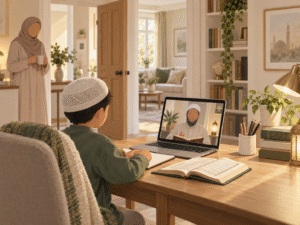
Safeguarding should be part of the decision when choosing any organisation or tutor working regularly with children.
This matters online as well as offline.
Parents comparing a Quran Academy for Kids UK should not feel uncomfortable asking how teachers are recruited, what professional boundaries exist and how safeguarding concerns are handled.
UK government guidance for parents using tuition and other out-of-school activities encourages families to ask about safeguarding arrangements and the checks used for adults working with children.
Parents can review the UK government guidance for parents using tuition and out-of-school activities.
You can ask an academy:
- How are teachers selected?
- What safeguarding procedures are followed?
- Who can a parent contact if they have a concern?
- How are teacher-child communications managed?
- Are teachers allowed to communicate privately with children outside approved channels?
- What background checks are used where applicable?
- What happens if a safeguarding concern is raised?
For families in England and Wales, parents can also ask how relevant DBS checks are handled.
Parents can read the official DBS guidance for private individuals considering tutors and other self-employed workers.
A background check should not be the only thing you consider. Safeguarding policies, professional boundaries, references, qualifications, experience, communication and your own observations all matter.
The NSPCC safeguarding guidance for tutors also explains the importance of appropriate checks, clear professional boundaries and safe practices when tutoring children.
What should online Quran lessons look like?
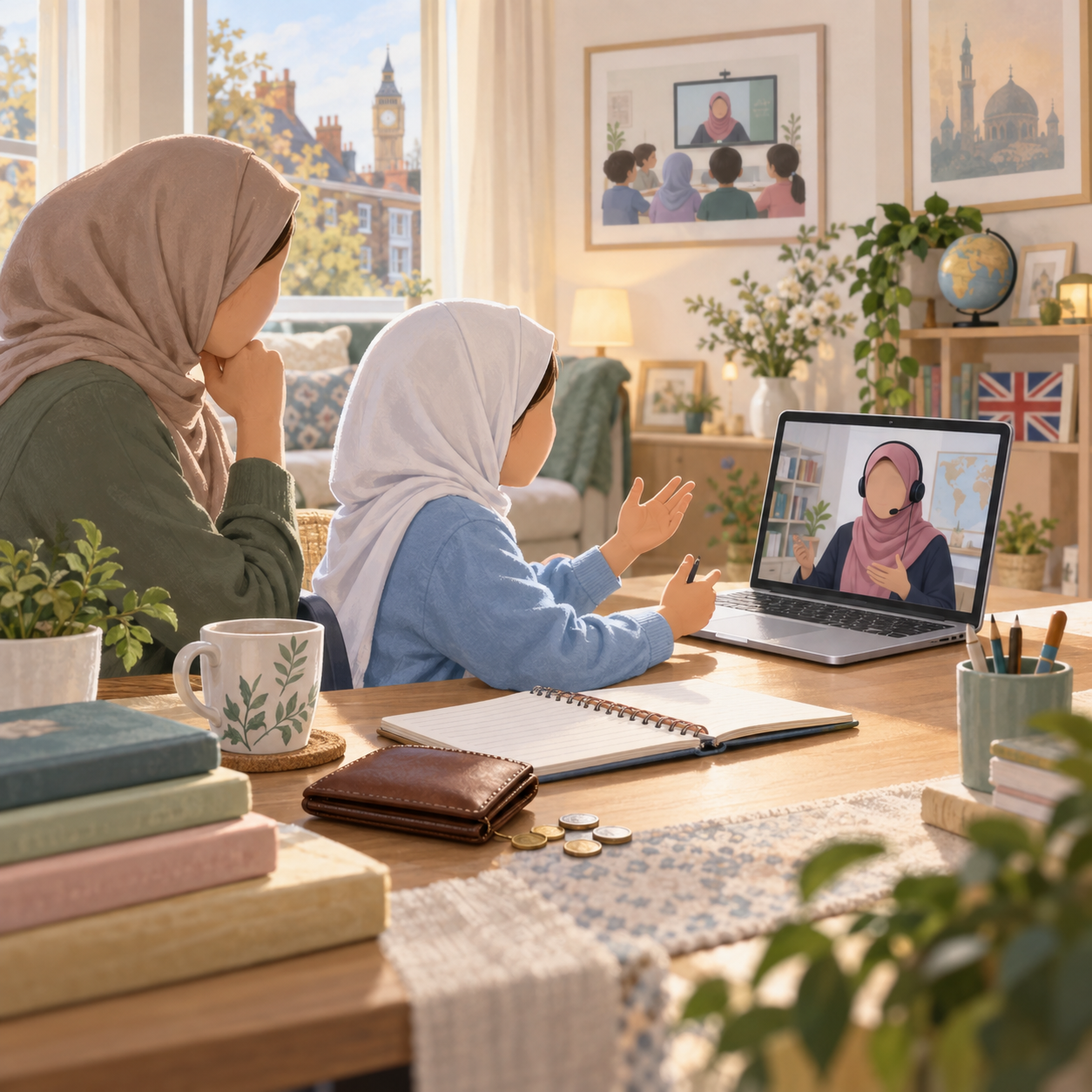
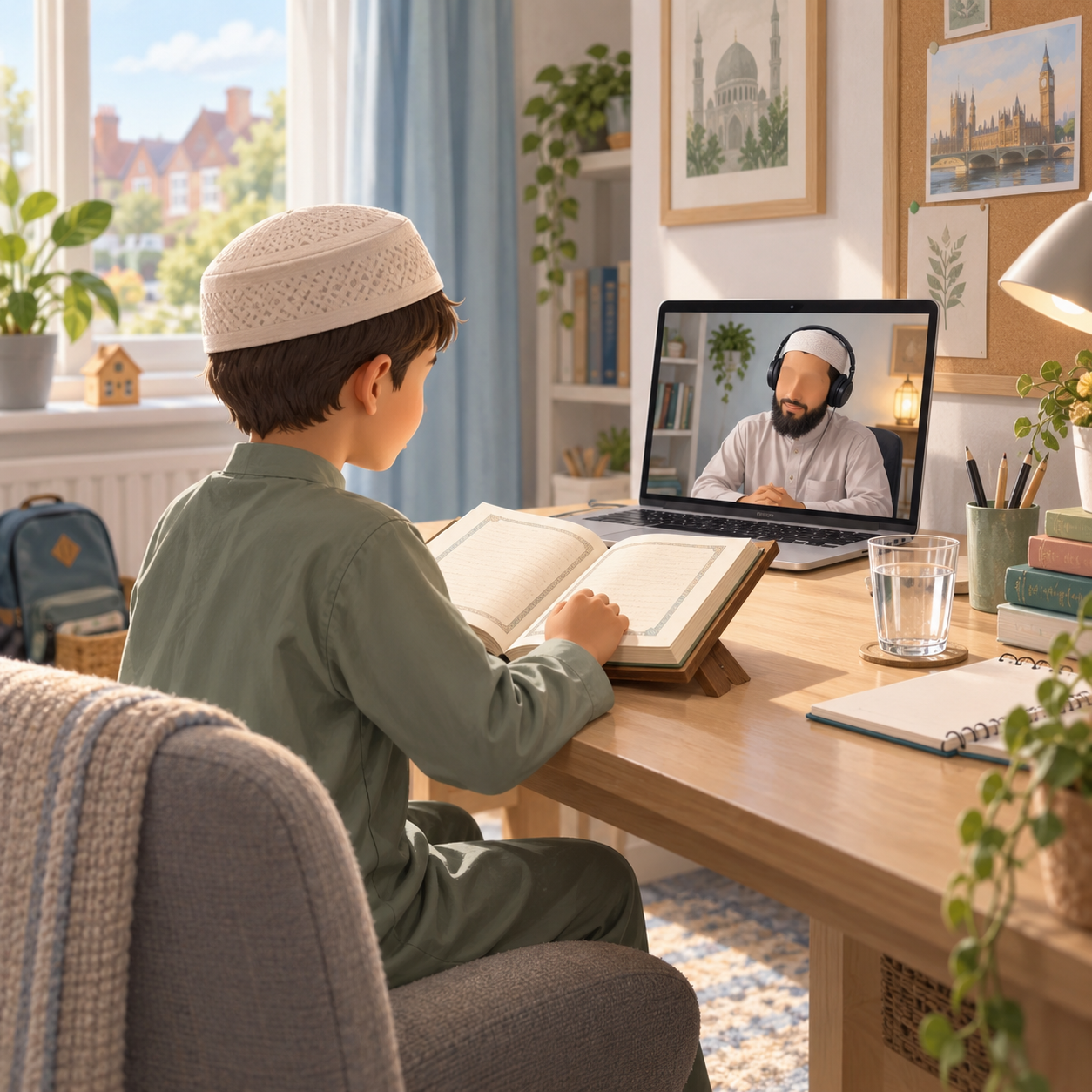
During an online lesson, the teacher should appear through the learning platform on the child’s laptop or tablet. Parents should understand how the online environment works and be able to remain appropriately involved in their child’s learning.
For younger children in particular, having a parent nearby or within easy reach can also help with technology, attention and reassurance.
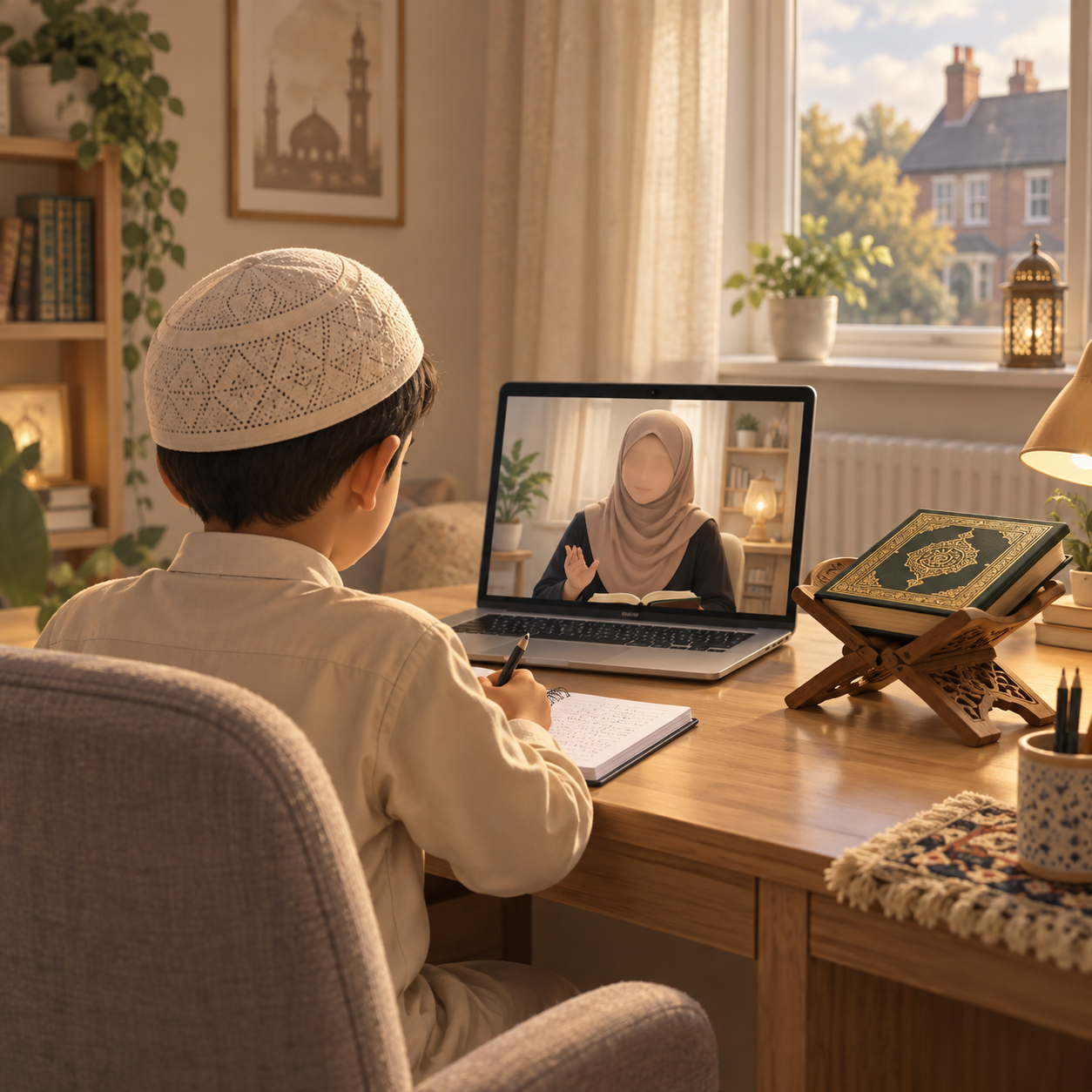
4. Does the Quran Academy for Kids UK Offer One-to-One Lessons?
The phrase “online Quran classes” does not tell you how much teacher attention your child actually receives.
When comparing a Quran Academy for Kids UK, ask how many children are in each lesson.
| Lesson Format | Possible Strength | Possible Limitation |
|---|---|---|
| One-to-one | Teacher attention is focused entirely on one child. | Less peer interaction during the lesson. |
| Small group | Some interaction with other learners. | Teacher listening time is shared. |
| Larger group | Community and shared learning environment. | Less individual recitation and correction time. |
| Recorded course | Flexible and useful for additional practice. | No live teacher listening or immediate correction. |
There is no single format that is automatically right for every child.
However, one-to-one teaching can be particularly useful when a child:
- Needs repeated pronunciation correction.
- Reads at a different pace from children their age.
- Is shy about reciting in front of others.
- Has gaps from previous Quran learning.
- Needs a personalised Hifz revision plan.
- Benefits from extra explanation or repetition.
If you are comparing private learning formats, our Online Quran Tuition UK guide explains the differences in more detail.
Considering one-to-one Quran lessons? A free trial is a useful way to see whether your child participates more comfortably when the teacher can focus on them individually.
Book a free one-to-one Quran trial on WhatsApp
5. How Should a Quran Academy for Kids UK Teach Tajweed?
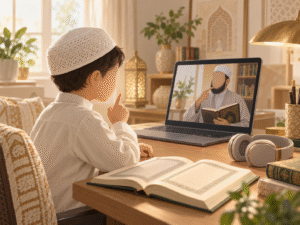
A child cannot develop Quran recitation only by learning the names of Tajweed rules.
They need to:
- Read.
- Listen.
- Repeat.
- Make mistakes.
- Hear the correct model.
- Try again.
- Apply the correction in later recitation.
This is why parents choosing a Quran Academy for Kids UK should ask what actually happens during the lesson.
Does the child spend meaningful time reciting?
Does the teacher listen carefully?
Are recurring mistakes noticed?
Is Tajweed introduced according to the child’s level?
For younger learners, too much terminology too early may make Tajweed feel difficult. A child-friendly teacher can often begin with listening, modelling, repetition and practical correction before expecting the child to remember long explanations.
6. A Quran Academy for Kids UK Should Balance Hifz and Revision
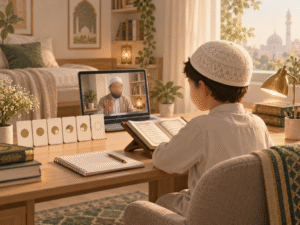
Memorising more is not always the same as progressing well.
A child may memorise a new surah quickly and then forget much of it several weeks later.
A structured Quran Academy for Kids UK should therefore explain how teachers balance new memorisation with both recent and older revision.
A Quran academy should explain its approach to:
- New memorisation.
- Recent revision.
- Older revision.
- Correction of memorised mistakes.
- Realistic portion sizes.
Ask:
“How do you decide whether my child should continue adding new Hifz or spend more time strengthening previous memorisation?”
The answer can tell you a lot about how personalised the learning plan really is.
7. A Quran Academy for Kids UK Should Keep Parents Informed
Parents should not need to guess whether Quran lessons are working.
A useful Quran Academy for Kids UK should be able to explain what the child is currently working on and what the next priority is.
Progress feedback might include:
- Current reading level.
- Recurring pronunciation difficulties.
- Tajweed points being practised.
- New memorisation completed.
- Surahs requiring stronger revision.
- Home practice recommended by the teacher.
- Changes to the learning goal.
Progress does not always mean completing pages quickly.
For one child, progress may mean reading more independently.
For another, it may mean making fewer repeated pronunciation mistakes.
For a Hifz student, progress may mean remembering older surahs more securely even if the amount of new memorisation temporarily decreases.
8. Choose a Quran Routine Your Family Can Maintain
Finding the right Quran Academy for Kids UK also means finding a lesson schedule that works in real family life.
A perfect timetable that your family cannot maintain is not actually a good timetable.
UK families may be balancing:
- School hours.
- Homework.
- Parents’ working schedules.
- Several children.
- Weekend activities.
- Mosque or community commitments.
Before enrolling, ask how regular lesson times work and what happens when a lesson needs to be changed.
Consistency matters more than creating an unrealistic schedule that leaves the child exhausted.
A Quran routine should have enough repetition to support progress while still fitting realistically into family life.
9. Try the Quran Academy for Kids UK Before Committing
A trial session is one of the most useful ways to evaluate a Quran Academy for Kids UK.
Qualifications, websites and course descriptions can tell parents important things.
But they cannot fully predict the relationship between one particular teacher and one particular child.
During a trial lesson, observe:
- How the teacher welcomes your child.
- Whether the teacher checks their level before teaching.
- How much your child actually participates.
- Whether mistakes are corrected calmly.
- Whether the pace changes when your child struggles.
- Whether your child feels able to try again.
- Whether the teacher can explain the recommended next step afterwards.
A trial should contain some real teaching, not only introductions and sales information.
Our Quran Trial Lesson UK guide explains what parents can expect during the first session.
10. Quran Academy for Kids UK vs Tutor vs Madrasa vs Recorded Course
Parents sometimes search for a Quran Academy for Kids UK when what they really need is a particular type of Quran support.
These options are not identical.
| Option | Best Suited When | Check Carefully |
|---|---|---|
| Online Quran academy | You want teacher-led lessons plus assessment, structure and progress follow-up. | Teacher quality, safeguarding, lesson format and learning plan. |
| Independent Quran tutor | You already know exactly what your child needs and find a suitable individual teacher. | Qualifications, safeguarding, parent communication and continuity. |
| Local madrasa | Community environment and learning with other Muslim children are important. | Class size, individual recitation time and whether the pace suits your child. |
| Recorded Quran course | You want extra listening, explanation or revision resources. | There may be no live correction when the child makes a recitation mistake. |
Families can also combine options.
A child might attend mosque activities for community while receiving one-to-one Quran tuition for personalised recitation or Hifz support.
The goal is not to find one format that is universally better.
The goal is to solve your child’s actual learning need.
11. Questions to Ask a Quran Academy for Kids UK Before Enrolling
Before choosing a Quran Academy for Kids UK, ask these questions:
- How do you assess my child’s Quran level?
- What Quran qualifications and child-teaching experience does the teacher have?
- Is the lesson one-to-one or group-based?
- How much time will my child spend actually reading or reciting?
- How is Tajweed taught to younger children?
- How do you balance new Hifz with revision?
- How will you support my child if they cannot read Arabic yet?
- How are teachers selected and checked?
- What safeguarding procedures apply to online lessons?
- How will I receive feedback about progress?
- Can my child try a lesson before we enrol?
- What happens if the teacher-child match does not work well?
A trustworthy provider should be comfortable answering reasonable parent questions.
12. Red Flags When Choosing a Quran Academy for Kids UK
No single warning sign automatically tells you that a Quran Academy for Kids UK is unsuitable, but parents should investigate further if they notice several of these:
- No meaningful level assessment.
- The same learning plan for every child.
- Pressure to memorise quickly regardless of retention.
- Little opportunity for the child to recite.
- Harsh correction or embarrassment after mistakes.
- No explanation of teacher selection.
- No clear safeguarding contact or procedure.
- Unclear communication boundaries with children.
- No parent feedback.
- Promises of unrealistic or extremely fast results.
- Pressure to pay for a long period before experiencing the teaching style.
Be particularly careful with guarantees such as “your child will master Quran in a few months”. Quran learning depends on the child’s starting point, frequency of study, practice, age, goals and many other factors.
When a Quran Academy for Kids UK May Not Be the Best Fit
A trustworthy guide should also explain when another option may suit a family better.
An online Quran Academy for Kids UK may not be your first choice if:
- Your main priority is face-to-face Muslim peer interaction during the Quran lesson.
- Your child strongly struggles with screen-based learning even in short sessions.
- You have a trusted local teacher who already understands your child’s needs and provides the structure you require.
- Your child mainly needs community activities rather than additional Quran instruction.
Online learning and local community involvement do not have to compete.
A child can learn Quran one-to-one online while still attending mosque activities, seeing Muslim friends and participating in community events.
Sibghah as a Quran Academy for Kids UK Families

Sibghah Academy provides live one-to-one online lessons for Muslim children aged 5–15 and can support UK families looking for structured Quran learning from home.
Quran, Arabic and Islamic Studies are treated as separate learning paths. A child does not have to take all three subjects together.
For Quran learning, the starting point depends on what the child actually needs.
This may include:
- Arabic reading foundations before independent Quran reading.
- Quran reading and fluency.
- Pronunciation and recitation correction.
- Practical Tajweed.
- Hifz.
- Revision of previous memorisation.
For parents comparing a Quran Academy for Kids UK, one-to-one teaching can be useful because the teacher can focus on one learner’s mistakes, pace and current goal rather than following the pace of a larger group.
Sibghah uses an initial assessment to understand the child’s starting point and offers a free trial session so the parent and child can experience the lesson format before deciding whether it is suitable.
Parents can then follow the child’s learning and receive progress feedback rather than being left unsure about what is happening during lessons.
Not sure whether your child needs reading support, Tajweed or Hifz?
Message Sibghah Academy on WhatsApp and book a free one-to-one trial.
Sibghah Teacher Note
Sibghah Teacher Note: When we meet a new child, the most useful question is not “How much Quran have they completed?” It is “What can they currently do independently, and where do they begin to need help?” One child may need to slow down and rebuild reading accuracy. Another may need pronunciation correction. Another may need less new Hifz and more revision. The right starting point makes the learning plan clearer for the teacher, parent and child.
Quran Academy for Kids UK: Parent Checklist
Before making your final Quran Academy for Kids UK decision, check how many of these statements you can answer with yes:
- I understand how my child’s starting level will be assessed.
- I know whether lessons are one-to-one or group-based.
- I understand the teacher’s Quran and teaching background.
- I know how safeguarding is handled.
- I know who to contact if I have a concern.
- My child will have enough time to actually read and recite.
- Tajweed will be taught through practical recitation, not theory alone.
- Hifz includes revision rather than only new memorisation.
- I will receive useful progress feedback.
- The timetable is realistic for our family.
- The academy does not promise unrealistic results.
- My child can experience a trial before we make a longer commitment.
If several of these points are unclear, ask more questions before enrolling.
A good Quran Academy for Kids UK should help parents understand the learning process rather than making the decision more confusing.
Frequently Asked Questions About Quran Academy for Kids UK
What should I look for in a Quran Academy for Kids UK?
When choosing a Quran Academy for Kids UK, look for a clear level assessment, suitable Quran teachers, child-friendly teaching, safeguarding procedures, enough live recitation time, practical Tajweed correction, balanced Hifz and revision, parent feedback and a trial lesson before longer-term commitment.
What makes a Quran Academy for Kids UK suitable for beginners?
A suitable Quran Academy for Kids UK should begin from the child’s actual level. A complete beginner may first need Arabic letter sounds, vowels and reading foundations before independent Quran reading becomes the main focus.
Should Quran lessons for children be one-to-one?
They do not have to be. Group learning can provide interaction with other children. One-to-one lessons can be particularly useful when the child needs individual correction, extra repetition, personalised Hifz revision or a pace different from their age group.
How can UK parents check safeguarding before choosing a Quran tutor?
Ask the provider how teachers are selected, what safeguarding procedures are used, what background checks apply, how online communication is managed and who parents should contact with a concern. Parents can also consult current government and NSPCC guidance for tuition and child safeguarding.
Does a DBS check mean a Quran teacher is automatically safe?
No single check should replace wider safeguarding. Background checks can be one part of safer recruitment, alongside professional boundaries, references, qualifications, experience, safeguarding procedures, supervision and continued parent awareness.
Should a Quran Academy for Kids UK offer a trial lesson?
A trial is very useful. It allows the child to become comfortable, show their current ability, receive some real teaching and correction, and allows the teacher to recommend a sensible next step. Parents can also observe the teacher’s communication and correction style.
Can my child memorise Quran before reading fluently?
Some children can begin suitable teacher-led memorisation through listening and repetition while reading develops. Whether this is appropriate depends on the child’s age, listening ability, pronunciation, current reading level and the teacher’s assessment.
How do I know if my child’s Hifz plan is working?
Do not measure Hifz only by the amount of new Quran memorised. Check whether previous surahs remain secure, pronunciation is accurate, mistakes are being corrected and the amount of new memorisation remains manageable.
Does Sibghah Academy provide a Quran Academy for Kids UK learning option?
Yes. Sibghah Academy provides live one-to-one Quran lessons for Muslim children aged 5–15, including Quran reading, recitation, Tajweed, Hifz and revision according to the child’s starting level. Families can begin with a free trial and level assessment.
Are Quran, Arabic and Islamic Studies combined at Sibghah?
No. Quran, Arabic and Islamic Studies are separate learning paths. Parents can choose the subject or subjects their child actually needs.
Final Thoughts: Choosing a Quran Academy for Kids UK
Choosing a Quran Academy for Kids UK is not about finding the website with the biggest promises.
It is about understanding what your child will experience every week.
Will the teacher know where to start?
Will your child have enough time to recite?
Will mistakes be corrected carefully?
Will Tajweed be connected to real reading?
Will Hifz include revision?
Will you understand your child’s progress?
Will the online environment have clear safeguarding expectations?
And most importantly, will the learning plan respond to your child rather than forcing your child to fit the plan?
The best Quran Academy for Kids UK for your family is therefore not necessarily the largest academy or the one making the biggest promises. It is the one that can explain clearly how it will support your child’s current level, goals and learning needs.
When parents can answer those questions clearly, comparing Quran academies becomes much easier.
At Sibghah Academy, Muslim children aged 5–15 can begin with a free one-to-one trial so the teacher can understand their current Quran level and the family can experience the teaching format before committing.