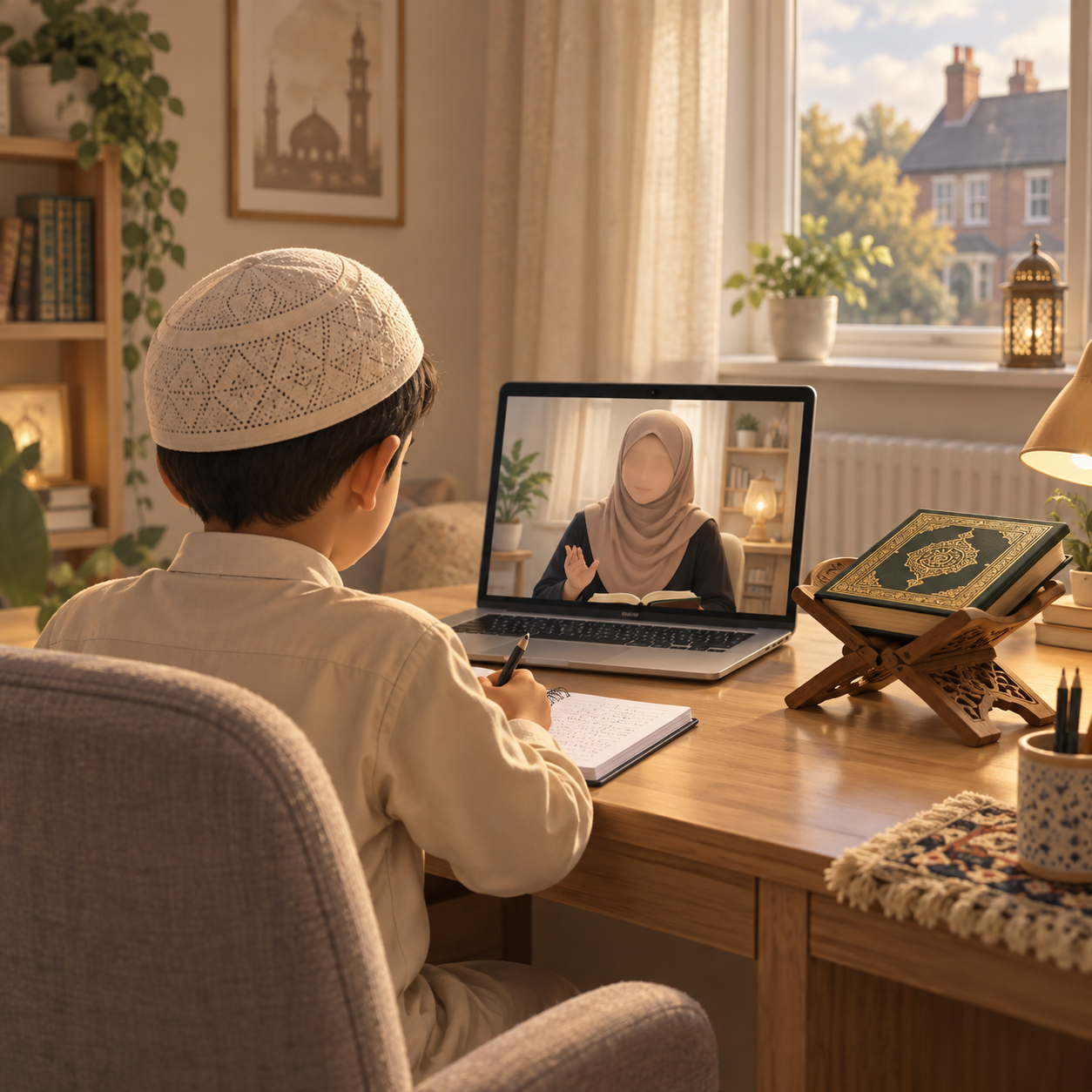
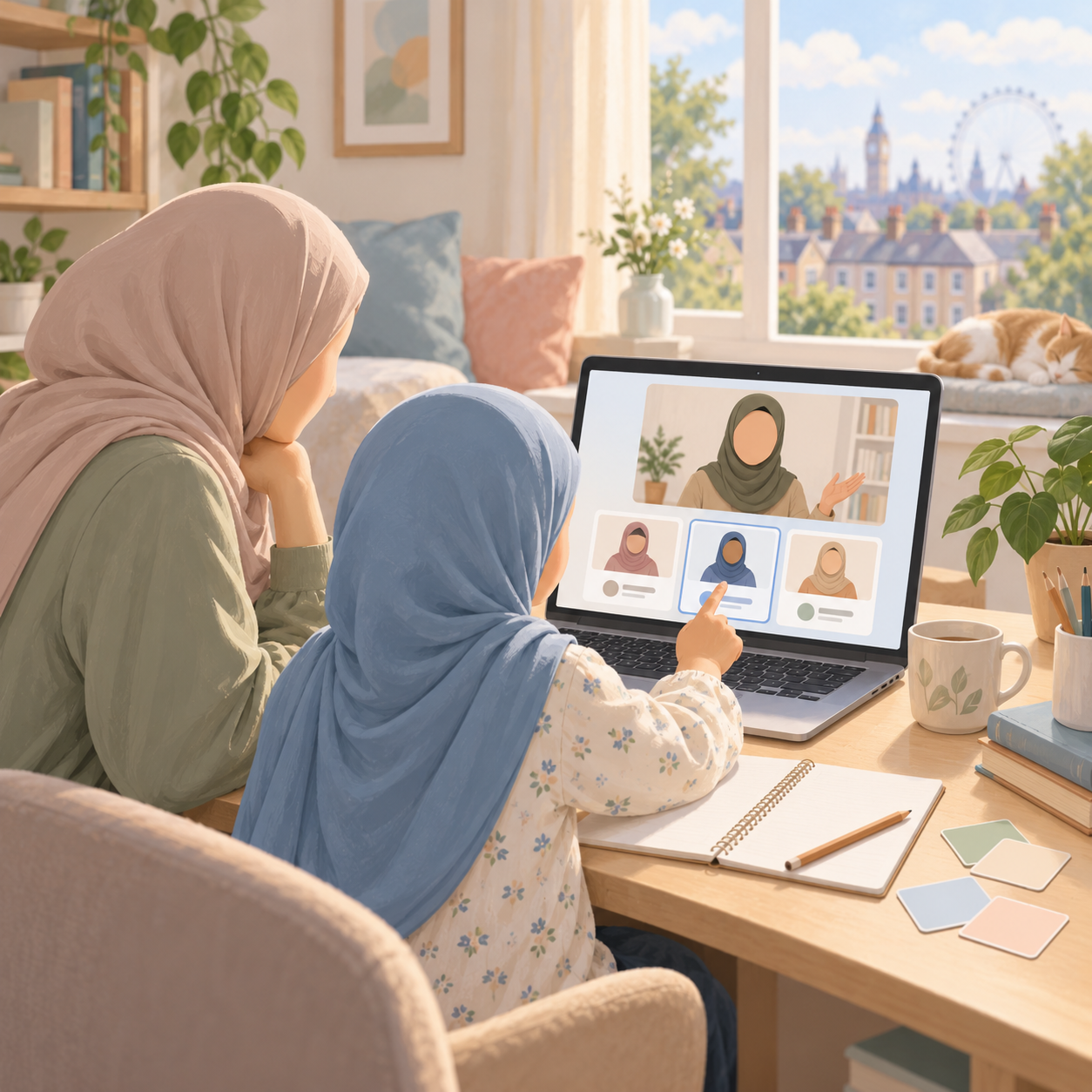
Best Online Arabic Classes for Kids in the UK is a search many Muslim parents make when they are ready to compare real options, not simply learn what online Arabic classes are. At this stage, the question is usually more practical: Which programme will actually suit my child? Which teacher will understand their level? Will they learn to read, speak, or both? How can I tell whether the lessons are working?
The answer is not simply to choose the academy with the most attractive website, the lowest price, or the longest list of features. The Best Online Arabic Classes for Kids in the UK should be the ones that match your child’s current level, learning goal, confidence, family routine, and need for personal attention.
A child who understands Arabic but answers in English needs something different from a complete beginner. A child who knows the alphabet but cannot read smoothly needs a different plan from a child who reads but rarely speaks. This is why comparing Arabic programmes requires more than looking at lesson length or price.
Quick answer: Parents comparing the Best Online Arabic Classes for Kids in the UK should look for nine things: an initial level check, a clear learning path, experienced child-friendly teachers, enough active Arabic practice, one-to-one support where needed, balanced reading and speaking, clear parent feedback, realistic progress tracking, and safe professional online communication.
Book a free Arabic trial session for your child on WhatsApp
Table of Contents
- What Does “Best” Really Mean for Your Child?
- Best Online Arabic Classes for Kids in the UK: 9 Smart Checks
- Compare Classes by Your Child’s Goal
- One-to-One vs Group Arabic Classes
- Reading vs Speaking: What Should the Course Teach?
- What Should You Look for in a Trial Lesson?
- How to Measure Real Arabic Progress
- Red Flags When Comparing Arabic Classes
- How Sibghah Approaches Arabic Learning
- Parent Comparison Checklist
- FAQ
What Does “Best” Really Mean for Your Child?
There is no single Arabic programme that is automatically best for every child. When parents search for the Best Online Arabic Classes for Kids in the UK, it is more useful to think about “best fit” than “best brand.”
A strong programme should answer one basic question clearly: What does this particular child need next?
For example:
- A five-year-old beginner may need sounds, letters, and short playful activities.
- A nine-year-old heritage learner may understand Arabic but need speaking confidence.
- An eleven-year-old may read slowly and need stronger fluency.
- A non-Arab Muslim child may need beginner Arabic with simple vocabulary and clear pronunciation.
- A child preparing to strengthen Arabic reading may need structured foundations before more advanced language work.
The Best Online Arabic Classes for Kids in the UK should therefore begin with the child, not with a fixed programme that every student follows in exactly the same way.
Best Online Arabic Classes for Kids in the UK: 9 Smart Checks
Use these nine checks when comparing academies, tutors, and programmes. They will help you move beyond marketing language and focus on what matters to your child.
1. Does the programme assess your child before teaching?
A good Arabic programme should not assume that age tells the whole story. Two children can be the same age and have completely different Arabic abilities.
Before regular lessons begin, the teacher should understand whether your child can:
- Recognise Arabic letters
- Pronounce common sounds
- Read joined letters
- Understand simple Arabic instructions
- Use basic vocabulary
- Answer short questions
- Build simple sentences
This is one of the strongest indicators when comparing the Best Online Arabic Classes for Kids in the UK. A useful programme should know where your child is starting before deciding where to take them.
2. Is there a clear learning path?
Good lessons should feel connected. The child should not simply complete a different activity every session without a clear purpose.
Parents should be able to understand the broad path. For example:
Reading path: sounds → letters → vowels → joining → words → sentences → fluency.
Speaking path: listening → vocabulary → short responses → sentence building → guided conversation → greater independence.
The Best Online Arabic Classes for Kids in the UK should have enough structure to show progress while still allowing the teacher to adjust the pace.
3. Does the teacher know how to teach children?
Knowing Arabic and teaching Arabic to a child are not the same skill.
A teacher working with children needs patience, simple explanations, good pacing, encouragement, and the ability to notice when a child is confused, tired, shy, or losing confidence.
During a trial lesson, watch the interaction:
- Does the teacher wait for the child to answer?
- Do they correct mistakes calmly?
- Do they encourage the child to try again?
- Do they adjust when something is too difficult?
- Does your child feel comfortable participating?
When evaluating the Best Online Arabic Classes for Kids in the UK, teacher-child interaction matters more than flashy slides or complicated learning platforms.
4. How much Arabic does your child actually use?
One of the easiest ways to evaluate a class is to watch who is doing most of the work.
If the teacher speaks for most of the session while the child listens quietly, the lesson may not provide enough active language practice.
A child learning Arabic should regularly:
- Listen
- Repeat
- Read
- Answer
- Describe
- Ask
- Speak
The Best Online Arabic Classes for Kids in the UK should create opportunities for the child to use Arabic, not only hear explanations about Arabic.
5. Does the lesson match your child’s actual goal?
Parents sometimes choose a programme because it is popular without first defining the goal.
Ask yourself what you most want your child to improve over the next few months.
| Parent Goal | What the Course Should Emphasise |
|---|---|
| Learn Arabic from zero | Sounds, simple vocabulary, listening, letters, confidence |
| Improve reading | Vowels, joining, pronunciation, fluency |
| Speak more Arabic | Vocabulary, questions, sentence building, conversation |
| Maintain family Arabic | Speaking, vocabulary expansion, reading and regular exposure |
| Build stronger foundations | Structured step-by-step literacy work |
The programme should fit the goal, not force the goal to fit the programme.
6. Is one-to-one support available?
Group Arabic classes can work well for children who enjoy learning with others and can comfortably follow the group pace. But some children need more individual attention.
One-to-one lessons can be particularly helpful if your child:
- Feels shy speaking in front of other children
- Needs frequent pronunciation correction
- Reads at a different level from children of the same age
- Needs more time to answer
- Needs more speaking practice
- Has uneven skills, such as strong understanding but weak reading
Personalisation is an important factor when comparing the Best Online Arabic Classes for Kids in the UK, because individual attention can make it easier to target the child’s real difficulty.
7. Do parents receive useful feedback?
Parents should not need to guess whether lessons are helping.
A good teacher or academy should be able to tell you:
- What your child is currently working on
- What they have improved
- What still needs practice
- What can be reviewed at home
- What the next learning goal is
This feedback does not need to be complicated. A short, clear update can be enough.
The Best Online Arabic Classes for Kids in the UK should make parents feel informed without expecting them to become the teacher at home.
8. Can the programme show progress in real skills?
Be careful with programmes that define progress only by completing books, pages, lessons, or levels.
Progress should appear in what your child can actually do.
For example:
- They recognise letters more quickly.
- They read with fewer pauses.
- They remember more vocabulary.
- They answer simple questions more confidently.
- They use longer Arabic phrases.
- They need less prompting from the teacher.
When comparing the Best Online Arabic Classes for Kids in the UK, ask what outcomes the programme tracks, not only what material it covers.
9. Does the programme feel safe and professional?
Online learning for children needs clear boundaries.
Parents should know:
- How lessons are scheduled
- How teachers communicate with families
- Which platform is used
- Who to contact if there is a concern
- How missed lessons are handled
- How parent feedback is shared
Parents can also review general NSPCC online safety guidance when thinking about their child’s wider online routines.
The Best Online Arabic Classes for Kids in the UK should feel organised, transparent, and parent-friendly from the first interaction.
Compare Arabic Classes by Your Child’s Goal
One useful way to compare programmes is to ignore the marketing for a moment and focus only on your child’s goal.
| If Your Child… | Prioritise a Programme That… |
|---|---|
| Is starting from zero | Introduces Arabic gently with clear sounds and simple vocabulary |
| Knows letters but cannot read well | Uses a structured Arabic reading method |
| Understands Arabic but replies in English | Gives plenty of speaking and sentence-building practice |
| Is losing family Arabic | Combines conversation, vocabulary and reading |
| Feels shy | Provides patient one-to-one interaction |
| Gets bored easily | Uses short, varied activities with active participation |
This approach makes searching for the Best Online Arabic Classes for Kids in the UK much easier because you are comparing programmes against a real need rather than a general promise.
One-to-One vs Group Arabic Classes
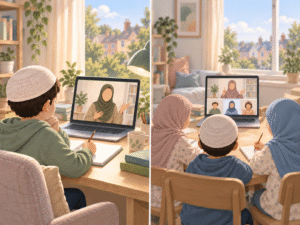
Neither format is automatically right for every child.
| Area | One-to-One | Group Class |
|---|---|---|
| Teacher attention | Focused on one child | Shared between several children |
| Speaking time | Usually higher | Depends on group size |
| Pace | Can follow the child | Usually follows the group |
| Correction | Immediate and personal | May be less frequent |
| Social interaction | Limited | Greater peer interaction |
| Shy learners | Often more comfortable | May feel more pressure |
At Sibghah Academy, the emphasis is on one-to-one lessons because this gives the teacher more time to listen to the child, correct carefully, and adapt the lesson.
You can read more in our guide to online Arabic classes for kids in the UK.
Reading vs Speaking: What Should the Course Teach?
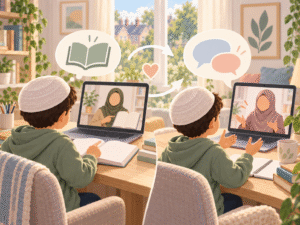
Parents searching for the Best Online Arabic Classes for Kids in the UK should pay close attention to this point because “learning Arabic” can mean different things.
A reading programme may work on:
- Letter recognition
- Sounds
- Short and long vowels
- Joining letters
- Words
- Reading fluency
A broader language programme may work on:
- Listening
- Vocabulary
- Questions and answers
- Sentence building
- Speaking
- Understanding simple conversations
This is why a child can be good at reading Arabic but still hesitate when speaking, or speak some Arabic at home but struggle to read.
Sibghah uses different learning paths depending on the child’s goal, including Noor Al-Bayan for reading foundations and the Takallam Series for wider Arabic language development.
Parents interested in reading foundations can also read our Noor Al-Bayan for Kids guide.
What Should You Look for in an Arabic Trial Lesson?
A trial lesson is one of the most useful ways to compare the Best Online Arabic Classes for Kids in the UK because it lets you see what the programme looks like when your own child is involved.
During or after the session, ask yourself:
- Did the teacher try to understand my child’s level?
- Did my child get enough opportunity to respond?
- Was correction gentle and clear?
- Did the teacher adjust when my child struggled?
- Did my child seem comfortable?
- Was there a clear recommendation afterwards?
A trial lesson should give you more information than “your child did well.” You should leave with a clearer idea of what your child needs next.
Book a free Arabic trial session
How to Measure Real Arabic Progress

Progress in Arabic is usually gradual. Parents should look for changes over weeks and months rather than expecting instant fluency.
A useful progress check might include:
| Skill | What Improvement May Look Like |
|---|---|
| Reading | Fewer pauses and less guessing |
| Pronunciation | More accurate sounds after correction |
| Vocabulary | Remembering and using more words |
| Listening | Understanding more without translation |
| Speaking | Giving longer answers with less hesitation |
| Confidence | Trying even when the child is unsure |
The Best Online Arabic Classes for Kids in the UK should be able to explain progress in these practical terms.
Red Flags When Comparing Online Arabic Classes
Not every warning sign means a programme is poor, but parents should ask more questions when they notice these patterns:
- No level check before starting
- Exactly the same programme for every child
- Very little child participation
- Most of the lesson is teacher talk
- No clear parent feedback
- Unrealistic promises of rapid fluency
- A child repeatedly feeling stressed or embarrassed
- Unclear communication or scheduling
- No explanation of what the child is working towards
When looking for the Best Online Arabic Classes for Kids in the UK, transparency matters. A good provider should be comfortable explaining how teaching works.
How Sibghah Approaches Arabic Learning
Sibghah Academy offers live one-to-one online Arabic lessons for Muslim children aged 5–15.
Rather than treating all children the same, the learning path can be adjusted according to the child’s starting level and goal.
Arabic learning at Sibghah may include:
- Arabic alphabet and sounds
- Reading foundations
- Reading fluency
- Vocabulary development
- Listening
- Sentence building
- Speaking confidence
For children who need stronger reading foundations, Noor Al-Bayan may be used. For broader communication and language development, the Takallam Series can support vocabulary, sentence-building, listening, and speaking.
The one-to-one format allows the teacher to spend more time on the areas where the child actually needs support.
For parents comparing the Best Online Arabic Classes for Kids in the UK, the aim should not be to find the programme with the biggest promises. It should be to find a learning path that your child can understand, enjoy, and continue consistently.
Read our Learn Arabic for Kids parent guide
Sibghah Teacher Note
Children often show uneven Arabic skills. A child may understand much more than they can say. Another may recognise letters but read very slowly. Another may speak confidently but have weak reading skills. Good Arabic teaching starts by noticing these differences. The goal is not to label the child as “beginner” or “advanced” too quickly, but to understand which skill needs the next step.
Parent Checklist for the Best Online Arabic Classes for Kids in the UK
Before enrolling, use this checklist:
- My child’s level is checked before the programme is fixed.
- The teacher has experience teaching children.
- The programme matches my child’s main Arabic goal.
- My child gets enough active reading or speaking time.
- The teacher corrects mistakes gently.
- One-to-one support is available if my child needs it.
- The programme has a clear learning path.
- I receive understandable parent feedback.
- Progress is measured through real skills, not only completed pages.
- Scheduling and online communication feel professional.
- The routine is realistic for my family.
- My child feels increasingly comfortable using Arabic.
If most of these points are present, you may have found a programme that deserves serious consideration.
FAQ About the Best Online Arabic Classes for Kids in the UK
What are the Best Online Arabic Classes for Kids in the UK?
The Best Online Arabic Classes for Kids in the UK are classes that match the individual child’s level and goal, provide active live learning, use child-friendly teachers, offer useful correction and parent feedback, and show progress in real Arabic skills such as reading, listening, vocabulary, and speaking.
Are one-to-one Arabic classes better for children?
One-to-one lessons can be especially helpful for children who need personal correction, more speaking time, a flexible pace, or confidence-building. Some children may still enjoy group learning, so the right choice depends on the child.
How do I compare Arabic classes for my child?
Compare the level assessment, teacher experience, learning method, child participation, class format, parent feedback, progress tracking, scheduling, safety, and whether the programme actually matches your child’s goal.
Should online Arabic classes teach reading and speaking?
That depends on the child’s goal. Some children mainly need reading foundations, while others need conversation and vocabulary. Many children eventually benefit from both, but the balance should reflect their current needs.
What is the difference between Noor Al-Bayan and a spoken Arabic programme?
Noor Al-Bayan is useful for Arabic reading foundations such as letters, sounds, vowels, and joining. A broader spoken Arabic programme focuses more on vocabulary, listening, sentence building, and communication. They can serve different needs or be combined over time.
How can I tell if an online Arabic class is working?
Look for practical changes: smoother reading, fewer repeated pronunciation errors, stronger vocabulary recall, better understanding, longer spoken responses, and greater willingness to use Arabic.
Should I choose the cheapest online Arabic course?
Price is one factor, but it should not be the only one. A lower-cost programme that gives little individual practice may provide less value than a programme where the child receives suitable teaching and makes steady progress.
Does Sibghah offer one-to-one online Arabic classes?
Yes. Sibghah Academy offers live one-to-one Arabic lessons for Muslim children aged 5–15, with learning paths that can support reading foundations, vocabulary, listening, sentence building, speaking, and confidence according to the child’s needs.
Final Thoughts on the Best Online Arabic Classes for Kids in the UK
Searching for the Best Online Arabic Classes for Kids in the UK becomes much easier when you stop looking for one universal “best” academy and start looking for the best fit for your child.
Begin with the child’s current level. Decide what skill matters most right now. Observe the teacher during a trial lesson. Ask how progress will be measured. Look at how much Arabic your child actually uses during class. And pay attention to how your child feels about learning.
The right programme should challenge your child enough to help them progress without making Arabic feel overwhelming. It should offer structure without becoming rigid, correction without embarrassment, and encouragement without unrealistic promises.
Sibghah Academy supports Muslim children aged 5–15 through live one-to-one Arabic lessons. If you are unsure whether your child needs reading foundations, speaking practice, or a combination of both, a trial session can help identify a suitable starting point.
Message Sibghah Academy on WhatsApp to book a free Arabic trial session