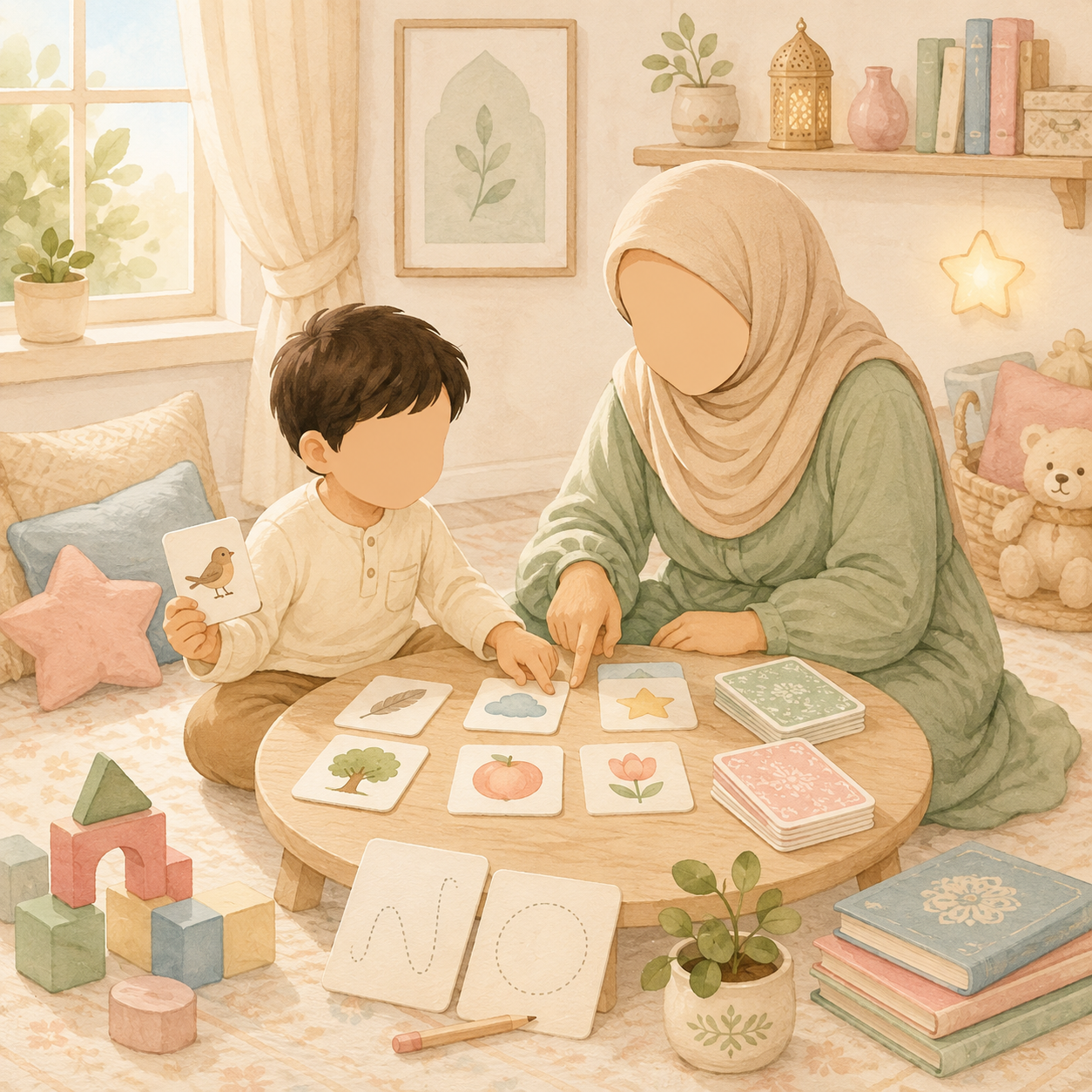
The goal of an arabic alphabet game is not only to entertain your child. A good game helps your child recognise Arabic letters, notice letter shapes, connect letters to sounds, remember similar letters, and begin the early steps of Arabic reading without feeling pressured.
If your child is learning Arabic in an English-speaking environment, games can be especially helpful. Arabic may not be the language they use at school or with friends, so home practice needs to feel light and encouraging. A simple arabic alphabet game can turn five minutes of practice into something your child accepts more easily.
This article shares 5 strong home ideas for parents. Each arabic alphabet game includes the learning goal, how to play it, what your child benefits from, which skills it develops, and which level it suits best.
Quick answer: The best arabic alphabet game for children is simple, short, and focused on one clear skill: letter recognition, letter matching, letter sounds, tracing, or first-sound awareness.
| Game | Main Goal | Skill It Builds |
|---|---|---|
| Letter Hunt Game | Find and recognise Arabic letters | Visual attention and letter recognition |
| Match the Letter Game | Match the same letter or similar letters | Memory and visual discrimination |
| Sound Detective Game | Connect each letter to its sound | Listening, pronunciation, and sound awareness |
| Trace and Say Game | Trace the letter while saying the sound | Hand-eye coordination and sound-letter connection |
| First Sound Game | Connect words to their first Arabic sound | Early reading readiness and phonological awareness |
Table of Contents
- Why Arabic Alphabet Games Help Children Learn
- When Should Parents Use an Arabic Alphabet Game?
- Arabic Alphabet Game: 5 Fun Home Ideas for Kids
- How to Choose the Right Game for Your Child
- A Simple Weekly Arabic Alphabet Game Routine
- Common Mistakes Parents Should Avoid
- When Your Child May Need Extra Arabic Support
- FAQ
Why Arabic Alphabet Games Help Children Learn
Children do not always learn best by sitting still and repeating letters from a page. Many children need to see, hear, move, touch, choose, compare, and repeat. This is why an arabic alphabet game can be useful at home.
Games help because they reduce pressure. Instead of telling your child, “Study these letters,” you can say, “Let’s find the letter,” or “Can you catch the sound?” The learning goal is still there, but the child experiences it as play.
Early literacy also depends on sound awareness. Children need to understand that words are made of sounds, and that letters can represent those sounds. Reading Rockets explains that phonological and phonemic awareness are important for children’s reading development, especially when children begin connecting letter names, letter sounds, and words.
For Arabic, this is very important. A child may see the letter ب, but they also need to hear and say بَ، بِ، بُ. A child may recognise س and ص, but they need to notice that the sounds are not the same. A simple arabic alphabet game can help children practise these skills gently.
Play also supports language development, problem-solving, and confidence. NAEYC describes play as a central teaching practice that supports young children’s development and learning, including language and problem-solving skills.
Helpful external resources for parents:
For parents, the important point is simple: an arabic alphabet game should still have a learning purpose. It should not be random play. The game should help the child recognise, hear, say, match, trace, or use Arabic letters.
When Should Parents Use an Arabic Alphabet Game?
You can use an arabic alphabet game when your child is starting Arabic letters, reviewing letters already learned, or struggling to remember similar letters.
An arabic alphabet game is especially useful when your child:
- Gets bored with worksheets.
- Confuses letters with similar shapes.
- Knows letter names but forgets sounds.
- Needs more repetition without pressure.
- Is not ready for long reading practice.
- Needs short daily Arabic exposure at home.
- Feels nervous when asked to read aloud.
Games work best when they are short. A 5-minute arabic alphabet game can be more useful than a 30-minute session full of stress. For many children, Arabic practice should feel small and achievable.
Start with one goal at a time. Do not use one game to teach letter names, sounds, writing, reading, and vocabulary all at once. Choose one skill, play for a few minutes, and stop while your child still feels successful.
Arabic Alphabet Game: 5 Fun Home Ideas for Kids
Here are 5 practical ideas parents can use at home. Each arabic alphabet game is simple, low-preparation, and focused on a specific Arabic learning skill.
1. Letter Hunt Game
The Letter Hunt Game is a simple arabic alphabet game that helps children recognise Arabic letters visually. It is especially useful for beginners who are still learning letter shapes.
Goal of the game
The goal is to help your child notice and recognise a target Arabic letter among other letters. This builds visual attention and letter recognition.
How to play at home
- Choose one Arabic letter your child is learning.
- Write that letter on a card.
- Place several Arabic letter cards around the room.
- Ask your child to find the target letter.
- When they find it, ask them to say the letter name or sound.
- Repeat with a new letter.
You can make the game easier by using only 3–4 letters. You can make it harder by adding similar-looking letters.
What your child benefits from
This arabic alphabet game helps your child become more aware of letter shapes. Instead of only seeing letters on a worksheet, the child searches, moves, chooses, and confirms the answer.
Skills it develops
- Visual scanning.
- Attention and focus.
- Arabic letter recognition.
- Confidence choosing the correct letter.
- Early preparation for reading.
Best for
This game is best for beginners who are learning Arabic letters for the first time. It is also useful for children who forget letters quickly and need playful review.
Parent tip: Start with easy wins. If your child is learning ب, do not immediately mix it with ت and ث unless they are ready. Add similar letters later.
2. Match the Letter Game
The Match the Letter Game is an arabic alphabet game that helps children compare letters and remember shapes. It is useful because Arabic letters can look similar, especially when children are still beginners.
Goal of the game
The goal is to help your child match the same letter, notice small differences, and reduce confusion between similar letters.
How to play at home
- Prepare two sets of Arabic letter cards.
- Choose 4–6 letters only.
- Place one set face up.
- Give your child the matching cards.
- Ask them to match each card with the same letter.
- Ask them to say the letter name or sound after each match.
For a harder version, use similar letters such as ب، ت، ث or ج، ح، خ. Ask your child to explain what changed: dots, shape, or sound.
What your child benefits from
This arabic alphabet game trains the child to look carefully. Many Arabic mistakes happen because the child does not notice dots or small shape differences. Matching helps the child slow down and compare.
Skills it develops
- Visual memory.
- Shape comparison.
- Dot awareness.
- Letter discrimination.
- Focus and accuracy.
Best for
This game is best for children who already know some letters but confuse similar ones. It is also useful as a review game before moving into reading.
| Letters to Compare | What the Child Should Notice |
|---|---|
| ب / ت / ث | Number and position of dots. |
| ج / ح / خ | Dot or no dot, and where the dot appears. |
| د / ذ | Same shape, but one has a dot. |
| ر / ز | Same shape, but one has a dot. |
| س / ش | Same base shape, but one has dots. |
3. Sound Detective Game
The Sound Detective Game is an arabic alphabet game that helps children connect Arabic letters to their sounds. This is very important because a child may know the letter name but still struggle to read.
Goal of the game
The goal is to help your child listen carefully, recognise the sound of a letter, and connect that sound to the correct Arabic letter.
How to play at home
- Choose 3 Arabic letters your child already knows.
- Place the letter cards in front of your child.
- Say one letter sound, not only the letter name.
- Ask your child to point to the matching letter.
- Ask your child to repeat the sound after you.
- Add Fatha, Kasra, or Damma if your child is ready.
For example, you can show ب، م، س. Then say مَ. Your child points to م and repeats مَ.
What your child benefits from
This arabic alphabet game strengthens the link between sound and symbol. This is one of the foundations of reading. Your child is not only looking at the letter; they are hearing it and matching it to a sound.
Skills it develops
- Listening attention.
- Letter-sound connection.
- Arabic pronunciation.
- Sound discrimination.
- Early reading readiness.
Best for
This game is best for children who know some letter shapes but need help connecting letters to sounds. It is also useful for children preparing for Noor Al-Bayan or early Arabic reading.
Parent tip: Do not use too many letters at once. A strong arabic alphabet game should feel clear. Three letters are enough at the beginning.
4. Trace and Say Game
The Trace and Say Game is an arabic alphabet game that connects movement, writing, and sound. It helps children remember letters through hand movement and pronunciation together.
Goal of the game
The goal is to help your child trace an Arabic letter while saying its sound. This connects visual memory, hand movement, and pronunciation.
How to play at home
- Write a large Arabic letter on paper.
- Ask your child to trace it with a finger first.
- Say the letter sound slowly.
- Ask your child to trace and repeat the sound.
- Let the child trace with pencil, crayon, or finger in sand or flour.
- Repeat the same letter with a vowel sound if the child is ready.
You can make this arabic alphabet game more sensory by using playdough, sand trays, pipe cleaners, or building blocks.
What your child benefits from
This game helps children remember the shape of the letter through movement. It also helps them connect writing with sound. Children who need hands-on activities often enjoy this more than a normal worksheet.
Skills it develops
- Fine motor skills.
- Hand-eye coordination.
- Letter shape memory.
- Sound-letter connection.
- Early writing confidence.
Best for
This game is best for children who like hands-on learning. It is also helpful for children who recognise a letter but cannot remember how it is shaped.
| Tracing Material | Why It Helps |
|---|---|
| Finger tracing | Simple and quick for daily practice. |
| Sand or flour tray | Adds sensory learning and makes practice playful. |
| Playdough | Builds hand strength and shape memory. |
| Crayons | Helps children practise pencil control gently. |
5. First Sound Game
The First Sound Game is an arabic alphabet game that helps children connect Arabic letters to the first sound in a word. This is a strong early reading skill because it helps children understand that words begin with sounds.
Goal of the game
The goal is to help your child hear the first sound in an Arabic word and connect it to the correct letter.
How to play at home
- Choose 3 letters your child knows.
- Choose simple Arabic words that begin with those letters.
- Say one word slowly.
- Ask: “What sound do you hear first?”
- Ask your child to choose the matching letter card.
- Repeat with another word.
For example, if your child knows ب, م, and س, you can use simple words such as باب, ماء, سمك. The child listens to the first sound and chooses the matching letter.
What your child benefits from
This arabic alphabet game helps your child understand that letters are used inside real words. It moves the child from isolated letters toward reading readiness.
Skills it develops
- First-sound awareness.
- Listening accuracy.
- Letter-sound matching.
- Vocabulary connection.
- Early reading preparation.
Best for
This game is best for children who already know several letters and are ready to connect them to simple Arabic words. It is also helpful before starting more serious word reading practice.
Parent tip: If your child cannot hear the first sound yet, do not worry. Say the word slowly, repeat it, and return to easier sound-matching games.
How to Choose the Right Game for Your Child
Not every arabic alphabet game fits every child. Choose the game based on your child’s current level.
| Your Child’s Level | Best Game | Why |
|---|---|---|
| New to Arabic letters | Letter Hunt Game | Helps with basic recognition. |
| Confuses similar letters | Match the Letter Game | Builds visual comparison and dot awareness. |
| Knows shapes but forgets sounds | Sound Detective Game | Connects letters to sounds. |
| Needs hands-on practice | Trace and Say Game | Uses movement, writing, and sound together. |
| Ready for early words | First Sound Game | Builds reading readiness and sound awareness. |
A good arabic alphabet game should feel slightly challenging but not frustrating. If your child keeps getting the answer wrong, make the game easier. Use fewer letters, choose clearer differences, or return to listening first.
Parents should also avoid turning games into tests. The purpose is practice, not pressure. Praise effort, not only correct answers.
A Simple Weekly Arabic Alphabet Game Routine
You can use an arabic alphabet game a few times a week without making Arabic feel heavy. Keep sessions short and repeat the same letters until your child becomes more confident.
| Day | Game | Focus |
|---|---|---|
| Day 1 | Letter Hunt Game | Recognise 2–3 target letters. |
| Day 2 | Sound Detective Game | Hear and repeat letter sounds. |
| Day 3 | Trace and Say Game | Connect shape, hand movement, and sound. |
| Day 4 | Match the Letter Game | Review similar letters. |
| Day 5 | First Sound Game | Connect letters to simple words. |
This routine does not need to take long. Five to ten minutes is enough for many children. The key is repetition with warmth.
If your child enjoys one arabic alphabet game more than the others, use it more often. The best home practice is the practice your child will actually do.
Common Mistakes Parents Should Avoid
An arabic alphabet game can be very helpful, but only if it is used in the right way. Here are common mistakes to avoid.
Using too many letters at once
If your child is still beginning, do not use 10 or 15 letters in one game. Start with 2–4 letters and build slowly.
Making the game too competitive
Some children enjoy competition, but others become anxious. Arabic games should build confidence, not fear of losing.
Focusing only on letter names
Letter names matter, but children also need letter sounds. A useful arabic alphabet game should include sound practice when possible.
Ignoring similar letters
Arabic has many similar-looking letters. Children need time to compare dots, shapes, and sounds.
Correcting too harshly
If your child makes a mistake, say the correct answer gently and try again. Harsh correction can make children avoid Arabic.
Using games without a goal
Play is helpful, but each game should have a clear learning goal: recognition, matching, sounds, tracing, or first-sound awareness.
Expecting one game to fix everything
Games support learning, but children still need repetition, guidance, and a clear Arabic learning path.
When Your Child May Need Extra Arabic Support
Home games are a helpful start. But sometimes an arabic alphabet game is not enough by itself.
Your child may need extra Arabic support if they:
- Still confuse the same letters after repeated practice.
- Cannot connect letters to sounds.
- Forget letters quickly.
- Feel frustrated when reading Arabic.
- Cannot move from letters to simple words.
- Need help with pronunciation.
- Need a clear path toward Noor Al-Bayan or Arabic reading.
In this case, one-to-one Arabic lessons can help because the teacher can listen to your child, identify the exact difficulty, and choose the right next step.
Sibghah Academy offers live one-to-one Arabic lessons for Muslim children aged 5–15. If your child is still struggling after home practice, a teacher can help with letter recognition, pronunciation, vowels, simple words, and early reading.
The goal is not to replace home games. A good arabic alphabet game can support learning at home, while one-to-one lessons can provide correction, structure, and a personal learning path.
Quick Parent Checklist
Use this checklist before choosing an arabic alphabet game for your child:
- Does the game have one clear learning goal?
- Is the game suitable for my child’s current level?
- Am I using only a few letters at once?
- Does the game include sound practice?
- Does my child need visual matching or listening practice?
- Does the game feel fun rather than stressful?
- Am I praising effort, not only correct answers?
- Do I know which letters my child still confuses?
- Can my child move from letter recognition to simple sounds?
- Does my child need extra support from a teacher?
FAQ: Arabic Alphabet Game
1. What is an arabic alphabet game?
An arabic alphabet game is a simple activity that helps children practise Arabic letters through play, such as finding letters, matching letters, tracing letters, or connecting letters to sounds.
2. Can Arabic alphabet games help children learn faster?
Arabic alphabet games can help children practise more happily and remember letters better, especially when the game has a clear goal and is repeated regularly.
3. What is the best arabic alphabet game for beginners?
The Letter Hunt Game is a good arabic alphabet game for beginners because it helps children recognise letter shapes in a simple and playful way.
4. How many Arabic letters should I use in one game?
For beginners, use 2–4 letters at a time. Too many letters can make the game confusing.
5. Should I teach letter names or sounds during games?
Teach both if possible, but do not ignore sounds. Letter sounds help children prepare for reading.
6. What if my child confuses similar Arabic letters?
Use matching and sorting games with similar letters. Help your child notice dots, shape differences, and sounds.
7. How often should we play Arabic alphabet games?
Short practice 3–5 times a week can help. Five to ten minutes may be enough for many children.
8. Can an arabic alphabet game replace Arabic lessons?
An arabic alphabet game can support home practice, but some children still need teacher guidance for pronunciation, vowels, reading, and progression.
9. What comes after Arabic alphabet games?
After Arabic alphabet games, children can move to sounds with vowels, simple words, Noor Al-Bayan, Arabic reading practice, and later speaking or Quran readiness.
10. Can parents use these games without knowing much Arabic?
Yes, parents can use simple games for recognition and matching. For pronunciation and reading correction, teacher support may be helpful.
11. How do I know if the game is working?
The game is working if your child recognises letters more easily, confuses fewer letters, connects letters to sounds, and feels more confident with Arabic practice.
12. Does Sibghah Academy help with Arabic letters?
Yes. Sibghah Academy helps children learn Arabic letters, sounds, vowels, pronunciation, and early reading through live one-to-one Arabic lessons.
Need help after home Arabic games?
If your child enjoys every arabic alphabet game at home but still struggles with letters, sounds, or early reading, Sibghah Academy can help through live one-to-one Arabic lessons.
Send us your child’s age, current Arabic level, and the letters they find difficult, and we will recommend the right starting point.