Arabic alphabet with pronunciation is one of the most important starting points for children who are learning Arabic, especially when they are growing up in an English-speaking environment. A child may recognize Arabic letters visually, but still pronounce them incorrectly or confuse similar sounds.
This is why learning the arabic alphabet with pronunciation is different from simply memorizing the alphabet. Pronunciation helps children move from letter recognition to real reading. It also prepares them for Arabic words, Noor Al-Bayan, Quran reading, and Arabic speaking later.
For many children, the hardest part is not remembering the letter shape. The harder part is producing sounds that do not exist in English, such as ح، خ، ع، غ، ق، ص، ض، ط، ظ. These sounds need listening, repetition, patience, and teacher correction.
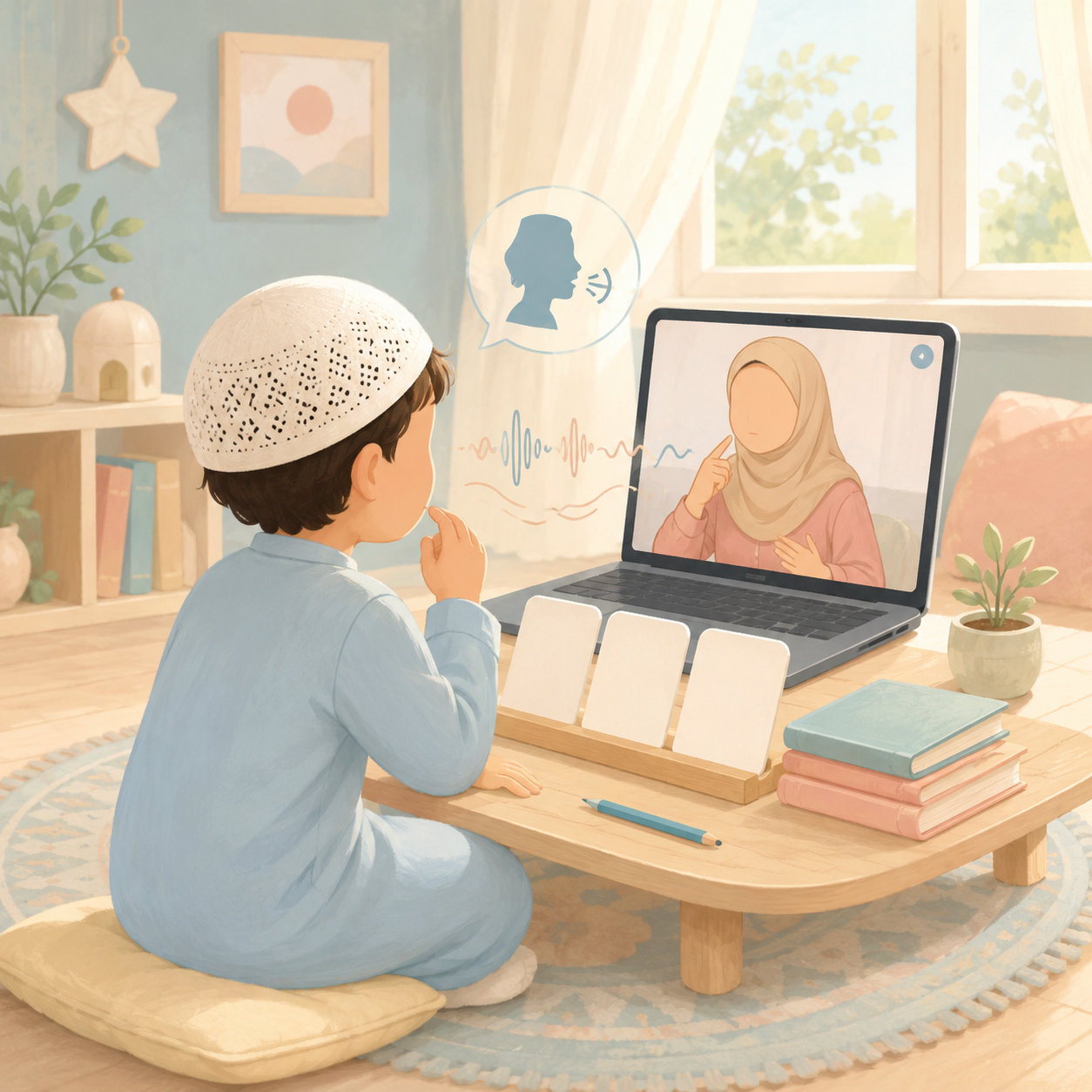
A one-to-one Arabic lesson can be especially helpful here. In a group class, a teacher may not hear every child’s pronunciation clearly. In a one-to-one lesson, the teacher can listen to your child directly, repeat difficult sounds, correct mouth position, and build confidence slowly.
This guide explains how parents can teach the arabic alphabet with pronunciation in a child-friendly way, with 8 practical tips, common sound mistakes, vowel practice, and a clear path from letters to early reading.
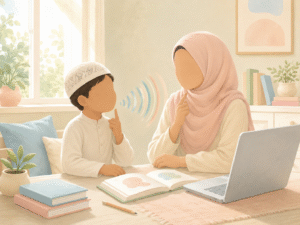
Quick answer: To teach the arabic alphabet with pronunciation, children need letter recognition, correct letter sounds, listening practice, mouth movement, short vowels, repeated examples, and one-to-one teacher correction.
| Child’s Challenge | What Helps |
|---|---|
| Knows letter names but cannot read sounds | Teach the sound of each letter with short vowels. |
| Confuses similar letters | Compare sounds in pairs, such as س and ص, ت and ط. |
| Finds throat letters difficult | Use slow listening, teacher modelling, and one-to-one correction. |
| Reads Arabic words by guessing | Practise letters with Fatha, Kasra, and Damma before full words. |
| Feels shy pronouncing Arabic sounds | Use gentle repetition in a one-to-one lesson without group pressure. |
Table of Contents
- Why Pronunciation Matters in the Arabic Alphabet
- Arabic Alphabet with Pronunciation: 8 Helpful Tips for Kids
- Letter Name vs Letter Sound
- Arabic Sounds English-Speaking Children Often Find Hard
- Arabic Alphabet with Pronunciation and Short Vowels
- Why One-to-One Lessons Help Pronunciation
- Simple Pronunciation Routine for Kids
- How Sibghah Academy Helps Children Learn Arabic Pronunciation
- FAQ
Why Pronunciation Matters in the Arabic Alphabet
The Arabic alphabet is not only a set of shapes. Each letter has a sound, and some Arabic sounds are very different from English sounds. This is why parents should teach the arabic alphabet with pronunciation from the beginning.
If a child learns only the shape of the letter, they may recognize the letter on the page but still read it incorrectly. If they learn the sound clearly, they can begin to connect the letter to reading, speaking, and Quran readiness.
For example, a child may see the letter ح and say it like ه. They may see ق and say it like ك. They may see ص and say it like س. These mistakes are normal at the beginning, but they need gentle correction before they become habits.
Teaching the arabic alphabet with pronunciation helps children:
- Recognize letters visually.
- Hear the difference between similar sounds.
- Produce Arabic sounds more clearly.
- Read letters with short vowels.
- Build early Arabic reading confidence.
- Prepare for Noor Al-Bayan and Quran reading.
- Feel more confident speaking Arabic words.
Many Arabic-learning resources for non-native speakers use a gradual approach. For example, At-Takallum presents a comprehensive Arabic course for non-native speakers, Arabic at Our Children’s Hands is designed for young non-native learners, and Al Jazeera Learning Arabic provides open interactive Arabic learning resources.
For children, the same principle matters: Arabic should be built gradually. A child should hear, repeat, read, and receive correction step by step.
Does your child struggle with Arabic sounds?
Sibghah Academy offers live one-to-one Arabic lessons, so the teacher can listen to your child’s pronunciation and correct difficult letters gently.
Arabic Alphabet with Pronunciation: 8 Helpful Tips for Kids
The following tips help parents teach the arabic alphabet with pronunciation in a practical and gentle way.
1. Teach the Sound, Not Only the Letter Name
Children often learn the names of Arabic letters first. This is useful, but reading Arabic depends more on letter sounds than letter names.
For example, the child may know the name “Baa,” but when reading, they need to produce the sound بَ، بِ، بُ. The letter name is not enough for reading.
When teaching the arabic alphabet with pronunciation, say the letter name, then practise the sound with vowels. This helps the child connect the letter to real reading.
A simple method:
- Show the letter.
- Say the letter name.
- Say the letter sound.
- Add Fatha, Kasra, and Damma.
- Ask the child to repeat slowly.
For example:
- بَ
- بِ
- بُ
This small step makes the arabic alphabet with pronunciation more useful because the child is not just memorizing; they are preparing to read.
2. Use Listening Before Repetition
Children need to hear Arabic sounds before they can produce them clearly. Some sounds are unfamiliar, so the child may need to listen several times before repeating.
When teaching the arabic alphabet with pronunciation, do not rush the child to say the letter immediately. First, let them listen.
Try this order:
- The teacher or parent says the sound slowly.
- The child listens without speaking.
- The sound is repeated again.
- The child repeats once.
- The teacher corrects gently.
- The child repeats again.
This is especially important for throat letters like ح، خ، ع، غ. Many English-speaking children need repeated listening before these sounds become comfortable.
One-to-one lessons are useful here because the teacher can repeat the same sound as many times as your child needs.
3. Compare Similar Arabic Sounds
Some Arabic letters look or sound similar to children. If you teach them separately only, the child may not notice the difference. Comparing them helps the child hear the contrast.
When teaching the arabic alphabet with pronunciation, compare difficult pairs such as:
| Sound Pair | Common Child Confusion | Practice Tip |
|---|---|---|
| س / ص | Child says both like س | Practise soft sound vs heavier sound slowly. |
| ت / ط | Child says both like ت | Compare light and heavy sounds with vowels. |
| د / ض | Child says both like د | Practise the heavier sound separately first. |
| ه / ح | Child says ح like ه | Use slow listening and gentle throat practice. |
| ك / ق | Child says ق like ك | Practise ق slowly with teacher modelling. |
| ء / ع | Child cannot produce ع clearly | Repeat ع with short vowels in one-to-one correction. |
These comparisons help children understand that Arabic pronunciation is not random. Each letter has a sound identity.
4. Practise Mouth Movement Gently
Pronunciation is physical. The mouth, tongue, throat, and lips all matter. Children need to learn how Arabic sounds feel, not only how they look on the page.
When teaching the arabic alphabet with pronunciation, encourage the child to notice mouth movement gently. Do not make it too technical. Use simple child-friendly language.
You can say:
- “This sound comes from deeper in the throat.”
- “Make this sound lighter.”
- “This letter needs a stronger sound.”
- “Listen first, then copy slowly.”
- “Let’s try it again together.”
Children should not feel embarrassed if a sound is difficult. They need reassurance that Arabic sounds take practice.
This is another reason one-to-one Arabic lessons are helpful. The child can practise difficult sounds privately with the teacher, without feeling watched by a group.
5. Connect Letters to Short Vowels Early
Children should not stay too long at isolated letters. Once they know a letter, connect it to Fatha, Kasra, and Damma.
The arabic alphabet with pronunciation becomes much clearer when children practise sounds like:
- مَ، مِ، مُ
- سَ، سِ، سُ
- قَ، قِ، قُ
- حَ، حِ، حُ
- عَ، عِ، عُ
This helps the child understand that a letter changes sound when the vowel changes. It also prepares them for reading Arabic words.
For example, a child who can say بَ، بِ، بُ is more ready to read simple words than a child who only knows the name Baa.
This stage is very important for Noor Al-Bayan and early Quran reading.
6. Move from Sounds to Simple Words
After practising letters with vowels, children need short words. This helps them see that sounds build meaning.
When teaching the arabic alphabet with pronunciation, use words that match the sounds the child already knows. Do not start with long or difficult words too early.
Examples of simple word practice:
- باب
- بيت
- قلم
- ولد
- كتب
- جلس
Ask the child to break the word into sounds, then blend the sounds slowly. If the child mispronounces a letter, return to that sound before reading the full word again.
This method helps children move from pronunciation to real Arabic reading.
7. Correct Mistakes Early, But Gently
Mistakes are normal. Children should not be shamed for mispronouncing Arabic letters. But mistakes should still be corrected before they become habits.
When teaching the arabic alphabet with pronunciation, correct gently. Instead of saying, “Wrong,” say:
- “Good try. Listen again.”
- “This sound is a little heavier.”
- “Let’s slow it down.”
- “Try it after me.”
- “Much better. One more time.”
A gentle correction style helps children keep trying. If every mistake feels like failure, the child may stop wanting to speak or read Arabic.
One-to-one lessons are especially effective here because correction can be personal and calm. The teacher can focus on one sound without making the child feel compared to other students.
8. Use One-to-One Practice for Difficult Letters
Some letters need more than home practice. Difficult sounds often need a trained teacher who can listen carefully and correct your child directly.
When children learn the arabic alphabet with pronunciation, one-to-one support helps with sounds such as:
- ح
- خ
- ع
- غ
- ق
- ص
- ض
- ط
- ظ
In a group lesson, the teacher may not have enough time to hear every child repeat these sounds several times. In a one-to-one lesson, your child gets more attempts, more correction, and more confidence.
This is why one-to-one Arabic lessons are one of the best ways to support pronunciation, especially for children who speak English most of the day.
Sibghah Teacher Note: A child may know the Arabic alphabet visually but still need help with pronunciation. The goal is not only to name the letters, but to hear them, say them, and use them in reading.
Letter Name vs Letter Sound
One of the most common mistakes in teaching the arabic alphabet with pronunciation is focusing only on letter names.
Letter names are important. Children should know Alif, Baa, Taa, Thaa, and so on. But reading depends on sounds.
| What the Child Learns | Example | Why It Matters |
|---|---|---|
| Letter name | Baa | Helps the child identify the letter. |
| Letter sound | بَ، بِ، بُ | Helps the child read syllables and words. |
| Letter in a word | باب | Helps the child move into real reading. |
If your child only knows letter names, they may still struggle to read. If they learn sounds with vowels, reading becomes easier.
This is why arabic alphabet with pronunciation practice should include the letter name, the letter sound, and short reading examples.
Arabic Sounds English-Speaking Children Often Find Hard
Children who speak English most of the day may find some Arabic sounds difficult. This is completely normal.
When teaching the arabic alphabet with pronunciation, parents should be patient with these letters:
| Arabic Letter | Why It May Be Hard | Helpful Practice |
|---|---|---|
| ح | It may be confused with ه. | Listen carefully and practise slowly with vowels. |
| خ | The sound is unfamiliar to many English-speaking children. | Use teacher modelling and repeated listening. |
| ع | It is a deep sound that may feel difficult. | Practise gently in one-to-one lessons. |
| غ | It may be hard to separate from خ. | Compare خ and غ slowly. |
| ق | It may be pronounced like ك. | Practise قَ، قِ، قُ with correction. |
| ص | It may be pronounced like س. | Compare س and ص in short syllables. |
| ض | It is often confused with د or ظ. | Use slow repetition and teacher correction. |
| ط | It may be pronounced like ت. | Compare ت and ط with vowels. |
| ظ | It may be confused with ذ or ز. | Practise with simple examples and correction. |
The goal is not perfection in one lesson. The goal is steady improvement. Children need to hear the difference, try the sound, and receive gentle correction over time.
One-to-one support is especially useful for these letters because the teacher can focus on your child’s exact pronunciation pattern.
Arabic Alphabet with Pronunciation and Short Vowels
The arabic alphabet with pronunciation should always connect to short vowels. Fatha, Kasra, and Damma are the bridge between letters and reading.
Without vowels, a child may know a letter but not know how to read it in words. With vowels, the child begins to understand Arabic sound patterns.
| Letter | With Fatha | With Kasra | With Damma |
|---|---|---|---|
| ب | بَ | بِ | بُ |
| ت | تَ | تِ | تُ |
| ج | جَ | جِ | جُ |
| ح | حَ | حِ | حُ |
| ع | عَ | عِ | عُ |
| ق | قَ | قِ | قُ |
Parents can practise a small group of letters each week. Do not rush through all letters in one sitting. Children need time to hear and produce each sound correctly.
If your child is preparing for Noor Al-Bayan, this vowel practice is very important. It helps the child move from alphabet recognition to reading fluency.
Helpful guides: Arabic Alphabet for Kids and Teach Arabic Letters to Kids.
Why One-to-One Lessons Help Pronunciation
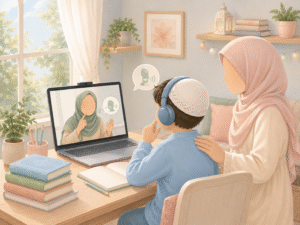
One-to-one Arabic lessons are one of the strongest ways to teach the arabic alphabet with pronunciation because pronunciation requires careful listening.
In a group class, a teacher may ask several children to repeat together. This can be useful for exposure, but it may hide individual mistakes. Your child may be saying the sound incorrectly, but the group sound covers it.
In a one-to-one lesson, the teacher can hear your child clearly. This makes correction more accurate.
| One-to-One Advantage | How It Helps Pronunciation |
|---|---|
| Direct listening | The teacher hears your child’s exact sound. |
| More repetition | The child can repeat difficult letters several times. |
| Personal correction | The teacher corrects the child’s specific mistake. |
| Less pressure | The child can practise without a group watching. |
| Flexible pace | The teacher can slow down for difficult sounds. |
| Better parent feedback | Parents know which letters need home practice. |
For children learning Arabic as a second language, this personal correction can make a big difference. A child may need several attempts before a sound becomes clear.
That is why Sibghah Academy focuses on one-to-one Arabic lessons. Children get more listening, more speaking, more correction, and more confidence.
Want one-to-one help with Arabic pronunciation?
Sibghah Academy can help your child learn Arabic sounds through live one-to-one lessons focused on letters, vowels, pronunciation, and early reading.
Simple Pronunciation Routine for Kids
A simple routine can help children practise the arabic alphabet with pronunciation without feeling overwhelmed.
Try this 10-minute routine between one-to-one Arabic lessons:
| Time | Practice | Goal |
|---|---|---|
| 2 minutes | Listen to 3 target letters. | Train the ear first. |
| 2 minutes | Repeat each letter with Fatha, Kasra, and Damma. | Connect sounds to vowels. |
| 2 minutes | Compare two similar sounds. | Reduce confusion. |
| 2 minutes | Read simple words using those letters. | Move from sound to reading. |
| 2 minutes | Praise effort and repeat the clearest sound. | Build confidence. |
This routine is short, but powerful. Children do not need long pronunciation drills. They need regular, calm, focused practice.
If your child becomes tired, stop and continue another day. Pronunciation improves with patience and repetition.
How Arabic Pronunciation Supports Reading and Quran Readiness
Learning the arabic alphabet with pronunciation is not only useful for Arabic class. It also supports reading and Quran readiness.
When children pronounce Arabic letters clearly, they are more prepared to read Arabic words. They are also more prepared for Noor Al-Bayan, Quran reading, and Tajweed later.
For example, if a child confuses ح and ه, this may affect Quran reading later. If a child says ق like ك, they may need correction before the habit becomes stronger.
This does not mean children must be perfect before starting Quran-related learning. It means that pronunciation should be built carefully and corrected gradually.
Useful guides: Learn Arabic for Kids, Arabic Reading Practice for Kids, and Noor Al-Bayan Course.
Common Mistakes Parents Should Avoid
Parents usually teach the arabic alphabet with pronunciation with good intentions, but some mistakes can make pronunciation harder.
Teaching only letter names
Letter names are useful, but children also need sounds with vowels.
Rushing through all letters
It is better to practise a few letters well than to finish all letters quickly with weak pronunciation.
Ignoring similar sounds
Children need to compare sounds such as س and ص, ت and ط, ه and ح.
Correcting harshly
Harsh correction can make children afraid to repeat. Correction should be gentle and clear.
Depending only on group repetition
Group repetition may hide individual mistakes. One-to-one correction is better for difficult sounds.
Separating pronunciation from reading
Children should use sounds in syllables and simple words, not only isolated letters.
Expecting instant results
Some Arabic sounds take time. Children need repeated listening and practice.
Avoiding these mistakes makes arabic alphabet with pronunciation practice calmer, clearer, and more effective.
How Sibghah Academy Helps Children Learn Arabic Pronunciation
Sibghah Academy offers live one-to-one Quran, Arabic, and Islamic Studies lessons for Muslim children aged 5–15.
For families who want their child to learn the arabic alphabet with pronunciation, Sibghah Academy provides one-to-one Arabic lessons that focus on the child’s real level.
In one-to-one lessons, the teacher can help your child with:
- Arabic letter recognition.
- Correct letter sounds.
- Short vowels.
- Difficult Arabic sounds.
- Similar letter pairs.
- Early Arabic reading.
- Noor Al-Bayan readiness.
- Confidence speaking and reading aloud.
Because the lesson is one-to-one, your child gets more time to repeat, more direct correction, and a pace that matches their needs. This is especially important for children who speak English most of the day and need extra support with Arabic sounds.
Sibghah Academy can also help children move from the arabic alphabet with pronunciation into the Noor Al-Bayan Course, then into wider Arabic reading and language learning through the Takallam Series.
The goal is not only to finish the alphabet. The goal is to help children hear Arabic clearly, pronounce it better, read it with confidence, and continue learning step by step.
Quick Parent Checklist
Use this checklist when teaching the arabic alphabet with pronunciation:
- Can my child recognize the Arabic letter shape?
- Can my child say the letter sound, not only the letter name?
- Can my child say the letter with Fatha, Kasra, and Damma?
- Does my child confuse similar sounds?
- Does my child struggle with throat letters?
- Does my child need one-to-one pronunciation correction?
- Can my child read simple words using the letters learned?
- Is my child practising gently without pressure?
- Do I know which letters need more review?
- Is my child ready for Noor Al-Bayan or early Arabic reading?
FAQ: Arabic Alphabet with Pronunciation
1. What is the best way to teach arabic alphabet with pronunciation?
The best way to teach arabic alphabet with pronunciation is to combine letter recognition, listening, sound repetition, short vowels, simple words, and one-to-one teacher correction.
2. Should my child learn letter names or letter sounds first?
Your child can learn both, but sounds are more important for reading. Letter names help recognition, while letter sounds help reading and pronunciation.
3. Why does my child know Arabic letters but cannot read?
Your child may know the letter names but not the sounds with vowels. Reading needs practice with Fatha, Kasra, Damma, and simple words.
4. Which Arabic letters are hard for English-speaking children?
Many children find ح، خ، ع، غ، ق، ص، ض، ط، ظ difficult because these sounds are different from common English sounds.
5. How can one-to-one lessons help Arabic pronunciation?
One-to-one lessons help because the teacher listens directly to your child, corrects specific mistakes, repeats difficult sounds, and gives more pronunciation practice.
6. How long does it take to learn arabic alphabet with pronunciation?
It depends on the child’s age, exposure, practice, and sound difficulties. Some children learn letter recognition quickly but need more time for pronunciation.
7. Should my child practise Arabic pronunciation every day?
Short regular practice is helpful. Even 5–10 minutes of calm sound practice can support progress.
8. What comes after arabic alphabet with pronunciation?
After arabic alphabet with pronunciation, children usually move to short vowels, simple words, Noor Al-Bayan, Arabic reading practice, and eventually Quran readiness or wider Arabic language learning.
9. Can Arabic pronunciation help Quran reading later?
Yes. Clear Arabic pronunciation helps children prepare for Quran reading, especially when they later learn Tajweed and recitation correction.
10. What if my child feels shy saying Arabic sounds?
Use gentle repetition, praise effort, avoid comparison, and choose one-to-one lessons so the child can practise without group pressure.
11. Is group learning enough for Arabic pronunciation?
Group learning can help with exposure, but one-to-one correction is often better for pronunciation because the teacher can hear the child clearly.
12. Does Sibghah Academy teach arabic alphabet with pronunciation?
Yes. Sibghah Academy helps children learn arabic alphabet with pronunciation through live one-to-one Arabic lessons focused on letters, sounds, vowels, and early reading.
13. Can my child start Noor Al-Bayan after learning pronunciation?
Yes, once your child has enough letter recognition and sound awareness, Noor Al-Bayan can help build vowels, reading, and Quran readiness.
14. What is the first step for parents?
The first step is to check which letters your child recognizes, which sounds are difficult, and whether they need one-to-one support for pronunciation and early reading.
Book your child’s free one-to-one Arabic trial on WhatsApp
If your child needs help with the arabic alphabet with pronunciation, Sibghah Academy can support them through live one-to-one Arabic lessons.
Send us your child’s age, Arabic level, and difficult letters, and we will recommend the right starting point.