Many Muslim parents in the UK want their children to learn Arabic, but the child may feel that Arabic is only a lesson, a worksheet, or a difficult reading task. This can make Arabic feel heavy, especially for children who speak English most of the day at school and with friends.
This is where Arabic Stories for Kids with English Translation can make a big difference. Stories feel warmer than drills. A story gives the child a reason to read, imagine, repeat words, ask questions, and connect Arabic with meaning.
For children who are still building Arabic reading, stories should be short, simple, and supported with English translation. The English translation should not replace Arabic. It should help the child understand the meaning, stay engaged, and return to the Arabic text with more confidence.
This guide explains how parents can use Arabic Stories for Kids with English Translation at home, what kind of stories to choose, how to avoid overwhelm, and how Sibghah Academy can support children with structured Arabic learning.
Quick answer: Arabic Stories for Kids with English Translation work best when the story is short, the vocabulary is simple, the translation supports meaning, and the child reads with gentle repetition.

| Parent Question | Simple Answer |
|---|---|
| Are Arabic stories useful for beginners? | Yes, if the story is short, clear, and matched to the child’s reading level. |
| Should children read Arabic or English first? | For beginners, read the Arabic slowly, then use English to understand the meaning. |
| How long should the story be? | Start with 3–6 short sentences before moving to longer stories. |
| What is the goal? | The goal is not only translation. The goal is reading confidence, vocabulary, and love for Arabic. |
Table of Contents
- Why Arabic Stories Help Children Learn
- Benefits of Arabic Stories for Kids with English Translation
- How to Choose the Right Arabic Story
- How to Read Arabic Stories with Your Child
- Simple Arabic Stories with English Translation
- What Story Level Does Your Child Need?
- Common Mistakes Parents Should Avoid
- How Sibghah Academy Supports Arabic Story Reading
- FAQ
Why Arabic Stories Help Children Learn
Children often learn better when language has meaning. A single word list can be useful, but a story gives words a setting. A child sees who is speaking, what is happening, and why the sentence matters.
Arabic Stories for Kids with English Translation help children move from reading isolated words to understanding simple Arabic sentences. This is an important step for children who already know Arabic letters but still struggle to read full sentences confidently.
Stories also make Arabic more emotional. A child may forget a random word, but they may remember a character, a moment, or a simple lesson from a story. This makes Arabic feel alive instead of dry.
For Muslim children in the UK, stories can also support identity. When children read simple stories about family, kindness, prayer, honesty, gratitude, or daily life, Arabic becomes connected to values and home culture.
Good Arabic Stories for Kids with English Translation should not be too long or too advanced. They should help the child feel, “I can read this,” not “Arabic is too hard for me.”
If your child is still learning how to read Arabic words, start with the foundation first. This guide may help: Arabic Reading Practice for Kids.
Not sure if your child is ready for Arabic stories?
Sibghah Academy can help you understand whether your child needs Arabic letters, word reading, sentence practice, or story-based Arabic learning.
Benefits of Arabic Stories for Kids with English Translation

Arabic Stories for Kids with English Translation can support Arabic learning in several ways. They help children read, understand, repeat, and remember language in a more natural way.
1. Stories make Arabic more meaningful
When a child reads a story, Arabic words are not separate pieces. They are part of a situation. This helps children understand how words work together.
2. English translation reduces frustration
Some children give up when they do not understand the meaning. English translation can support understanding without removing the Arabic learning goal.
3. Stories build vocabulary naturally
A child can learn words like house, book, mother, father, school, prayer, food, friend, and kindness through story context. This is often easier than memorizing a list.
4. Stories improve sentence reading
Arabic Stories for Kids with English Translation help children move from reading single words to reading connected Arabic sentences.
5. Stories support speaking practice
After reading, parents can ask simple questions. The child can answer with one word, then two words, then a short sentence. This makes Arabic more interactive.
6. Stories encourage repetition
Children often enjoy hearing the same story again. Repetition is useful because repeated reading strengthens recognition and confidence.
7. Stories can connect Arabic with Islamic values
Simple stories about honesty, gratitude, kindness, family, salah, and helping others can connect Arabic learning with Islamic character.
Sibghah Teacher Note: the best story is not always the most beautiful story. For beginners, the best story is the one your child can read, understand, and repeat with confidence.
How to Choose the Right Arabic Story
Not every story is suitable for every child. Some stories look nice but have difficult vocabulary, long sentences, or grammar that is too advanced.
When choosing Arabic Stories for Kids with English Translation, think first about your child’s level. A story should gently stretch your child, not overwhelm them.
Choose short stories first
For beginners, choose a story with a few short sentences. A long page of Arabic can make children feel defeated before they begin.
Look for repeated words
Repeated words help children recognize patterns. If the story repeats “ذهب”، “رأى”، “قال”، or “في البيت”, the child starts to feel familiar with common Arabic structures.
Use simple sentence structure
Children need simple sentences before complex ones. Start with basic sentence patterns, then move gradually into longer Arabic stories.
Choose familiar topics
Stories about home, family, school, food, animals, prayer, helping parents, and friends are easier for children because the topics are already familiar.
Make sure the translation is clear
The English translation should be simple and child-friendly. It should help the child understand the story without becoming the only thing they read.
Good Arabic Stories for Kids with English Translation should make Arabic feel possible. If your child needs English support first, this guide may help: Learn Arabic from English for Kids.
| Story Feature | Good for Beginners? | Why It Matters |
|---|---|---|
| Short sentences | Yes | They reduce stress and help children complete the story. |
| Repeated vocabulary | Yes | It builds recognition and confidence. |
| Very long paragraphs | No | They can overwhelm early readers. |
| Clear English translation | Yes | It helps children understand meaning. |
| Familiar daily-life topic | Yes | It makes the story easier to understand. |
How to Read Arabic Stories with Your Child

Arabic Stories for Kids with English Translation work best when parents use a clear reading method. Do not simply give the story to the child and expect them to read it alone.
Step 1: Preview the story
Look at the title, picture, or topic first. Ask your child what they think the story may be about. This creates curiosity before reading.
Step 2: Read the Arabic slowly
Let your child read one short sentence at a time. If they struggle, help with one word instead of reading everything for them.
Step 3: Use the English translation
After reading a sentence or short section in Arabic, check the meaning in English. This helps the child understand without losing the Arabic focus.
Step 4: Repeat useful words
Choose two or three words from the story and repeat them. Ask your child to find them again in the Arabic text.
Step 5: Ask simple questions
Ask questions such as: Who is in the story? Where are they? What happened first? What did the child learn?
Step 6: Read again later
Do not treat rereading as boring. Rereading helps children become fluent. A story that is hard on Monday may feel much easier by Friday.
This simple method makes Arabic Stories for Kids with English Translation more useful because the child reads, understands, repeats, and reflects.
Want your child to read Arabic stories with confidence?
If your child knows some Arabic but struggles with sentence reading, Sibghah Academy can help through structured reading and story-based Arabic practice.
Simple Arabic Stories with English Translation
Below are simple examples of Arabic Stories for Kids with English Translation. These are not meant to be advanced literature. They are beginner-friendly reading models that show how short Arabic stories can support reading and meaning.
Story 1: In the House
| Arabic | English Translation |
|---|---|
| أَنَا فِي البَيْتِ. | I am at home. |
| عِنْدِي كِتَابٌ. | I have a book. |
| أَقْرَأُ الكِتَابَ. | I read the book. |
| أُمِّي تَسْتمَعُ لِي. | My mother listens to me. |
| أَنَا سَعِيدٌ. | I am happy. |
This story is suitable for children who can read short Arabic sentences. It includes simple vocabulary about home, book, reading, mother, and feeling happy.
Story 2: The Good Friend
| Arabic | English Translation |
|---|---|
| لِي صَدِيقٌ طَيِّبٌ. | I have a kind friend. |
| هُوَ يُسَاعِدُنِي. | He helps me. |
| وَأَنَا أُسَاعِدُهُ. | And I help him. |
| نَتَكَلَّمُ بِأَدَبٍ. | We speak politely. |
| الصَّدِيقُ الطَّيِّبُ نِعْمَةٌ. | A good friend is a blessing. |
This example connects language with manners. It can help children learn words related to friendship, helping, speaking, and good character.
Story 3: Before Salah
| Arabic | English Translation |
|---|---|
| سَمِعْتُ الأَذَانَ. | I heard the adhan. |
| قُمْتُ لِلصَّلَاةِ. | I got up for prayer. |
| تَوَضَّأْتُ بِهُدُوءٍ. | I made wudu calmly. |
| صَلَّيْتُ مَعَ أَبِي. | I prayed with my father. |
| أَحْمَدُ اللهَ. | I praise Allah. |
This story connects Arabic reading with Islamic routine. It may be suitable for children who already know basic Islamic vocabulary such as salah, wudu, and Allah.
When using Arabic Stories for Kids with English Translation, do not expect your child to master every word immediately. Choose a few words, repeat the story, and let confidence grow gradually.
What Story Level Does Your Child Need?
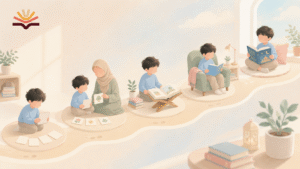
The right level depends on your child’s Arabic reading ability. Arabic Stories for Kids with English Translation should match the child’s current level, not only their age.
| Child’s Level | Best Story Type | Recommended Support |
|---|---|---|
| Does not know Arabic letters | Picture-based storytelling only | Begin with Arabic letters and sounds first. |
| Knows letters but cannot read words | Very simple word cards before stories | Focus on short vowels and blending. |
| Can read short words | One-sentence mini stories | Use repetition and English meaning support. |
| Can read short sentences | Short stories with 3–6 sentences | Read Arabic first, then English translation. |
| Can read comfortably | Longer stories with dialogue | Ask questions and practise speaking. |
If your child is still at the letter or word stage, the Noor Al-Bayan Course may be a better starting point. If your child can already read words and sentences, the Takallam Series can help build reading, vocabulary, speaking, and confidence.
This is why Arabic Stories for Kids with English Translation should not be used randomly. They work best when they are part of a structured Arabic learning path.
How to Turn One Story into a Full Arabic Lesson
Parents sometimes read one story once and move on. But one short story can become a full learning session if used wisely.
Here is a simple structure:
- Read the Arabic title or topic together.
- Read one sentence in Arabic.
- Check the English meaning.
- Repeat the Arabic sentence.
- Choose two useful words.
- Ask one simple question.
- Read the story again later in the week.
Using Arabic Stories for Kids with English Translation this way helps children practise reading, meaning, vocabulary, and confidence without needing a long lesson.
Common Mistakes Parents Should Avoid
Parents usually choose Arabic Stories for Kids with English Translation because they want to make Arabic easier. But some habits can make story reading less effective.
1. Choosing stories that are too difficult
A beautiful story is not useful if the child cannot read it. Start easier than you think. Confidence matters.
2. Letting the child read only the English
English translation is helpful, but it should support Arabic reading, not replace it. Make sure the Arabic text stays the main focus.
3. Correcting every mistake immediately
If you stop the child at every word, they may lose interest. Correct the most important mistakes first.
4. Moving to a new story too quickly
Children benefit from rereading. Repeating the same story can build fluency and confidence.
5. Using stories without speaking practice
After reading, ask simple questions. Let the child answer in one word or a short sentence.
6. Expecting instant progress
Reading Arabic takes time, especially for children who mainly speak English. Progress grows with repetition.
7. Making story time feel like a test
Stories should feel warm and encouraging. If story reading becomes a test, the child may avoid it.
Need help choosing Arabic stories for your child?
Send us your child’s age and Arabic level, and Sibghah Academy can help you choose the right next step for reading, vocabulary, and confidence.
How Sibghah Academy Supports Arabic Story Reading
Sibghah Academy offers live online Quran, Arabic, and Islamic Studies lessons for Muslim children aged 5–15.
For Arabic learning, Sibghah Academy helps children move step by step from letters and sounds to words, sentences, reading fluency, vocabulary, speaking, and understanding.
Arabic Stories for Kids with English Translation can be very helpful when children are ready for sentence reading. A teacher can choose suitable stories, explain vocabulary, support pronunciation, ask questions, and help the child practise reading without pressure.
Some children need the foundation first through Noor Al-Bayan. Other children are ready to move into the Takallam Series, where they can build more reading, vocabulary, listening, speaking, and sentence confidence.
A structured Arabic path helps families avoid random resources. Instead of giving the child a difficult story and hoping it works, the teacher can choose reading material that matches the child’s level.
For Muslim families in the UK, this can be especially useful because many children need English support while gradually building stronger Arabic confidence. Arabic Stories for Kids with English Translation can become a bridge between English understanding and Arabic reading.
Quick Parent Checklist
Use this checklist when choosing Arabic Stories for Kids with English Translation:
- Is the story short enough for my child?
- Can my child read most of the words?
- Does the story include repeated vocabulary?
- Is the English translation simple and clear?
- Can we reread the same story more than once?
- Does the story connect to daily life or Islamic manners?
- Can I ask my child simple questions after reading?
- Does my child need teacher support before story reading?
FAQ: Arabic Stories for Kids with English Translation
1. Are Arabic Stories for Kids with English Translation good for beginners?
Yes, Arabic Stories for Kids with English Translation can be good for beginners if the stories are short, simple, and matched to the child’s reading level.
2. Should children read Arabic or English first?
It is usually best to try the Arabic first, then use the English translation to understand the meaning and return to the Arabic with more confidence.
3. How long should Arabic stories be for children?
For beginners, start with very short stories of 3–6 sentences. Longer stories can come later when reading confidence improves.
4. Can Arabic stories improve vocabulary?
Yes. Stories help children meet words in context, which can make vocabulary easier to remember than isolated word lists.
5. Are Arabic Stories for Kids with English Translation useful for Muslim children in the UK?
Yes. Arabic Stories for Kids with English Translation are especially useful for Muslim children in the UK who understand English better but need to build Arabic reading gradually.
6. Can stories help my child speak Arabic?
Yes, if you ask simple questions after reading and encourage the child to answer using words or short phrases from the story.
7. Should I correct every Arabic reading mistake?
No. Correct the most important mistakes first. Too much correction can make children nervous and reduce enjoyment.
8. What if my child only wants to read the English translation?
Use English as support, but keep the Arabic as the main reading task. You can read one Arabic sentence first, then check the English meaning together.
9. How often should we read Arabic stories?
One or two short story sessions a week can be helpful, especially when combined with regular Arabic reading practice.
10. Can Arabic Stories for Kids with English Translation support Quran learning?
Yes. Arabic Stories for Kids with English Translation can build Arabic reading fluency, vocabulary awareness, and sentence confidence, which may support Quran and Islamic learning.
11. What age is best for Arabic stories?
Many children can begin with simple story listening early, but reading Arabic stories depends more on the child’s Arabic level than age.
12. Should the stories include Islamic values?
They can. Stories about kindness, honesty, gratitude, family, prayer, and helping others can connect Arabic learning with Islamic manners.
13. How can I use Arabic Stories for Kids with English Translation at home?
You can use Arabic Stories for Kids with English Translation by reading one short Arabic sentence, checking the English meaning, repeating useful words, and asking simple questions.
14. What if my child cannot read Arabic sentences yet?
Start with Arabic letters, short vowels, and word reading before full stories. Story listening can still be used, but independent reading may come later.
15. Does Sibghah Academy help children read Arabic stories?
Yes. Sibghah Academy supports children with Arabic reading, vocabulary, sentence understanding, speaking practice, and suitable story-based learning when the child is ready.
16. What is the best way to choose Arabic Stories for Kids with English Translation?
The best way to choose Arabic Stories for Kids with English Translation is to match the story to your child’s reading level, attention span, vocabulary, and confidence.
Book your child’s free Arabic trial on WhatsApp
Arabic Stories for Kids with English Translation can help your child enjoy Arabic, understand simple sentences, and build reading confidence step by step.
Send Sibghah Academy a WhatsApp message with your child’s age, Arabic level, and main goal, and we will help you choose the right Arabic learning path.