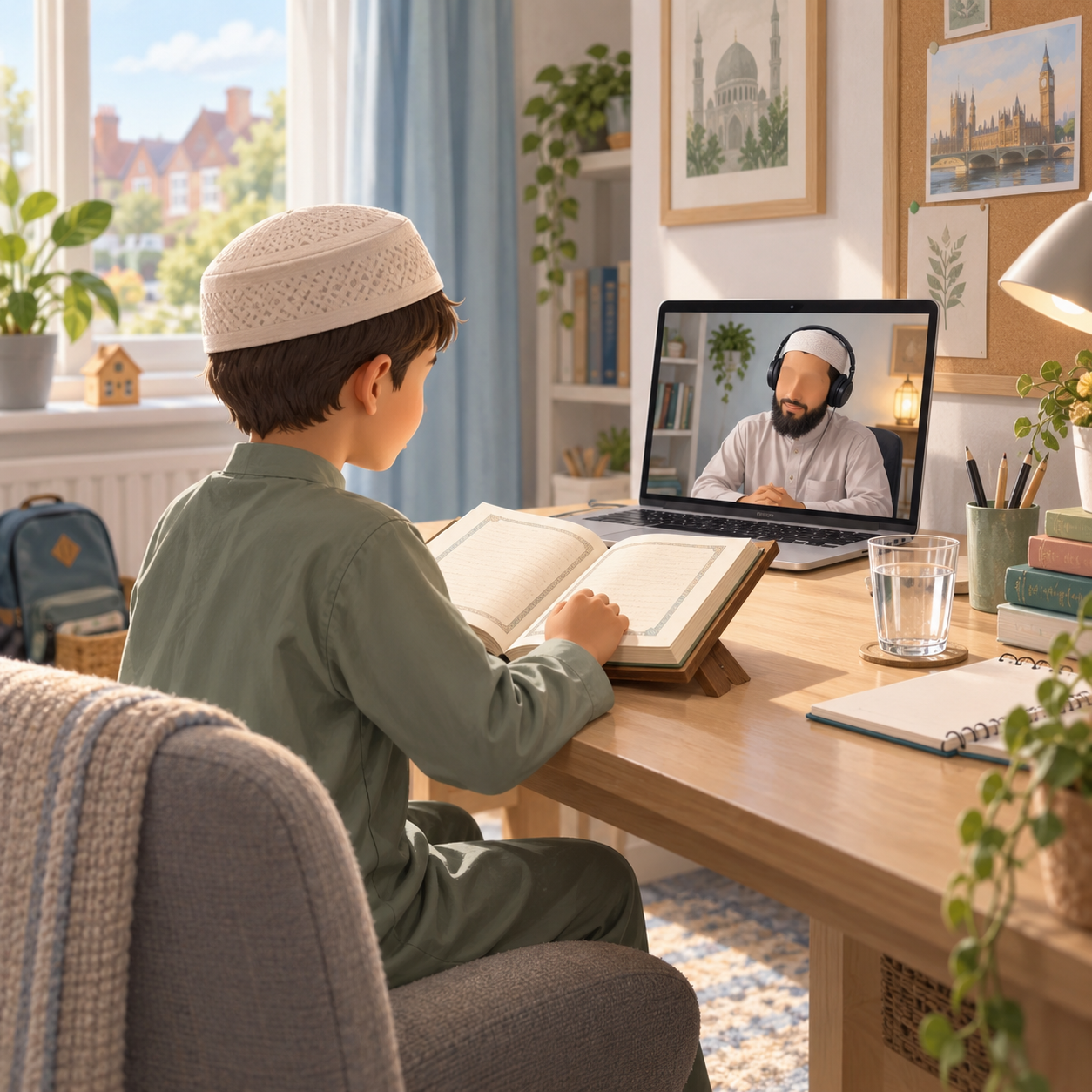
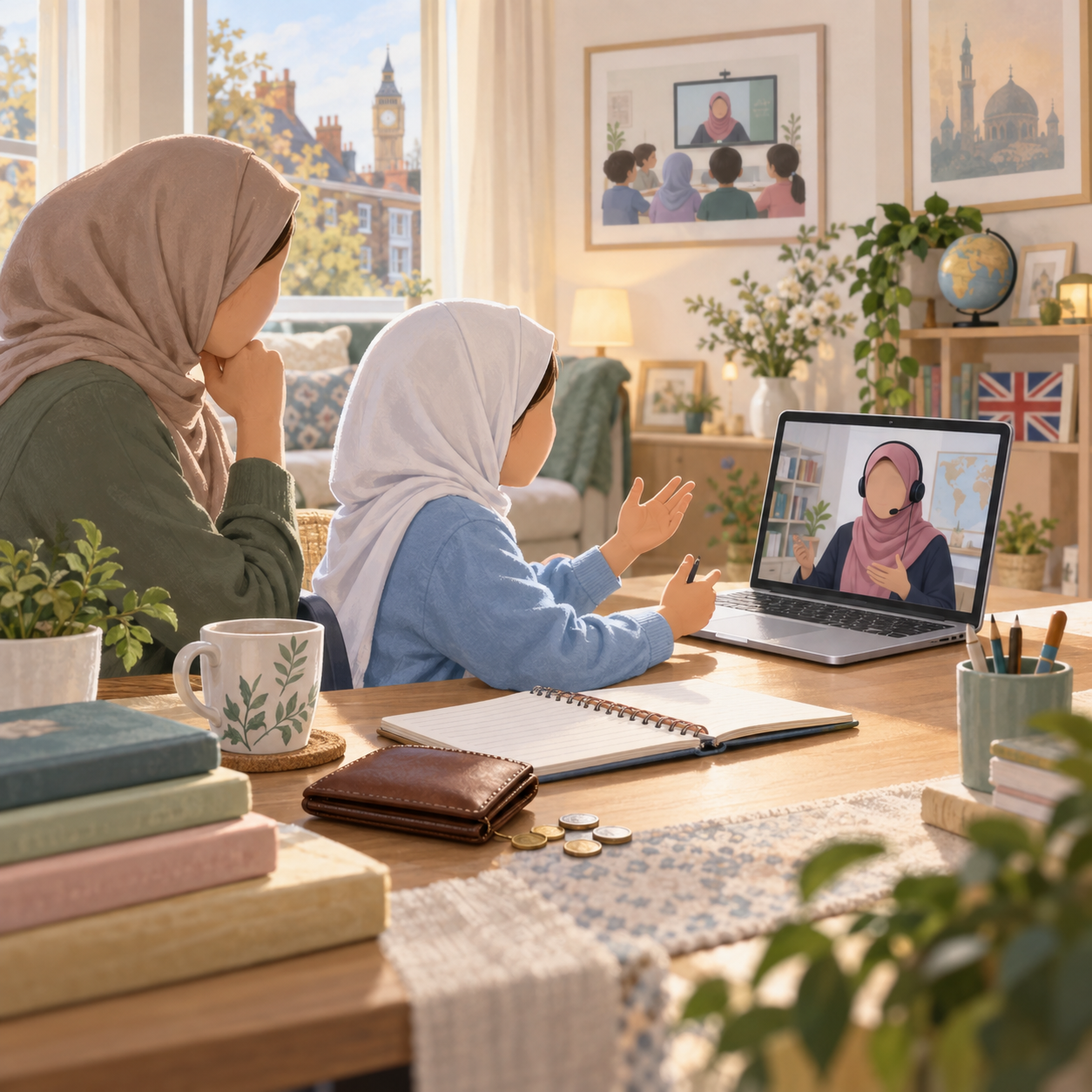

Searching for a Private Quran Teacher for Child often begins when a parent notices that their child needs something more personal than a general Quran class.
Perhaps your child reads slowly and needs more correction. Perhaps they memorise quickly but forget older surahs. They may struggle with Tajweed, feel shy when reciting in front of other children, or simply need a teacher who can move at their own pace.
In these situations, a Private Quran Teacher for Child can provide something that is difficult to achieve in a busy group lesson: sustained attention to one child’s reading, recitation, mistakes, confidence, Hifz, revision, and individual learning needs.
This does not mean every child must study privately. Some children enjoy group learning and benefit from being around other students. But when the main goal is focused Quran progress, individual correction, or personalised pacing, private one-to-one teaching can offer clear advantages.

Quick answer: A Private Quran Teacher for Child can be especially helpful when a child needs more recitation time, personal correction, a flexible pace, individual Tajweed support, a personalised Hifz and revision plan, greater confidence, or clearer parent feedback. The strongest private lessons are not simply “one teacher and one child”; they are built around the child’s actual level and next learning need.
Book a free one-to-one Quran trial session
Table of Contents
- What Is a Private Quran Teacher for Child?
- When Does a Child Need a Private Quran Teacher?
- Private Quran Teacher for Child: 8 Powerful Benefits
- Private Quran Teacher for Quran Reading
- Private Quran Teacher for Tajweed
- Private Quran Teacher for Hifz
- Private Quran Teacher vs Group Quran Classes
- What Should Parents Look for in the Teacher?
- Private Quran Lessons and Safeguarding
- Why Try the Teacher Before Enrolling?
- Private Quran Learning at Sibghah Academy
- Parent Checklist
- FAQ
What Is a Private Quran Teacher for Child?
A Private Quran Teacher for Child teaches one child individually rather than teaching several children at the same time.
The lesson may take place online or face-to-face, but the defining feature is that the teacher’s attention is focused on one student.
This allows lessons to be shaped around areas such as:
- Quran reading foundations
- Reading fluency
- Pronunciation
- Recitation
- Tajweed
- Hifz
- Revision
- Confidence
A private teacher can also change the balance between these areas as the child progresses.
For example, the first few lessons may focus heavily on reading. Later, the teacher may spend more time on practical Tajweed. A Hifz student may sometimes pause new memorisation and spend several lessons strengthening revision.
This ability to adapt is one of the main reasons parents search for a Private Quran Teacher for Child.
When Does a Child Need a Private Quran Teacher?

Not every child who studies Quran needs private tuition. However, several situations may make a Private Quran Teacher for Child particularly useful.
Your child may benefit if they:
- Regularly hesitate while reading Quran.
- Repeat the same pronunciation mistakes.
- Need more time than a group class allows.
- Feel embarrassed reciting in front of other children.
- Memorise new surahs but quickly forget older ones.
- Need focused Tajweed correction.
- Have gaps in Arabic reading foundations.
- Are progressing faster than their current group.
- Need clearer goals and progress feedback.
- Have lost confidence or motivation in Quran lessons.
Sometimes parents first notice the problem through behaviour rather than Quran performance.
A child may start avoiding practice, complain before class, become unusually quiet when asked to recite, or say that they never get enough time with the teacher.
In these situations, the issue may not be the child’s ability. The learning format may simply not be giving them the type of support they currently need.
Our One-to-One Quran Tutor UK guide explores the types of children who may benefit most from individual Quran support.
Private Quran Teacher for Child: 8 Powerful Benefits

1. More Individual Quran Recitation Time
One of the clearest benefits of a Private Quran Teacher for Child is the amount of time the teacher can spend listening to one student.
Quran reading improves through practice.
A child needs opportunities to:
- Read aloud
- Make mistakes
- Hear correction
- Repeat difficult words
- Try again
- Apply the correction in the next line
In a group class, the teacher naturally has to divide listening time between several students.
In a private lesson, most of the interactive Quran time can centre on one child.
This can be especially valuable for a child who reads slowly or needs repeated correction, because they do not have to stop simply because another student’s turn has arrived.
2. The Lesson Can Move at the Child’s Own Pace
Children of the same age can have completely different Quran levels.
One nine-year-old may still be learning how to join Arabic letters. Another may already read Quran fluently. Another may be memorising several surahs while needing stronger Tajweed.
A Private Quran Teacher for Child does not need to force these children through the same lesson at the same speed.
If your child needs another lesson on one skill, the teacher can stay there.
If your child already understands something, the teacher can move forward.
This reduces two common problems:
- Pressure: when the class moves faster than the child is ready for.
- Boredom: when the child already understands what the group is practising.
Personal pacing does not mean lowering expectations. It means building the next challenge from the child’s current ability.
3. Repeated Mistakes Can Be Identified Earlier
Many Quran difficulties are not random.
A child may repeatedly confuse the same letters, shorten the same vowel, rush at the same type of word, or make the same pronunciation mistake every time they recite.
A Private Quran Teacher for Child has more opportunity to notice these patterns.
Instead of only correcting the individual word, the teacher can recognise the underlying problem.
For example:
Problem: the child repeatedly struggles with one Arabic sound.
Private lesson response: the teacher can model the sound, let the child listen, practise it separately, return to the Quran word, and then check whether the correction is retained later in the lesson.
This type of repeated listening and correction can be difficult when teacher attention is shared among many students.
4. Tajweed Can Be Taught Through the Child’s Real Recitation
A Private Quran Teacher for Child can make Tajweed much more personal.
Instead of giving long general explanations about rules the child may not currently need, the teacher can listen to real recitation and focus on the mistakes appearing now.
The process might look like:
- The child recites.
- The teacher identifies a repeated problem.
- The teacher demonstrates the correct pronunciation.
- The child listens and repeats.
- The child returns to the verse.
- The teacher checks the sound again later.
This can help Tajweed become part of Quran reading rather than a separate collection of terminology.
For younger learners especially, practical listening and repetition can make correction easier to understand.
5. Hifz and Revision Can Follow the Individual Child
Memorisation speed varies greatly between children.
That makes Hifz one of the strongest reasons to consider a Private Quran Teacher for Child.
One child may comfortably memorise a new portion but forget previous surahs.
Another may need many repetitions before memorising a small amount but retain it very well afterwards.
A private teacher can adjust:
- The amount of new memorisation
- The amount of old revision
- The number of repetitions
- Which older portions need checking
- When to pause new Hifz
- When the child is ready to move forward
This is important because successful Hifz is not simply about continually adding new verses.
Retention matters.
A child who has weak revision may benefit more from strengthening previous Hifz than from receiving another new portion.
Also, children do not always need independent Quran reading before beginning suitable Hifz. Depending on age and level, a child may begin through listening, teacher-led recitation, and repetition while their reading develops separately.
6. A Shy Child Can Learn Without Performing in Front of a Group
Some children understand more than they show.
A child may read comfortably at home but freeze when several other children are listening.
A Private Quran Teacher for Child can create a quieter environment where mistakes happen between one teacher and one learner.
The child can:
- Take more time before answering.
- Ask for repetition.
- Try a difficult word several times.
- Make mistakes without classmates watching.
- Build confidence gradually.
For a shy child, this can make a major difference to participation.
Of course, private learning should not be used to isolate a child socially. Muslim children can still enjoy friendships and community through family, mosque activities, Islamic events, and other group experiences.
The purpose of the private Quran lesson is simply to create a focused environment for learning.
7. Parents Can Receive More Specific Feedback
Parents often ask:
“Is my child actually improving?”
Attendance alone does not answer that question.
A Private Quran Teacher for Child should be able to give feedback related to one specific student.
For example:
- Your child now recognises the letters confidently but still needs work on joining them.
- Your child reads independently but rushes and loses accuracy.
- Your child has improved one repeated pronunciation problem.
- Your child is memorising well but needs stronger revision.
- Your child is ready to add more practical Tajweed.
This gives the parent something much more useful than a general statement such as “they are doing well.”
It also helps families know what to practise between lessons without turning the parent into a second teacher.
8. The Teacher Can Build a Quran Path Around One Child
The biggest benefit of a Private Quran Teacher for Child is not simply receiving more attention.
It is the ability to make decisions around one learner.
The teacher can ask:
- What is the child’s current level?
- What is limiting their progress?
- What should we prioritise now?
- What can wait until later?
- How much practice can this child manage?
- When should we review the plan?
The answer may be different from what the parent initially expected.
A parent may request Tajweed lessons, but assessment shows that reading fluency needs strengthening first.
Another parent may request more Hifz, but the teacher discovers that old memorisation needs revision.
A strong private teacher should be willing to adapt the plan according to what the child actually needs.
Private Quran Teacher for Child Who Struggles with Quran Reading
A Private Quran Teacher for Child can be particularly helpful when the difficulty begins at the reading stage.
Quran reading problems may involve:
- Letter recognition
- Confusion between similar letters
- Short vowels
- Long vowels
- Joining letters
- Moving from isolated words to continuous reading
- Slow fluency
- Guessing rather than decoding
If these foundations are weak, repeatedly asking a child to read longer Quran passages may not solve the problem.
The teacher may need to identify the exact missing skill and rebuild it gradually.
Private teaching can make this easier because the child can practise the same skill without worrying about keeping pace with a class.
Private Quran Teacher for Child Who Needs Tajweed Support
For Tajweed, a Private Quran Teacher for Child has the advantage of sustained listening.
The teacher can focus on the sounds and recitation habits of one student rather than offering only general Tajweed reminders to a class.
This is particularly useful when mistakes are subtle or repeated.
Parents should still look for age-appropriate teaching.
A young child does not necessarily need a long theoretical explanation every time a Tajweed rule appears. The teacher can often:
- Model the correct sound.
- Ask the child to listen.
- Let them repeat.
- Apply it immediately to Quran recitation.
- Name the rule gradually when appropriate.
The goal is correct recitation and understanding, not simply memorising terminology.
Private Quran Teacher for Child Learning Hifz
Hifz is highly individual, which makes a Private Quran Teacher for Child particularly useful for memorisation.
A good Hifz plan should balance three things:
- New memorisation
- Recent revision
- Older revision
If one part is ignored, memorisation can become unstable.
The teacher can also listen for errors before they become deeply memorised.
For younger beginners, Hifz may use:
- Listening
- Teacher modelling
- Short repeated portions
- Frequent revision
- Simple understanding of meaning where appropriate
The amount should fit the child’s age, ability, and retention rather than being based only on how quickly another student memorises.
Private Quran Teacher for Child vs Group Quran Classes
Parents considering a Private Quran Teacher for Child often compare it with a local madrasa or group Quran class.
| Area | Private One-to-One Quran Teacher | Group Quran Class |
|---|---|---|
| Teacher attention | Focused on one child | Shared between students |
| Recitation time | Usually more individual practice | Children take turns |
| Learning pace | Based on the child | Influenced by group pace |
| Correction | Immediate and personal | Depends on available teacher time |
| Hifz plan | Can be individually adjusted | May follow a wider class routine |
| Parent feedback | Can be highly specific | May be more general |
| Peer interaction | Limited during the lesson | Higher |
| Community environment | Not the primary benefit | Can be a major advantage |
A group class can be excellent for children who enjoy learning alongside peers and still receive sufficient teacher attention.
Private teaching becomes especially attractive when the child needs individual correction, personal pacing, Hifz revision, Tajweed practice, or confidence support.
What Does Islam Say About Teaching the Quran?
Teaching and learning the Quran hold an honoured place in Islam.
Arabic: خَيْرُكُمْ مَنْ تَعَلَّمَ الْقُرْآنَ وَعَلَّمَهُ
English: “The best among you are those who learn the Qur’an and teach it.”
Source: Sahih al-Bukhari 5027.
For parents, this also highlights the responsibility involved in choosing someone to teach their child.
Knowledge matters, but so do patience, trust, care, and the way the teacher helps the child develop a positive relationship with Quran learning.
What Should Parents Look for in a Private Quran Teacher for Child?
Choosing a Private Quran Teacher for Child should involve more than finding someone who recites Quran well.
A teacher working with children should ideally combine Quran knowledge with child-friendly teaching ability.
Look for whether the teacher:
- Assesses the child’s level before setting a plan.
- Has experience teaching children.
- Corrects clearly without humiliating the child.
- Can teach Quran reading foundations where needed.
- Understands practical Tajweed.
- Has a structured approach to Hifz and revision.
- Allows the child enough recitation time.
- Explains progress to parents.
- Can adapt when a method is not working.
- Maintains clear professional boundaries.
Our Quran Teacher UK guide covers the broader qualities parents should look for in a Quran teacher.
For a more detailed selection checklist, read How to Find a Qualified Private Quran Teacher for Your Child in the UK.
Private Quran Teacher for Child: Safeguarding Matters
Safeguarding should be part of the decision whenever a parent chooses a Private Quran Teacher for Child.
For families in England, Department for Education guidance for parents covers private tuition, supplementary religious education, community activities, and other out-of-school settings.
The guidance encourages parents to ask questions about safeguarding arrangements, staff suitability, policies, communication, and how concerns are handled. It also notes that parents may wish to supervise a one-to-one session with a private tutor.
Read the Department for Education safeguarding guidance for parents.
For an online private Quran lesson, sensible questions include:
- How are teachers recruited?
- What suitability and safeguarding checks are used?
- How does the academy communicate with parents?
- Can parents remain nearby during lessons?
- What communication is allowed between the teacher and child?
- Who should the parent contact if they have a concern?
- What safeguarding policy does the provider follow?
Parents should feel comfortable asking these questions.
A professional provider should be able to explain how child safety and parent communication are managed.
Why Try a Private Quran Teacher Before Regular Lessons?
A trial lesson is one of the most useful ways to decide whether a Private Quran Teacher for Child is genuinely suitable.
A written profile can tell you about qualifications and experience.
A trial shows you something different: how the teacher actually interacts with your child.
During the trial, watch for:
- How the teacher welcomes your child
- Whether they check the child’s current level
- How much time the child gets to read or recite
- How mistakes are corrected
- Whether the teacher adjusts difficulty
- How your child reacts to correction
- Whether the parent receives meaningful feedback
The child does not need to perform perfectly.
In fact, mistakes during the trial are useful because they allow you to see how the teacher responds.
Read our Quran Trial Lesson UK guide for a detailed explanation of what parents should expect from the first session.
Questions to Ask Before Hiring a Private Quran Teacher for Child
Before committing to a Private Quran Teacher for Child, ask practical questions rather than relying only on general descriptions.
- How will you assess my child’s current level?
- What do you think my child should focus on first?
- How much of the lesson will my child spend reading or reciting?
- How do you correct pronunciation mistakes?
- How do you teach Tajweed to children?
- How do you balance new Hifz and revision?
- How will I know whether my child is progressing?
- What should we practise between lessons?
- How do you support shy or struggling children?
- What safeguarding and communication procedures are used?
A strong teacher does not need to give a complicated answer to every question.
But they should be able to explain their approach clearly.
Red Flags When Choosing a Private Quran Teacher for Child
Parents looking for a Private Quran Teacher for Child should also know what may require further questions.
Be cautious if:
- The teacher starts a fixed programme without checking the child’s level.
- The child is regularly embarrassed for making mistakes.
- The teacher promises unusually fast results.
- There is no clear structure from lesson to lesson.
- Hifz continues increasing even when old revision is weak.
- The parent receives no useful feedback.
- The teacher does most of the talking and the child gets little recitation time.
- The teacher cannot explain why a particular learning path was chosen.
- Communication boundaries with the child are unclear.
One concern does not always mean the teacher is unsuitable, but parents should ask questions rather than ignore something that does not feel clear.
Private Quran Teacher for Child at Sibghah Academy
At Sibghah Academy, families looking for a Private Quran Teacher for Child can access live one-to-one online Quran lessons for Muslim children aged 5–15.
The one-to-one model means the teacher can focus on one child’s:
- Current level
- Reading ability
- Recitation
- Pronunciation
- Tajweed needs
- Hifz
- Revision
- Confidence
A child can begin at the level that suits them rather than being expected to match a large group.
If reading foundations need strengthening, the teacher can work there.
If the child already reads, more attention can move towards recitation and practical Tajweed.
If the goal is Hifz, the teacher can balance listening, repetition, new memorisation, and revision according to the child’s progress.
For families searching for a Private Quran Teacher for Child, the aim is therefore not simply to provide a private lesson. It is to use the one-to-one format to make Quran teaching more focused and responsive to the individual child.
Sibghah also offers a free trial session so the parent can observe the lesson style and the teacher can begin understanding the child’s level before regular enrolment.
Ask about a private one-to-one Quran teacher for your child
Sibghah Teacher Note
Private teaching is most useful when the extra attention is used purposefully. The goal is not simply to spend the whole lesson with one child. The teacher should use that time to listen carefully, identify patterns, choose the next useful skill, give the child enough practice, and check whether corrections are being retained.
Parent Checklist: Private Quran Teacher for Child
Use this checklist before choosing a Private Quran Teacher for Child:
- The teacher checks my child’s current level.
- The lesson has a clear purpose.
- My child gets enough Quran reading or recitation time.
- The teacher notices repeated mistakes.
- Correction is clear and respectful.
- The pace can change according to my child.
- Tajweed is taught at an age-appropriate level.
- Hifz includes revision, not only new memorisation.
- The teacher understands children’s learning needs.
- My child feels able to make mistakes and try again.
- I receive useful feedback.
- I understand the current learning goal.
- Safeguarding and communication procedures are clear.
- The timetable is realistic for our family.
- We have had an opportunity to try the teacher before committing.
FAQ About Private Quran Teacher for Child
What is a Private Quran Teacher for Child?
A Private Quran Teacher for Child teaches one child individually, allowing lessons to focus on that child’s Quran reading, recitation, Tajweed, Hifz, revision, confidence, and learning pace.
Is a private Quran teacher better than a group class?
A private teacher can be especially useful for children who need individual correction, more recitation time, personal pacing, Tajweed support, Hifz revision, or confidence-building. Some children still benefit strongly from group classes, particularly when peer interaction is an important goal.
When should I consider a Private Quran Teacher for Child?
You may consider a Private Quran Teacher for Child if your child is struggling to read, repeatedly making the same mistakes, feeling shy in groups, forgetting memorised Quran, needing more Tajweed correction, or not receiving enough individual teacher attention.
Can a private Quran teacher help a complete beginner?
Yes. A child can begin from foundational skills such as Arabic letters, sounds, vowels, joining, listening, and early Quran reading. The teacher should first assess the child’s level.
Can my child begin Hifz before reading Quran fluently?
Depending on age and ability, some children can begin suitable memorisation through listening, repetition, and teacher-led recitation while developing Quran reading separately.
Can a Private Quran Teacher for Child teach Tajweed?
Yes, provided the teacher has the required Quran and Tajweed knowledge. One-to-one teaching can be particularly useful because the teacher can listen continuously and correct the child’s actual recitation.
How often should my child have private Quran lessons?
The right frequency depends on age, current level, goal, attention span, home practice, and family schedule. Consistency is usually more useful than choosing an intensive schedule that the child cannot sustain.
What should happen in the first private Quran lesson?
The teacher should usually spend time understanding the child, checking their level, listening to relevant Quran skills, giving some real teaching or correction, and explaining the recommended next step.
Should parents supervise private online Quran lessons?
Parents should understand how the provider manages one-to-one online learning and safeguarding. For families in England, Department for Education guidance notes that parents may wish to supervise one-to-one sessions with private tutors. Younger children may also need a parent nearby for reassurance or technical support.
How do I know if a private Quran teacher is qualified?
Look beyond recitation ability alone. Consider Quran knowledge, Tajweed, experience teaching children, correction style, level assessment, lesson structure, Hifz and revision methods, safeguarding, and parent communication.
Should I book a trial before choosing a Private Quran Teacher for Child?
Yes. A trial is one of the best ways to see whether a Private Quran Teacher for Child communicates well with your child, listens carefully, corrects appropriately, and understands the child’s current level.
Does Sibghah Academy provide a Private Quran Teacher for Child?
Yes. Sibghah Academy provides live online one-to-one Quran lessons for Muslim children aged 5–15. Lessons can focus on Quran reading, recitation, Tajweed, Hifz, revision, or confidence according to the child’s level and learning needs.
Final Thoughts: Is a Private Quran Teacher for Child Worth Considering?
A Private Quran Teacher for Child can be a valuable choice when your child needs learning that is built around them rather than around a whole class.
The main advantage is not privacy by itself.
It is focus.
More time to recite. More opportunity to correct. More flexibility to repeat. More freedom to slow down or move forward. A Hifz plan that responds to retention. Tajweed practice based on the child’s real recitation. Feedback that tells parents what is actually happening.
For a struggling or shy child, a Private Quran Teacher for Child can also create space to rebuild confidence without the pressure of keeping up with other students.
At the same time, parents should choose carefully. Quran knowledge, child-friendly teaching, safeguarding, structure, communication, and teacher-child fit all matter.
The best way to know whether private Quran teaching suits your child is not simply to read a teacher profile. Let your child experience the lesson.
Observe whether the teacher listens. Notice how correction happens. Ask what the teacher identified. Make sure you understand the recommended next step.
At Sibghah Academy, Muslim children aged 5–15 can learn Quran through live one-to-one online lessons designed around their level, pace, and current goal.
If you are currently searching for a Private Quran Teacher for Child, a free trial can help you see whether this personalised approach is the right fit before beginning regular lessons.
Message Sibghah Academy to book a free one-to-one Quran trial