Online Quran vs Local Madrasa UK is an important comparison for Muslim parents deciding how their child should learn Quran. Both options can provide valuable Islamic learning, but the experience can be very different depending on whether the child learns individually online or attends a local group madrasa.
For many UK families, the biggest difference is personal attention. A child learning Quran one-to-one online can spend much more of the lesson reading, reciting, receiving correction, revising Hifz, and working at their own pace. In a local madrasa using a group model, the teacher’s attention and listening time usually need to be shared among several children.
This does not mean that every local madrasa is the same or that every online class is automatically good. Some madrasas provide excellent teaching, and some children enjoy learning with other Muslim children. But when comparing Online Quran vs Local Madrasa UK specifically for Quran progress, personalised one-to-one online learning can offer major practical advantages.
Parents can choose teachers beyond their immediate neighbourhood, avoid travel, fit Quran around school and family routines, receive more individual feedback, and build a Quran plan around their child’s actual reading, Tajweed, Hifz, revision, and confidence needs.
Quick answer: In the Online Quran vs Local Madrasa UK comparison, online one-to-one Quran lessons can be the stronger choice for many families when the priority is individual teacher attention, more recitation time, flexible scheduling, personal correction, customised Hifz and Tajweed support, and easier parent follow-up. A local madrasa can still offer valuable community and peer interaction, but group learning may provide less individual Quran practice per child.
Book a free one-to-one Quran trial session
Table of Contents
- What Are We Comparing?
- Online Quran vs Local Madrasa UK: Quick Comparison
- Online Quran vs Local Madrasa UK: 9 Key Differences
- Which Option Is Better for Quran Reading?
- Which Option Is Better for Tajweed?
- Which Option Is Better for Hifz?
- What About a Shy or Struggling Child?
- Where Does the Local Madrasa Have an Advantage?
- Can a Family Use Both?
- Safeguarding and Online Safety
- How Sibghah Approaches Online Quran Learning
- Parent Decision Checklist
- FAQ
What Are We Comparing in Online Quran vs Local Madrasa UK?
Before comparing Online Quran vs Local Madrasa UK, it is important to define the two models clearly.
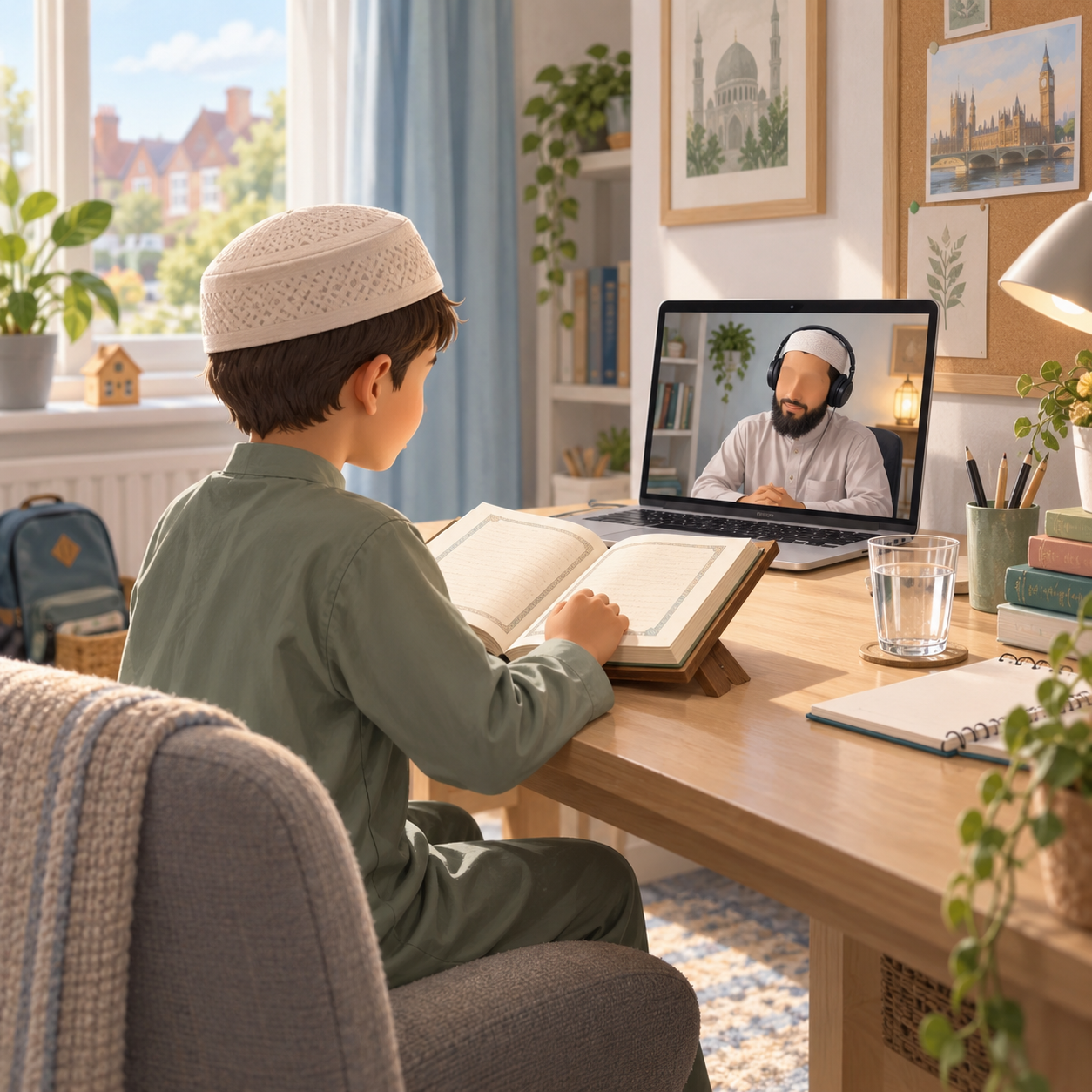
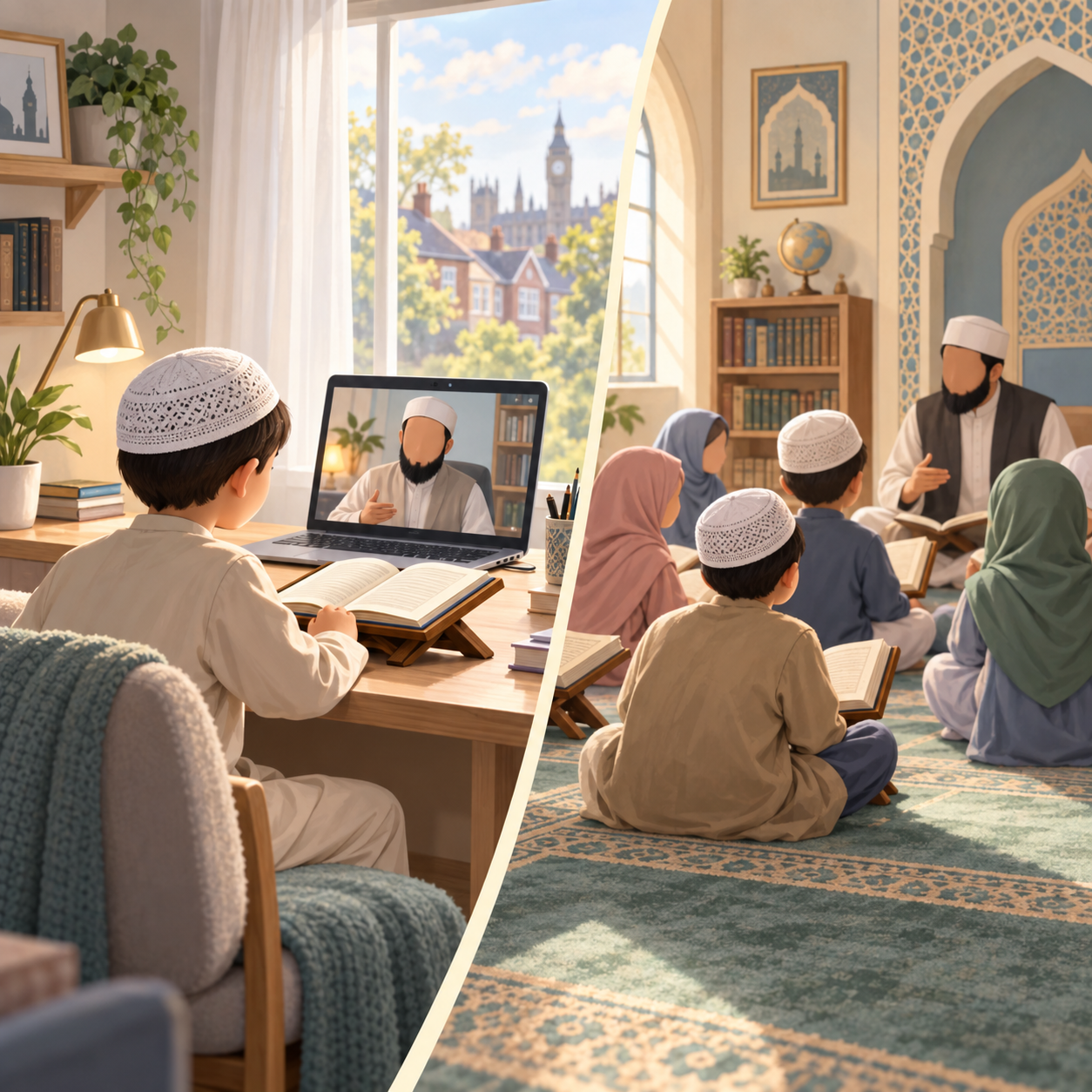
In this guide, online Quran learning mainly means live one-to-one Quran lessons where one teacher works directly with one child through an online classroom or video platform.
Local madrasa refers mainly to the common supplementary-school model where children attend a mosque, Islamic centre, or community setting and learn in a group.
Not every madrasa works this way. Some offer very small classes or individual tuition. Likewise, not every online Quran programme is one-to-one.
So the fairest comparison is:
Live one-to-one online Quran learning vs a typical group-based local madrasa experience.
This distinction matters because many of the strongest advantages of online learning come from the one-to-one format, not simply from using a computer.
Online Quran vs Local Madrasa UK: Quick Comparison
| Area | Online One-to-One Quran | Typical Group Local Madrasa |
|---|---|---|
| Teacher attention | Focused on one child | Shared between students |
| Recitation time | Usually much higher | Shared across the class |
| Learning pace | Built around the child | Often influenced by group pace |
| Schedule flexibility | Usually higher | Fixed timetable |
| Travel | No regular travel | Travel required |
| Teacher choice | Not limited by local area | Usually depends on local availability |
| Tajweed correction | Highly individual | Depends on available individual time |
| Hifz plan | Can match the individual child | May follow a more standard group routine |
| Parent feedback | Easier to personalise | Can vary by setting and class size |
| Peer interaction | Limited | Usually stronger |
| Community environment | Mostly family and teacher focused | Can be a strong benefit |
Looking at Online Quran vs Local Madrasa UK this way shows why online one-to-one learning can be particularly attractive when a family’s main goal is Quran progress rather than social interaction.
Online Quran vs Local Madrasa UK: 9 Key Differences
1. One Child Gets the Teacher’s Full Attention Online
The clearest difference in Online Quran vs Local Madrasa UK is teacher attention.
In a one-to-one online Quran lesson, the teacher is listening to one child.
If the child makes a pronunciation mistake, the teacher can stop immediately. If a word needs five repetitions, they can repeat it five times. If the child reads confidently, they can move forward without waiting for anyone else.
In a group madrasa, the teacher may be responsible for several children. Even with an excellent teacher, time must be divided.
Imagine a 60-minute lesson with ten children. The teacher cannot realistically spend the full hour listening individually to every child.
By contrast, one-to-one online teaching allows much more of the lesson to revolve around your child’s recitation.
This is why, for parents primarily concerned with individual Quran progress, online learning can have a major advantage.
You can explore this further in our One-to-One Quran Tutor UK guide.
2. Online Lessons Can Give the Child More Actual Quran Recitation Time

A Quran lesson only helps so much if the child spends most of it waiting.
Reading and recitation improve through practice.
When comparing Online Quran vs Local Madrasa UK, parents should ask a simple question:
How many minutes does my child actually spend reading Quran aloud to the teacher?
In a one-to-one lesson, the answer can be a substantial part of the session.
The child can:
- Read aloud
- Repeat difficult words
- Listen to the teacher
- Try again after correction
- Revise older material
- Practise Tajweed
- Recite Hifz
In a group setting, some of the lesson may naturally involve waiting while other children read.
That peer environment has its own benefits, but from a pure practice-efficiency perspective, one-to-one online Quran learning can make stronger use of the child’s available lesson time.
3. The Online Quran Plan Can Follow Your Child’s Pace
Children do not learn Quran at the same speed.
This makes personalised pacing one of the strongest points in the Online Quran vs Local Madrasa UK comparison.
One child may:
- Recognise Arabic letters but struggle to join them.
- Read fluently but need Tajweed correction.
- Memorise quickly but forget without revision.
- Need several repetitions before a sound becomes secure.
- Feel nervous reading in front of others.
A one-to-one teacher can build the lesson around that exact situation.
If the child needs another week on one skill, they can take another week.
If they are ready to move forward, there is no need to wait for a whole class.
A group madrasa may still differentiate learning, but the teacher also has to manage the wider group.
For children with uneven skills, Online Quran vs Local Madrasa UK often favours one-to-one online teaching because personalisation is built into the format.
4. Online Quran Lessons Are Easier to Fit Around UK Family Life

School, homework, clubs, family visits, work schedules, and travel can make weekday routines difficult.
Flexibility is therefore another major difference in Online Quran vs Local Madrasa UK.
A local madrasa usually has a timetable that families need to follow.
That may work perfectly for some households.
But an online programme can often offer more choice around:
- Lesson days
- Lesson times
- School schedules
- Weekend activities
- Different family routines
There is also no regular journey to and from the learning location.
For a 30-minute Quran lesson, a family may otherwise spend additional time preparing, driving, parking, waiting, and travelling home.
Online learning allows the child to use more of that time for the lesson itself or for family life.
For busy Muslim families, this practical difference can make Quran learning easier to maintain consistently.
5. Online Learning Gives Families a Wider Choice of Quran Teachers
A local madrasa can only work with teachers who are available within that setting and area.
Online learning removes much of that geographical limitation.
This makes teacher choice an important part of Online Quran vs Local Madrasa UK.
Families can look for a teacher who fits their child’s needs rather than choosing mainly according to distance.
For example, a child may need a teacher who is particularly patient with beginners, experienced in Hifz revision, comfortable teaching younger children, or strong at correcting Tajweed gently.
The ability to match teacher and child more carefully can be especially useful when the child has already had a difficult learning experience.
Teacher quality still needs to be evaluated carefully, of course. Online access gives families more options; it does not automatically make every available teacher suitable.
6. Individual Tajweed Correction Can Be Stronger Online One-to-One

Tajweed requires listening.
The teacher needs to hear exactly how the child produces sounds and applies rules during recitation.
In the Online Quran vs Local Madrasa UK comparison, one-to-one teaching can give Tajweed an important advantage because the teacher can listen continuously.
If the child repeatedly struggles with one sound, the teacher can:
- Model it slowly.
- Ask the child to listen.
- Let the child repeat.
- Correct again.
- Use the sound in another Quran word.
- Return to it later in the lesson.
There is no pressure to move to another student’s turn.
For children, Tajweed should usually be connected to real recitation rather than becoming a long theoretical lesson.
Parents can read our Tajweed Classes for Kids guide for more detail.
7. Hifz Can Be More Personalised Online
Children memorise at very different speeds.
Some need a small portion repeated many times. Others remember quickly but lose old memorisation because revision is weak.
This makes Hifz another area where the Online Quran vs Local Madrasa UK comparison can favour one-to-one learning.
The teacher can decide according to one child’s performance:
- How much new Quran to memorise
- How much older Hifz to revise
- Which repeated mistakes need correction
- When to stop adding new material
- When more listening is needed
- When the child is ready to progress
The child does not need to memorise the same amount as everyone else.
Importantly, Hifz can also begin through listening, repetition, and teacher-led recitation for children who are not yet independent Quran readers.
One-to-one online Hifz makes it easier to build this process around the child rather than around a fixed group target.
Our Hifz Classes for Kids guide explains how memorisation, revision, and simple understanding can work together.
8. Parents Can Follow Progress More Closely Online
Many parents do not want to interrupt lessons, but they do want to know whether their child is progressing.
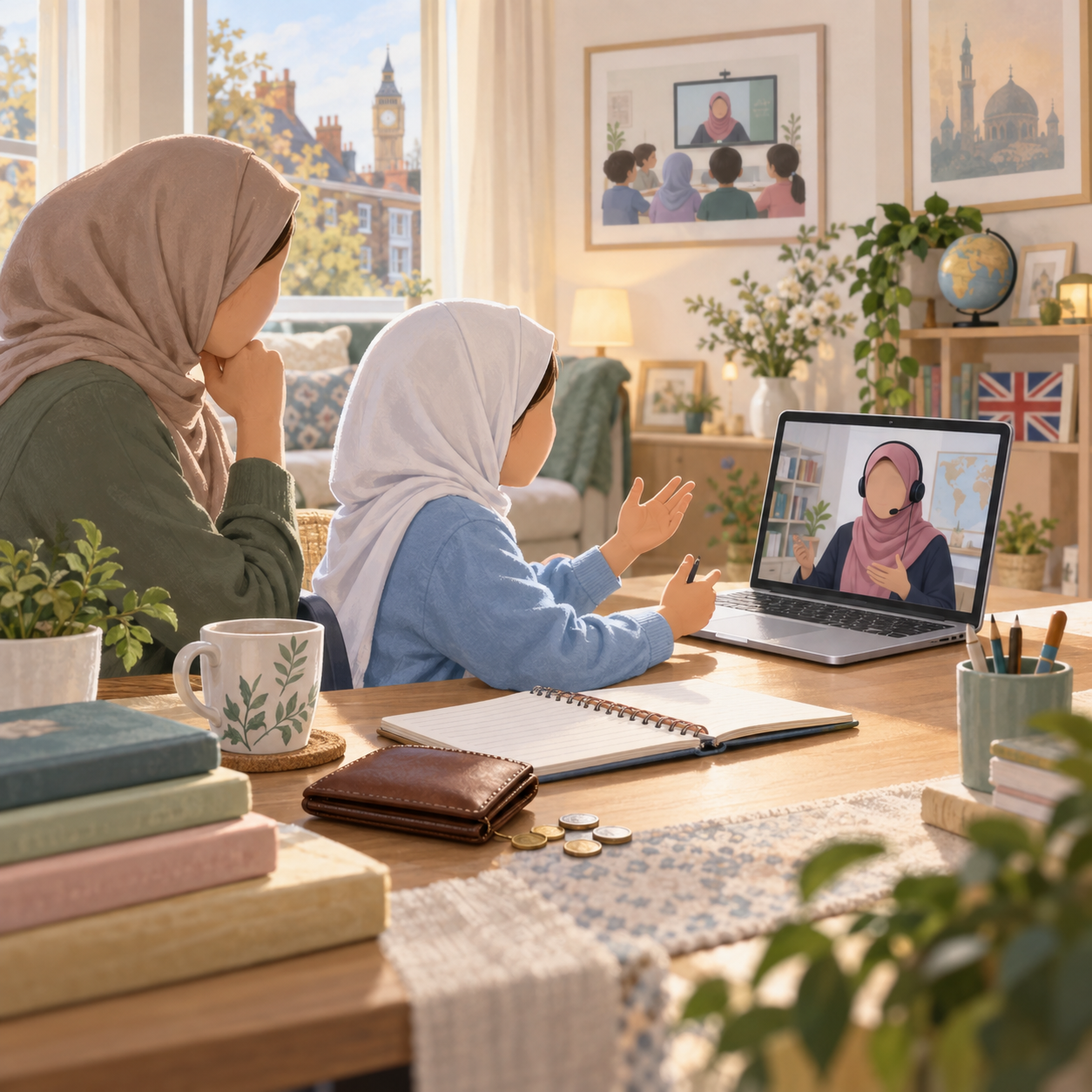
One-to-one online learning can make parent feedback easier to personalise.
In the Online Quran vs Local Madrasa UK decision, ask how easy it will be to understand:
- What your child is learning now
- Which mistakes keep repeating
- Whether reading is improving
- Whether Tajweed needs more work
- How Hifz revision is going
- What should be practised at home
- What the next learning target is
A teacher working with one child can usually give feedback that is specifically about that child.
This can help parents support Quran learning without having to become the teacher themselves.
9. Online Quran Learning Removes Regular Travel
Travel may sound like a small factor, but over a year it can become significant.
For families comparing Online Quran vs Local Madrasa UK, consider the whole routine rather than only the lesson duration.
A local lesson might involve:
- Getting children ready
- Travelling to the madrasa
- Finding parking or using public transport
- Waiting during lessons
- Travelling home
Weather, winter evenings, younger siblings, and parents’ work schedules can make the routine harder.
Online Quran learning removes most of this regular travel.
The child can finish school, rest, have their Quran lesson at home, and continue the family evening without another journey.
For many households, this convenience is not merely about comfort. It can make consistent Quran learning much easier to sustain.
Online Quran vs Local Madrasa UK for Quran Reading
For a child struggling with Quran reading, Online Quran vs Local Madrasa UK often comes down to how much direct reading time and correction the child receives.
A child may need help with:
- Arabic letters
- Sounds
- Short vowels
- Long vowels
- Joining letters
- Reading Quran words
- Fluency
- Pronunciation
One-to-one online teaching allows the teacher to hear every attempt.
If the child hesitates on almost every word, the teacher can slow down.
If the child already reads confidently, the lesson can move forward instead of repeating work they have mastered.
For children who need targeted reading support, this personal correction can make online one-to-one learning especially effective.
See our Quran Reading Classes for Kids guide for more guidance.
Online Quran vs Local Madrasa UK for Tajweed
Tajweed improvement depends heavily on individual listening and correction.
That gives one-to-one teaching an obvious practical strength in the Online Quran vs Local Madrasa UK comparison.
The teacher can hear:
- How the child pronounces letters
- Which sounds are repeatedly confused
- Whether the child rushes
- Whether previously corrected mistakes return
- Which Tajweed principles the child can apply naturally
The teacher can then spend the lesson correcting what this child needs rather than giving the same Tajweed explanation to an entire group.
This makes online one-to-one Quran learning particularly attractive when the parent wants close recitation correction.
Online Quran vs Local Madrasa UK for Hifz
Hifz is another area where personal pacing matters.
When comparing Online Quran vs Local Madrasa UK, parents should not ask only which option helps children memorise more quickly.
Ask:
- Does the child retain old memorisation?
- Can the teacher listen carefully to revision?
- Is the new portion adjusted when necessary?
- Are pronunciation mistakes corrected before they become memorised?
- Can the child repeat directly with the teacher?
A personalised online Hifz lesson can change the plan immediately.
If revision is weak, the teacher can reduce new memorisation.
If the child needs more listening, the lesson can include more teacher-led repetition.
If the child is ready for more, they can progress without waiting for a group schedule.
What If My Child Is Shy, Slow, or Struggling?
This is one of the situations where the Online Quran vs Local Madrasa UK decision can become much clearer.
Some children dislike reading Quran aloud in front of other children.
They may know the answer but become nervous when everyone is listening.
Others need more time to process corrections or repeat difficult words.
In a one-to-one lesson:
- There are no classmates waiting for the child to finish.
- The child can take a little longer to respond.
- The teacher can repeat without embarrassment.
- Mistakes stay inside a private learning interaction.
- The teacher can rebuild confidence gradually.
This does not mean every shy child must learn online.
But for a child whose anxiety or pace is limiting participation in a group, online one-to-one learning can provide a calmer environment.
Where Can a Local Madrasa Be Stronger?

A fair Online Quran vs Local Madrasa UK comparison should also recognise the strongest advantage of a local madrasa: community and peer interaction.
Children may:
- Meet other Muslim children
- Learn in a shared Islamic environment
- Build friendships
- Join mosque or community activities
- Feel part of a wider Muslim community
For some families, these benefits are very important.
However, parents should separate two different questions:
Where can my child build Muslim community?
and
Which format gives my child the strongest personalised Quran teaching?
Those do not have to have the same answer.
A child can receive one-to-one Quran teaching online while still attending the mosque, Muslim youth activities, family gatherings, Islamic events, or community programmes for social connection.
This is why the social advantage of madrasa does not necessarily remove the academic and practical advantages of online Quran learning.
Can Families Use Online Quran Lessons and a Local Madrasa Together?
Yes. The Online Quran vs Local Madrasa UK decision does not always need to be an absolute either-or choice.
Some families may use different environments for different purposes.
For example:
- One-to-one online lessons for Quran reading, Tajweed, and Hifz
- Mosque activities for friendships and community
- Weekend Islamic events for social learning
- Family Quran practice for reinforcement
This can give a child the personal Quran attention of online learning while maintaining strong Muslim community connections.
The key is to avoid creating an overloaded schedule.
If the child is attending several programmes that all repeat the same Quran material differently, they may become tired or confused.
Parents should decide what each activity is meant to achieve.
Which Option Is More Efficient for Busy Families?
For many families, efficiency is one of the strongest reasons the Online Quran vs Local Madrasa UK comparison leans towards online learning.
Consider two children who both receive a Quran lesson.
The first child travels to a group class, waits while others recite, receives a few minutes of direct correction, then travels home.
The second child opens the lesson from home and spends most of the session directly interacting with the teacher.
The exact experience will vary between providers, but the one-to-one online model has the potential to concentrate more of the family’s time on actual learning.
For parents balancing several children, this can be especially useful because they do not need to transport everyone to different locations.
Which Option Gives Parents More Control Over Teacher Choice?
Teacher fit matters enormously.
One child may respond well to a lively teacher. Another needs someone calm and patient. Another needs a teacher experienced with early reading. Another needs strong Hifz revision support.
In Online Quran vs Local Madrasa UK, online learning generally gives families a wider geographic pool of teachers.
You are not limited to the person who happens to teach within driving distance.
That can make it easier to look for the right match between:
- Teacher style
- Child’s age
- Quran level
- Learning goal
- Schedule
- Personality
A free trial is particularly valuable because parents can see the teacher-child interaction before committing.
Safeguarding in Online Quran vs Local Madrasa UK
Safeguarding matters in both sides of the Online Quran vs Local Madrasa UK comparison.
Parents should not assume that a physical setting is automatically safe or that online learning is automatically unsafe. The important question is what safeguarding procedures the provider follows.
For families in England, Department for Education guidance for parents covers out-of-school activities including supplementary religious schools and private tuition. It advises parents to consider safeguarding, staff suitability, health and safety, and how concerns are handled.
Read the Department for Education guidance for parents using out-of-school settings.
For an online Quran programme, parents should understand:
- Which platform is used
- How teachers communicate with families
- How concerns can be reported
- What teacher suitability checks are used
- Who is responsible for safeguarding
- How parents remain involved in the learning process
Parents can also review the NSPCC online safety guidance for wider advice about keeping children safe when using digital services.
For families elsewhere in the UK, safeguarding frameworks and official guidance can differ, so parents should also consult the relevant guidance for their nation.
How Sibghah Approaches Online Quran Learning
For parents comparing Online Quran vs Local Madrasa UK, Sibghah Academy provides a model built specifically around live one-to-one Quran education for Muslim children aged 5–15.
The child learns directly with one teacher rather than joining a large online class.
Depending on the child’s needs, lessons may focus on:
- Quran reading foundations
- Reading fluency
- Recitation
- Pronunciation
- Tajweed
- Hifz
- Revision
- Confidence
The one-to-one structure means the teacher can listen to the child throughout the session, correct directly, slow down, repeat, or change the lesson focus when needed.
This is one of the main reasons online Quran learning can be a strong alternative to the traditional group madrasa model.
The aim is not to remove the child’s connection to Muslim community life. Families can still build that connection through mosques, friends, Islamic events, and community activities.
Instead, Sibghah uses online one-to-one lessons to make the Quran learning itself more personal, flexible, and focused.
Sibghah Teacher Note
A child does not improve simply because they spend more hours in a Quran classroom. What matters is what happens during those hours. Are they reading? Is someone listening carefully? Are repeated mistakes noticed? Is Hifz being revised? Can the teacher slow down when the child needs help? One-to-one learning gives us more opportunities to answer those questions for one specific child.
Parent Checklist: Online Quran vs Local Madrasa UK
Use this checklist before making your Online Quran vs Local Madrasa UK decision:
- How much individual recitation time will my child receive?
- Can the teacher adjust the pace to my child?
- Will repeated pronunciation mistakes receive personal correction?
- Can Hifz portions be adjusted individually?
- Is revision monitored?
- Can Tajweed be taught through my child’s actual recitation?
- Can I choose a teacher suited to my child?
- Will I receive personal progress feedback?
- How much weekly travel does the option require?
- Does the timetable work with school and family life?
- Does my child learn confidently in a group?
- Is social interaction one of our main goals?
- Are safeguarding procedures clear?
- Can we provide Muslim social opportunities separately if we choose online learning?
If your priorities are individual attention, Quran progress, flexibility, personal correction, and efficient use of lesson time, the Online Quran vs Local Madrasa UK comparison may strongly favour live one-to-one online lessons.
FAQ About Online Quran vs Local Madrasa UK
Which is better: Online Quran vs Local Madrasa UK?
In Online Quran vs Local Madrasa UK, one-to-one online learning can be the stronger option for many families when the priority is personal teacher attention, more recitation time, flexible scheduling, individual Tajweed correction, personalised Hifz, and parent feedback. A local madrasa can have an advantage when community and peer interaction are a major priority.
Do children get more teacher attention in online Quran lessons?
In a genuine one-to-one online lesson, the teacher’s attention is focused on one child. In a group madrasa, teacher time normally needs to be shared among the children attending the class.
Is online Quran learning better for Tajweed?
One-to-one online Quran learning can be particularly useful for Tajweed because the teacher can listen continuously, identify individual pronunciation problems, model the correct sound, and give the child repeated attempts.
Is online Quran learning better for Hifz?
It can be very useful for Hifz because the memorisation portion, listening, repetition, and revision can be adjusted to one child. A teacher can reduce new memorisation when revision needs strengthening rather than following a fixed group target.
What is the biggest advantage of a local madrasa?
The strongest advantage is often the shared Muslim environment. Children can interact with Muslim peers, attend a mosque or community space, and build friendships. Families can also create these social opportunities separately while using one-to-one online Quran lessons for personalised teaching.
Is online Quran easier for busy UK families?
For many families, yes. Online lessons remove regular travel and can provide more scheduling flexibility around school, homework, work, and family commitments.
Can a shy child benefit from online Quran classes?
Yes. Some shy children feel more comfortable reciting one-to-one because they are not making mistakes in front of a group. The teacher can also give them more time to answer and repeat.
Does online learning mean my child will miss Muslim community life?
Not necessarily. Quran teaching and community participation do not need to come from the same activity. A child can learn Quran one-to-one online while still attending the mosque, Islamic events, Muslim youth activities, or family and community gatherings.
Can we use both online Quran learning and a local madrasa?
Yes. Some families use one-to-one online lessons for personalised Quran progress while using mosque or community activities for social connection. The important thing is to keep the child’s schedule manageable and make the purpose of each activity clear.
Is online Quran teaching safe for children?
It can be, but parents should evaluate the provider’s safeguarding procedures, teacher suitability checks, communication methods, lesson platform, and process for reporting concerns. Safeguarding should be considered in both online and physical settings.
How does Sibghah fit into the Online Quran vs Local Madrasa UK comparison?
Sibghah Academy provides live one-to-one online Quran lessons for Muslim children aged 5–15. The model focuses on personal listening, Quran reading, Tajweed, Hifz, revision, correction, flexible pacing, and parent feedback.
Final Thoughts on Online Quran vs Local Madrasa UK
The Online Quran vs Local Madrasa UK decision becomes much easier when parents separate two goals: Quran teaching and Muslim social life.
A local madrasa can provide children with a valuable community environment and interaction with other Muslim children.
But when the main goal is personalised Quran progress, one-to-one online learning has several strong advantages.
Your child can receive more individual recitation time. The teacher can hear every mistake. Tajweed correction can focus on the child’s exact pronunciation. Hifz and revision can follow the child’s pace. Scheduling can fit around school. There is no regular travel. Parents can receive more personalised feedback, and the family can choose from teachers beyond the immediate local area.
For many families comparing Online Quran vs Local Madrasa UK, these benefits make online one-to-one Quran lessons a particularly strong choice.
This does not require giving up the social and community benefits of Muslim life. Children can build community through the mosque, family, Islamic activities, friends, and local events while receiving focused Quran education online.
At Sibghah Academy, Quran teaching is live and one-to-one. The learning path can be adjusted according to whether your child needs Quran reading, recitation, Tajweed, Hifz, revision, or greater confidence.
If you are currently deciding between Online Quran vs Local Madrasa UK, a trial session can help you see the practical difference one-to-one teacher attention makes for your own child before making a longer-term decision.
Message Sibghah Academy on WhatsApp to book a free one-to-one Quran trial session