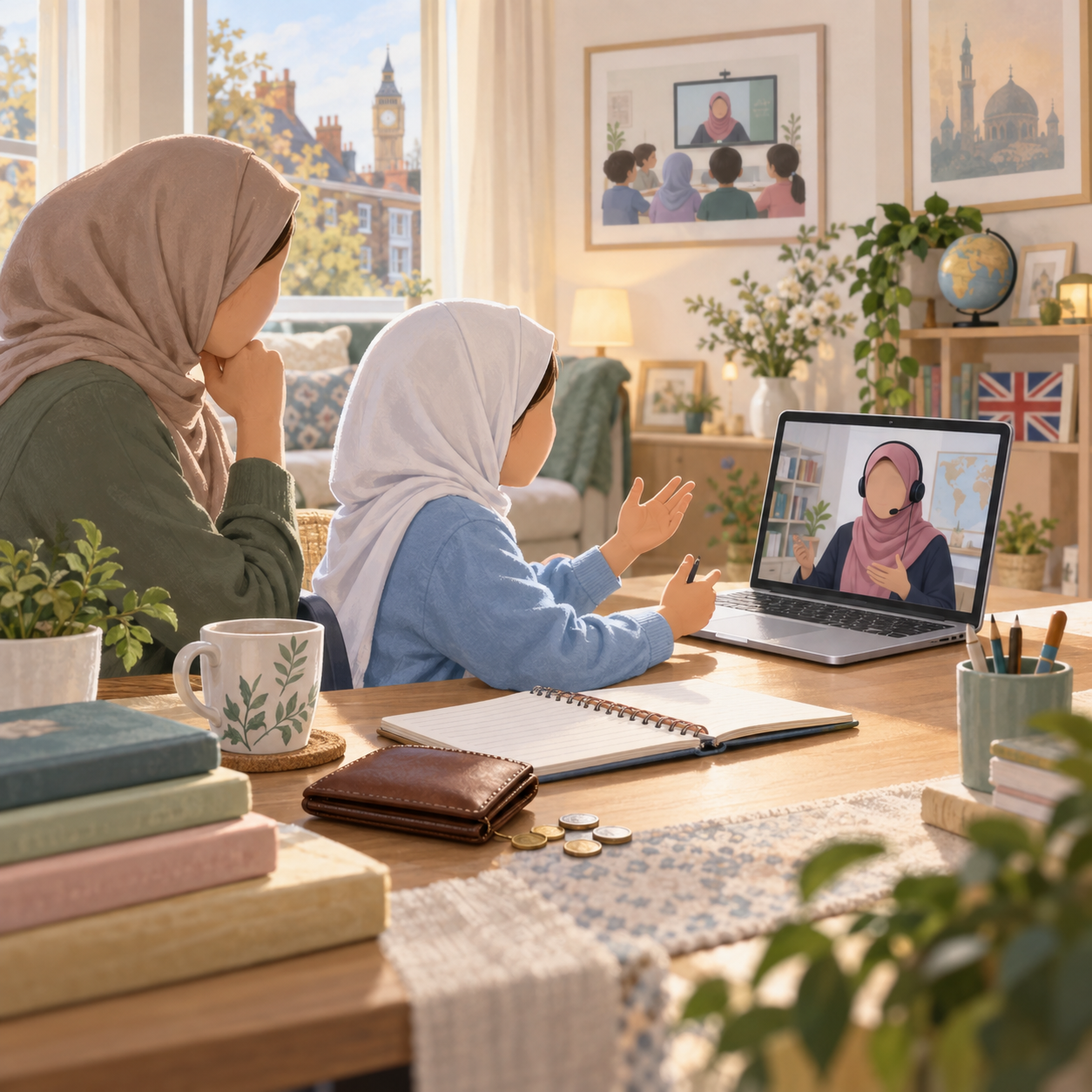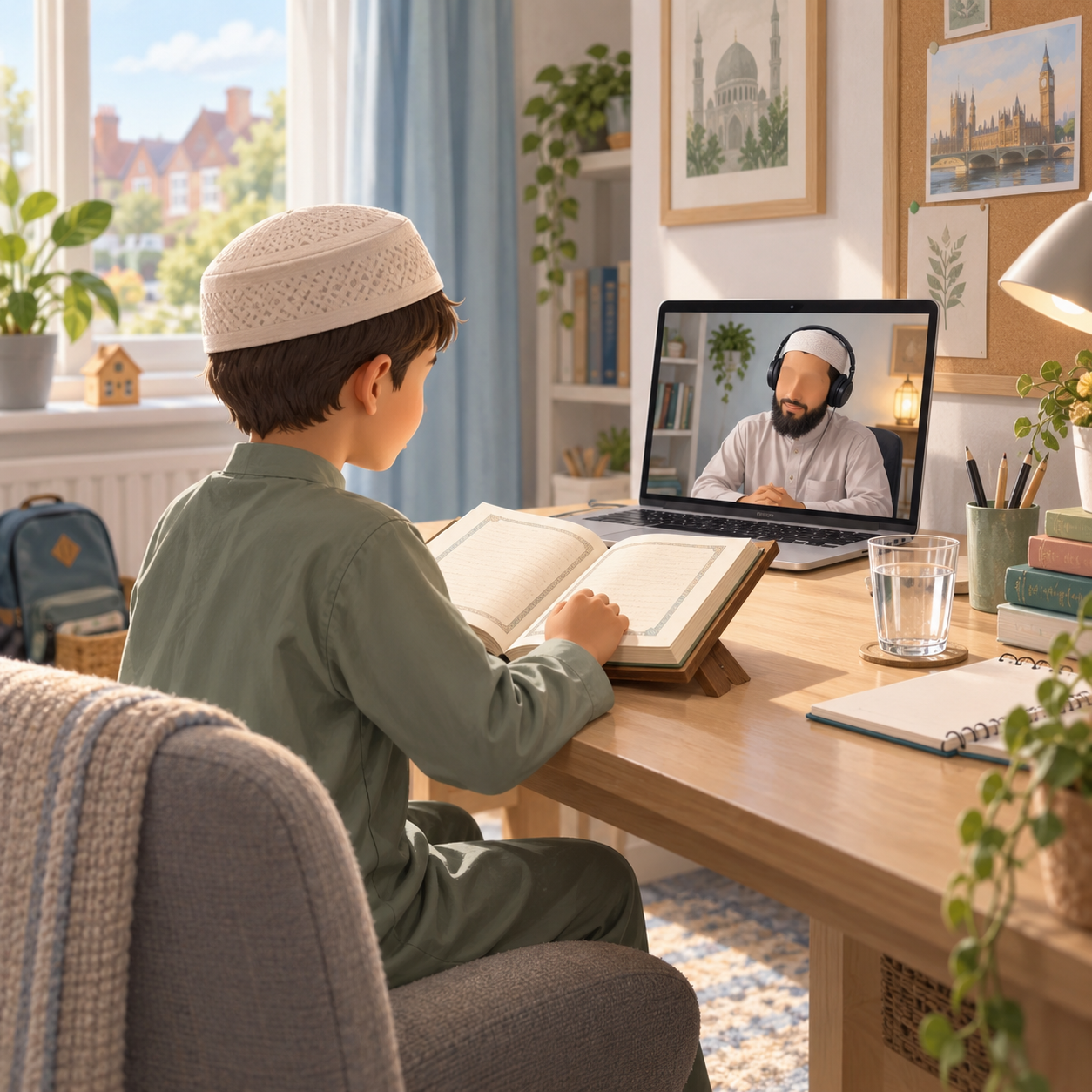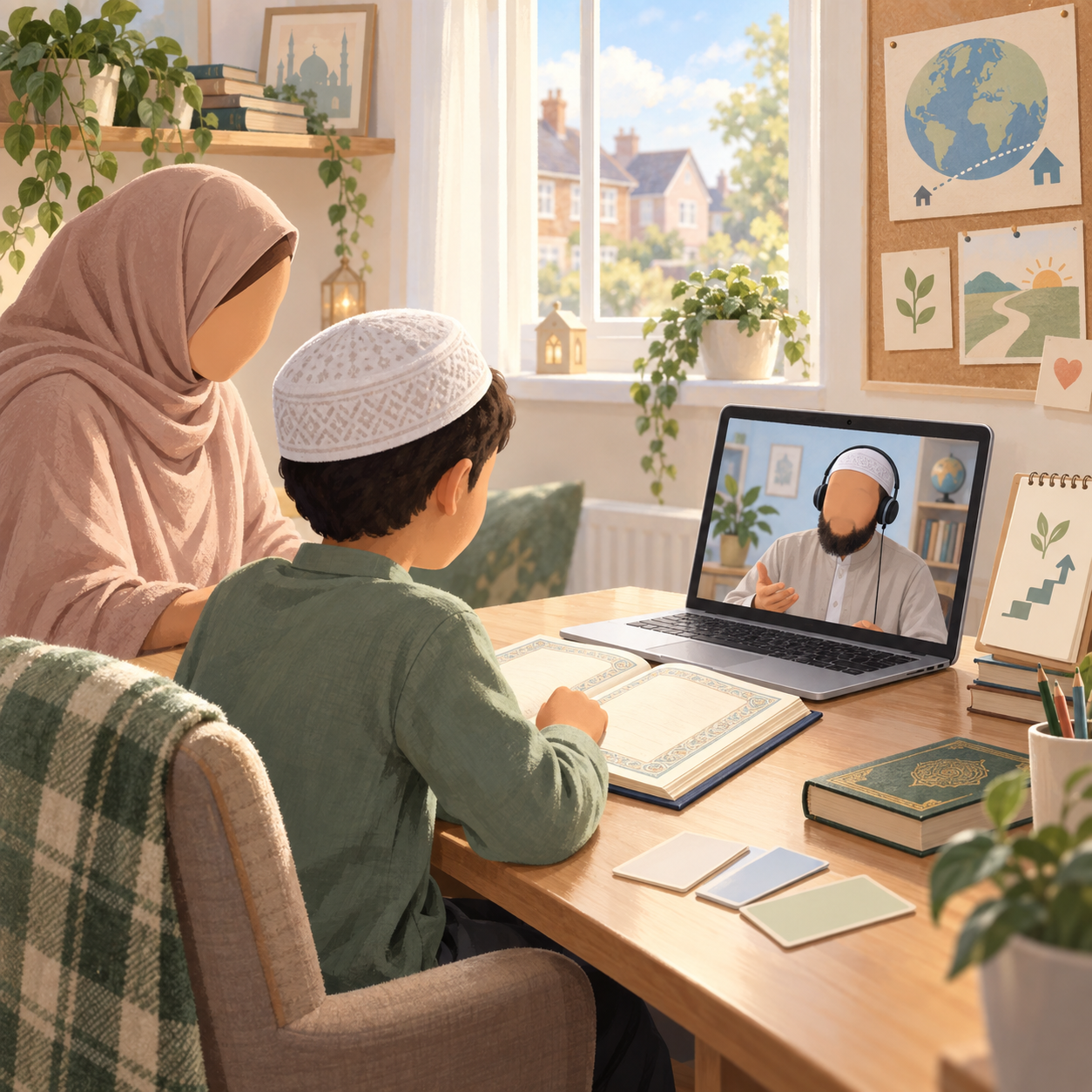

Good tajweed classes for kids should be connected to actual Quran recitation. Children should learn Tajweed through reading, listening, repeating, and being corrected gently. Rules matter, but rules should serve recitation. They should not become a barrier between the child and the Quran.
At Sibghah Academy, Quran learning is taught through one-to-one online lessons. This allows the teacher to hear the child clearly, correct mistakes gently, introduce Tajweed step by step, and help the child recite with more confidence.
This guide helps parents understand what to look for in tajweed classes for kids, how Tajweed should be introduced gently, why one-to-one support matters, and how to avoid classes that make Tajweed feel too difficult too early.

Quick answer: Good tajweed classes for kids should help children improve Quran recitation through listening, repetition, pronunciation correction, gradual Tajweed awareness, and gentle one-to-one teacher support.
| What Good Tajweed Classes Include | Why It Helps Children |
|---|---|
| Listening to correct recitation | The child hears the right sound before trying to repeat it. |
| Gentle pronunciation correction | The teacher corrects mistakes without pressure or embarrassment. |
| Gradual Tajweed awareness | The child learns rules slowly through practice, not heavy theory. |
| Measured recitation | The child learns not to rush while reading Quran. |
| One-to-one attention | The teacher hears the child clearly and adapts the lesson. |
| Confidence-building | The child feels safe to try again after mistakes. |
Table of Contents
- What Are Tajweed Classes for Kids?
- Tajweed Should Not Feel Like Heavy Theory
- Tajweed Should Serve Quran Recitation
- Listening and Gentle Correction Matter
- Why One-to-One Tajweed Classes Help
- Common Signs Your Child Needs Tajweed Support
- How to Use a Tajweed Trial Class Properly
- How Sibghah Academy Supports Tajweed Learning
- FAQ
What Are Tajweed Classes for Kids?
tajweed classes for kids are Quran lessons that help children improve the way they recite the Quran. They focus on pronunciation, sound quality, measured recitation, common mistakes, and gradual Tajweed rules in a way that matches the child’s age and level.
For children, Tajweed should begin with what they can hear and practise. The teacher may recite first, ask the child to repeat, correct one sound, slow the reading down, or help the child notice the difference between a short sound and a longer sound.
Good tajweed classes for kids usually include:
- Listening to the teacher’s recitation.
- Repeating short parts after the teacher.
- Correcting letter sounds gently.
- Practising slow and measured recitation.
- Noticing common recitation mistakes.
- Learning simple Tajweed ideas gradually.
- Building confidence while reading aloud.
The purpose is not to make the child memorize a list of rules without applying them. The purpose is to help the child recite better.
This is the main difference between a class that talks about Tajweed and a class that teaches Tajweed properly. Good tajweed classes for kids should make the child’s Quran recitation clearer, calmer, and more careful over time.
If parents want a separate explanation of basic Tajweed concepts, they can also read this parent guide: Tajweed for Kids.
Tajweed Should Not Feel Like Heavy Theory
One of the biggest mistakes in tajweed classes for kids is giving children too much theory too early.
Children need to understand what they are doing, but they do not need to be overwhelmed with advanced terms before they can apply simple recitation corrections. If a child is still struggling to pronounce letters clearly, long explanations may make Tajweed feel confusing.
A gentle Tajweed class should start from practice. The teacher can say the sound, ask the child to repeat, correct gently, and then explain the idea simply. Over time, the child can learn the names of rules when they are ready.
For example, a child may first learn to hear that one sound is longer than another. Later, the teacher can explain the rule behind that length. A child may first learn to stop at a suitable place. Later, the teacher can explain stopping and starting in more detail.
Good tajweed classes for kids should feel like:
- Listen carefully.
- Repeat after the teacher.
- Fix one mistake at a time.
- Read slowly.
- Try again calmly.
- Understand the rule when the child is ready.
They should not feel like a child is being tested on complicated names while still unable to apply the sound properly.
This is especially important for children who are shy, easily frustrated, or new to Quran recitation. If Tajweed feels too hard from the beginning, the child may avoid it. But when Tajweed is taught gently, the child can begin to enjoy noticing improvement.
Tajweed Should Serve Quran Recitation
The heart of tajweed classes for kids is Quran recitation. Tajweed is not separate from the Quran. It is a way to recite the Quran more carefully and beautifully.
The Quran teaches measured recitation:
Quran — Surah Al-Muzzammil 73:4
وَرَتِّلِ الْقُرْآنَ تَرْتِيلًا
English meaning: “And recite the Quran with measured recitation.”
This verse reminds parents that Quran recitation should not be rushed or careless. Children need time to hear, repeat, read, and improve.
In practical terms, tajweed classes for kids should help the child:
- Read more slowly.
- Pronounce letters more clearly.
- Notice repeated mistakes.
- Understand when a sound should be lengthened.
- Listen before repeating.
- Build a calmer recitation habit.
When Tajweed serves recitation, children can see why it matters. It is not a random subject. It helps them read Quran with more care.
For a child who is still improving Quran reading itself, this article may also help parents understand the difference between reading support and Tajweed support: Quran Reading Classes for Kids.
The best tajweed classes for kids keep this balance. They respect Tajweed, but they teach it through the child’s real recitation level.
Listening and Gentle Correction Matter
Children learn Tajweed by hearing correct recitation and receiving careful correction. This is why listening is so important in tajweed classes for kids.
A child may not notice their own mistake. They may think they are reading correctly because they have repeated the same sound many times. A teacher can hear the mistake, model the correct sound, and guide the child to repeat it.
But correction must be gentle. If every mistake becomes a harsh interruption, the child may become afraid to recite. A good teacher corrects without breaking the child’s confidence.
Gentle correction may sound like:
- “Let’s try that sound again slowly.”
- “Listen to me first, then repeat.”
- “Good effort. Now let’s make this part clearer.”
- “This sound needs a little more care.”
- “Read it again, but slower this time.”
Good tajweed classes for kids should correct mistakes early, but with kindness. The child should feel that correction is part of learning, not punishment.
The Prophet ﷺ said:
Hadith — Sahih al-Bukhari 5027
خَيْرُكُمْ مَنْ تَعَلَّمَ الْقُرْآنَ وَعَلَّمَهُ
English meaning: “The best among you are those who learn the Qur’an and teach it.”
This hadith shows the great value of Quran learning and teaching. For children, that teaching should be patient, careful, and suitable for their age.
Why One-to-One Tajweed Classes Help
One-to-one tajweed classes for kids can be very helpful because Tajweed needs careful listening. The teacher must hear the child clearly, notice small pronunciation mistakes, and correct them in real time.
In a group class, a child may not read enough. The teacher may not hear every mistake. Shy children may speak less. A child who needs repeated correction may not receive enough individual attention.
In one-to-one lessons, the teacher can focus on the child’s exact recitation.
| One-to-One Benefit | How It Helps Tajweed Learning |
|---|---|
| Clear listening | The teacher hears the child’s recitation carefully. |
| Immediate correction | Mistakes can be corrected before they become habits. |
| Personal pace | The child is not rushed by a group level. |
| More recitation time | The child practises more during the lesson. |
| Gentler confidence-building | The child can try again without comparison to others. |
| Parent feedback | Parents know which sounds or habits need practice. |
This is why one-to-one tajweed classes for kids can be suitable for children who need pronunciation correction, measured recitation, and gradual Tajweed support.
They are also helpful for children who feel embarrassed in group lessons. A calm one-to-one setting can make it easier for the child to read aloud, accept correction, and try again.
Does your child need gentle Tajweed correction?
Sibghah Academy offers one-to-one Quran lessons that help children improve recitation, pronunciation, and Tajweed step by step without pressure.
Common Signs Your Child Needs Tajweed Support
Parents often look for tajweed classes for kids after noticing repeated recitation difficulties. These signs do not mean the child is failing. They simply show that the child needs guided correction.
Your child rushes through recitation
Some children read quickly because they want to finish. Tajweed support can help them slow down and recite with more care.
Your child struggles with pronunciation
Some Quranic sounds may be unfamiliar for children, especially if they use English most of the day. A teacher can model the sound and help the child repeat it gently.
Your child shortens long sounds
Children may not always notice the difference between short and long sounds. Tajweed correction can help them hear and practise the difference gradually.
Your child makes the same mistake again and again
Repeated mistakes need focused correction. A one-to-one teacher can identify the pattern and return to it patiently.
Your child feels nervous when corrected
This is a sign that the class must protect confidence. Good tajweed classes for kids correct mistakes without making the child feel ashamed.
Your child reads Quran but does not improve much
Practice is important, but practice without correction may repeat the same mistakes. Tajweed support gives practice a clear direction.
If you notice these signs, tajweed classes for kids may help your child improve recitation with more structure and confidence.
How to Use a Tajweed Trial Class Properly
A trial lesson can help parents understand whether tajweed classes for kids are suitable for their child.
The trial should not only ask the child to read and finish. It should help the teacher listen carefully, identify repeated mistakes, and recommend the right level of Tajweed support.
Before the trial, prepare:
- Your child’s age.
- Current Quran reading or recitation level.
- Whether your child reads from the mushaf or recites from memory.
- Common mistakes you notice.
- Whether your child rushes while reading.
- Whether your child feels nervous when corrected.
- Your goal: pronunciation, Tajweed basics, confidence, or recitation improvement.
After the trial, ask:
- What Tajweed support does my child need first?
- Which sounds or habits need correction?
- Should my child focus on pronunciation before rules?
- How much theory is suitable for my child now?
- What should we practise at home?
- How can we improve without pressure?
A good trial for tajweed classes for kids should leave you with a clear direction. The teacher should explain whether your child needs pronunciation correction, slower recitation, basic rule awareness, or wider Quran reading support.
How Sibghah Academy Supports Tajweed Learning
Sibghah Academy offers live one-to-one Quran lessons for children aged 5–15. For parents looking for tajweed classes for kids, Sibghah can help children improve Quran recitation through listening, repetition, correction, and gradual Tajweed support.
Sibghah’s one-to-one Tajweed support can help your child with:
- Listening to correct recitation.
- Practising clear pronunciation.
- Reading more slowly and carefully.
- Correcting repeated mistakes.
- Understanding simple Tajweed ideas gradually.
- Building confidence while reciting aloud.
- Receiving parent-friendly feedback.
Because the lessons are one-to-one, the teacher can adapt to your child. If your child needs pronunciation correction, the lesson can focus there. If your child is ready for basic Tajweed awareness, the teacher can introduce it gradually. If your child feels shy, the teacher can slow down and build confidence.
This makes Sibghah’s tajweed classes for kids suitable for families who want Quran recitation improvement without overwhelming children with heavy theory too early.
Parents can also explore Sibghah’s wider Quran Memorization Program for Kids, which includes Quran recitation, memorization, revision, and Tajweed support according to the child’s level.
Quick Parent Checklist
Use this checklist before choosing tajweed classes for kids:
- Does the teacher listen carefully to my child’s recitation?
- Does the class correct pronunciation gently?
- Does the teacher avoid heavy theory too early?
- Does Tajweed support connect to real Quran recitation?
- Does my child get enough time to read aloud?
- Does the teacher explain mistakes clearly?
- Does the class help my child slow down?
- Does the lesson protect my child’s confidence?
- Is the lesson one-to-one?
- Do parents receive clear feedback?
FAQ: Tajweed Classes for Kids
What are tajweed classes for kids?
tajweed classes for kids are Quran lessons that help children improve recitation through pronunciation correction, listening, repetition, measured reading, and gradual Tajweed awareness.
When should my child start Tajweed?
Your child can start gentle Tajweed support when they are reciting Quran and need help with pronunciation, long sounds, careful reading, or repeated mistakes.
Should Tajweed classes for kids include heavy rules?
No. tajweed classes for kids should introduce rules gradually. Children should first learn through listening, repetition, and practical correction.
Does my child need to memorize Tajweed rules?
Not at the beginning. A child benefits more from applying corrections in real recitation before memorizing many rule names.
Are one-to-one Tajweed classes better for children?
One-to-one tajweed classes for kids can be better for many children because the teacher can hear mistakes clearly, correct gently, and adjust the pace.
Can Tajweed classes help my child read Quran more slowly?
Yes. Tajweed support can help children slow down, listen carefully, and recite with more measured reading.
What if my child feels shy when corrected?
A gentle one-to-one class can help because the child can practise without comparison to others. The teacher should correct mistakes calmly and encourage effort.
Are Tajweed classes the same as Quran reading classes?
They are connected but not exactly the same. Quran reading classes focus on reading and recitation support, while Tajweed classes focus more on improving the quality and correctness of recitation.
Does Sibghah Academy offer tajweed classes for kids?
Yes. Sibghah Academy offers one-to-one tajweed classes for kids with pronunciation support, gentle correction, gradual Tajweed awareness, and parent feedback.
What is the best next step?
The best next step is to book a trial lesson so the teacher can listen to your child’s recitation and recommend the right Tajweed starting point.
Book your child’s free Tajweed trial
If you are looking for tajweed classes for kids, Sibghah Academy can help your child improve Quran recitation through one-to-one listening, correction, and gentle Tajweed support.
Send us your child’s age, current Quran level, and main recitation difficulty, and we will recommend the right starting point.